High-Speed Rotary Tablet Press Machines: Explore Tablet Compression Processes
Pharmaceutical tablets must meet strict requirements for weight, hardness, thickness, and consistency, even when production volumes reach hundreds of thousands of units.
High-speed rotary tablet press machines make this possible by compressing prepared powder or granules into uniform tablets through a continuous mechanical process.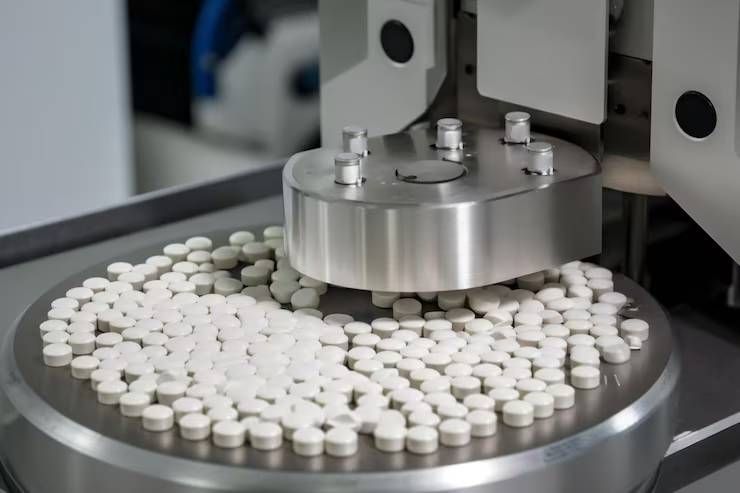
These machines are widely used in pharmaceutical manufacturing and other industries that produce compressed solid dosage forms. Their rotating turret, multiple punch-and-die stations, and automated controls allow many tablets to be formed during each revolution, supporting high production rates while maintaining process control.
Understanding how rotary tablet presses operate helps explain the relationship between machine design, powder properties, compression force, and finished-tablet quality. From material feeding to ejection and inspection, each stage contributes to reliable production and consistent tablet characteristics.
How a Rotary Tablet Press Produces Tablets
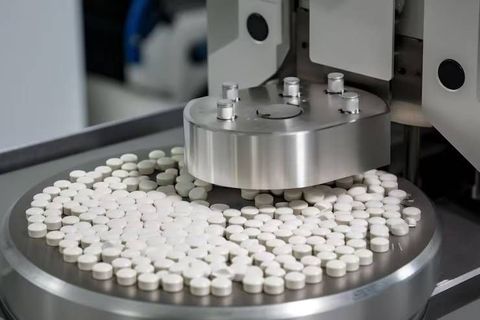
A high-speed rotary tablet press uses a rotating turret fitted with multiple dies and corresponding upper and lower punches. As the turret turns, each punch-and-die assembly moves through a sequence of operations that forms an individual tablet.
The process begins when powder or granules enter the feed system and fill the dies. The machine then controls the amount of material in each cavity before applying compression through a set of rollers. The compressed tablet is subsequently released from the die and directed toward collection or downstream equipment.
Unlike a single-punch press, which produces tablets through an individual compression cycle, a rotary machine processes numerous stations in sequence. This arrangement enables continuous, high-volume operation without requiring the turret to stop for every tablet.
Actual output depends on factors such as the number of tooling stations, turret speed, tablet design, formulation behavior, and operating conditions. A machine's maximum mechanical speed does not necessarily represent the practical production rate for every product.
The Main Components Behind the Compression Process
Several interconnected components control how material moves through the machine and becomes a finished tablet.
The turret holds the dies and punches while rotating at a controlled speed. Each station follows the same basic production sequence, allowing tablets to be formed repeatedly throughout the operating cycle.
The feed frame distributes powder or granules across the die table. Its design and operating settings influence how consistently material enters each die, particularly when the formulation has differences in flowability or bulk density.
The dosing and filling system determines the quantity of material placed into each die. On many conventional presses, the lower punch position during filling helps control the fill volume, while the formulation's density and behavior influence the resulting tablet weight.
The compression rollers apply force through the upper and lower punches. The main compression stage consolidates the material into a compact solid, while precompression may be used to remove trapped air and prepare the powder bed for the main compression event.
Finally, the ejection system raises the lower punch so the tablet reaches the die surface. A take-off blade or similar mechanism guides the tablet away from the turret for collection.
Understanding the Tablet Compression Cycle
The compression cycle consists of several coordinated stages. Each stage must occur at the correct point in the turret's rotation to maintain production consistency.
Die filling and powder dosing
Powder enters the dies as the turret passes beneath the feed frame. The lower punches occupy positions that allow the cavities to receive the intended amount of material.
Consistent filling depends on powder flow, particle size distribution, moisture content, bulk density, and feed-frame performance. If material does not flow evenly, tablets may show unacceptable weight variation even when the press operates at a stable speed.
Precompression and main compression
After filling, the punches may pass through a precompression stage. This applies a relatively lower force to the powder bed, helping consolidate the material and reduce air pockets before the primary compression event.
During main compression, the punches move toward one another under the influence of the compression rollers. The applied force brings particles into closer contact, encouraging bonding and creating a compact tablet with the required mechanical properties.
The appropriate compression settings depend on the formulation. Excessive force can cause problems such as capping or lamination in susceptible formulations, while insufficient compression may produce weak tablets.
Tablet ejection
After compression, the upper punch withdraws and the lower punch rises to push the tablet out of the die. The tablet is then removed from the die table and transferred for collection.
Ejection behavior matters because excessive friction between the tablet and die wall can damage the tablet or increase mechanical stress on the tooling. Lubricant levels, tooling condition, formulation properties, and compression settings can all influence this stage.
Why Formulation Properties Matter at High Speed
Machine capability alone does not determine tablet quality. The formulation must behave predictably as it moves through filling, compression, and ejection.
Powder flowability affects whether dies fill consistently at the selected turret speed. Particle size distribution and bulk density can influence material movement and dosing accuracy. Moisture content may affect powder flow, particle bonding, and the stability of the finished product.
Compressibility and compactibility are also important. Compressibility describes how a powder bed responds to applied pressure, while compactibility concerns the strength of the compact produced at a given level of compression.
These properties help formulation and production teams determine whether a material can be processed reliably. Some formulations require granulation or other preparation steps to improve flow and compression behavior before they enter the tablet press.
Maintaining Tablet Quality During High-Speed Production
High-speed compression creates a need for consistent monitoring because small process variations can affect a large number of tablets in a short period.
Tablet weight is one of the primary quality attributes. Changes in die filling can produce variation in the amount of material compressed into individual tablets. Weight monitoring can help identify these variations, although acceptable tablet weight alone does not establish every aspect of product quality.
Hardness, thickness, and friability provide additional information about the finished tablets. Hardness testing evaluates resistance to a defined breaking force, while friability testing assesses how well tablets resist abrasion and mechanical handling. Thickness measurements help verify dimensional consistency.
Disintegration and dissolution testing may also be required, depending on the product and its intended performance. A tablet that appears uniform may still release its active ingredient differently if formulation or compression conditions change.
In pharmaceutical manufacturing, in-process controls and documented procedures help ensure that production remains within established specifications. Requirements depend on the product, process, and applicable regulatory framework.
Automation, Monitoring, and Production Efficiency
Modern rotary tablet presses may include automated adjustment systems, electronic batch records, machine alarms, and interfaces for monitoring critical operating parameters. These features help operators observe machine behavior and respond to deviations during production.
Depending on the equipment, monitoring may include compression force, turret speed, fill settings, ejection behavior, and rejection events. Some machines can automatically reject tablets when monitored parameters fall outside defined limits.
Automation can reduce manual intervention, but it does not remove the need for sound process development and operator oversight. Sensors must be calibrated, operating limits must be appropriate, and unusual trends require investigation rather than simple acknowledgment.
High-speed production also depends on reliable material supply, effective cleaning procedures, tooling maintenance, and coordination with downstream operations. A press may be mechanically capable of running quickly, yet frequent stoppages or poor material flow can reduce overall manufacturing efficiency.
Tooling, Cleaning, and Equipment Maintenance
Punches and dies directly influence tablet shape, dimensions, and compression performance. Tooling must be suitable for the formulation and tablet design, with appropriate attention to wear, surface condition, alignment, and dimensional tolerances.
Worn or damaged tooling can contribute to sticking, picking, inconsistent tablet appearance, or dimensional variation. Routine inspection helps identify these issues before they cause extensive production problems.
Cleaning is equally important, particularly when equipment is used for different pharmaceutical products. Validated cleaning procedures, where required, help control product residues and cross-contamination risks. Maintenance and cleaning activities must follow the equipment manufacturer's instructions and the facility's established procedures.
Frequently Asked Questions
How does a rotary tablet press differ from a single-punch machine?
A rotary tablet press uses multiple punch-and-die stations on a rotating turret, allowing tablets to be formed in sequence during continuous rotation. A single-punch machine uses one tooling station for each compression cycle.
What determines the production speed of a tablet press?
Production speed depends on turret rotation, the number of tooling stations, formulation behavior, tablet dimensions, and process settings. The highest rated speed may not be suitable for every formulation.
Why is tablet weight inconsistent during production?
Weight variation can result from uneven die filling, poor powder flow, changes in bulk density, unsuitable feed settings, or mechanical issues. Investigating the underlying cause is necessary before adjusting the process.
What is the purpose of precompression?
Precompression applies an initial, relatively lower force to the powder bed. It can help remove trapped air and improve the conditions for the main compression stage.
How is tablet quality monitored?
Quality monitoring may include tablet weight, thickness, hardness, friability, appearance, disintegration, and dissolution. The required tests depend on the product specifications and applicable manufacturing requirements.
Conclusion
High-speed rotary tablet press machines combine coordinated mechanical movements, controlled powder feeding, and carefully managed compression forces to produce tablets at scale. Reliable operation depends on more than turret speed; formulation properties, tooling condition, machine settings, and quality monitoring all influence the final product.
When these elements work together, manufacturers can maintain consistent tablet characteristics while supporting efficient production. Understanding the compression cycle provides a practical foundation for evaluating machine performance, troubleshooting process variations, and maintaining dependable pharmaceutical manufacturing operations.

Related Post...

Automated Optical Inspection Machines: Insights Into Automated Quality Control
Updated: October 02, 2026
Read More
Industrial Equipment Insights for Smarter Operations and Better Productivity
Updated: October 19, 2026
Read More
Fluid Pump Systems Discover How Modern Industries Improve Flow Efficiency
Updated: July 22, 2026
Read More