Material Shaping Guide: Understanding Common Techniques, Tools, and Processes
Material shaping is an important part of manufacturing, construction, engineering, and product development. It involves changing raw materials into specific forms, dimensions, or surface conditions through controlled physical processes.
Material shaping techniques can be applied to metals, plastics, ceramics, wood, composites, and other materials.
Understanding common material shaping methods helps explain how everyday components and industrial products are produced. Processes such as cutting, forming, casting, machining, molding, forging, and additive manufacturing use different tools and principles depending on the material and desired result.
Context
Material shaping refers to the processes used to transform a material from an initial form into a useful shape. The starting material may appear as a sheet, bar, billet, powder, pellet, liquid, or solid block. A shaping process changes its geometry while attempting to achieve the required dimensions and physical characteristics.
The history of material shaping is closely connected with technological development. Early methods relied heavily on hand tools, hammers, molds, and basic cutting instruments. Industrialization introduced powered machinery, standardized tooling, and improved process control.
Modern manufacturing combines mechanical, thermal, chemical, and digital technologies. Computer-controlled equipment can produce complex shapes with repeatable dimensions, while simulation software can help engineers study how materials behave during forming or machining.
Common material shaping techniques include:
- Cutting and sawing for separating material
- Turning, milling, and drilling for material removal
- Forging and rolling for deformation
- Casting for producing shapes from molten material
- Injection molding for many polymer components
- Additive manufacturing for layer-by-layer production
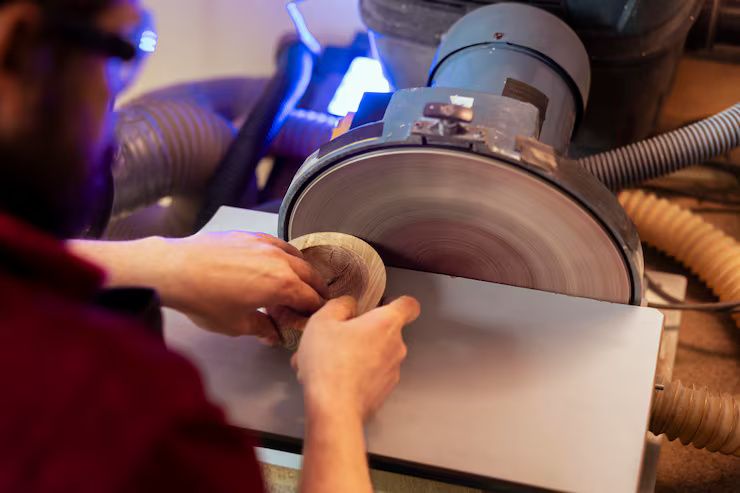
- Grinding and finishing for dimensional and surface refinement
The choice of technique depends on factors such as material properties, geometry, dimensional requirements, production volume, surface requirements, and process limitations.
Importance
Material shaping is important because the shape of a component can influence its strength, weight, durability, performance, and compatibility with other parts. Engineers therefore consider shaping methods during the early stages of product development rather than treating manufacturing as a separate final step.
Different materials respond differently to shaping. Metals can often undergo plastic deformation, while some ceramics are more susceptible to cracking. Thermoplastics can soften when heated and harden when cooled, making them suitable for several molding processes.
Material shaping also affects resource use. Efficient process planning can reduce unnecessary material removal, scrap, energy consumption, and processing time. Near-net-shape techniques attempt to produce components close to their final geometry, reducing the amount of later machining.
The topic affects many groups, including:
- Mechanical and manufacturing engineers
- Product designers
- Machine operators and technicians
- Quality-control professionals
- Construction and fabrication teams
- Researchers and engineering students
Safety is another important consideration. Shaping equipment can involve rotating parts, high temperatures, pressure, sharp tooling, dust, vibration, or electrical hazards. Appropriate training, machine guarding, ventilation, personal protective equipment, and operating procedures are therefore important.
Recent Updates
Material shaping continues to develop through automation, digital manufacturing, advanced materials, and improved process monitoring.
Computer numerical control, commonly known as CNC, has become an important part of precision machining. CNC systems can control tool movement according to programmed instructions, supporting repeatable production of complex geometries.
Additive manufacturing has also expanded the range of possible shaping approaches. Instead of removing material from a larger block, additive systems build an object layer by layer. Different technologies use polymers, metals, ceramics, and composite materials.
Artificial intelligence and machine learning are increasingly being investigated for process monitoring and quality prediction. Sensors can collect information about temperature, vibration, force, pressure, or tool condition. Analytical systems can then identify patterns that may indicate process changes.
Digital twins and simulation tools are also becoming more significant. Engineers can create digital representations of manufacturing processes and examine factors such as material flow, deformation, heat transfer, or potential defects before physical production begins.
Another development is the increased use of hybrid manufacturing. These approaches combine two or more processes, such as additive manufacturing followed by machining, to achieve both geometric flexibility and dimensional precision.
A simplified comparison of common techniques is shown below:
| Technique | Basic Principle | Common Materials | Typical Purpose |
|---|---|---|---|
| Casting | Material is formed in a mold | Metals, polymers | Complex shapes |
| Forging | Material is compressed or shaped | Metals | Strong components |
| Machining | Material is removed with tools | Metals, plastics | Precision geometry |
| Rolling | Material passes through rolls | Metals, polymers | Sheets and sections |
| Injection molding | Heated material enters a mold | Thermoplastics | Repeated components |
| Additive manufacturing | Material is deposited layer by layer | Polymers, metals, ceramics | Complex prototypes and parts |
Sustainability is another area of development. Manufacturers are examining ways to improve material utilization, reduce energy consumption, reuse process materials, and extend tooling life.
Laws or Policies
Material shaping activities may be affected by workplace safety, environmental, energy, chemical, and waste-management requirements. The exact rules depend on the country, industry, material, machinery, and workplace conditions.
In the United States, the Occupational Safety and Health Administration provides workplace safety requirements relevant to machinery, machine guarding, hazardous materials, and other manufacturing hazards.
In the European Union, machinery and workplace safety requirements can apply to equipment used for manufacturing and material processing. Environmental rules may also address emissions, waste, chemicals, and energy-related activities.
In India, industrial workplaces can be subject to requirements under national and state-level occupational safety, environmental, factory, waste-management, and pollution-control frameworks. The applicable requirements depend on the type and scale of the activity.
Organizations should consult the relevant government authorities and current regulatory documents before establishing or modifying manufacturing processes. Regulations can change, and specific operations may require additional documentation, inspections, risk assessments, or environmental controls.
Tools and Resources
Several tools can help learners, engineers, and manufacturing professionals understand material shaping processes.
Technical handbooks and engineering textbooks provide information about material properties, machining principles, forming behavior, tooling, tolerances, and process selection.
Digital calculators can help with basic engineering calculations involving dimensions, material removal, feed rates, cutting speeds, mass, and unit conversions. However, calculations should be checked against equipment specifications and applicable engineering practices.
Useful resources may include:
- Government workplace-safety publications
- Manufacturing standards and technical specifications
- Engineering material databases
- CAD and computer-aided manufacturing software
- CNC programming references
- Materials-selection guides
- Manufacturing process handbooks
- University engineering resources
Computer-aided design software is commonly used to create and evaluate component geometry. Computer-aided manufacturing systems can then translate design information into manufacturing instructions for compatible equipment.
For beginners, learning the basic properties of materials is a useful starting point. Understanding hardness, ductility, strength, thermal behavior, brittleness, and machinability makes it easier to understand why one shaping technique may be appropriate for a particular material.
FAQs
What is material shaping?
Material shaping is the process of changing a raw material into a desired geometry or form. It can involve cutting, deformation, casting, molding, machining, grinding, or layer-by-layer addition.
What are the main material shaping techniques?
Common techniques include casting, forging, rolling, extrusion, machining, molding, cutting, grinding, and additive manufacturing. The appropriate method depends on the material and the required component characteristics.
How does material type affect shaping?
Material properties strongly influence process selection. Factors such as hardness, ductility, melting temperature, brittleness, thermal conductivity, and machinability determine how a material responds to different shaping methods.
What role does CNC play in material shaping?
CNC equipment uses programmed instructions to control machine movements. It is commonly used for precise cutting, drilling, milling, turning, and other machining operations.
Is additive manufacturing a material shaping process?
Yes. Additive manufacturing creates objects by depositing or solidifying material layer by layer. It differs from conventional machining because material is primarily added rather than removed from a larger starting piece.
Conclusion
Material shaping includes a broad range of techniques used to transform raw materials into functional forms. Cutting, forming, casting, machining, molding, and additive manufacturing each have distinct principles and applications.
The selection of a shaping process depends on material characteristics, geometry, precision, surface requirements, production conditions, safety considerations, and environmental factors.
Modern developments are making material shaping more digitally controlled and data-driven. CNC systems, simulation, sensors, automation, additive manufacturing, and hybrid processes are expanding manufacturing capabilities.
For anyone learning manufacturing, understanding the relationship between material properties and shaping techniques provides a strong foundation. Reliable technical references, applicable standards, and appropriate safety practices should be considered when evaluating real-world processes.

Related Post...
Chemical Processing Overview: Discover Processes, Materials, and Modern Industry Practices
Updated: October 12, 2026
Read More
Automotive Parts Information Guide: Understanding Vehicle Technology
Updated: July 22, 2026
Read More