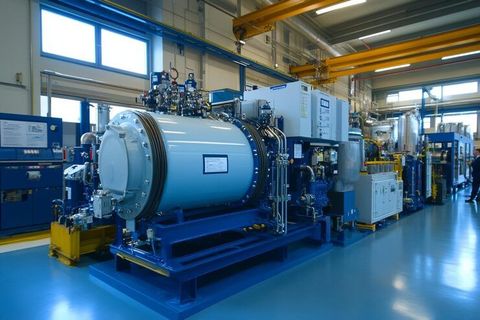
Industrial Gas Compressors: Types, Applications and Technology
Industrial gas compressors are mechanical machines designed to increase the pressure of gases by reducing their volume or transferring energy to the gas. They play an important role in industries where gases must be transported, stored, processed or supplied at specific pressure levels.
Unlike ordinary ventilation equipment, industrial gas compressors are engineered to handle demanding operating conditions, including high pressure, continuous operation and different gas compositions.
These systems are widely used in oil and gas facilities, petrochemical plants, chemical manufacturing, natural gas pipelines, power generation and industrial processing units.
The need for gas compression comes from the way industrial processes operate. Natural gas, hydrogen, nitrogen, carbon dioxide and other gases often need controlled pressure before they can move through pipelines, enter processing equipment or reach storage facilities.
An industrial gas compressor generally consists of several important components:
Compression chamber: The area where gas pressure increases.
Drive motor or turbine: Supplies mechanical energy.
Inlet and outlet valves: Control gas movement.
Cooling system: Manages heat generated during compression.
Lubrication system: Reduces friction in applicable compressor designs.
Control system: Monitors pressure, temperature, vibration and operating conditions.
Safety devices: Help protect equipment against abnormal operating conditions.
The compressor design depends on the gas being handled, required pressure, flow capacity, temperature and industrial application.
Importance of Industrial Gas Compressors Today
Industrial gas compressors are essential to modern infrastructure because many manufacturing and energy processes depend on the controlled movement of gases.
They affect energy companies, chemical manufacturers, industrial engineers, pipeline operators, power plants and processing facilities.
Their importance is increasing as countries develop natural gas infrastructure, explore hydrogen applications and improve industrial energy efficiency.
Major problems addressed by industrial gas compression include:
Maintaining the required pressure in gas pipelines.
Supporting continuous gas movement over long distances.
Supplying compressed gases to industrial processing equipment.
Supporting natural gas storage and distribution.
Maintaining suitable pressure for chemical reactions.
Improving the control of industrial gas systems.
Supporting gas recovery and processing operations.
Industrial applications and their importance
Industry | Compressor Application | Main Purpose |
|---|---|---|
Oil and gas | Natural gas compression | Pipeline transportation |
Petrochemical | Process gas compression | Chemical processing |
Power generation | Fuel gas compression | Gas turbine operation |
Chemical manufacturing | Hydrogen and nitrogen compression | Industrial production |
Fertiliser | Ammonia synthesis gas compression | Fertiliser manufacturing |
Steel manufacturing | Oxygen and nitrogen compression | Industrial processing |
Biogas | Biogas compression | Gas purification and distribution |
Energy storage | Hydrogen compression | High-pressure storage |
Gas compressors also contribute to the development of emerging energy technologies. Hydrogen compression, for example, is an important requirement in certain hydrogen storage and distribution systems.
Types of Industrial Gas Compressors
Different compressor technologies are designed for different pressure requirements, gas characteristics and operating conditions.
1. Reciprocating Gas Compressors
Reciprocating compressors use pistons moving inside cylinders to compress gas. The piston moves back and forth, reducing the gas volume and increasing its pressure.
They are commonly used in applications requiring high pressure and controlled gas flow.
Typical applications include natural gas processing, hydrogen compression, chemical plants and industrial gas storage.
2. Centrifugal Gas Compressors
Centrifugal compressors use rotating impellers to increase gas velocity. Diffusers then convert much of this kinetic energy into pressure.
They are suitable for applications requiring large gas flow rates and continuous operation.
Common applications include petroleum refineries, petrochemical plants, natural gas processing facilities and pipeline systems.
3. Rotary Screw Gas Compressors
Rotary screw compressors use two intermeshing helical rotors to compress gas continuously.
They are known for relatively smooth gas delivery and compact mechanical arrangements.
Their applications include industrial gas processing and selected chemical and manufacturing operations. Their suitability depends on gas composition, pressure requirements and material compatibility.
4. Diaphragm Gas Compressors
Diaphragm compressors use a flexible membrane to compress gas without direct contact between the gas and the piston lubrication system.
They are particularly useful when handling high-purity, toxic or sensitive gases.
Typical applications include hydrogen research, specialty gas processing and laboratory installations.
Comparison of Compressor Technologies
Compressor Type | Working Principle | Common Application |
|---|---|---|
Reciprocating | Piston movement | High-pressure gas |
Centrifugal | Rotating impeller | Large gas flow |
Rotary screw | Intermeshing rotors | Continuous compression |
Diaphragm | Flexible membrane | High-purity gases |
Recent Developments and Industry Trends in 2025–2026
Industrial gas compression is evolving through developments in energy efficiency, environmental management, digital monitoring and domestic manufacturing.
Several developments in India during the past year are particularly relevant.
5 June 2025 – PNGRB Encourages Electric Motor-Driven Compressors
The Petroleum and Natural Gas Regulatory Board (PNGRB) advised relevant entities to transition from gas-engine-driven compressors to electric motor-driven compressors across India's natural gas pipeline network, which extends over 25,429 kilometres.
The initiative aims to reduce carbon dioxide and other pollutant emissions. PNGRB also encouraged the use of renewable electricity for operating compressor motors. This represents an important development in the environmental management of gas pipeline infrastructure.
15 January 2026 – Expansion of Compressor Manufacturing in India
Copeland announced the completion of the first phase of its manufacturing expansion at its Atit facility in India. The development included the production of locally manufactured scroll compressors and reflected wider investment in domestic compression technology.
Although scroll compressors are primarily associated with refrigeration and HVAC applications, the development demonstrates broader progress in India's compressor manufacturing ecosystem.
26 June 2026 – Development of Centrifugal Compression Technology
Kirloskar Pneumatic introduced the Tezcatlipoca A800 centrifugal air compressor, developed and manufactured in India. The announcement highlighted developments in aerodynamic design, intelligent monitoring and industrial compression efficiency.
This is an air compressor rather than a process gas compressor, but it illustrates related progress in industrial compression engineering.
27 October 2026 – International Cooperation in Compressor Technology
Kobe Steel and Kirloskar Pneumatic signed a memorandum of understanding to explore strategic cooperation in India's non-general-purpose compressor business.
The announcement identified oil and gas, petrochemicals, hydrogen and ammonia as important areas of industrial development.
Other important industry trends include:
Digital monitoring of compressor performance.
Variable-speed motor technology.
Predictive maintenance using sensor information.
Improved sealing systems to reduce gas leakage.
Development of hydrogen-compatible compressor equipment.
Greater attention to energy consumption and emissions.
Laws and Safety Regulations for Industrial Gas Compressors in India
Industrial gas compressors operate under technical and safety requirements because compressed gases can create significant risks when equipment is improperly designed, installed or maintained.
The applicable regulations depend on the type of gas, operating pressure, installation location and industrial activity.
Several important Indian laws and regulatory frameworks are relevant.
1. Petroleum Act, 1934
The Petroleum Act provides a legal framework for the import, storage, production and transportation of petroleum products. It is relevant to installations handling petroleum and associated flammable materials.
2. Static and Mobile Pressure Vessels (Unfired) Rules, 2016
These rules regulate certain pressure vessels used for storing and handling compressed gases.
Important requirements include:
Appropriate pressure vessel design and fabrication.
Inspection and testing procedures.
Safety relief valves and associated fittings.
Periodic testing of applicable pressure vessels.
Relevant approvals and licensing requirements.
The Petroleum and Explosives Safety Organization (PESO) administers important provisions relating to pressure vessels and compressed gas safety.
3. Gas Cylinders Rules, 2016
These rules apply to the filling, storage, handling and transportation of gases in cylinders.
They are relevant to industrial facilities that use compressed gases such as oxygen, hydrogen, nitrogen and other regulated gases.
4. Oil Industry Safety Directorate Standards
The Oil Industry Safety Directorate (OISD), under the Ministry of Petroleum and Natural Gas, develops safety standards for oil and gas installations.
Relevant standards include:
OISD-STD-105: Work Permit System.
OISD-STD-106: Pressure Relief and Disposal System.
OISD-STD-116: Fire Protection Facilities for Petroleum Refineries and Oil and Gas Processing Plants.
OISD-STD-118: Layouts for Oil and Gas Installations.
OISD-STD-226: Natural Gas Transmission Pipelines and City Gas Distribution Networks.
OISD published updated editions of several standards during 2025 and 2026, including OISD-STD-226 in August 2026.
5. PESO Regulatory Updates in 2025–2026
PESO issued a circular on 3 September 2025 concerning approval of CNG and CBG gas compressors proposed for installation at premises covered under the Gas Cylinders Rules, 2016.
Additional 2026 circulars addressed LNG filling in cryogenic cylinders and guidelines for district pressure-regulating skids at CNG and CBG dispensing stations. These developments are relevant to India's expanding gas infrastructure.
Industrial operators should verify the latest applicable regulations, technical standards and approval requirements before commissioning or modifying compressor installations.
Tools and Resources for Industrial Gas Compressors
Selecting, operating and maintaining an industrial gas compressor requires technical information, engineering calculations and appropriate monitoring systems.
The following tools and resources are useful for understanding compressor performance and industrial applications.
Tool or Resource | Main Purpose |
|---|---|
Aspen HYSYS | Process simulation and gas compression analysis |
Aspen Plus | Chemical process modelling |
ANSYS | Engineering simulation and fluid analysis |
MATLAB | Compressor performance calculations |
Excel | Pressure, flow and efficiency calculations |
Siemens SIMATIC | Industrial monitoring and automation |
Emerson AMS | Equipment condition monitoring |
SKF @ptitude | Machinery condition analysis |
AutoCAD | Compressor installation layouts |
ISO 1217 | Displacement compressor acceptance testing |
Important engineering calculations
Several calculations are commonly used when evaluating compressor performance.
Compression Ratio: The ratio of absolute discharge pressure to absolute suction pressure.
Gas Flow Rate: The quantity of gas passing through the compressor during a specific period.
Power Requirement: The energy needed to achieve the required gas compression.
Volumetric Efficiency: The relationship between actual gas intake and theoretical displacement.
Isentropic Efficiency: A measure comparing actual compression performance with ideal isentropic compression.
A simplified compression ratio formula is:
Where:
= Compression ratio.
= Absolute discharge pressure.
= Absolute suction pressure.
Both pressures must use the same units and absolute pressure reference.
For actual industrial engineering calculations, gas composition, compressibility, temperature changes and compressor characteristics must also be considered.
Maintenance and Operational Considerations
Regular inspection is important for maintaining the reliability and safety of industrial gas compressors.
A suitable maintenance programme should consider the compressor design, operating environment and manufacturer's technical instructions.
Important maintenance activities include:
Monitoring vibration and operating temperature.
Checking lubrication systems where applicable.
Inspecting seals, valves and connections.
Monitoring inlet and discharge pressure.
Checking cooling system performance.
Inspecting filters and gas separation equipment.
Recording operating hours and maintenance history.
Checking safety instruments and shutdown systems.
Gas leakage requires particular attention, especially when handling flammable, toxic or high-pressure gases.
Condition monitoring systems can help identify unusual operating patterns. However, automated monitoring should complement physical inspection and qualified technical supervision.
Frequently Asked Questions About Industrial Gas Compressors
1. What is an industrial gas compressor used for?
An industrial gas compressor increases gas pressure to support transportation, storage and industrial processing. It is commonly used in natural gas pipelines, petrochemical facilities, chemical plants, power generation and hydrogen applications.
2. What are the main types of industrial gas compressors?
The main types include reciprocating, centrifugal, rotary screw and diaphragm compressors. Each type has a different working principle and is designed for particular pressure, flow and gas-handling requirements.
3. What is the difference between an air compressor and a gas compressor?
An air compressor specifically compresses atmospheric air, while a gas compressor is designed to handle different gases, including natural gas, hydrogen, nitrogen and carbon dioxide. Gas compressors may require specialised materials, seals and safety arrangements depending on the gas properties.
4. How is industrial gas compressor efficiency measured?
Compressor efficiency is evaluated using parameters such as power consumption, gas flow rate, compression ratio, temperature and isentropic efficiency. Actual performance depends on operating conditions, equipment design and maintenance.
5. What safety precautions are important for industrial gas compressors?
Important precautions include regular inspection, leak detection, pressure monitoring, adequate ventilation, appropriate electrical protection, emergency shutdown systems and properly maintained safety valves. Personnel should follow applicable industrial safety procedures and manufacturer instructions.
Conclusion
Industrial gas compressors are an important part of modern industrial infrastructure. They support the transportation, storage and processing of gases across the oil and gas, chemical, petrochemical, manufacturing and energy sectors.
Different compressor technologies, including reciprocating, centrifugal, rotary screw and diaphragm systems, address different industrial requirements.
Recent developments in India highlight increasing attention to energy-efficient compression, electric motor-driven systems, digital monitoring and domestic engineering capabilities. The growing interest in hydrogen and other emerging energy technologies is also creating new technical requirements for gas compression.
At the same time, safe operation requires appropriate equipment selection, regular maintenance, pressure monitoring and compliance with applicable Indian regulations.
As industrial processes continue to evolve, gas compressors will remain an important technology for supporting reliable operations, energy infrastructure and industrial development.

Related Post...

Electric Vehicles and Battery Manufacturing in India: Trends and Policies
Updated: November 26, 2026
Read More
Robotics in Manufacturing Industries: Applications, Benefits & Future Trends
Updated: November 26, 2026
Read More
Artificial Intelligence in Industries: Applications, Benefits and Future Trends
Updated: November 26, 2026
Read More