Robotics in Manufacturing Industries: Applications, Benefits & Future Trends
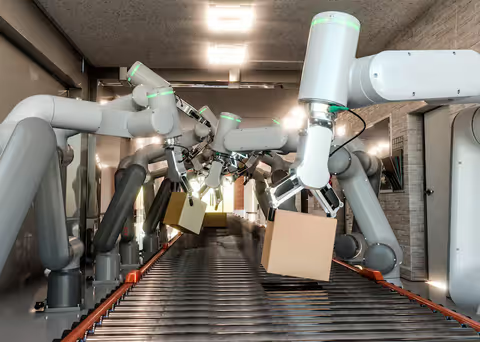
Robotics in manufacturing refers to the use of programmable machines and automated robotic systems to perform different industrial operations. These robots are designed to handle repetitive, precise, heavy or hazardous tasks in manufacturing facilities.
Industrial robotics has become an important part of modern production because manufacturers need consistent product quality, accurate operations and efficient production processes.
Traditional manufacturing often depends on manual activities for assembly, material handling, welding, painting and product inspection. Although human workers remain essential, certain repetitive operations can be performed using industrial robots.
Robotic systems help manufacturers automate selected production activities while allowing employees to focus on supervision, engineering, maintenance and quality management.
Modern manufacturing robots are equipped with sensors, controllers, cameras and specialised software. Some advanced systems also use Artificial Intelligence (AI), Machine Learning (ML) and the Internet of Things (IoT) to improve their ability to interact with industrial environments.
The main types of industrial robots include:
- Articulated Robots: Robots with rotating joints commonly used for welding, painting and assembly.
- Cartesian Robots: Operate along linear axes and are used for material handling and precision manufacturing.
- SCARA Robots: Designed for fast and accurate assembly operations.
- Collaborative Robots (Cobots): Designed to work near human operators with appropriate safety measures.
- Autonomous Mobile Robots (AMRs): Move materials and components around manufacturing facilities.
- Delta Robots: Commonly used for high-speed picking, sorting and packaging operations.
These robotic technologies support the development of smart factories and Industry 4.0 manufacturing systems.
Importance – Why Robotics Matters in Manufacturing Industries
Industrial robotics is becoming increasingly important because manufacturing processes require accuracy, consistency, equipment reliability and effective production management.
Robotic automation affects automobile manufacturers, electronics companies, pharmaceutical industries, textile manufacturers, food processing facilities and heavy engineering organisations.
1. Improved Production Efficiency
Industrial robots can perform programmed tasks repeatedly with consistent movement and timing.
They are useful for manufacturing operations that involve repetitive activities, allowing production processes to operate with greater consistency.
2. Better Product Quality
Robots can perform precise operations such as welding, cutting, drilling and component assembly.
Their programmed movements help maintain consistent manufacturing conditions and reduce certain errors associated with repetitive manual operations.
However, final product quality also depends on equipment calibration, materials, process settings and inspection systems.
3. Improved Workplace Safety
Some manufacturing operations involve high temperatures, hazardous materials, heavy objects and dangerous machinery.
Robots can perform selected activities in these environments, reducing the need for workers to remain directly exposed to certain hazards.
Examples include:
- Industrial painting.
- Heavy material handling.
- High-temperature operations.
- Chemical processing support.
- Repetitive machine loading.
- Certain hazardous inspection activities.
Robotic installations still require suitable guarding, emergency stops, risk assessments and safety procedures.
4. Reduced Production Interruptions
Robotic systems can be integrated with machine monitoring and predictive maintenance technologies.
Sensors can monitor operating conditions such as temperature, vibration and movement. Maintenance teams can use this information to identify unusual equipment behaviour and investigate possible problems.
5. Improved Manufacturing Accuracy
Robots are particularly useful in industries where precise positioning and controlled movements are necessary.
For example, electronics manufacturing uses robotic systems for component placement, soldering and assembly activities.
6. Better Material Handling
Autonomous mobile robots and robotic arms can move components between manufacturing stations.
They help organise material movement and coordinate activities across warehouses, assembly areas and production lines.
7. Support for Smart Manufacturing
Industrial robots can communicate with manufacturing execution systems, sensors and production monitoring platforms.
This allows manufacturers to collect operational information and understand equipment performance.
Major Applications of Robotics in Different Industries
Robotic technology is used across several manufacturing sectors.
| Industrial sector | Robotics application |
|---|---|
| Automobile | Welding, painting and vehicle assembly |
| Electronics | Component placement and circuit board assembly |
| Pharmaceuticals | Packaging and material handling |
| Food processing | Sorting, picking and packaging |
| Textile | Fabric handling and automated cutting |
| Aerospace | Precision drilling and component assembly |
| Metal manufacturing | Welding, cutting and grinding |
| Warehousing | Automated material movement and sorting |
Examples of Industrial Robotic Applications
- Robotic welding helps join metal components with controlled movements.
- Robotic painting supports consistent coating application.
- Robotic packaging systems organise products for further processing.
- Machine-tending robots load and unload manufacturing equipment.
- Vision-guided robots identify objects and support automated inspection.
- Collaborative robots assist with selected assembly and handling operations.
Recent Updates – Robotics Developments in India (2025–2026)
India's robotics ecosystem has continued developing through government initiatives, advanced manufacturing research and domestic technology development.
Several developments during the past year are relevant to manufacturing industries.
1. India's Advanced Manufacturing Roadmap – 29 October 2025
On 29 October 2025, NITI Aayog unveiled its roadmap titled Reimagining Manufacturing: India's Roadmap to Global Leadership in Advanced Manufacturing.
The roadmap identified robotics, Artificial Intelligence, Machine Learning, advanced materials and digital twins as important technologies for India's manufacturing development.
It examined opportunities across 13 priority manufacturing sectors and highlighted the importance of research, infrastructure and workforce development.
2. Strategic Roadmap for Robotics in India – 3 February 2026
On 3 February 2026, the Technology Advisory Group of the Empowered Technology Group held a meeting under the Office of the Principal Scientific Adviser.
The discussion focused on India's robotics ecosystem, technological challenges and a strategic roadmap for robotics development.
Participants examined the importance of advanced robotic technologies, domestic innovation and manufacturing capabilities.
3. Advanced Manufacturing Systems Consultation – 23 February 2026
On 23 February 2026, the Office of the Principal Scientific Adviser and the Ministry of Heavy Industries organised a stakeholder consultation at the Central Manufacturing Technology Institute in Bengaluru.
The consultation examined important areas such as:
- Industrial robotics and robotic arms.
- Advanced manufacturing machinery.
- CNC machine tools and controllers.
- Testing and measurement infrastructure.
- Advanced additive manufacturing.
The discussions focused on strengthening India's domestic advanced manufacturing ecosystem.
4. Advanced Manufacturing Discussion – 10 March 2026
On 10 March 2026, the 29th Prime Minister's Science, Technology and Innovation Advisory Council meeting discussed advanced manufacturing systems.
Industrial robotics and automation were among the important themes.
The discussions highlighted the need to strengthen domestic capabilities in robotics subsystems, machine tools, testing infrastructure and advanced industrial equipment.
5. Development of Indigenous Robotic Components – 24 November 2026
On 24 November 2026, Bengaluru-based Cosine Robots announced a funding round of ₹22.36 crore to expand its research and development and production capabilities.
The company focuses on robotic actuators and motion systems used in robotic arms, collaborative robots and other advanced robotic platforms.
The development reflects growing attention towards domestic manufacturing of critical robotic components in India.
These developments indicate increasing interest in robotics research, industrial automation and domestic manufacturing capabilities.
Laws or Policies – Robotics Regulations in India
Industrial robotics is affected by Indian laws covering workplace safety, machinery operation, electrical safety and manufacturing activities.
India does not have one single law governing every industrial robot. Manufacturers must consider several applicable legal and technical frameworks.
1. Occupational Safety, Health and Working Conditions Code, 2020
The Occupational Safety, Health and Working Conditions Code, 2020 establishes a framework for workplace health, safety and working conditions.
The Code came into force on 21 November 2025.
Manufacturing facilities using robotic machinery must consider applicable workplace safety requirements, including risk management and safe operating procedures.
2. Factories Act, 1948 and Applicable State Rules
The Factories Act, 1948 historically provided requirements relating to factory safety, machinery guarding and worker protection.
India's transition to the Occupational Safety, Health and Working Conditions Code changes the applicable legal framework. Manufacturers should refer to current commencement notifications, transitional provisions and applicable state rules rather than assuming older provisions independently govern every situation.
3. Electricity Act, 2003
Industrial robotic systems depend on electrical power, control panels, motors and electronic equipment.
The Electricity Act, 2003 provides the broader legal framework for electricity generation, distribution and use.
Applicable electrical safety requirements must be considered when installing and operating industrial robotic equipment.
4. Bureau of Indian Standards (BIS)
BIS develops Indian Standards covering industrial products, machinery and safety-related requirements.
Manufacturers and system integrators should identify the relevant standards applicable to robotic equipment, electrical systems and machinery safety.
5. ISO 10218 and ISO/TS 15066
ISO 10218 establishes international safety requirements for industrial robots and robotic applications.
ISO/TS 15066 provides additional guidance for collaborative robot applications.
These are technical standards rather than automatically applicable Indian laws. Their relevance depends on adoption, contractual requirements and applicable regulatory provisions.
6. SAMARTH Udyog Bharat 4.0
The Ministry of Heavy Industries supports the SAMARTH Udyog Bharat 4.0 initiative to promote smart manufacturing and Industry 4.0 technologies.
Its activities include technology demonstrations, industrial awareness and training related to advanced manufacturing systems.
7. National Manufacturing Mission
Announced in the Union Budget 2025–26 on 1 February 2025, the National Manufacturing Mission focuses on strengthening India's manufacturing ecosystem.
It includes technology development, workforce readiness, MSME participation and manufacturing competitiveness.
These initiatives support the wider industrial environment in which robotics and automation are developing.
Tools and Resources – Helpful Robotics Technologies
Several software platforms and technical resources help manufacturers understand, design and operate robotic systems.
1. ROS 2 (Robot Operating System)
An open-source robotics framework used for developing robotic applications, communication systems and automated machine operations.
2. RoboDK
A robotics simulation and offline programming platform used to plan robot movements and examine industrial automation applications.
3. MATLAB and Simulink
Engineering platforms used for robotic modelling, motion analysis, control-system development and simulation.
4. Siemens TIA Portal
An industrial engineering platform used for configuring automation systems, programmable logic controllers and manufacturing equipment.
5. NVIDIA Isaac
A robotics development platform that supports simulation, AI-based robotics and virtual testing environments.
6. CoppeliaSim
A robotics simulation environment used to model robotic movements, sensors and industrial automation scenarios.
7. Industrial Robotics Planning Templates
Useful technical documents include:
- Robotic automation feasibility assessment.
- Robot installation checklist.
- Industrial safety risk assessment.
- Robotic maintenance schedule.
- Robot performance monitoring report.
- Production line automation plan.
- Robotic system inspection checklist.
- Industrial equipment troubleshooting sheet.
These resources help engineering teams organise robotic projects and evaluate system performance.
FAQs – Robotics in Manufacturing Industries
1. What is robotics in manufacturing industries?
Robotics in manufacturing refers to the use of programmable robotic machines to perform industrial activities such as welding, assembly, painting, packaging, inspection and material handling.
2. What are the main types of industrial robots?
The main types include articulated robots, Cartesian robots, SCARA robots, delta robots, collaborative robots and autonomous mobile robots. Each type is designed for different manufacturing requirements.
3. How do industrial robots improve manufacturing?
Industrial robots support consistent production, precise movements, repetitive operations, automated material handling and improved workplace safety when properly integrated into manufacturing systems.
4. What is the difference between industrial robots and collaborative robots?
Traditional industrial robots commonly operate within designated workspaces with physical safeguarding. Collaborative robots are designed to work near people under defined safety conditions. Both require appropriate risk assessments and protective measures.
5. What is the future of robotics in manufacturing industries?
The future of industrial robotics is expected to involve greater integration of AI, machine vision, autonomous mobile robots, collaborative robotics and digital twins. These technologies can support more flexible and connected manufacturing environments.
Conclusion
Robotics is transforming manufacturing industries by introducing automated systems for assembly, welding, painting, packaging, material handling and quality inspection.
Industrial robots help manufacturers improve operational consistency, support workplace safety and manage repetitive production activities. Their integration with Artificial Intelligence, Industrial IoT and digital twins is also expanding the capabilities of smart factories.
In India, government initiatives, advanced manufacturing programmes and domestic robotics development are strengthening the country's industrial technology ecosystem.
However, successful robotic automation requires proper equipment selection, technical expertise, employee training, safety assessments and regular maintenance.
As manufacturing technology continues to evolve, industrial robotics is expected to remain an important part of Industry 4.0 and the future of smart manufacturing in India.

Related Post...

Industrial Cybersecurity and Data Protection in India: Laws, Trends and Security
Updated: November 26, 2026
Read More
Artificial Intelligence in Industries: Applications, Benefits and Future Trends
Updated: November 26, 2026
Read More