Explore Modern Paper Recycling Plants and Their Role in Sustainable Manufacturing
Paper recycling plants are industrial facilities that collect, sort, process, and transform used paper products into recycled paper materials. These facilities help recover valuable fibres from discarded newspapers, cardboard, office documents, packaging materials, and other paper-based products.
Paper is made primarily from cellulose fibres obtained from trees and other plant materials. Instead of depending entirely on newly produced pulp, recycling facilities recover fibres from previously manufactured paper products. These fibres can then be processed into new paper, cardboard, tissue products, and packaging materials.
The development of paper recycling plants is closely connected to increasing awareness of resource conservation, waste reduction, and sustainable manufacturing. As paper consumption continues across educational institutions, commercial buildings, publishing industries, and manufacturing operations, recycling facilities play an important role in managing discarded materials.
How Does a Paper Recycling Plant Operate?
A paper recycling plant generally follows several stages to convert collected paper waste into reusable raw materials.
Collection: Used paper is gathered from households, offices, educational institutions, printing facilities, and industrial locations.
Sorting: Different paper grades are separated according to quality, thickness, colour, and material composition.
Pulping: Sorted paper is mixed with water inside specialised equipment to separate the fibres and create a pulp mixture.
Cleaning: Contaminants such as plastic, staples, adhesives, sand, and other unwanted materials are removed.
Deinking: Printing ink and other surface substances are separated when required by the intended recycled paper grade.
Refining: Recovered fibres are processed to improve their bonding characteristics and suitability for manufacturing.
Paper formation: The cleaned pulp is distributed across a moving screen to create a continuous paper sheet.
Drying and finishing: Moisture is removed, and the finished material is processed into rolls or sheets.
The exact process depends on the type of paper being recycled and the specifications of the final material.
Common Types of Paper Recycling Plants
Different facilities specialise in particular paper grades and production requirements.
Plant type | Main materials processed |
|---|---|
Newspaper recycling plants | Used newspapers and printed publications |
Cardboard recycling plants | Corrugated boxes and packaging board |
Office paper recycling plants | Documents, printing paper and stationery |
Tissue paper recycling plants | Selected recovered paper fibres |
Mixed paper recycling plants | Multiple grades of collected paper |
Industrial paper recycling plants | Manufacturing and commercial paper waste |
Each facility requires suitable machinery, water management systems, quality controls, and material handling arrangements.
Importance of Paper Recycling Plants Today
Reducing Paper Waste
Paper recycling plants help divert significant quantities of discarded paper from landfills and uncontrolled disposal sites. Paper products can occupy considerable space in waste management systems, particularly in regions with high consumption of packaging and printed materials.
Recovering used paper allows suitable fibres to enter another production cycle rather than becoming discarded material.
Conserving Natural Resources
Traditional paper production relies heavily on wood pulp. Recycling facilities recover cellulose fibres from existing paper products, reducing the requirement for newly processed raw materials.
Although recycled paper production still requires energy, water, and processing chemicals, efficient recycling systems can reduce dependence on virgin fibre production.
Supporting Sustainable Manufacturing
Manufacturers increasingly consider recycled materials when developing packaging, printing products, and commercial paper goods.
Paper recycling plants provide recovered fibre that can support different manufacturing applications, including:
Corrugated cardboard production.
Recycled printing and writing paper.
Paperboard packaging.
Tissue and hygiene paper.
Protective paper-based packaging.
Industrial paper products.
Environmental and Economic Importance
Recycling facilities contribute to more organised material recovery systems. They also create opportunities for equipment manufacturers, collection networks, paper mills, logistics operators, and environmental technology providers.
The following table highlights some major areas of impact.
Area | Potential contribution |
|---|---|
Waste management | Reduces paper disposal volumes |
Forestry | Lowers demand for virgin paper fibres |
Manufacturing | Supplies recovered raw materials |
Energy management | Can reduce energy requirements compared with certain virgin-pulp processes |
Water management | Encourages improved industrial water treatment |
Circular economy | Keeps recoverable materials in productive use |
However, environmental performance depends on electricity sources, transportation distances, fibre quality, wastewater treatment, and plant efficiency.
Recent Updates and Industry Trends
Growing Interest in Circular Paper Production
During 2025 and 2026, circular economy policies and packaging regulations continued influencing paper manufacturing and recycling operations.
Manufacturers are increasingly examining how packaging materials can be collected, sorted, recovered, and reintroduced into production systems.
The European Union's Packaging and Packaging Waste Regulation, Regulation (EU) 2025/40, entered into force on 11 February 2025 and became applicable from 12 August 2026. It establishes a broader framework for packaging prevention, reuse, and recyclability. Requirements concerning packaging recyclability at scale are scheduled for 2035.
Automation in Paper Recycling Facilities
Modern paper recycling plants increasingly incorporate automated technologies to improve material identification and processing accuracy.
Some important developments include:
Optical sorting systems for identifying different paper grades.
Automated conveyor systems for material movement.
Digital monitoring of production equipment.
Advanced contaminant detection systems.
Automated pulp consistency measurement.
Computer-controlled drying and paper formation.
These technologies help improve operational consistency and reduce unnecessary material losses.
Water and Energy Efficiency
Water consumption and energy requirements remain important considerations in paper recycling operations.
Recent engineering developments focus on closed-loop water systems, improved filtration, efficient pumping equipment, heat recovery, and better wastewater treatment.
These approaches can help facilities manage industrial resources more carefully while maintaining production quality.
Changing Packaging Requirements
Paper-based packaging remains an important part of global packaging systems.
According to European Commission data, paper and cardboard represented 40.8% of all packaging waste generated in the European Union in 2024. This demonstrates the importance of effective collection and recycling infrastructure.
The industry is also examining packaging designs that make materials easier to separate and recycle.
Laws, Policies and Government Regulations
Paper recycling plants operate within environmental and industrial regulatory frameworks. Requirements vary according to the country, plant capacity, production processes, and types of materials handled.
European Union Regulations
The European Union has established several policies concerning packaging waste, resource efficiency, and recycling.
Regulation (EU) 2025/40 introduces requirements covering packaging design, recyclability, waste prevention, and packaging management.
For paper recycling facilities, these developments highlight the importance of producing recyclable materials and maintaining effective collection and sorting infrastructure.
The regulation generally applies from 12 August 2026, with certain requirements scheduled for later implementation.
United States Environmental Regulations
In the United States, paper recycling plants may be subject to federal, state, and local environmental requirements.
Important regulatory frameworks include:
Resource Conservation and Recovery Act (RCRA): Establishes a framework for managing solid and hazardous waste.
Clean Water Act: Regulates industrial wastewater discharges into protected waters.
Clean Air Act: Establishes requirements for controlling air pollution from industrial operations.
Occupational Safety and Health Administration (OSHA): Provides workplace safety requirements relevant to industrial machinery and plant operations.
Facilities must identify which requirements apply to their specific activities and operating locations.
India's Waste Management Framework
India has developed several regulations to improve waste segregation, material recovery, and recycling infrastructure.
The Solid Waste Management Rules, 2026, notified in January 2026 and effective from 1 April 2026, establish mandatory segregation into four waste streams: wet waste, dry waste, sanitary waste, and special-care waste.
Paper is included within the dry-waste category, supporting its separate collection and transfer to appropriate recovery and recycling facilities.
Environmental Compliance Requirements
Depending on the jurisdiction, paper recycling facilities may need to consider:
Industrial operating permissions.
Waste collection and transportation requirements.
Wastewater treatment standards.
Air emission monitoring.
Chemical storage and handling rules.
Occupational health and machinery safety.
Environmental reporting and recordkeeping.
Regulatory compliance is important for maintaining responsible industrial operations.
Tools and Resources for Paper Recycling Plants
Modern recycling facilities use different machinery, monitoring systems, and technical resources to manage production activities.
Essential Recycling Machinery
1. Industrial Paper Shredders
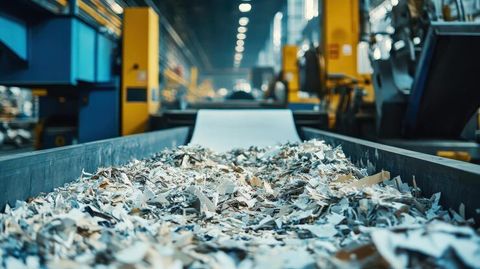
These machines reduce discarded paper into smaller pieces before further processing. Shredding supports material preparation and handling.
2. Hydrapulpers
Hydrapulpers mix paper with water and separate cellulose fibres to produce pulp. They are important components of many paper recycling production lines.
3. Paper Sorting Machines
Sorting equipment separates different paper grades and identifies unwanted materials. Optical and sensor-based systems can improve sorting accuracy.
4. Deinking Systems
Deinking equipment removes printing ink and other unwanted substances from recovered fibres. These systems are particularly important when producing certain printing and writing papers.
5. Pulp Screening Equipment
Screens remove larger contaminants, including plastic fragments, adhesives, and other unwanted materials.
6. Paper Making Machines
These machines transform prepared pulp into continuous paper sheets through forming, pressing, drying, and finishing operations.
Digital Tools and Technical Resources
The following resources can help plant operators, engineers, and researchers understand recycling processes.
Tool or resource | Main application |
|---|---|
CAD software | Designing plant layouts and machinery arrangements |
SCADA systems | Monitoring industrial processes |
ERP software | Managing production and inventory records |
Energy monitoring systems | Analysing electricity consumption |
Water quality testing equipment | Monitoring industrial water conditions |
Fibre quality analysers | Evaluating recovered pulp characteristics |
Environmental management software | Maintaining compliance documentation |
Useful Industry Organisations and Information Sources
Several international organisations publish information about paper manufacturing, recycling, and environmental management.
Environmental Protection Agency (EPA): Information about waste management and environmental regulations in the United States.
European Commission: Publications about European packaging and waste management policies.
Confederation of European Paper Industries (Cepi): Industry information about European pulp and paper manufacturing.
International Organization for Standardization (ISO): Standards covering environmental management and quality systems.
Food and Agriculture Organization (FAO): Information about forestry, forest products, and resource management.
These resources can help readers understand technical developments and regulatory expectations.
Frequently Asked Questions
What Is the Main Purpose of a Paper Recycling Plant?
The main purpose is to recover usable fibres from discarded paper products and convert them into raw materials for manufacturing new paper and packaging products. These facilities also help reduce paper waste and support resource conservation.
What Materials Can Be Processed in Paper Recycling Plants?
Common materials include newspapers, cardboard, office documents, magazines, printing paper, and selected packaging materials.
However, heavily contaminated paper, laminated materials, wax-coated paper, and certain composite products may require specialised processing or may not be suitable for conventional recycling systems.
What Machinery Is Required for a Paper Recycling Plant?
Common equipment includes industrial shredders, conveyor systems, sorting machines, hydrapulpers, screening equipment, deinking systems, pulp refiners, paper-making machines, and drying systems.
The machinery configuration depends on the material type, processing capacity, and intended recycled paper products.
How Many Times Can Paper Be Recycled?
Paper fibres can generally be recycled multiple times, but their quality gradually decreases as the fibres become shorter and weaker during repeated processing.
The actual number of recycling cycles depends on the original fibre quality, manufacturing process, and final paper application. New fibres are often introduced to maintain the required strength and quality.
Are Paper Recycling Plants Environmentally Friendly?
Paper recycling plants can provide environmental benefits by recovering materials, reducing landfill disposal, and lowering demand for virgin fibres.
However, their overall environmental impact depends on electricity consumption, water use, chemical management, transportation, and wastewater treatment practices.
Conclusion
Paper recycling plants play an important role in modern waste management and sustainable manufacturing. By recovering fibres from discarded paper products, these facilities help reduce material waste and support the production of recycled paper, cardboard, tissue, and packaging materials.
Technological developments such as automated sorting, advanced pulp processing, digital monitoring, and improved water treatment are changing how recycling facilities operate.
At the same time, environmental regulations and circular economy policies are encouraging better collection systems and more responsible material recovery.
As industries continue to examine resource efficiency and packaging sustainability, paper recycling plants will remain an important part of global recycling infrastructure. Their long-term effectiveness will depend on efficient machinery, suitable raw materials, responsible environmental management, and consistent improvements in recycling technology.

Related Post...
Explore Modern Paper Recycling Plants and Their Role in Sustainable Manufacturing
Updated: November 25, 2026
Read More
Laser Cutting Machines Overview: Materials, Processes, and Technology Developments
Updated: November 25, 2026
Read More
Explore Label Printing Machines: Types, Features, and Industrial Applications
Updated: November 25, 2026
Read More