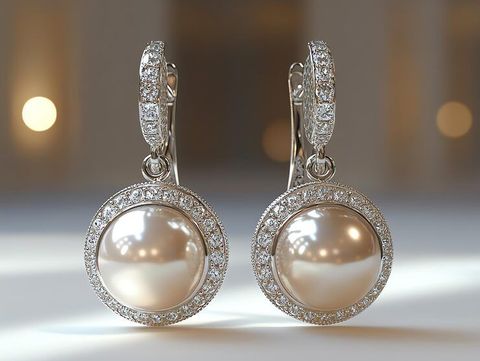
A Complete Guide to Pearl Earrings: Styles, Shapes, and Designs
Pearl earrings are a classic category of jewellery known for their natural lustre, smooth surface, and elegant appearance. They are created using natural or cultured pearls and are available in different shapes, colours, sizes, and settings. From traditional pearl studs to contemporary drop earrings, these designs have remained relevant across different generations and fashion preferences.
Pearls are formed inside certain molluscs when layers of nacre develop around an irritant or implanted nucleus. Natural pearls form without human intervention, while cultured pearls develop through a controlled process involving human assistance.
Pearl earrings are available in freshwater, Akoya, Tahitian, and South Sea varieties. Each type has distinct visual characteristics and is associated with different jewellery-making traditions.
Why Pearl Earrings Remain Important in Modern Jewellery
Pearl earrings continue to have a place in the international jewellery industry because they combine traditional craftsmanship with changing fashion preferences. Their versatility allows them to complement formal clothing, everyday outfits, cultural attire, and contemporary fashion styles.
Pearl jewellery also represents an important part of the global gemstone and luxury jewellery market. Its production involves pearl farmers, marine specialists, gemstone laboratories, jewellery manufacturers, designers, and retailers.
Cultural and Fashion Significance
Pearls have been associated with elegance, heritage, and formal jewellery for centuries. Their appearance varies depending on the pearl type, making them suitable for different design preferences.
Common applications include:
Everyday jewellery: Small freshwater pearl studs and simple pearl earrings.
Formal occasions: Akoya pearl drops and diamond-accented pearl earrings.
Traditional jewellery: Gold earrings featuring round pearls and decorative settings.
Contemporary fashion: Baroque pearl earrings with irregular shapes.
Luxury collections: South Sea pearl earrings with larger pearl dimensions.
Importance for Jewellery Professionals
Understanding pearl characteristics is useful for several groups within the jewellery sector.
Jewellery designers use pearl dimensions, colours, and shapes when developing new collections.
Gemologists examine nacre quality, surface characteristics, and pearl identification.
Manufacturers evaluate drilling, matching, setting techniques, and metal compatibility.
Collectors consider origin, rarity, treatments, and documented quality characteristics.
Pearl Earrings and Consumer Awareness
One important challenge is distinguishing natural, cultured, imitation, and treated pearls. Products may look similar in photographs, but their formation processes and material characteristics are different.
Knowledge of pearl classification helps consumers understand jewellery descriptions and avoid confusion when evaluating pearl authenticity.
Different Types of Pearl Earrings and Their Characteristics
Pearl earrings are classified according to the type of pearl, formation process, appearance, and jewellery setting.
Freshwater Pearl Earrings
Freshwater pearls are primarily cultivated in freshwater mussels. They are available in white, pink, lavender, peach, and other natural or treated shades. Their variety of shapes makes them suitable for studs, drops, hoops, and decorative earrings.
Akoya Pearl Earrings
Akoya pearls are saltwater cultured pearls traditionally associated with Japan and other Asian producing regions. They are recognised for their round shapes, reflective lustre, and relatively consistent appearance.
These characteristics make Akoya pearl earrings popular in traditional and formal jewellery designs.
Tahitian Pearl Earrings
Tahitian pearls are cultivated in black-lipped pearl oysters, mainly in French Polynesia. They are known for their dark body colours, including grey, green, silver, and peacock overtones.
Their distinctive appearance makes them suitable for contemporary earrings and statement jewellery.
South Sea Pearl Earrings
South Sea pearls are produced by large pearl oysters in regions such as Australia, Indonesia, and the Philippines. They are known for their relatively large dimensions and soft, satin-like lustre.
White and golden varieties are commonly used in high-end jewellery designs.
Baroque Pearl Earrings
Baroque pearls have irregular or non-spherical shapes. Their individual forms create distinctive jewellery designs, including asymmetrical earrings, sculptural drops, and artistic metal settings.
Unlike perfectly round pearls, baroque pearls emphasise natural variations in shape and surface appearance.
Comparison of Major Pearl Types
| Pearl type | Main characteristics | Common colours |
|---|---|---|
| Freshwater | Diverse shapes and sizes | White, pink, lavender |
| Akoya | Round shape and bright lustre | White, cream, silver |
| Tahitian | Dark body colours | Grey, green, peacock |
| South Sea | Larger dimensions and soft lustre | White, silver, gold |
| Baroque | Irregular natural shapes | White, cream, grey |
Important Factors That Determine Pearl Earring Quality
Pearl quality is evaluated through several characteristics rather than a single measurement. These factors are important in gemological assessments, pearl grading, jewellery manufacturing, and collection management.
Lustre and Surface Quality
Lustre describes how light reflects from the pearl's surface. Pearls with sharp, clear reflections generally display stronger lustre.
Surface quality considers visible imperfections such as spots, bumps, scratches, and uneven areas. Natural variations are common, but their extent can influence the overall appearance.
Pearl Size, Shape, and Colour
Pearl dimensions are generally measured in millimetres. Larger pearls can create a more noticeable appearance, although size alone does not establish quality.
Important characteristics include:
Shape: Round, near-round, oval, drop, and baroque.
Colour: White, cream, pink, silver, gold, and darker shades.
Overtone: Secondary colour visible across the pearl's body.
Matching: Similarity between the two pearls in an earring pair.
Nacre Quality and Earring Construction
Nacre is the material responsible for the characteristic appearance of many pearls. Its thickness and structure influence durability and visual quality.
Earring construction also matters. Secure clasps, suitable metal settings, properly aligned drilling, and balanced weight contribute to the overall design.
Recent Pearl Jewellery Trends and Developments (2025–2026)
Pearl jewellery has experienced renewed attention through contemporary fashion collections and changing design preferences. During 2025 and 2026, designers increasingly combined traditional pearl materials with unconventional shapes, mixed metals, and modern jewellery structures.
Contemporary Pearl Earring Designs in 2026
Several noticeable developments include:
Baroque pearl designs: Irregular shapes are increasingly incorporated into statement earrings.
Mixed-metal settings: Gold, silver, and other metal finishes create contrasting visual effects.
Asymmetrical earrings: Different pearl shapes and lengths provide more individual styling options.
Sculptural jewellery: Designers combine pearls with geometric and artistic metal structures.
Everyday pearl jewellery: Smaller pearl studs and lightweight drops are being incorporated into casual fashion.
Developments in Pearl Identification and Classification
Pearl identification remains an important area of gemological research. Distinguishing natural, cultured, treated, and imitation pearls requires appropriate examination methods.
In 2025 and 2026, pearl industry organisations continued working on classification terminology, production methods, and treatment descriptions. These developments highlight the importance of transparent pearl descriptions and reliable gemological documentation.
Laws, Regulations, and Industry Standards
Pearl earrings are affected by different regulations depending on their country of production, importation, and distribution. Rules can cover precious-metal purity, product descriptions, consumer protection, environmental requirements, and international trade.
India: BIS Hallmarking Requirements
In India, the Bureau of Indian Standards regulates hallmarking for gold and silver jewellery.
Important points include:
Gold jewellery covered by mandatory hallmarking requirements must carry the applicable BIS hallmark.
Hallmarked gold jewellery includes the BIS logo, purity marking, and six-digit Hallmark Unique Identification (HUID) number.
The BIS Care application provides a feature for checking eligible gold jewellery HUID information.
Silver jewellery also has a separate HUID-based hallmarking framework.
An important distinction is that hallmarking verifies the purity of the precious metal, not the authenticity or quality of the pearl itself. Therefore, a gold pearl earring's metal marking should not be interpreted as a pearl grading certificate.
International Pearl Disclosure Standards
In the United States, Federal Trade Commission jewellery guidelines address descriptions of natural, cultured, and imitation pearls. Appropriate terminology is important because these materials have different origins.
The guidance also addresses disclosure of certain pearl treatments, particularly when treatment is non-permanent, affects care requirements, or significantly influences value.
Consumer Protection and Environmental Considerations
Consumer protection rules in different jurisdictions discourage misleading descriptions of jewellery materials, origin, and quality.
Pearl production also involves environmental considerations, particularly mollusc farming, coastal ecosystems, water quality, and responsible sourcing. International jewellery organisations publish technical guidance to encourage consistent terminology and responsible industry practices.
Tools and Resources for Pearl Jewellery Research
Several professional resources help users understand pearl identification, jewellery quality, precious-metal standards, and industry developments.
| Tool or resource | Main purpose |
|---|---|
| BIS Care App | Verify eligible gold jewellery HUID details |
| CIBJO Pearl Guide | Understand pearl classification and terminology |
| Gemological Institute of America | Study pearl identification and gemology |
| Pearl-Guide educational resources | Explore pearl varieties and characteristics |
| Jewellery design software | Develop earring settings and design concepts |
| Digital jewellery calipers | Measure pearl dimensions |
| Gemological microscope | Examine pearl surface and structural features |
| Jewellery inventory templates | Record pearl type, dimensions, and treatments |
Useful Technical Assessment Methods
Digital calipers: Measure pearl diameter and dimensions accurately.
Microscopic examination: Identify surface features and examine visible structures.
Gemological laboratory reports: Help establish pearl identity and disclose relevant treatments.
Design software: Supports the development of balanced earring settings and metal structures.
Inventory documentation: Records pearl origin, identification, measurements, and jewellery specifications.
Frequently Asked Questions About Pearl Earrings
1. What are the main types of pearl earrings?
The main types include freshwater, Akoya, Tahitian, South Sea, and baroque pearl earrings. Each variety has different characteristics relating to colour, shape, lustre, and origin.
2. How can natural pearls be distinguished from cultured pearls?
Natural pearls form without deliberate human intervention, whereas cultured pearls develop through human-assisted cultivation. Gemological examination can help identify their formation characteristics.
3. What determines the quality of pearl earrings?
Important quality factors include lustre, surface condition, shape, colour, nacre characteristics, size, and matching between the two pearls. Metal quality and construction also influence the overall jewellery assessment.
4. Are pearl earrings suitable for everyday use?
Yes. Small freshwater and Akoya pearl studs are commonly used for everyday styling. However, pearls require careful handling because their surfaces can be affected by chemicals, cosmetics, friction, and excessive moisture.
5. How should pearl earrings be maintained?
Pearl earrings should be cleaned gently using a soft, slightly damp cloth and stored separately from harder jewellery. Avoid perfumes, household chemicals, ultrasonic cleaners, and prolonged exposure to heat.
Conclusion
Pearl earrings represent an important combination of natural materials, gemological characteristics, and jewellery craftsmanship. Their different varieties, including freshwater, Akoya, Tahitian, South Sea, and baroque pearls, provide a wide range of design possibilities.
Understanding pearl formation, lustre, surface quality, colour, and classification helps consumers and jewellery professionals evaluate these products more accurately. Developments during 2025 and 2026 also demonstrate how traditional pearl designs are evolving through contemporary settings and creative styling.
Knowledge of hallmarking requirements, consumer protection regulations, pearl identification methods, and responsible sourcing remains important for the international jewellery industry. As jewellery design continues to evolve, pearl earrings maintain their relevance through a balance of traditional characteristics and modern aesthetics.

Related Post...
Solitaire Pendants Overview: Popular Styles, Shapes, and Design Trends
Updated: November 03, 2026
Read More
Explore Wedding Band Trends 2026: Latest Diamond Wedding Ring Designs
Updated: October 31, 2026
Read More
Explore Diamond Jewellery: Latest Designs, Popular Styles & Buying Guide
Updated: October 30, 2026
Read More