Telehandlers were developed to address a practical challenge: moving heavy materials across uneven terrain and placing them precisely at height or distance. Traditional forklifts work well on flat surfaces but lack forward reach and elevation. Cranes offer reach but are not designed for frequent repositioning. Telehandlers bridge this gap by providing mobility, reach, and lifting capability in a single machine.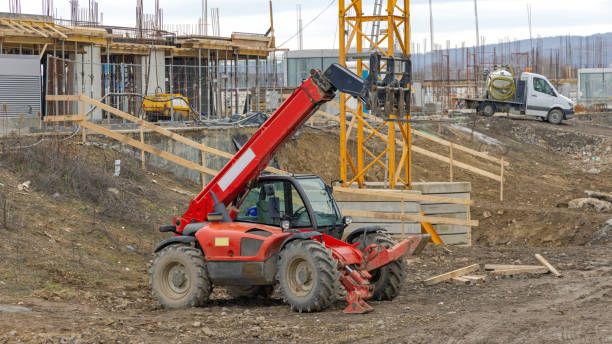
Modern telehandlers are engineered with robust chassis designs, all-terrain tires, and advanced control systems. They support a wide range of attachments such as forks, buckets, lifting hooks, and work platforms, making them adaptable to multiple tasks within the same project environment.
Why Telehandlers Matter in Today’s Worksites
Telehandlers play a critical role in modern project execution, particularly in construction and industrial operations where time efficiency, safety, and flexibility are essential. As projects grow in complexity, equipment that can perform multiple tasks without constant changeovers becomes increasingly valuable.
These machines matter today because they:
-
Enable safe lifting and placement of heavy materials at height
-
Reduce reliance on multiple machines for similar tasks
-
Improve productivity on sites with limited space or uneven ground
-
Support precise material positioning for structural work
-
Adapt to different applications through interchangeable attachments
Telehandlers affect a wide range of stakeholders, including site planners, equipment operators, safety supervisors, logistics coordinators, and project engineers. They help solve challenges related to vertical access, load stability, and movement across rough terrain.
In sectors such as commercial construction, infrastructure development, and industrial maintenance, telehandlers help streamline operations by reducing manual handling and minimizing repeated equipment movement.
How Telehandlers Function in Practical Use
The core working principle of a telehandler is based on its telescopic boom mechanism. The boom extends outward from the machine body and can be raised or lowered depending on the task. Load charts guide operators on safe lifting limits based on boom angle, extension length, and attachment type.
Key functional characteristics include:
-
Telescopic boom extension for forward and vertical reach
-
Four-wheel drive and steering for maneuverability
-
Stabilizers or outriggers on certain models for added balance
-
Enclosed operator cabins with visibility-focused design
-
Hydraulic systems controlling lift, tilt, and extension
Attachments significantly expand functionality. Fork attachments handle pallets, buckets move bulk material, and lifting jibs support suspended loads. This adaptability makes telehandlers suitable for varied tasks throughout a project lifecycle.
Common Telehandler Applications Across Industries
Telehandlers are used wherever lifting, placing, and transporting materials at height or distance is required.
Typical applications include:
-
Construction material placement on multi-level structures
-
Loading and unloading materials in industrial yards
-
Handling formwork, scaffolding, and prefabricated components
-
Agricultural material handling such as bales and feed containers
-
Maintenance access using approved work platforms
Their ability to operate on uneven terrain makes them especially useful in early-stage construction and outdoor industrial sites.
Table: Telehandler Types and Typical Use Scenarios
| Telehandler Type | Key Feature | Typical Environment |
|---|---|---|
| Compact Telehandler | Smaller size, high maneuverability | Confined construction sites |
| High-Reach Telehandler | Extended boom length | Multi-story building projects |
| Rotational Telehandler | 360-degree rotating upper structure | Complex placement tasks |
| Heavy-Duty Telehandler | Higher load capacity | Infrastructure and industrial sites |
Recent Developments and Industry Trends
Over the past year, telehandler technology has continued to evolve with a focus on efficiency, safety, and digital integration. In 2024 and early 2025, manufacturers and industry bodies highlighted advancements that reflect broader construction and equipment trends.
Notable developments include:
-
Increased integration of digital load monitoring systems
-
Enhanced operator-assist features for stability awareness
-
Improved fuel-efficiency and lower-emission engine designs
-
Growing use of electric and hybrid telehandler variants
-
Advanced cabin ergonomics and visibility improvements
-
Telematics-based usage and maintenance tracking
These updates reflect a shift toward smarter equipment that supports data-driven decision-making and safer operation across complex worksites.
Laws, Policies, and Regulatory Considerations
Telehandler operation is influenced by occupational safety regulations, machinery standards, and site-specific compliance requirements. While regulations vary by country, several common principles apply in many regions, including India and other major construction markets.
Key regulatory themes include:
-
Mandatory operator training and competency certification
-
Compliance with machinery safety standards for lifting equipment
-
Adherence to load charts and stability guidelines
-
Routine inspection and maintenance documentation
-
Site safety rules governing working at height and load movement
Government labor and safety authorities typically require that telehandlers used for lifting personnel follow additional guidelines, especially when fitted with work platforms. Regulatory frameworks aim to reduce accident risks and promote consistent operational practices.
Tools and Resources for Understanding Telehandler Use
Several technical and educational resources help users understand telehandler operation, planning, and safety considerations.
Helpful tools and references include:
-
Load capacity and reach calculators provided by equipment manufacturers
-
Operator manuals detailing controls, limits, and attachment use
-
Site planning templates for lift path and material placement
-
Equipment telematics dashboards for usage monitoring
-
Safety checklists for pre-operation inspection
-
Training guides explaining stability principles and attachment compatibility
These resources support informed decision-making and improve operational awareness without relying solely on on-site trial and error.
Table: Key Telehandler Performance Parameters
| Parameter | What It Indicates | Why It Matters |
|---|---|---|
| Maximum Lift Capacity | Highest safe load | Prevents overloading |
| Maximum Reach | Horizontal boom extension | Affects placement distance |
| Lift Height | Vertical reach capability | Determines usable building levels |
| Turning Radius | Maneuverability range | Important in tight spaces |
Frequently Asked Questions
What makes a telehandler different from a forklift?
A telehandler offers forward reach and greater lift height through a telescopic boom, while forklifts primarily lift vertically and are best suited for flat surfaces.
Can telehandlers operate on uneven ground?
Yes. Telehandlers are designed with all-terrain capabilities and are commonly used on rough or unprepared surfaces.
Are telehandlers suitable for lifting people?
They can be used with approved work platforms when permitted by regulations and operated according to safety guidelines.
Why are load charts important?
Load charts define safe operating limits based on boom position and attachment type, helping prevent tipping or instability.
Do telehandlers require specialized training?
Yes. Operators must understand controls, load dynamics, and safety protocols to operate telehandlers responsibly.
Conclusion
Telehandlers have become an essential part of modern construction and industrial operations due to their unique combination of reach, lifting capability, and mobility. By addressing the limitations of traditional lifting equipment, they enable safer and more efficient material handling across a wide range of environments.
Advancements in digital monitoring, safety systems, and energy efficiency continue to improve telehandler functionality and usability. Understanding how telehandlers work, where they are applied, and which regulations govern their use helps stakeholders plan projects more effectively and maintain safe worksites.
As infrastructure development and industrial activity continue to grow, telehandlers remain a practical solution for handling complex lifting and placement tasks with precision and adaptability.