Submersible Pump Manufacturing: Insights Into Modern Production and Reliability
Submersible pump manufacturing involves designing and producing pumps intended to operate while fully or partly immersed in a liquid.
These pumps are commonly used for moving groundwater, wastewater, drainage water, irrigation water, and other liquids from one location to another.
Unlike surface-mounted pumps, a submersible pump places the pumping unit close to or inside the liquid. This arrangement can reduce the need for long suction lines and allows the pump to move liquid from wells, tanks, pits, drainage areas, and other submerged environments.
Modern submersible pump manufacturing combines mechanical design, electrical engineering, material selection, machining, assembly, and testing. Manufacturers typically produce components such as pump casings, impellers, shafts, seals, motors, bearings, cables, and protective housings before assembling them into a complete unit.
Main Production Stages
The production process generally begins with design specifications based on flow requirements, operating depth, liquid characteristics, pressure, and motor capacity. Computer-aided design tools can be used to develop component dimensions and evaluate how parts fit together.
Material selection is another important stage. Components exposed to water or wastewater may require materials with suitable resistance to corrosion and wear. Stainless steel, cast iron, engineered polymers, and other materials may be selected depending on the application.
After material selection, components undergo processes such as casting, machining, forming, drilling, grinding, and finishing. Critical dimensions are checked during production to maintain appropriate alignment between rotating and stationary parts.
Importance
Submersible pumps play a role in water management across residential, agricultural, municipal, and industrial environments. They can support groundwater extraction, drainage, irrigation, wastewater movement, and water transfer operations.
Reliability is particularly important because a pump may operate in locations that are difficult to access. A failure can interrupt water movement and may require equipment removal before inspection or repair can take place.
Factors That Affect Reliability
Several factors influence how a submersible pump performs during operation:
- Motor protection: Electrical components require suitable protection against moisture and operating conditions.
- Mechanical alignment: Correct alignment of the shaft, impeller, and bearings helps support consistent rotation.
- Sealing: Proper seals help limit liquid entry into sensitive internal areas.
- Material selection: Appropriate materials can improve resistance to corrosion, abrasion, and chemical exposure.
- Thermal management: Motors need suitable heat dissipation to operate within their designed temperature range.
- Testing: Electrical and mechanical checks can identify manufacturing defects before equipment reaches the operating environment.
Quality control may include dimensional inspection, insulation testing, pressure checks, vibration assessment, rotational testing, and operational testing. The exact testing program depends on pump design and intended application.
Common Applications
| Application | Typical Purpose | Key Consideration |
|---|---|---|
| Groundwater wells | Moving groundwater | Pumping depth |
| Irrigation | Water transfer | Flow requirement |
| Drainage | Removing accumulated water | Debris handling |
| Wastewater | Liquid movement | Solids management |
| Industrial tanks | Process liquid transfer | Liquid characteristics |
Tools and Resources
Modern submersible pump manufacturing relies on several technical tools and reference resources. CAD platforms help engineers develop component drawings, assemblies, and dimensional specifications. Simulation software may also be used to study fluid movement, structural behavior, or thermal conditions during the design stage.
Pump sizing calculators can help users estimate flow rate, total head, pipe losses, and motor requirements. These calculations are useful when determining whether a particular pump configuration is suitable for a defined operating condition.
Manufacturing teams may also use coordinate measuring machines, digital calipers, micrometers, electrical test equipment, vibration meters, pressure gauges, and balancing equipment. These tools help verify dimensions and operating characteristics during production and inspection.
Technical standards and manufacturer documentation can provide additional information about electrical ratings, installation conditions, materials, safety requirements, and operating limitations. Maintenance records and inspection templates can also help organize information about pump performance over time.
FAQs
What is submersible pump manufacturing?
Submersible pump manufacturing is the process of designing, producing, assembling, and testing pumps that operate while immersed in a liquid. It includes component production, motor integration, sealing, inspection, and functional testing.
How does submersible pump manufacturing support reliability?
Submersible pump manufacturing supports reliability through accurate component dimensions, suitable materials, proper sealing, motor protection, shaft alignment, and structured testing. Each stage can affect the pump's operating performance.
What materials are used in submersible pump manufacturing?
Common materials include cast iron, stainless steel, engineered polymers, and other alloys. Material selection depends on factors such as liquid composition, temperature, pressure, abrasion, and corrosion exposure.
Where are submersible pumps commonly used?
They are commonly used in groundwater wells, drainage systems, irrigation, wastewater applications, construction sites, tanks, and industrial liquid-transfer systems.
What tools are used to test submersible pumps?
Testing can involve electrical measurement equipment, pressure gauges, vibration instruments, dimensional inspection tools, balancing equipment, and controlled operating test systems.
Conclusion
Submersible pump manufacturing combines product design, material selection, precision production, electrical integration, assembly, and testing. Reliability depends on multiple factors, including component quality, sealing, alignment, motor protection, and application conditions. Modern manufacturing tools help producers inspect dimensions and evaluate pump performance before deployment. Understanding these production stages provides useful context for how submersible pumps are designed for different liquid-handling environments.

Related Post...
Exploring CNC Machines in China: A Clear Guide for Everyday Readers
Updated: October 20, 2026
Read More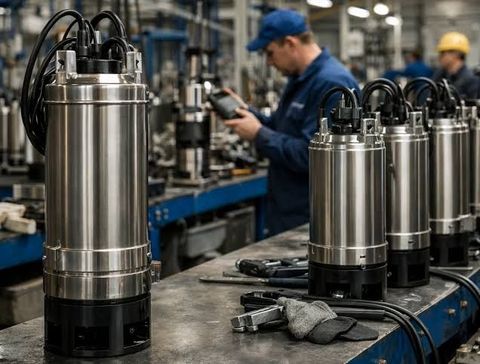
Submersible Pump Manufacturing: Insights Into Modern Production and Reliability
Updated: September 30, 2026
Read More
Discover China’s Top Electronics Manufacturers Shaping Global Tech
Updated: October 20, 2026
Read More