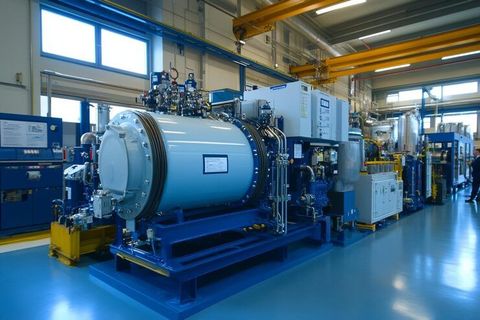
Industrial Furnaces: Types, Applications, Safety Standards & Uses
Industrial furnaces are specialised heating systems designed to produce and maintain high temperatures for manufacturing, processing, and material treatment. They are widely used in industries that require controlled heating to change the physical or chemical properties of materials.
These systems play an important role in metal production, automotive manufacturing, glass processing, ceramics, cement production, chemical processing, and several other industrial activities.
An industrial furnace generally uses electricity, natural gas, oil, coal, or other energy sources to generate heat. The heat is transferred to materials through radiation, convection, or conduction, depending on the furnace design and application.
Industrial furnaces exist because many manufacturing processes require temperatures and heating conditions that ordinary heating equipment cannot provide. They allow industries to perform operations such as melting, annealing, hardening, drying, forging, and sintering under controlled conditions.
How Do Industrial Furnaces Work?
The working principle of an industrial furnace depends on its heating technology, fuel source, temperature requirements, and material being processed.
Most industrial furnaces follow a similar operating process:
Energy input: Electricity or fuel supplies the energy required to generate heat.
Heat generation: Heating elements or combustion burners produce thermal energy.
Heat transfer: Thermal energy moves towards the material through radiation, convection, or conduction.
Temperature control: Sensors and control systems monitor and regulate furnace temperature.
Material processing: The material undergoes the required heating process.
Cooling: The material is cooled naturally or through a controlled cooling arrangement.
Modern industrial furnaces use temperature sensors, programmable controllers, and automated monitoring systems to maintain consistent operating conditions.
Importance of Industrial Furnaces in Modern Industries
Industrial furnaces are essential for industries that depend on high-temperature processing. They help manufacturers achieve specific material properties, maintain production quality, and perform complex thermal operations.
Their importance is increasing as industrial production, infrastructure development, and advanced manufacturing continue to expand.
1. Supporting Metal Manufacturing
Metal industries use furnaces to melt, refine, heat, and process different metals. Steel, aluminium, copper, and other metals require controlled temperatures during manufacturing.
Industrial furnaces support processes such as:
Metal melting and casting.
Steel reheating.
Metal forging.
Annealing and tempering.
Surface hardening.
2. Improving Material Properties
Heat treatment changes the physical and mechanical properties of materials.
For example, controlled heating and cooling can improve metal hardness, strength, ductility, and resistance to wear. These properties are important in automotive components, industrial machinery, construction materials, and engineering applications.
3. Supporting Energy Efficiency
Industrial heating can account for a substantial share of energy consumption in energy-intensive manufacturing facilities.
Modern furnace technologies focus on reducing unnecessary heat losses through:
Improved insulation materials.
Waste heat recovery systems.
Regenerative burners.
Automated temperature control.
Efficient combustion systems.
Better furnace maintenance.
These measures can help industries manage energy consumption and reduce greenhouse gas emissions.
4. Maintaining Production Quality
Incorrect heating temperatures or uneven heat distribution can affect the quality of processed materials.
Industrial furnaces use temperature sensors, programmable controllers, and monitoring systems to maintain consistent heating conditions.
This is particularly important in precision engineering, aerospace components, automotive manufacturing, and metal processing.
5. Supporting Multiple Industrial Sectors
Industrial furnaces are used across several major sectors:
Industry
Typical furnace application
Steel
Reheating and heat treatment
Automotive
Component hardening and annealing
Aluminium
Melting and heat treatment
Glass
Melting and forming
Ceramics
Firing and sintering
Cement
Clinker production
Chemical
Thermal processing
Aerospace
Precision heat treatment
Major Types of Industrial Furnaces
Industrial furnaces are classified according to their energy source, construction, heating method, and application. Each type is designed for particular operating conditions.
1. Electric Industrial Furnaces
Electric furnaces use electrical energy to generate heat through resistance elements, induction systems, or electric arcs.
They are commonly used where accurate temperature control is important.
Typical applications include:
Metal heat treatment.
Laboratory material testing.
Ceramic production.
Metal melting.
Specialised industrial processing.
Electric furnaces can provide precise heating control, although their environmental impact depends partly on how the electricity is generated.
2. Gas-Fired Industrial Furnaces
Gas-fired furnaces use natural gas or other suitable gaseous fuels to generate heat through combustion.
They are widely used in metal processing, steel production, reheating operations, and industrial drying.
Their performance depends on burner design, combustion control, insulation, and the quality of fuel supply.
3. Induction Furnaces
Induction furnaces use electromagnetic induction to heat electrically conductive materials.
They are particularly common in foundries and metal processing facilities.
Important applications include:
Iron melting.
Steel melting.
Copper processing.
Aluminium melting.
Special alloy production.
Induction heating allows rapid and controlled heating of suitable materials.
4. Electric Arc Furnaces
Electric arc furnaces generate intense heat through electrical arcs between electrodes and the metal charge.
They are mainly used in steelmaking and metal recycling.
These furnaces are important in processes involving scrap steel and other metallic raw materials.
5. Rotary Furnaces
Rotary furnaces consist of rotating cylindrical chambers that help distribute heat across materials.
They are used in metal recovery, mineral processing, recycling, and selected chemical applications.
6. Heat Treatment Furnaces
Heat treatment furnaces are designed to modify the mechanical properties of metals through controlled heating and cooling.
Common processes include:
Annealing.
Hardening.
Tempering.
Normalising.
Stress relieving.
These processes help achieve specific material characteristics required in industrial applications.
7. Vacuum Furnaces
Vacuum furnaces operate in a controlled low-pressure environment to reduce unwanted reactions between heated materials and surrounding gases.
They are used in aerospace manufacturing, precision engineering, specialised alloy processing, and advanced material treatment.
Recent Updates and Industrial Furnace Trends in India
Industrial furnace technology is changing due to energy efficiency requirements, environmental regulations, automation, and the development of advanced manufacturing processes.
Several developments during 2025 and 2026 are relevant to this industry.
1. Updated Industrial Furnace Safety Standards in 2025
The Bureau of Indian Standards published IS 17984 (Part 2):2025, covering combustion and fuel-handling systems for industrial furnaces and associated processing equipment.
The standard aligns with ISO 13577-2:2023 and addresses safety requirements for combustion and fuel-handling arrangements.
It is part of a wider industrial furnace safety standards series covering general requirements, protective systems, and furnace atmosphere systems.
2. Stronger Focus on Industrial Energy Efficiency
In 2025 and 2026, energy-intensive industries continued to operate under India's Perform, Achieve and Trade (PAT) framework.
The Bureau of Energy Efficiency updated its PAT information and notifications during 2026. The framework focuses on reducing specific energy consumption in designated industrial facilities.
For furnace operators, this makes energy measurement, thermal efficiency, insulation, and waste heat recovery important areas of attention.
+13. Increased Attention to Industrial Air Emissions
On 20 February 2026, the Commission for Air Quality Management issued Direction No. 98 establishing revised particulate matter emission requirements for identified industries in Delhi-NCR.
Following an amendment announced on 31 July 2026, the revised limit of 50 mg/Nm³ is scheduled to apply from 1 October 2026 to the identified industries covered by the direction.
The requirements are relevant to specified industrial facilities operating furnaces and other emission-generating equipment.
+14. Growth of Digital Furnace Monitoring
Industrial facilities are increasingly adopting digital temperature monitoring and automated furnace controls.
Emerging developments include:
Internet-connected temperature sensors.
Automated burner management.
Predictive maintenance systems.
Digital furnace performance records.
Artificial intelligence-assisted process monitoring.
Real-time energy consumption tracking.
These technologies help improve process consistency and identify operating problems earlier.
Laws and Policies Affecting Industrial Furnaces in India
Industrial furnaces are subject to various safety, environmental, energy efficiency, and workplace regulations in India. The exact requirements depend on furnace capacity, fuel type, industrial activity, location, and operating conditions.
1. Environment (Protection) Act, 1986
The Environment (Protection) Act, 1986 provides the central legal framework for environmental protection in India.
Industrial furnace operations may be affected by environmental standards relating to:
Particulate matter emissions.
Industrial air pollution.
Fuel combustion emissions.
Industrial waste management.
Environmental monitoring.
Industries must follow applicable emission standards and directions issued by the relevant environmental authorities.
2. Air (Prevention and Control of Pollution) Act, 1981
This legislation establishes requirements for preventing and controlling air pollution.
Depending on the industrial activity, furnace operators may need consent from the relevant State Pollution Control Board or Pollution Control Committee.
Industrial facilities must also follow applicable emission limits and pollution-control requirements.
3. Bureau of Indian Standards (BIS)
BIS develops technical standards relevant to industrial furnace design, operation, and safety.
One important standard is IS 17984, covering industrial furnaces and associated processing equipment.
Its different parts address:
General safety requirements.
Combustion and fuel-handling systems.
Protective and reactive atmosphere gases.
Safety-related protective systems.
Organisations should identify the standards applicable to their specific furnace category.
4. Factories Act, 1948 and Occupational Safety Requirements
The Factories Act, 1948 has historically provided important workplace health and safety requirements for factories in India. The Occupational Safety, Health and Working Conditions Code, 2020 is part of India's labour code framework.
Applicable provisions and commencement notifications should be checked when determining current legal obligations.
Industrial furnace operators should pay particular attention to:
Protection against burns and heat exposure.
Safe handling of molten materials.
Furnace inspection and maintenance.
Ventilation and workplace conditions.
Emergency shutdown procedures.
Employee safety training.
5. Bureau of Energy Efficiency (BEE)
The Bureau of Energy Efficiency operates the Perform, Achieve and Trade scheme under India's energy conservation framework.
Designated energy-intensive industrial facilities must follow applicable energy consumption targets, reporting requirements, and energy audit provisions.
The framework encourages industries to monitor thermal efficiency and improve energy performance.
Tools and Resources for Industrial Furnace Management
Industrial furnace operations require engineering tools, measurement equipment, and technical resources for design, monitoring, maintenance, and safety assessment.
The following tools are useful in different stages of furnace management.
Tool or resource
Main application
AutoCAD
Furnace layout and engineering drawings
ANSYS
Thermal and structural simulation
COMSOL Multiphysics
Heat transfer modelling
MATLAB/Simulink
Temperature control simulation
FLIR thermal cameras
Thermal inspection
Fluke temperature instruments
Temperature measurement
SCADA systems
Industrial process monitoring
PLC controllers
Automated furnace operation
BIS standards database
Technical and safety standards
BEE publications
Energy efficiency guidance
Important Industrial Furnace Calculators
Several calculations are useful when evaluating furnace performance and operating conditions.
Heat energy calculator: Estimates the thermal energy required to heat a material.
Thermal efficiency calculator: Evaluates the relationship between useful heat output and energy input.
Fuel consumption calculator: Estimates fuel requirements based on energy demand and fuel characteristics.
Temperature conversion calculator: Converts Celsius, Fahrenheit, and Kelvin measurements.
Heat loss calculator: Helps estimate thermal energy losses through furnace walls and openings.
Power consumption calculator: Estimates electrical energy consumption in electric heating systems.
Key Parameters to Monitor
Industrial facilities should regularly monitor important furnace operating parameters.
Parameter
Why it matters
Operating temperature
Maintains process requirements
Fuel consumption
Tracks energy usage
Oxygen levels
Supports combustion control
Exhaust temperature
Helps identify heat losses
Furnace pressure
Supports safe operation
Heating cycle duration
Monitors process consistency
Emission levels
Supports environmental compliance
Qualified engineers should verify calculations and monitoring arrangements before making operational changes.
Frequently Asked Questions About Industrial Furnaces
1. What is the main purpose of an industrial furnace?
An industrial furnace generates controlled high temperatures for manufacturing and material processing. It is used for melting, heating, annealing, hardening, drying, forging, and other thermal operations.
2. What are the different types of industrial furnaces?
Common types include electric furnaces, gas-fired furnaces, induction furnaces, electric arc furnaces, rotary furnaces, heat treatment furnaces, and vacuum furnaces. Each type is designed for particular materials and industrial processes.
3. Which industries use industrial furnaces?
Industrial furnaces are used in steel manufacturing, automotive production, aerospace engineering, aluminium processing, glass manufacturing, ceramics, cement production, foundries, and chemical industries.
4. How can industrial furnace energy efficiency be improved?
Energy efficiency can be improved through better insulation, waste heat recovery, efficient burners, accurate temperature control, regular maintenance, and improved combustion management. The most appropriate measures depend on furnace design and operating conditions.
5. What safety standards apply to industrial furnaces in India?
Relevant requirements may include BIS standards such as IS 17984, environmental legislation, applicable factory safety provisions, and State Pollution Control Board requirements. Specific obligations depend on the furnace type, industrial application, and location.
Conclusion
Industrial furnaces are an important part of modern manufacturing and industrial infrastructure. They enable high-temperature operations that are necessary for processing metals, producing glass and ceramics, manufacturing automotive components, and supporting several other industrial activities.
Different furnace technologies, including electric, gas-fired, induction, arc, rotary, and vacuum furnaces, serve different technical requirements.
The industry is also evolving through improved energy efficiency, digital temperature monitoring, automated controls, waste heat recovery, and stronger environmental awareness.
In India, BIS standards, environmental regulations, workplace safety requirements, and BEE energy efficiency initiatives influence how industrial furnaces are designed, operated, and maintained.
Understanding furnace technology, operating principles, safety practices, and regulatory requirements helps industries maintain reliable thermal processing while supporting energy conservation and responsible industrial development.



Related Post...
Electric Vehicles and Battery Manufacturing in India: Trends and Policies
Updated: November 26, 2026
Read More
Industrial Cybersecurity and Data Protection in India: Laws, Trends and Security
Updated: November 26, 2026
Read More