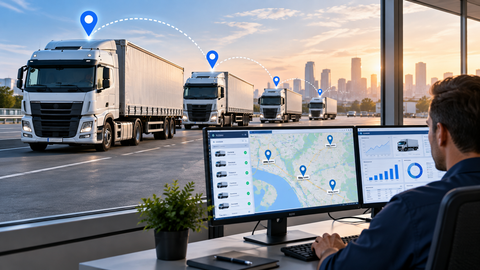
Exploring Fleet GPS Tracking Systems: Enterprise Solutions
Fleet GPS tracking systems are integrated technologies that use satellite positioning, vehicle telematics, wireless communication, and centralized management platforms to monitor commercial vehicles and mobile assets.
Enterprise fleet GPS tracking solutions provide real-time location visibility, route monitoring, driver behavior information, vehicle diagnostics, and operational reporting across large, geographically distributed fleets.
For organizations managing trucks, delivery vehicles, construction equipment, or field operations, these systems help coordinate transportation activities, monitor fleet utilization, identify operational issues, and support data-driven management decisions.
Quick Facts About Fleet GPS Tracking Systems
The following table summarizes the primary characteristics of enterprise fleet GPS tracking technology.
Feature | Details |
|---|---|
Technology | GPS and Global Navigation Satellite Systems (GNSS) |
Primary Purpose | Vehicle location monitoring and fleet visibility |
Main Hardware | GPS trackers, telematics devices, antennas, and sensors |
Communication | Cellular networks, satellite communication, and wireless connectivity |
Data Collection | Location, speed, direction, vehicle status, and diagnostics |
Monitoring Method | Web dashboards and mobile interfaces |
Tracking Capabilities | Real-time tracking, historical routes, and geofencing |
Advanced Functions | Driver behavior analysis, fuel monitoring, and vehicle diagnostics |
Integration | ERP, dispatch, maintenance, and fleet management platforms |
Common Users | Logistics companies, transportation operators, construction fleets, and utilities |
Deployment Models | Cloud-based, on-premises, and hybrid |
Enterprise Requirements | Scalability, security, integration, and centralized administration |
What Are Enterprise Fleet GPS Tracking Systems?
Enterprise fleet GPS tracking systems are centralized vehicle monitoring solutions designed to manage location information and operational data across multiple vehicles, business units, and geographical locations.
Unlike basic vehicle trackers that primarily report location, enterprise systems can combine GPS positioning with telematics information, vehicle diagnostics, driver activity, fuel measurements, and operational records.
A typical installation includes tracking devices fitted inside vehicles or connected to their electronic systems. These devices collect information and transmit it to a centralized platform, where fleet managers can review vehicle positions, movement histories, alerts, and performance indicators.
For example, a transportation organization operating trucks across several distribution centers can use an enterprise tracking platform to monitor vehicle locations, review delivery routes, identify unexpected stops, and coordinate dispatch activities.
Enterprise solutions are particularly relevant when organizations need to manage:
Large vehicle fleets distributed across multiple locations.
Different vehicle categories and equipment types.
Centralized monitoring with department-level access.
Multiple operational teams and administrative users.
Integration with existing business and transportation systems.
Historical fleet information and consolidated reporting.
The main distinction between basic GPS tracking and enterprise fleet management is the breadth of information, administrative control, integration capabilities, and operational coordination available across the organization.
Why Enterprise Fleet GPS Tracking Matters
Managing a large fleet involves more than knowing where vehicles are located. Fleet operators must coordinate routes, monitor vehicle utilization, maintain equipment availability, manage driver activities, and understand operational performance.
Without centralized tracking, information may remain distributed across individual vehicles, departments, and regional operations. This makes it difficult to establish a consistent view of fleet activity.
Enterprise GPS tracking addresses these challenges through several capabilities.
Centralized visibility: Managers can monitor vehicles across different branches and operating regions.
Fleet utilization: Location and trip records help identify inactive vehicles and underused assets.
Route monitoring: Managers can compare planned routes with actual vehicle movements.
Operational coordination: Dispatch teams can use location information to coordinate vehicle assignments.
Driver safety monitoring: Selected telematics events help identify driving patterns that require attention.
Vehicle maintenance: Diagnostic information can help identify developing mechanical problems.
Operational reporting: Consolidated records support fleet performance analysis and planning.
These capabilities allow organizations to evaluate fleet operations using recorded information rather than relying entirely on manual reports and individual observations.
How Enterprise Fleet GPS Tracking Systems Work
Enterprise fleet GPS tracking systems operate through connected hardware, satellite positioning, communication networks, data processing infrastructure, and user interfaces.
The following stages explain the typical operating process.
1. Satellite-Based Vehicle Positioning
A GPS tracking device receives positioning signals from satellites and calculates its geographical location. Depending on the hardware, it may also use other GNSS constellations to support positioning availability.
The resulting information can include latitude, longitude, speed, direction, and timestamp.
2. Vehicle Data Collection
The tracking device collects additional information from supported vehicle systems and connected sensors.
Depending on the vehicle and installation, available information may include:
Ignition status.
Engine operating conditions.
Vehicle speed.
Battery voltage.
Fuel measurements.
Engine diagnostic codes.
Motion and driving events.
3. Wireless Data Transmission
The tracking device transmits collected information through an available communication network, commonly a cellular connection.
Some enterprise applications use satellite communication for vehicles operating in locations with limited cellular coverage.
4. Centralized Data Processing
The receiving platform processes incoming vehicle information, associates it with the appropriate vehicle records, and organizes it for monitoring and analysis.
Enterprise architectures may also validate incoming data, detect operational events, and combine vehicle information with schedules, routes, and organizational records.
5. Fleet Monitoring and Visualization
Fleet managers access the processed information through centralized dashboards, maps, reports, and mobile interfaces.
These displays can present vehicle locations, movement histories, operating conditions, geofence events, and maintenance notifications.
6. Operational Decisions and Reporting
Managers use the available information to coordinate dispatch activities, investigate unexpected vehicle movements, review driver performance, and plan maintenance activities.
Historical records also support comparisons between vehicles, routes, branches, and operating periods.
The following table summarizes the information flow.
Stage | System Component | Main Function |
|---|---|---|
1 | GNSS satellites | Provide positioning signals |
2 | GPS tracking device | Calculates location |
3 | Vehicle electronics and sensors | Supply operating information |
4 | Communication network | Transmits vehicle data |
5 | Enterprise platform | Processes and organizes information |
6 | Monitoring dashboard | Displays fleet activity |
7 | Fleet management team | Reviews information and coordinates operations |
The frequency of location updates depends on the tracking device, network availability, configuration, and operating requirements.
Main Types of Fleet GPS Tracking Systems
Fleet GPS tracking solutions can be classified according to their hardware configuration, communication method, and deployment architecture. These categories serve different operational requirements and are not necessarily mutually exclusive.
1. Basic GPS Vehicle Tracking Systems
Basic GPS tracking systems primarily monitor vehicle position and movement. They typically collect location information, speed, direction, and trip history.
These systems are suitable for organizations that need visibility into vehicle movements without extensive diagnostic or operational data.
Main characteristics:
Satellite-based vehicle positioning.
Location history and trip records.
Basic movement notifications.
Centralized map-based monitoring.
Typical applications: Small commercial fleets, company vehicles, and basic transportation monitoring.
2. Advanced Telematics Tracking Systems
Advanced telematics systems combine GPS positioning with information collected from vehicle electronics, onboard diagnostics, and additional sensors.
They provide a broader understanding of vehicle operation beyond geographical location.
Main characteristics:
GPS location and trip monitoring.
Engine diagnostics and vehicle health information.
Driving behavior analysis.
Ignition and operating-state monitoring.
Support for selected fuel and maintenance measurements.
Typical applications: Logistics companies, heavy transportation fleets, construction vehicles, and commercial delivery operations.
3. Real-Time Fleet Tracking Systems
Real-time fleet tracking systems provide frequent location updates to support ongoing vehicle monitoring and dispatch coordination.
They are particularly useful when managers need current information about vehicle movement, route progress, and unexpected stops.
Main characteristics:
Frequent location updates.
Live fleet maps.
Geofence notifications.
Route deviation monitoring.
Vehicle movement alerts.
Typical applications: Delivery networks, passenger transportation, emergency logistics, and distribution operations.
4. Satellite-Based Fleet Tracking Systems
Satellite-based tracking and communication solutions are designed for vehicles operating in remote areas where cellular coverage is limited or unavailable.
A satellite communication device can transmit selected vehicle information through supported satellite networks.
Main characteristics:
Communication beyond conventional cellular coverage.
Remote vehicle monitoring.
Support for isolated operating locations.
Suitability for specialized transportation activities.
Typical applications: Mining operations, remote construction projects, long-distance transportation, and off-road equipment.
5. Cloud-Based Enterprise Fleet Tracking Systems
Cloud-based enterprise platforms process and store vehicle information through remotely hosted infrastructure. Authorized users access the system through supported web or mobile interfaces.
This deployment model supports organizations operating across multiple locations without requiring every branch to maintain its own tracking infrastructure.
Main characteristics:
Centralized data management.
Multi-location monitoring.
Remote administrative access.
Integration capabilities.
Flexible expansion across vehicle groups.
Typical applications: Large transportation organizations, multinational fleets, and distributed logistics operations.
6. On-Premises Fleet Tracking Systems
On-premises fleet tracking systems operate using infrastructure maintained within an organization's own computing environment.
Organizations may select this architecture when they require greater direct control over system hosting, internal data management, network configuration, or integration arrangements.
Main characteristics:
Internally managed infrastructure.
Greater control over hosting arrangements.
Customizable integration environments.
Direct responsibility for infrastructure maintenance and security.
Typical applications: Large organizations with established IT infrastructure and specific data governance requirements.
Fleet GPS Tracking System Type Comparison
Different tracking architectures provide different levels of vehicle visibility, data collection, and administrative control.
System Type | Primary Capability | Data Coverage | Common Enterprise Use |
|---|---|---|---|
Basic GPS Tracking | Location monitoring | Position and movement | Company vehicles |
Advanced Telematics | Vehicle monitoring | Location and diagnostics | Commercial transportation |
Real-Time Tracking | Frequent position updates | Current vehicle movement | Delivery and dispatch |
Satellite Tracking | Remote communication | Location and selected telemetry | Remote operations |
Cloud-Based Tracking | Centralized monitoring | Multi-location fleet data | Distributed enterprises |
On-Premises Tracking | Internally hosted monitoring | Organization-managed fleet data | Large controlled environments |
An enterprise may combine multiple tracking types. For example, a logistics organization might use advanced telematics devices in trucks, satellite communication for remote vehicles, and a cloud-based platform for centralized monitoring.
Fleet GPS Tracking vs Telematics vs Fleet Management Systems
GPS tracking, telematics, and fleet management are related technologies, but they represent different levels of operational functionality.
Understanding their differences helps organizations identify the capabilities required for enterprise transportation operations.
Comparison Factor | GPS Tracking | Vehicle Telematics | Fleet Management |
|---|---|---|---|
Primary Focus | Vehicle location | Vehicle location and operating data | Overall fleet operations |
Main Data | Coordinates, speed, direction | GPS, diagnostics, sensor information | Tracking, maintenance, schedules, and operational records |
Route Monitoring | Yes | Yes | Yes |
Driver Behavior | Limited or additional sensors required | Supported through available telematics data | Used for operational management |
Vehicle Diagnostics | Not normally included in basic systems | Supported through compatible connections | Can be integrated |
Maintenance Planning | Limited | Diagnostic-based monitoring | Maintenance scheduling and management |
Dispatch Coordination | Basic location support | Location and vehicle information | Broader operational coordination |
Reporting | Trip and location reports | Vehicle and driving reports | Consolidated operational reports |
GPS Tracking
GPS tracking primarily answers the question: Where is the vehicle?
It provides geographical information, trip history, movement records, and location-based notifications.
Vehicle Telematics
Telematics answers broader questions about vehicle operation. It combines positioning information with available data from vehicle electronics, sensors, and communication devices.
Fleet Management Systems
Fleet management systems provide a broader operational framework. They can combine tracking and telematics information with vehicle records, driver assignments, maintenance schedules, dispatch activities, and organizational reporting.
GPS tracking is therefore one component of a larger enterprise fleet management environment.
Main Components of Enterprise Fleet GPS Tracking Systems
An enterprise tracking architecture contains several connected components that collect, transmit, process, and display vehicle information.
The following table explains the main components and their functions.
Component | Primary Function | Technical Role |
|---|---|---|
GPS/GNSS Receiver | Determines geographical position | Receives satellite positioning signals |
Telematics Control Unit | Collects vehicle information | Processes tracking and vehicle data |
Cellular Modem | Transmits information | Connects devices to communication networks |
Vehicle Interface | Retrieves vehicle information | Connects with supported vehicle electronics |
Sensors | Measure specific conditions | Collect fuel, temperature, motion, or other readings |
Communication Infrastructure | Transfers information | Supports cellular or satellite communication |
Data Processing Platform | Organizes incoming information | Processes vehicle records and operational events |
Mapping Interface | Displays vehicle positions | Presents locations and routes |
Reporting Engine | Generates fleet reports | Organizes historical and performance information |
User Access Management | Controls platform access | Manages accounts, permissions, and administrative roles |
GPS and GNSS Receivers
A GPS receiver determines vehicle position by processing satellite signals. Many modern tracking devices support multiple GNSS constellations to improve positioning availability under suitable conditions.
Telematics Control Units
A telematics control unit is an electronic device installed in a vehicle to collect and process operational information. It may combine positioning, vehicle diagnostics, communication, and sensor inputs.
Vehicle Diagnostic Interfaces
Vehicle diagnostic connections allow compatible tracking devices to retrieve selected information from onboard electronic systems.
Depending on the vehicle, this information may include engine status, diagnostic trouble codes, operating hours, and other supported parameters.
Communication Networks
Communication networks transfer vehicle information to the centralized platform. Cellular connectivity is commonly used for road transportation, while satellite communication can support remote operations.
Centralized Management Platform
The enterprise platform organizes incoming information and makes it available through maps, dashboards, notifications, reports, and administrative controls.
It may also connect tracking data with other business systems through supported integration interfaces.
Enterprise Fleet GPS Tracking Features
Enterprise tracking platforms offer a combination of standard monitoring functions and advanced operational capabilities. The available features depend on device compatibility, system configuration, and the organization's requirements.
Real-Time Vehicle Location
Real-time location monitoring displays the current or most recently reported position of each connected vehicle.
Managers can review vehicle movement, identify nearby fleet resources, and understand the geographical distribution of operations.
Route History and Trip Playback
Historical tracking records show where vehicles traveled during a selected period. Trip playback can help managers examine routes, stops, departure times, and movement patterns.
This information is useful for investigating route deviations and evaluating transportation activities.
Geofencing and Location Alerts
Geofencing creates a virtual geographical boundary around a defined location.
When a tracked vehicle enters or leaves the configured area, the system can generate a notification.
Common applications include:
Distribution center arrival monitoring.
Construction site entry and exit records.
Warehouse movement monitoring.
Restricted-area notifications.
Vehicle movement outside approved operating periods.
Driver Behavior Monitoring
Compatible telematics devices can identify selected driving events, such as harsh braking, rapid acceleration, excessive speeding relative to configured thresholds, and sharp cornering.
These records can support driver safety reviews and structured coaching programs.
However, event detection depends on device capabilities, sensor calibration, vehicle characteristics, and configuration.
Fuel Monitoring
Fleet tracking systems may collect fuel-related information through supported vehicle data interfaces or external fuel sensors.
Depending on the installation, organizations can examine fuel consumption patterns, unusual fuel-level changes, and vehicle operating conditions.
Fuel measurements should be validated against the accuracy and limitations of the installed hardware.
Vehicle Diagnostics and Maintenance Monitoring
Advanced tracking devices can retrieve selected diagnostic information from vehicle electronic systems.
Fleet managers may use these records to identify warning conditions, monitor engine operating hours, and coordinate maintenance inspections.
Reporting and Analytics
Enterprise platforms consolidate tracking and telematics information into operational reports.
Common reporting categories include:
Vehicle utilization.
Distance traveled.
Trip duration.
Idle time.
Driving events.
Route performance.
Vehicle operating hours.
Maintenance-related alerts.
These reports help management identify recurring operational patterns and compare performance across different fleet groups.
Applications of Enterprise Fleet GPS Tracking Across Industries
Fleet GPS tracking systems support organizations that operate commercial vehicles, specialized equipment, and geographically distributed mobile assets.
1. Logistics and Transportation
Logistics companies use enterprise GPS tracking to monitor trucks, coordinate transportation activities, and maintain visibility across distribution networks.
Managers can review vehicle positions, route histories, delivery progress, and unexpected stops.
Common applications include:
Long-distance freight transportation.
Regional distribution networks.
Truck fleet monitoring.
Delivery coordination.
Intercity transportation operations.
2. Last-Mile Delivery Operations
Last-mile delivery organizations manage vehicles traveling between distribution centers and final delivery locations.
GPS tracking helps dispatch teams monitor vehicle movement, review delivery routes, and identify delays.
When integrated with dispatch systems, location information can support vehicle assignment and delivery coordination.
3. Construction and Heavy Equipment
Construction companies operate trucks, excavators, loaders, cranes, and other mobile equipment across different project locations.
GPS tracking helps managers understand equipment locations, movement patterns, operating hours, and utilization.
Geofencing can also support monitoring around construction sites, equipment storage areas, and designated operating zones.
4. Public Transportation
Bus operators and passenger transportation organizations use GPS tracking to monitor vehicle movement and coordinate fleet activities.
Tracking information can support route monitoring, vehicle availability, schedule analysis, and operational reporting.
Depending on the installation, selected information may also be used to support passenger-facing arrival information systems.
5. Field Operations and Utility Fleets
Electricity, water, telecommunications, and infrastructure organizations often manage geographically distributed field teams.
Fleet tracking provides visibility into vehicle locations and helps coordinators understand the availability of mobile resources.
It can support field assignment coordination, vehicle utilization analysis, and operational activity monitoring.
6. Cold Chain and Temperature-Controlled Transportation
Cold chain transportation involves vehicles carrying temperature-sensitive products.
GPS tracking can be integrated with temperature sensors to provide location and cargo-condition information.
For example, a refrigerated transportation fleet may monitor vehicle position alongside the temperature of a storage compartment. This allows operators to investigate temperature alerts and review transportation conditions.
7. Mining and Remote Industrial Operations
Mining organizations operate vehicles and mobile equipment in locations where conventional communication coverage may be limited.
GPS tracking combined with suitable communication infrastructure can help monitor vehicle movement, equipment locations, and operating activities.
Satellite-based communication may be relevant where cellular connectivity is unavailable.
Common Enterprise Fleet GPS Tracking Challenges and Solutions
Large fleet tracking deployments involve technical, operational, and administrative challenges. Addressing these issues during implementation can improve system reliability and data quality.
Common Challenge | Potential Impact | Recommended Solution |
|---|---|---|
Weak GPS reception | Inaccurate or delayed position updates | Evaluate antenna placement and receiver capabilities |
Cellular coverage gaps | Missing vehicle information | Use local data buffering and suitable alternative communication |
Incompatible vehicle hardware | Incomplete diagnostic information | Verify vehicle and device compatibility |
Inconsistent data | Unreliable fleet reports | Standardize vehicle identification and validate incoming records |
Excessive notifications | Important alerts may be overlooked | Configure meaningful event thresholds |
Integration difficulties | Disconnected business information | Plan API and system integration requirements |
Unauthorized access | Exposure of operational information | Apply authentication and role-based permissions |
Large data volumes | Increased processing and storage demands | Establish data retention and processing policies |
Driver privacy concerns | Reduced workforce confidence | Establish transparent monitoring policies |
Device maintenance issues | Interrupted tracking | Conduct periodic hardware inspections |
Enterprise implementations should also establish responsibility for device installation, communication monitoring, data validation, user administration, and technical support.
How to Choose an Enterprise Fleet GPS Tracking Solution
Selecting an enterprise fleet GPS tracking system requires more than comparing location features. Organizations should evaluate how the platform fits their existing vehicles, operational processes, IT infrastructure, and future fleet requirements.
The following selection criteria provide a practical framework.
Selection Factor | What to Evaluate | Enterprise Importance |
|---|---|---|
Fleet Capacity | Supported vehicle and device volumes | Supports organizational expansion |
GPS Accuracy | Receiver capabilities and positioning performance | Improves location visibility |
Update Frequency | Configurable tracking intervals | Determines monitoring detail |
Hardware Compatibility | Vehicle models and diagnostic interfaces | Supports consistent data collection |
Communication | Cellular and satellite connectivity | Supports different operating regions |
Geofencing | Configurable geographical boundaries | Supports location-based monitoring |
Telematics | Engine, fuel, and driving information | Expands operational visibility |
Reporting | Historical data and performance indicators | Supports management analysis |
Integration | APIs and existing business systems | Connects enterprise workflows |
Security | Encryption, authentication, and access controls | Protects operational information |
Scalability | Additional vehicles, users, and locations | Supports future expansion |
Data Management | Retention, backup, and export capabilities | Supports information governance |
Evaluate Fleet Size and Organizational Structure
Organizations should determine how many vehicles, branches, departments, and administrative users the platform must support.
A suitable enterprise system should accommodate different vehicle groups while maintaining consistent reporting and access management.
Check Hardware Compatibility
Vehicle tracking devices should be evaluated against the actual fleet composition.
Different vehicles may expose different diagnostic information, communication interfaces, and electronic signals. A device that works with one vehicle category may not support every function on another.
Assess Integration Requirements
Enterprise platforms may need to exchange information with:
Enterprise resource planning systems.
Transportation management systems.
Dispatch management platforms.
Maintenance management systems.
Fuel management platforms.
Workforce management systems.
Business intelligence environments.
Integration requirements should be identified before deployment to avoid disconnected data and duplicated administrative work.
Review Security and Data Governance
Organizations should evaluate user authentication, permission management, encryption, audit records, backup arrangements, and data retention policies.
They should also define who can view vehicle locations, access driver-related information, and administer tracking devices.
Consider Future Expansion
A tracking architecture should accommodate changes in vehicle numbers, geographical coverage, reporting requirements, and connected equipment.
The ability to add vehicles and integrate additional data sources is particularly relevant to organizations with changing operational requirements.
Limitations of Enterprise Fleet GPS Tracking Systems
Although enterprise GPS tracking provides valuable operational information, it has limitations that organizations should understand before deployment.
Dependence on satellite signals: Buildings, tunnels, dense urban environments, and other physical obstructions can affect satellite reception.
Communication interruptions: Cellular tracking devices may stop transmitting when network coverage is unavailable. Local buffering can preserve records for later transmission when supported.
Positioning limitations: GPS coordinates are not always identical to a vehicle's precise physical position, particularly in difficult reception environments.
Hardware compatibility: Vehicle diagnostic information varies by manufacturer, model, and electronic architecture.
Data interpretation: Tracking records require proper context. A location event or driving alert does not automatically explain the reason behind the activity.
Implementation complexity: Enterprise deployments may involve device installation, network configuration, integration testing, employee training, and administrative planning.
Privacy considerations: Continuous location monitoring can involve employee-related information. Organizations should establish transparent policies, appropriate access restrictions, and retention practices consistent with applicable requirements.
GPS tracking should therefore be treated as an operational information system rather than a complete replacement for fleet supervision, vehicle inspections, maintenance procedures, or driver safety programs.
Enterprise Fleet GPS Tracking Security and Data Management
Security is a major consideration when connecting large numbers of vehicles to a centralized tracking environment.
Vehicle location records, driver activity, operational schedules, and diagnostic information can reveal sensitive details about an organization's transportation activities.
A structured security approach should address the following areas.
Device Authentication
Tracking devices should be registered and authenticated before they are permitted to transmit information to the enterprise platform.
Device identity management helps distinguish legitimate fleet equipment from unauthorized connections.
Data Encryption
Encryption should protect information during transmission and, where supported, while stored within the platform.
Security requirements should cover communication between vehicle devices, network infrastructure, and centralized systems.
Role-Based Access Control
Different users require different levels of access.
For example, a regional fleet manager may need visibility into vehicles within an assigned territory, while a central administrator may require broader fleet-level access.
Data Retention and Ownership
Organizations should establish how long location and telematics records are retained, who can access them, and how they are exported or deleted.
Data ownership and platform exit arrangements should also be considered when evaluating enterprise systems.
Monitoring and Backup
System administrators should monitor device connectivity, data transmission failures, unauthorized access attempts, and platform availability.
Appropriate backup and recovery procedures help preserve important operational records.
Future Trends in Enterprise Fleet GPS Tracking Technology
Enterprise fleet tracking is evolving through connected vehicle technology, advanced analytics, automation, and improved communication infrastructure.
Several developments are shaping the next generation of fleet monitoring systems.
Artificial Intelligence and Predictive Analytics
Advanced analytics can examine historical vehicle information, diagnostic events, and driving patterns to identify unusual behavior.
These capabilities may help organizations prioritize maintenance inspections, identify recurring operational problems, and improve fleet planning.
Predictions should be treated as decision-support information rather than guaranteed outcomes.
Video Telematics Integration
Video telematics combines vehicle tracking with camera-based monitoring and selected driving-event information.
Depending on the configuration, these systems can associate recorded video with events such as harsh braking, sudden acceleration, or potential collisions.
Electric Vehicle Fleet Monitoring
Electric vehicle fleets introduce additional monitoring requirements related to battery condition, charging activity, energy consumption, and driving range.
Enterprise tracking platforms are increasingly incorporating EV-related information to support vehicle utilization and charging coordination.
Internet of Things Integration
IoT sensors can extend fleet monitoring beyond vehicle location and engine diagnostics.
Examples include cargo temperature sensors, door sensors, tire pressure monitoring, and equipment condition sensors.
This creates a broader view of vehicle and transported asset conditions.
Advanced Fleet Data Integration
Enterprise platforms are increasingly designed to combine vehicle telemetry with dispatch records, maintenance information, delivery schedules, and organizational data.
This creates a more unified operational view and supports analysis across different departments.
Satellite and Multi-Network Connectivity
Communication options continue to expand for vehicles operating across different geographical environments.
Combining cellular and satellite connectivity can support more consistent monitoring where conventional network coverage is limited.
Frequently Asked Questions About Enterprise Fleet GPS Tracking Systems
1. What is an enterprise fleet GPS tracking system?
An enterprise fleet GPS tracking system is a centralized platform that monitors the location and operational information of multiple commercial vehicles. It combines GPS tracking devices, communication networks, and fleet management tools to provide visibility across large transportation operations.
2. How does fleet GPS tracking work?
Fleet GPS tracking devices receive satellite signals to calculate vehicle positions. They transmit location information and, where supported, vehicle data through cellular or satellite networks to a centralized platform for monitoring, reporting, and analysis.
3. What are the main features of enterprise fleet tracking systems?
Common features include real-time vehicle tracking, route history, geofencing, driver behavior monitoring, fuel monitoring, vehicle diagnostics, maintenance alerts, and fleet performance reporting. Advanced systems may also support video telematics and enterprise integrations.
4. What is the difference between GPS tracking and fleet telematics?
GPS tracking primarily provides vehicle location and movement information. Fleet telematics combines positioning with additional information such as engine diagnostics, fuel measurements, vehicle operating conditions, and driving events.
5. Can enterprise GPS tracking systems monitor multiple locations?
Yes. Enterprise platforms can consolidate vehicle information from different branches, regions, and operating facilities. Access permissions can also be configured to allow regional managers and central administrators to monitor their respective fleet groups.
6. Can GPS tracking systems monitor driver behavior?
Compatible telematics devices can detect driving events such as harsh braking, rapid acceleration, speeding relative to configured thresholds, and sharp cornering. Fleet managers can review these records to identify patterns and support driver safety programs.
7. What industries use enterprise fleet GPS tracking?
Common industries include logistics, transportation, construction, mining, public transportation, utilities, field operations, cold chain distribution, and infrastructure management. These organizations use tracking technology to monitor vehicles, equipment, and mobile assets.
8. Can fleet GPS tracking systems integrate with ERP and dispatch platforms?
Yes. Enterprise tracking platforms may support integrations with ERP, transportation management, dispatch, maintenance, and reporting systems through APIs or other supported interfaces. Integration allows organizations to combine vehicle information with wider business operations.
9. Are enterprise fleet GPS tracking systems suitable for remote locations?
Yes, provided the tracking architecture supports the available communication environment. Satellite communication can extend monitoring capabilities to locations with limited cellular coverage, although device capabilities, network availability, and transmission frequency vary.
10. What factors should organizations consider when selecting fleet GPS tracking technology?
Important considerations include fleet size, GPS accuracy, hardware compatibility, communication coverage, reporting capabilities, integration requirements, cybersecurity, data management, and scalability. Organizations should also evaluate employee privacy requirements and long-term maintenance responsibilities.
Conclusion
Enterprise fleet GPS tracking systems combine satellite positioning, vehicle telematics, communication networks, and centralized monitoring platforms to provide visibility across large transportation operations. Their capabilities extend beyond basic vehicle location tracking to include route monitoring, geofencing, driver behavior analysis, vehicle diagnostics, fuel monitoring, and operational reporting. Selecting an appropriate enterprise solution requires evaluating fleet size, hardware compatibility, communication infrastructure, integration capabilities, cybersecurity, and data governance. As connected vehicles, artificial intelligence, electric transportation, and IoT technologies develop, fleet tracking systems will continue to expand their role in enterprise transportation and asset management.

Related Post...