Explore Turquoise Jewellery: Styles, Designs, and Their Timeless Appeal
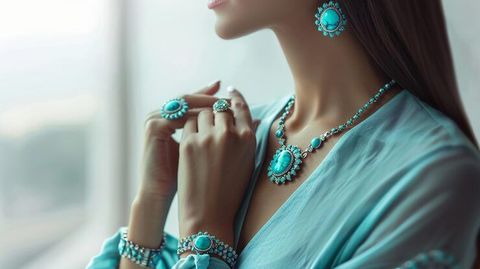
Turquoise jewellery features a distinctive blue-to-green gemstone that has been valued for centuries. Its colours range from pale sky blue to deep blue-green, sometimes with brown, black, or golden-brown veins known as matrix patterns. The stone is commonly used in rings, necklaces, earrings, bracelets, pendants, and decorative accessories.
Turquoise is a hydrated phosphate mineral formed through geological processes involving copper and aluminium. Copper generally contributes to blue shades, while iron can influence greenish tones. Natural variations in mineral composition create the wide range of colours seen in turquoise gemstones.
The gemstone has a long history across regions including Persia, Egypt, Central Asia, China, and the Americas. Archaeological discoveries show that ancient communities used turquoise in ornaments, ceremonial objects, and decorative inlays. Today, it remains relevant to traditional jewellery craftsmanship and contemporary fashion.
Main Types of Turquoise
Turquoise can be described according to its geological origin, colour, treatment, and physical characteristics. These distinctions help explain why two stones with similar appearances may differ in durability and market valuation.
Natural turquoise: Extracted from the earth without stabilising treatments or artificial colour enhancement.
Stabilised turquoise: Treated with a bonding material, commonly resin, to improve hardness and reduce porosity.
Treated turquoise: May undergo colour enhancement or other processes that alter its appearance.
Reconstituted turquoise: Produced from small turquoise fragments or powder combined with binding materials.
Imitation turquoise: Made from unrelated minerals, glass, ceramic, or synthetic materials designed to resemble the gemstone.
These categories are not interchangeable. Understanding the difference is important when researching gemstone authenticity, jewellery materials, and gemstone identification methods.
Why Turquoise Jewellery Matters Today
Cultural Heritage and Personal Style
Turquoise jewellery connects modern design with historical craftsmanship. In several Indigenous communities of the American Southwest, turquoise has important cultural, artistic, and spiritual associations. Persian turquoise also has a long history in architectural decoration and ornamental arts.
The gemstone appears in traditional silverwork, contemporary minimalist designs, statement accessories, and handcrafted jewellery. Its blue-green colour complements silver, gold, leather, pearls, and other gemstones, making it suitable for a broad range of personal styles.
However, cultural designs should be understood in context. Jewellery associated with Indigenous communities may represent specific traditions, family histories, or artistic identities rather than simply a fashion trend.
Gemstone Quality and Valuation
Turquoise gemstone valuation depends on several characteristics. Colour is often important, but it is not the only consideration.
Quality factor | What to examine |
|---|---|
Colour | Consistency, intensity, and blue or green undertones |
Matrix | Natural veins, patterns, and their visual distribution |
Hardness | Resistance to scratching and surface damage |
Treatment | Whether stabilisation, dyeing, or other enhancement occurred |
Origin | Documented geological source, when established |
Craftsmanship | Stone setting, metalwork, finish, and structural quality |
No single characteristic establishes authenticity or determines value on its own. A visually attractive stone may be treated, while a natural stone may have uneven colour or a pronounced matrix. Reliable assessment considers the complete gemstone and its documented history.
Environmental and Ethical Considerations
Mining can affect land, water, local habitats, and nearby communities. The environmental impact depends on extraction methods, the location of the deposit, and how the site is managed.
Responsible jewellery research may include questions about mineral sourcing, worker safety, traceability, and the environmental practices of mining operations. Documentation can help establish where a gemstone originated, although the level of available evidence varies across the supply chain.
Consumers, collectors, designers, and jewellery professionals all benefit from clear descriptions of gemstone treatments and materials. Accurate information reduces confusion and supports informed decisions about jewellery quality and provenance.
Recent Turquoise Jewellery Trends and Developments
Design Trends in 2025 and 2026
Turquoise jewellery has continued to appear in discussions about coloured gemstones, statement accessories, and Western-inspired fashion. Jewellery market observations published in June 2026 highlighted turquoise alongside large beads, white metals, and Western-style designs as notable trends for the second half of the year.
Several design directions are relevant to the current turquoise jewellery landscape:
Chunky gemstone necklaces: Large turquoise beads create a bold appearance and make the gemstone the central feature of an outfit.
Minimalist pendants: Small turquoise stones set in simple metal frames provide a subtle alternative to larger statement pieces.
Silver and turquoise combinations: Oxidised silver, engraved metalwork, and traditional settings highlight the contrast between blue-green stones and metallic surfaces.
Mixed gemstone designs: Turquoise paired with pearls, coral, or dark stones creates differences in colour and texture.
Vintage-inspired jewellery: Antique-style rings, ornate pendants, and handcrafted bracelets combine historical references with contemporary styling.
These developments indicate a broad range of aesthetic preferences rather than a single universal trend. Regional traditions, individual taste, and the intended occasion all influence jewellery design.
Technology and Gemstone Identification
Digital tools are making gemstone research more accessible. High-resolution photography, digital inventory systems, and online gemological references can help document colour, dimensions, visible matrix patterns, and treatment information.
However, a photograph cannot reliably establish whether a turquoise stone is natural, stabilised, dyed, or imitated. Lighting, camera settings, and image editing can change the appearance of blue and green gemstones.
For important collections, laboratory examination and documentation from qualified gemological professionals provide stronger evidence than visual comparisons alone.
Changes in Consumer Awareness
During 2025 and 2026, broader jewellery-industry discussions have placed continued emphasis on coloured gemstones, individual design, and material transparency. Reports on gemstone markets have also described interest in distinctive colours and personalised jewellery styles.
For turquoise jewellery, this makes information about geological origin, treatments, craftsmanship, and cultural context particularly relevant. These factors help readers understand what differentiates one gemstone from another without assuming that every natural-looking stone has the same characteristics.
Laws, Policies and Jewellery Standards
International Rules on Gemstone Descriptions
Turquoise jewellery is affected by consumer protection laws, advertising standards, product-description rules, and regulations governing imported materials. The exact requirements depend on the country where the jewellery is marketed and the circumstances of the transaction.
In the United States, the Federal Trade Commission's Jewelry Guides address truthful descriptions of gemstones, metal content, treatments, and imitation materials. Under the guidance on gemstone treatment disclosures, certain treatments must be disclosed when they are not permanent, create special care requirements, or significantly affect the gemstone's value.
Clear descriptions should distinguish among:
Natural turquoise without known enhancement.
Stabilised or otherwise treated turquoise.
Reconstituted material made with turquoise fragments and binding substances.
Imitation materials that resemble turquoise but are not the mineral itself.
Using an accurate description helps prevent misunderstandings about a gemstone's physical characteristics and origin.
Indian Consumer Protection Considerations
In India, jewellery descriptions and advertisements fall within the broader framework of consumer protection and advertising regulation. The Consumer Protection Act, 2019, addresses unfair trade practices and misleading representations. Applicable rules may depend on the specific product and claim being made.
Hallmarking requirements should also be distinguished from gemstone identification. Hallmarking relates to the purity of specified precious metals, such as gold and silver, under the relevant regulatory framework; it does not independently verify that an inset turquoise stone is natural or untreated.
For international shipments, customs requirements, import documentation, and any applicable wildlife-material restrictions should be reviewed according to the origin, destination, and materials used. Turquoise itself is a mineral, but jewellery containing other regulated materials may require additional checks.
Cultural Heritage and Ethical Representation
Some turquoise jewellery designs are closely connected to Indigenous artistic traditions, particularly in the American Southwest. In the United States, the Indian Arts and Crafts Act of 1990 prohibits certain misrepresentations involving American Indian-produced arts and crafts.
This is especially relevant when jewellery descriptions imply that a piece was made by a particular Indigenous artisan, community, or tribe. Accurate attribution respects cultural heritage and helps audiences distinguish traditional craftsmanship from designs merely inspired by it.
Tools and Resources for Turquoise Jewellery Research
Gemstone Identification and Documentation
Several types of resources can support reliable turquoise research:
Gemological laboratories: Professional testing can help assess gemstone identity, treatments, and other relevant characteristics.
Mineral reference databases: Geological publications explain turquoise's chemical composition, formation, hardness, and mineral associations.
Jewellery appraisal records: Written documentation can record dimensions, visible features, metal composition, and the stated treatment history.
Digital photography tools: Consistent lighting and colour references help document a stone's appearance over time.
Inventory spreadsheets: Structured records can track item descriptions, gemstone origin claims, treatments, metal types, and supporting documents.
A Practical Gemstone Evaluation Checklist
Use the following checklist when examining turquoise jewellery for research, collection management, or educational purposes.
Checkpoint | Information to record |
|---|---|
Gemstone identity | Turquoise, imitation, or undetermined |
Colour and pattern | Blue, green, matrix, and visible variations |
Treatment status | Natural, stabilised, dyed, other treatment, or unknown |
Setting material | Silver, gold, another metal, or an unverified alloy |
Documentation | Laboratory report, receipt, provenance, or maker details |
Condition | Chips, scratches, loose settings, or surface changes |
This checklist is a recordkeeping aid, not a substitute for gemological testing. If the treatment status or identity remains uncertain, documenting it as unknown is more reliable than making an unsupported claim.
Frequently Asked Questions About Turquoise Jewellery
Is turquoise a natural gemstone?
Yes. Turquoise is a naturally occurring mineral formed through geological processes. However, jewellery may also contain stabilised, dyed, reconstituted, synthetic, or imitation materials. Reliable documentation and professional testing can help clarify the identity and treatment of a particular stone.
What determines turquoise gemstone quality?
Important factors include colour, matrix patterns, durability, treatment history, and craftsmanship. Geological origin and documented provenance can also be relevant. No single colour or pattern guarantees authenticity or establishes the overall quality of a turquoise gemstone.
How should turquoise jewellery be cleaned?
Use a soft, dry or slightly damp cloth and handle the stone gently. Avoid prolonged exposure to water, harsh chemicals, ultrasonic cleaners, steam cleaning, and extreme heat. Some treatments can make turquoise particularly sensitive to moisture and cleaning products, so follow care instructions appropriate to the specific stone.
Does turquoise change colour over time?
Turquoise can change in appearance through exposure to oils, perspiration, cosmetics, chemicals, moisture, and sunlight. Some treated materials may be more susceptible to colour changes than others. Proper storage and gentle handling can help maintain the stone's appearance.
How can natural turquoise be distinguished from imitation material?
Colour alone is not sufficient to identify turquoise. Surface appearance, matrix patterns, hardness, and density may provide clues, but these characteristics can overlap with those of imitations and treated stones. A qualified gemologist or recognised gemological laboratory can provide a more reliable assessment.
Conclusion
Turquoise jewellery combines geological interest, cultural history, artistic craftsmanship, and contemporary fashion. Its distinctive blue-green colour and varied matrix patterns make it recognisable, while its different treatments and material imitations create important distinctions for collectors and researchers.
Understanding gemstone quality involves more than examining colour. Treatment history, durability, setting materials, provenance, and craftsmanship all contribute to a complete assessment. Recent jewellery trends in 2025 and 2026 have also highlighted turquoise in statement necklaces, silver settings, vintage-inspired designs, and colourful gemstone combinations.
Responsible research should include accurate material descriptions, awareness of applicable consumer protection rules, and respect for the cultural traditions associated with particular designs. Professional gemological assessment remains valuable when authenticity or treatment status is uncertain.
By combining reliable mineralogical information with practical care methods and an understanding of jewellery regulations, readers can develop a clearer picture of turquoise jewellery and its continuing place in global decorative arts and personal style.

Related Post...
Discover How Prong Settings Shape Jewellery Design and Enhance Gemstone Appearance
Updated: October 27, 2026
Read More
Topaz Jewellery Tips for Choosing Elegant Styles for Different Occasions
Updated: October 26, 2026
Read More
Discover Bar Stud Earrings: A Guide to Minimalist Jewelry and Timeless Style
Updated: October 28, 2026
Read More