Environmental Test Chambers for Electronics: Guide and Types
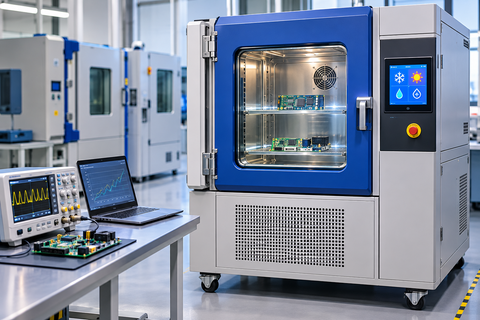
Environmental test chambers for electronics are specialized testing enclosures designed to reproduce controlled environmental conditions, including extreme temperatures, humidity, thermal changes, and other external stresses.
They help manufacturers evaluate electronic components, circuit boards, electrical assemblies, and finished devices under conditions that may affect their performance, reliability, and durability.
These chambers are used during product development, quality assurance, reliability testing, and manufacturing validation. Selecting the appropriate chamber depends on the electronic product, expected operating environment, testing requirements, and applicable industry standards.
Quick Facts About Environmental Test Chambers for Electronics
The following table summarizes the main characteristics of environmental testing equipment used in electronics manufacturing.
Feature | Details |
|---|---|
Equipment Name | Environmental Test Chamber |
Primary Purpose | Simulating environmental conditions for electronic products |
Main Testing Parameters | Temperature, humidity, pressure, and environmental exposure |
Common Temperature Tests | High temperature, low temperature, and temperature cycling |
Humidity Tests | Damp heat, steady-state humidity, and cyclic humidity |
Specialized Testing | Thermal shock, altitude, salt mist, and dust exposure |
Main Test Subjects | PCBs, semiconductors, sensors, batteries, and electronic assemblies |
Common Industries | Electronics, automotive, aerospace, telecommunications, and industrial automation |
Control Technology | Programmable controllers and environmental sensors |
Testing Objectives | Reliability evaluation, design validation, and quality assurance |
Relevant Standards | IEC 60068, MIL-STD-810, and applicable JEDEC JESD22 methods |
What Are Environmental Test Chambers for Electronics?
Environmental test chambers are controlled enclosures that expose electronic products to specified environmental conditions. They reproduce selected temperature, humidity, and other environmental stresses to evaluate how equipment responds during storage, transportation, and operation.
Unlike ordinary storage cabinets, these chambers use integrated environmental control systems to maintain programmed testing conditions. Heating elements, refrigeration equipment, humidification systems, air circulation fans, and electronic controllers work together to create the required environment.
For example, a manufacturer developing an industrial electronic controller may use a temperature and humidity chamber to examine how the circuit board performs under high humidity and changing temperatures.
The testing process helps identify potential problems such as:
Electronic component degradation.
Moisture-related corrosion.
Condensation and insulation problems.
Thermal expansion and contraction.
Solder joint fatigue.
Electrical performance variations.
Material deformation and enclosure damage.
Environmental testing does not guarantee that a product will operate reliably in every real-world condition. Instead, it provides controlled evidence about how a product responds to defined environmental stresses.
Why Environmental Testing Matters for Electronic Products
Electronic devices often operate in environments that expose them to changing temperatures, moisture, pressure, and mechanical conditions. These factors can affect sensitive components, electrical connections, printed circuit boards, and protective enclosures.
Environmental test chambers help manufacturers evaluate these effects before products enter regular production or reach their intended operating environments.
Product Reliability Evaluation
Environmental testing helps determine whether electronic components maintain their required functionality when exposed to specified environmental conditions.
For example, automotive electronic modules may experience substantial temperature changes during vehicle operation. Testing helps evaluate whether their components and connections remain functional under the selected test conditions.
Early Defect Identification
Some manufacturing and design defects become visible only after repeated environmental exposure. Temperature cycling and humidity testing can reveal weaknesses that may not appear during ordinary functional testing.
Product Design Validation
Engineers use environmental chambers to evaluate different materials, component arrangements, enclosure designs, and protective coatings. Test results can help identify design changes needed to improve environmental resistance.
Quality Assurance
Manufacturers can use environmental testing as part of product qualification and quality control programs. Defined test procedures help maintain consistency when evaluating different production batches or product designs.
Compliance With Testing Requirements
Certain electronic products must undergo environmental tests specified by industry standards or customer requirements. Appropriate testing equipment helps manufacturers perform these procedures under controlled conditions.
How Does an Environmental Test Chamber Work?
An environmental test chamber creates a controlled internal atmosphere using heating, cooling, humidity regulation, air circulation, and electronic monitoring systems.
The chamber controller receives environmental measurements from installed sensors and compares them with programmed test conditions. It then adjusts the relevant systems to maintain the required environment.
1. Test Sample Preparation
The electronic product is prepared according to the test procedure. Engineers may inspect the device, record its initial operating condition, and connect measurement equipment to monitor electrical performance.
The sample is then positioned inside the chamber using suitable shelves, fixtures, or mounting arrangements.
2. Environmental Parameter Configuration
The operator programs the required testing conditions through the chamber control panel.
These settings may include:
Target temperature.
Relative humidity.
Exposure duration.
Temperature change rate.
Number of testing cycles.
Required stabilization periods.
3. Temperature Regulation
Heating elements increase the chamber temperature, while refrigeration systems reduce it. The controller adjusts these systems according to sensor feedback.
Air circulation helps distribute conditioned air throughout the test space.
4. Humidity Regulation
For humidity testing, the chamber uses a humidification system to increase moisture content and a dehumidification process when lower humidity is required.
Humidity sensors monitor the internal atmosphere and provide feedback to the control system.
5. Environmental Exposure
The electronic sample remains inside the chamber under the programmed conditions. Depending on the test procedure, the environment may remain constant or change through multiple temperature and humidity stages.
6. Performance Monitoring and Evaluation
Engineers monitor the sample during or after environmental exposure. They may examine electrical characteristics, physical condition, functional performance, and visible damage.
The results are compared with the product's specified acceptance criteria.
The following table summarizes the main operating stages.
Stage | Main Equipment or Activity | Purpose |
|---|---|---|
1 | Test sample preparation | Establish initial product condition |
2 | Programmable controller | Configure testing parameters |
3 | Heating and refrigeration | Regulate temperature |
4 | Humidification system | Control moisture levels |
5 | Air circulation system | Distribute environmental conditions |
6 | Environmental sensors | Monitor chamber conditions |
7 | Measurement instruments | Evaluate electronic performance |
8 | Test documentation | Record and assess results |
Main Types of Environmental Test Chambers for Electronics
Environmental test chambers are classified according to the environmental conditions they reproduce. Different chamber designs address different reliability concerns, so selecting the correct type requires understanding the intended test.
1. Temperature Test Chambers
Temperature test chambers expose electronic products to controlled high or low temperatures without necessarily controlling humidity.
They are commonly used to evaluate component performance under hot and cold conditions. The testing process helps identify temperature-related changes in electrical characteristics, mechanical dimensions, and material behavior.
Main characteristics:
Controlled heating and refrigeration.
Programmable temperature settings.
Temperature monitoring through sensors.
Suitable for high-temperature and low-temperature exposure.
Advantages:
Supports hot and cold environmental testing.
Helps identify temperature-sensitive components.
Suitable for electronic components and finished devices.
Typical applications: Semiconductors, industrial controllers, electronic sensors, and automotive components.
2. Temperature and Humidity Chambers
Temperature and humidity chambers control both temperature and relative humidity within the testing enclosure.
They are commonly used to evaluate electronic products exposed to humid environments. Moisture can affect electrical insulation, metal connections, circuit boards, and protective materials.
These chambers can perform steady-state and cyclic damp-heat tests, depending on their design and control capabilities.
Main characteristics:
Combined temperature and humidity regulation.
Programmable environmental cycles.
Integrated heating, cooling, and humidification systems.
Monitoring of temperature and relative humidity.
Advantages:
Evaluates moisture-related product weaknesses.
Supports controlled damp-heat testing.
Helps assess corrosion and insulation-related risks.
Typical applications: Printed circuit boards, communication devices, electronic sensors, and electrical assemblies.
3. Thermal Shock Chambers
Thermal shock chambers expose electronic products to rapid changes between hot and cold environments.
Many systems use separate hot and cold zones with an automatic transfer mechanism. Other designs use controlled airflow switching to change the temperature around the sample.
The rapid environmental transition helps evaluate stresses caused by differences in thermal expansion between connected materials.
Main characteristics:
Separate hot and cold environments or equivalent rapid-change architecture.
Automated sample transfer in many designs.
Programmable exposure periods.
Controlled temperature transitions.
Advantages:
Evaluates resistance to rapid temperature changes.
Helps identify weaknesses in solder connections.
Supports reliability evaluation of electronic assemblies.
Typical applications: Semiconductor packages, automotive electronics, circuit boards, and aerospace components.
4. Temperature Cycling Chambers
Temperature cycling chambers repeatedly change the temperature according to a programmed test profile.
Unlike thermal shock testing, temperature cycling generally uses specified heating and cooling rates rather than focusing on extremely rapid transitions.
Repeated temperature changes can create expansion and contraction stresses in electronic components and their connections.
Main characteristics:
Programmable heating and cooling sequences.
Repeated temperature exposure.
Controlled transition rates.
Configurable dwell periods.
Advantages:
Helps evaluate thermal fatigue.
Supports electronic assembly qualification.
Identifies weaknesses associated with repeated temperature changes.
Typical applications: PCB assemblies, semiconductor devices, automotive electronics, and industrial electronic equipment.
5. Altitude and Low-Pressure Chambers
Altitude chambers reproduce reduced atmospheric pressure to simulate conditions associated with high-altitude environments.
Lower air pressure can affect electronic equipment through changes in heat dissipation, insulation performance, and the behavior of certain sealed components.
These chambers are particularly relevant to products intended for aviation, aerospace, and high-altitude operation.
Main characteristics:
Controlled pressure reduction.
Vacuum pumping equipment.
Pressure monitoring systems.
Programmable pressure exposure.
Advantages:
Evaluates performance under reduced atmospheric pressure.
Helps identify pressure-related enclosure weaknesses.
Supports testing of equipment intended for elevated altitudes.
Typical applications: Aircraft electronics, aerospace instruments, communication equipment, and pressure-sensitive electronic assemblies.
6. Salt Spray Test Chambers
Salt spray chambers expose electronic components and protective materials to a controlled saline mist.
This testing method evaluates corrosion resistance in materials, coatings, connectors, and exposed metal surfaces.
The chamber produces a controlled salt-containing atmosphere, allowing engineers to examine corrosion-related changes over a defined exposure period.
Main characteristics:
Controlled salt solution preparation.
Mist generation and distribution.
Regulated chamber temperature.
Corrosion exposure monitoring.
Advantages:
Evaluates protective coatings.
Helps identify corrosion-sensitive materials.
Supports testing of exposed electrical connections.
Typical applications: Automotive connectors, outdoor electronic enclosures, marine electronics, and electrical terminals.
7. Dust Test Chambers
Dust test chambers expose electronic products to controlled airborne dust conditions.
These chambers help evaluate enclosure protection and the ability of equipment to resist dust penetration. They are particularly relevant to electronic devices intended for factories, construction environments, transportation systems, and outdoor installations.
Main characteristics:
Controlled dust circulation.
Defined exposure conditions.
Test enclosure and sample mounting arrangements.
Monitoring of dust exposure conditions.
Advantages:
Evaluates enclosure resistance to dust.
Helps identify weaknesses in seals and protective housings.
Supports ingress protection testing.
Typical applications: Industrial control panels, outdoor electronic equipment, automotive components, and electrical enclosures.
8. Combined Environmental Test Chambers
Combined environmental test chambers reproduce multiple environmental stresses within one integrated testing arrangement.
Depending on the equipment configuration, these systems may combine temperature, humidity, pressure, and vibration testing.
They are useful when engineers need to evaluate how electronic products respond to interacting environmental conditions rather than testing each condition separately.
Main characteristics:
Multiple environmental control systems.
Integrated testing capabilities.
Programmable test sequences.
Compatibility with suitable external testing equipment.
Advantages:
Supports complex environmental test procedures.
Evaluates combined environmental stresses.
Helps investigate interactions between different failure mechanisms.
Typical applications: Aerospace electronics, automotive control modules, industrial electronics, and advanced communication equipment.
Environmental Test Chamber Type Comparison
The following comparison highlights the main differences between chamber categories and their typical electronics testing applications.
Chamber Type | Main Testing Condition | Primary Evaluation | Common Test Subjects |
|---|---|---|---|
Temperature Chamber | High and low temperatures | Thermal performance | Electronic components |
Temperature and Humidity Chamber | Temperature and moisture | Moisture resistance | PCBs and sensors |
Thermal Shock Chamber | Rapid hot-to-cold transitions | Thermal shock resistance | Semiconductor packages |
Temperature Cycling Chamber | Repeated temperature changes | Thermal fatigue | Electronic assemblies |
Altitude Chamber | Reduced air pressure | Low-pressure performance | Aerospace electronics |
Salt Spray Chamber | Saline mist | Corrosion resistance | Connectors and coatings |
Dust Chamber | Airborne dust | Enclosure protection | Industrial electronics |
Combined Environmental Chamber | Multiple environmental stresses | Combined-condition performance | Automotive and aerospace systems |
Not all these tests require the same chamber architecture. For example, vibration testing normally uses a dedicated vibration system, while combined temperature and vibration testing requires compatible integrated equipment.
Main Components of an Environmental Test Chamber
An environmental test chamber contains several interconnected systems that regulate and monitor the internal testing environment.
The following table explains the main components and their functions.
Component | Primary Function | Technical Purpose |
|---|---|---|
Test Chamber Enclosure | Contains the test environment | Provides thermal insulation and structural protection |
Heating Elements | Increase internal temperature | Generate controlled heat |
Refrigeration System | Reduce internal temperature | Provides cooling capacity |
Humidification System | Increase moisture levels | Controls relative humidity |
Dehumidification System | Reduce moisture levels | Maintains lower humidity conditions |
Air Circulation Fans | Distribute conditioned air | Improve temperature and humidity uniformity |
Temperature Sensors | Measure temperature | Provide feedback to the controller |
Humidity Sensors | Measure relative humidity | Monitor moisture conditions |
Programmable Controller | Manages chamber operation | Executes environmental test profiles |
Test Shelves and Fixtures | Hold electronic samples | Support appropriate sample positioning |
Safety Protection System | Monitors abnormal conditions | Helps protect equipment and operators |
Component specifications vary according to chamber type, test capacity, environmental range, and manufacturer configuration.
Applications of Environmental Test Chambers in Electronics Industries
Environmental test chambers are used throughout the electronics industry, from early component development to finished-product validation.
1. Semiconductor Manufacturing
Semiconductor devices contain sensitive materials and interconnected structures that can respond differently to temperature and humidity exposure.
Environmental chambers help evaluate packaged integrated circuits, semiconductor modules, and other electronic components under defined environmental conditions.
Typical tests include temperature cycling, thermal shock, and damp-heat exposure.
2. Printed Circuit Board Manufacturing
Printed circuit boards contain copper conductors, solder joints, insulating materials, and mounted electronic components.
Temperature and humidity testing helps identify problems associated with moisture absorption, material expansion, corrosion, and connection reliability.
These tests are useful during PCB design validation and assembly qualification.
3. Automotive Electronics
Modern vehicles contain electronic control units, sensors, communication modules, power electronics, and battery management systems.
These components may experience changing temperatures, humidity, vibration, and other environmental conditions during vehicle operation.
Environmental chambers help evaluate their ability to withstand specified testing profiles.
4. Aerospace and Aviation Electronics
Aerospace electronic equipment may operate under substantial temperature and pressure variations.
Altitude chambers and temperature chambers help evaluate the performance of electronic instruments, navigation systems, communication devices, and control equipment.
Combined environmental testing may also be required for specific aerospace applications.
5. Consumer Electronics
Consumer electronic products are exposed to different storage, transportation, and operating conditions.
Manufacturers may use temperature, humidity, and thermal cycling chambers to evaluate smartphones, computers, wearable devices, and electronic accessories.
6. Telecommunications Equipment
Telecommunication devices and network equipment may be installed in indoor facilities, outdoor cabinets, and remote infrastructure locations.
Environmental testing helps evaluate their resistance to temperature fluctuations, humidity, and other environmental stresses.
7. Industrial Automation Equipment
Industrial electronic equipment often operates near machinery, production lines, and electrical installations.
Environmental chambers help assess the durability of sensors, control modules, industrial displays, power supplies, and automation controllers under specified conditions.
Environmental Test Chambers vs Temperature Chambers vs Thermal Shock Chambers
These terms are closely related, but they do not describe identical equipment.
Equipment | Main Purpose | Environmental Control | Typical Application |
|---|---|---|---|
Environmental Test Chamber | Simulates specified environmental conditions | Temperature, humidity, or other conditions depending on design | General electronics reliability testing |
Temperature Chamber | Controls high and low temperatures | Temperature | Component temperature testing |
Temperature and Humidity Chamber | Controls temperature and moisture | Temperature and relative humidity | PCB and electronic assembly testing |
Thermal Shock Chamber | Produces rapid hot-to-cold environmental transitions | Rapid temperature changes | Semiconductor and solder joint evaluation |
Altitude Chamber | Simulates reduced atmospheric pressure | Air pressure | Aerospace electronic testing |
An environmental test chamber is a broad equipment category. Temperature chambers and thermal shock chambers are more specialized designs intended for particular testing requirements.
Common Environmental Testing Challenges and Solutions
Environmental testing requires accurate test conditions, appropriate sample preparation, and reliable measurement systems. The following table outlines common challenges and practical approaches.
Common Challenge | Possible Impact | Recommended Solution |
|---|---|---|
Uneven temperature distribution | Inconsistent sample exposure | Evaluate chamber temperature uniformity |
Humidity fluctuations | Unreliable moisture exposure | Verify humidity control and sensor calibration |
Incorrect sample placement | Disturbed airflow and test results | Follow approved loading arrangements |
Condensation on samples | Unintended moisture exposure | Define suitable test transitions and procedures |
Sensor measurement errors | Incorrect environmental readings | Maintain calibrated measurement instruments |
Overloading the chamber | Reduced environmental uniformity | Follow manufacturer loading recommendations |
Inappropriate test duration | Incomplete or misleading evaluation | Follow the applicable test specification |
Electrical connection problems | Incomplete performance monitoring | Use suitable feedthroughs and test connections |
Another common challenge is selecting an environmental profile that does not match the product's intended application. Testing at unnecessarily severe conditions may produce results that do not represent the actual product requirements.
Engineers should establish the test profile using product specifications, environmental expectations, and applicable testing standards.
How to Choose an Environmental Test Chamber for Electronics
Selecting an environmental test chamber requires more than comparing temperature ranges. Engineers should consider the electronic product, required environmental conditions, test volume, measurement accuracy, and future testing requirements.
The following factors can help guide equipment selection.
Selection Factor | What to Evaluate | Why It Matters |
|---|---|---|
Testing Requirements | Temperature, humidity, pressure, or dust | Determines chamber category |
Temperature Range | Required high and low limits | Ensures compatibility with test profiles |
Humidity Range | Required relative humidity conditions | Determines moisture control capability |
Test Space | Sample dimensions and quantity | Establishes chamber capacity |
Temperature Change Rate | Required heating and cooling performance | Determines transition capabilities |
Environmental Uniformity | Temperature and humidity distribution | Supports consistent sample exposure |
Controller Technology | Programming and monitoring features | Supports repeatable test sequences |
Electrical Feedthroughs | Connections for powered samples | Enables functional monitoring during testing |
Data Recording | Measurement and reporting capabilities | Supports test documentation |
Calibration Requirements | Sensor accuracy and measurement traceability | Supports reliable test results |
Maintenance Requirements | Refrigeration, humidification, and sensor servicing | Supports long-term operation |
Understanding Chamber Capacity
Chamber capacity should accommodate the electronic samples, fixtures, and measurement equipment without obstructing airflow.
An oversized sample arrangement can affect temperature and humidity distribution. Therefore, engineers should consider the actual loading configuration rather than relying only on the chamber's stated internal volume.
Evaluating Temperature Performance
Temperature range and temperature change rate are separate specifications.
A chamber may reach a particular temperature but take a relatively long time to reach it. Applications requiring rapid temperature transitions need equipment designed for the specified ramp rate.
Checking Environmental Uniformity
Temperature uniformity describes how consistently the temperature is distributed throughout the usable test space.
Humidity distribution also needs consideration when performing damp-heat tests. Chamber performance should be evaluated at relevant operating conditions rather than relying only on nominal specifications.
Reviewing Controller and Data Features
A programmable controller should support the required test profiles, dwell periods, environmental transitions, and monitoring functions.
Data recording is particularly useful when engineers need to compare test results, investigate abnormal conditions, or maintain testing documentation.
Industry Standards for Environmental Testing of Electronics
Environmental testing procedures are often based on recognized international and industry-specific standards. The correct standard depends on the product category, intended application, and required test conditions.
The following standards are commonly relevant to electronics environmental testing.
IEC 60068 Series: Environmental Testing
The IEC 60068 series provides environmental test methods for electronic and electrical products.
Relevant methods include:
IEC 60068-2-1: Tests – Test A: Cold.
IEC 60068-2-2: Tests – Test B: Dry heat.
IEC 60068-2-6: Tests – Test Fc: Vibration (sinusoidal).
IEC 60068-2-11: Tests – Test Ka: Salt mist.
IEC 60068-2-13: Tests – Test M: Low air pressure.
IEC 60068-2-14: Tests – Test N: Change of temperature.
IEC 60068-2-30: Tests – Test Db: Damp heat, cyclic.
IEC 60068-2-78: Tests – Test Cab: Damp heat, steady state.
MIL-STD-810: Environmental Engineering Considerations and Laboratory Tests
MIL-STD-810 provides environmental engineering and laboratory testing methods for evaluating equipment under specified environmental conditions.
It is particularly relevant to military and defense equipment, but its methods may also inform other applications when appropriately tailored.
JEDEC JESD22: Reliability Test Methods for Semiconductor Devices
The JEDEC JESD22 series contains reliability test methods for semiconductor devices.
Relevant methods include temperature cycling and steady-state temperature-humidity bias testing. These methods support the evaluation of semiconductor package and device reliability under defined stress conditions.
ISO 16750: Road Vehicles – Environmental Conditions and Testing for Electrical and Electronic Equipment
ISO 16750 addresses environmental conditions and testing requirements for electrical and electronic equipment used in road vehicles.
It covers different environmental stresses relevant to automotive electronic systems.
A chamber's ability to reach a particular temperature or humidity level does not automatically establish compliance with a standard. The complete test procedure, equipment performance, sample configuration, and acceptance criteria must be considered.
Maintenance Best Practices for Environmental Test Chambers
Regular maintenance helps maintain environmental control accuracy and reduces unexpected equipment interruptions.
Inspect the Chamber Enclosure
Check the chamber door, seals, internal surfaces, shelves, and insulation for damage. Worn seals can allow unwanted air exchange and affect environmental stability.
Maintain the Refrigeration System
Inspect refrigeration components according to the manufacturer's maintenance schedule. Check for abnormal operating conditions, airflow restrictions, and cooling performance changes.
Clean Humidification Components
Humidification systems may accumulate mineral deposits or contaminants. Cleaning the relevant components helps maintain consistent humidity generation.
Calibrate Environmental Sensors
Temperature and humidity sensors should be checked and calibrated according to their required accuracy and maintenance schedule.
Measurement traceability is particularly important when testing is performed for qualification or formal reliability evaluation.
Check Air Circulation
Inspect internal fans and airflow pathways to ensure that conditioned air can circulate properly. Avoid loading arrangements that block the intended airflow.
Verify Safety Systems
Check alarms, protective devices, and emergency functions according to established maintenance procedures. Testing equipment should be operated within its specified limits.
Maintain Testing Records
Document maintenance activities, calibration results, operating abnormalities, and equipment configuration changes. These records help identify recurring issues and support consistent testing practices.
Limitations of Environmental Test Chambers
Environmental test chambers provide controlled testing conditions, but they have limitations that should be considered when interpreting results.
Limited environmental simulation: A single chamber may reproduce only specific environmental conditions rather than every stress encountered in actual operation.
Testing time: Some reliability tests require extended exposure and multiple environmental cycles.
Sample capacity: Chamber dimensions limit the size and number of electronic products that can be tested simultaneously.
Environmental uniformity: Temperature and humidity can vary within the usable test space.
Equipment requirements: Specialized testing may require separate thermal shock, altitude, dust, or vibration systems.
Test interpretation: Passing a defined laboratory test does not guarantee identical performance throughout a product's entire operating life.
Sample preparation: Incorrect electrical connections, mounting arrangements, or sample loading can influence test results.
For these reasons, environmental chamber testing should be combined with appropriate electrical measurements, physical inspections, and other reliability evaluation methods.
Future Trends in Environmental Testing Equipment
Environmental testing technology continues to develop as electronic products become more compact, integrated, and sensitive to operating conditions.
Advanced Programmable Testing
Modern chamber controllers increasingly support complex environmental profiles, automated sequences, and detailed test data recording. These capabilities help laboratories manage repeatable testing procedures.
Integrated Electrical Monitoring
Environmental chambers can be configured with electrical feedthroughs and external measurement systems to monitor electronic samples during exposure.
This allows engineers to examine functional behavior while the product remains inside the controlled environment.
Combined Environmental Testing
Combined testing systems can reproduce multiple environmental stresses within an integrated setup. Temperature, humidity, pressure, and vibration may be combined when the equipment is designed for those requirements.
Improved Energy Management
Manufacturers continue to develop refrigeration, insulation, and control technologies intended to improve energy efficiency while maintaining environmental performance.
Automated Test Data Analysis
Testing environments increasingly use digital data collection and analysis tools to organize environmental measurements, identify deviations, and compare results across test runs.
These developments support more detailed reliability evaluation, although test validity still depends on correct procedures, calibrated instruments, and suitable acceptance criteria.
Frequently Asked Questions About Environmental Test Chambers for Electronics
1. What is an environmental test chamber used for in electronics?
An environmental test chamber is used to expose electronic products to controlled environmental conditions such as high temperature, low temperature, humidity, and pressure. It helps engineers evaluate product reliability, identify potential defects, and assess environmental resistance.
2. What are the main types of environmental test chambers?
The main categories include temperature chambers, temperature and humidity chambers, thermal shock chambers, temperature cycling chambers, altitude chambers, salt spray chambers, dust chambers, and combined environmental chambers. Each type reproduces different environmental stresses.
3. What is the difference between a temperature chamber and a humidity chamber?
A temperature chamber primarily controls the internal temperature, while a humidity chamber controls both temperature and relative humidity. Temperature and humidity chambers are commonly used to evaluate moisture-related effects on electronic components and assemblies.
4. Why is thermal shock testing important for electronic components?
Thermal shock testing exposes electronic products to rapid temperature transitions. It helps identify weaknesses associated with differences in thermal expansion between materials, including solder joints, component packages, and circuit board connections.
5. Which electronics products require environmental chamber testing?
Common test subjects include printed circuit boards, semiconductor devices, automotive electronic modules, communication equipment, industrial controllers, sensors, and aerospace instruments. The required tests depend on the product's intended operating environment.
6. What is the difference between temperature cycling and thermal shock testing?
Temperature cycling uses repeated heating and cooling according to a defined temperature profile. Thermal shock testing focuses on rapid transitions between hot and cold environments, creating more abrupt thermal changes.
7. Which standards are used for electronics environmental testing?
Commonly referenced standards include the IEC 60068 series, MIL-STD-810, JEDEC JESD22 methods, and ISO 16750 for automotive electrical and electronic equipment. The applicable standard depends on the product and testing requirements.
8. What factors should be considered when selecting an environmental test chamber?
Important factors include temperature range, humidity capability, test space, environmental uniformity, temperature change rate, controller functions, data recording, calibration requirements, and compatibility with the intended testing procedure.
9. Can environmental test chambers monitor electronic products during testing?
Yes. Suitable chambers can include electrical feedthroughs that allow external measurement equipment to monitor powered electronic samples. This enables engineers to evaluate functional performance while the product is exposed to programmed environmental conditions.
10. How often should environmental test chambers be calibrated?
Calibration frequency depends on the equipment manufacturer's recommendations, laboratory quality requirements, usage conditions, and applicable testing procedures. Temperature and humidity measurement systems should be checked regularly to maintain reliable environmental measurements.
Conclusion
Environmental test chambers for electronics help manufacturers evaluate how electronic components and finished products respond to controlled environmental stresses. Temperature, humidity, thermal shock, altitude, dust, and salt spray chambers address different reliability requirements across semiconductor, automotive, aerospace, telecommunications, and industrial electronics applications.
Selecting the appropriate equipment requires evaluating the product's environmental exposure, required testing standards, chamber capacity, control accuracy, and measurement capabilities. Regular calibration and maintenance also help maintain consistent testing conditions. As electronic products become more complex, advanced environmental testing systems will continue to support product development, reliability evaluation, and manufacturing quality assurance.

Related Post...
Universal Tensile Testing Machine Guide: Types, Working and Uses
Updated: November 16, 2026
Read More