Universal Tensile Testing Machine Guide: Types, Working and Uses
A Universal Tensile Testing Machine (UTM) is a mechanical testing instrument used to evaluate the strength, deformation, and mechanical properties of materials under controlled forces.
It performs tensile, compression, and flexural tests using interchangeable fixtures, load cells, and testing accessories to measure how materials respond to different loading conditions.
Universal testing machines are widely used in material testing laboratories, manufacturing facilities, research institutions, construction industries, and quality control departments. They help engineers evaluate material performance, verify product specifications, and determine whether materials meet required mechanical standards.
Quick Facts About Universal Tensile Testing Machines
The following table summarizes the essential characteristics of a universal tensile testing machine.
Feature | Details |
|---|---|
Full Name | Universal Testing Machine |
Common Abbreviation | UTM |
Primary Function | Mechanical property testing |
Main Testing Modes | Tensile, compression, and flexural |
Operating Principle | Controlled force application and measurement |
Main Components | Load frame, load cell, grips, crosshead, and controller |
Testing Materials | Metals, plastics, rubber, composites, and textiles |
Measurement Parameters | Force, elongation, displacement, and strain |
Common Outputs | Tensile strength, yield strength, modulus, and elongation |
Main Industries | Manufacturing, construction, automotive, aerospace, and research |
Control Systems | Manual, digital, and computer-controlled |
Testing Standards | ASTM and ISO material testing standards |
What Is a Universal Tensile Testing Machine?
A Universal Testing Machine is laboratory equipment designed to measure how materials behave when subjected to mechanical forces. It applies a controlled load to a prepared specimen and records the resulting deformation, extension, compression, or failure.
The machine is called universal because it can perform different mechanical tests by changing the fixtures and test arrangements. For example, tensile grips are used to pull a specimen apart, while compression plates apply force to squeeze a material.
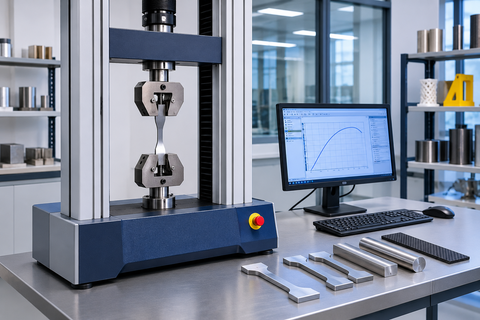
A typical UTM consists of a rigid load frame, moving crosshead, force measurement system, specimen holding fixtures, and electronic control unit.
During testing, the machine records force and displacement data. When combined with specimen dimensions and suitable strain measurements, this information can be used to calculate important mechanical properties.
Common properties measured using a UTM include:
Tensile strength.
Yield strength.
Compressive strength.
Elongation at break.
Young's modulus.
Flexural strength.
Modulus of elasticity.
Deformation characteristics.
These measurements help engineers understand material behavior before selecting materials for manufacturing, structural design, or industrial applications.
Why Universal Tensile Testing Machines Are Important
Material strength and deformation characteristics directly influence the performance of manufactured products and engineered structures. A component may appear physically suitable but still fail when exposed to repeated loading, stretching, compression, or bending.
Universal testing machines provide controlled testing conditions for evaluating these mechanical properties.
Their importance can be understood through several industrial functions.
Material quality verification: Helps determine whether raw materials meet specified mechanical requirements.
Product development: Supports comparisons between different material formulations and manufacturing methods.
Failure investigation: Helps identify mechanical weaknesses and possible causes of material failure.
Production quality control: Provides measurable information for evaluating production consistency.
Material selection: Helps engineers compare strength, stiffness, and deformation characteristics.
Research and development: Supports experiments involving new materials, coatings, composites, and manufacturing processes.
For example, a manufacturer producing metal fasteners may use a UTM to evaluate tensile strength and elongation. A plastic product manufacturer may use it to determine how much force a molded component can withstand before deformation or failure.
How Does a Universal Tensile Testing Machine Work?
A universal testing machine works by applying a controlled mechanical force to a specimen while measuring the force and the resulting movement or deformation.
The machine uses a drive mechanism to move a crosshead or actuator. A load cell measures the applied force, while an extensometer or displacement measurement system records the specimen's deformation.
1. Specimen Preparation
The material sample is prepared according to the applicable testing standard.
Its dimensions, shape, thickness, and gauge length are measured before testing. Proper specimen preparation helps ensure that the results can be compared with the required material specifications.
2. Specimen Installation
The prepared specimen is placed between suitable grips, fixtures, or compression plates.
For tensile testing, the specimen is secured at both ends. Correct alignment is necessary to reduce unwanted bending and uneven loading.
3. Test Parameter Configuration
The operator selects the appropriate testing method and configures the machine.
Common parameters include:
Test speed.
Maximum force.
Specimen dimensions.
Loading direction.
Measurement range.
Test termination conditions.
These settings depend on the material and the applicable testing procedure.
4. Controlled Force Application
The machine begins applying force through its electromechanical or hydraulic drive system.
Depending on the selected test, the specimen may be pulled, compressed, or bent. The machine maintains the specified loading conditions throughout the test.
5. Force and Deformation Measurement
The load cell continuously measures the applied force.
An extensometer may measure the change in specimen length over a defined gauge section. The machine may also record crosshead displacement, depending on the test requirements.
6. Data Collection and Analysis
The control system records the measurement data and generates a force-displacement or stress-strain curve.
The software can calculate mechanical properties such as tensile strength, yield strength, elongation, and elastic modulus when the necessary measurements and test methods are available.
7. Test Completion and Reporting
The test ends when the specified condition is reached, such as specimen fracture, a maximum displacement, or a defined force limit.
The results are reviewed and documented for material evaluation, quality control, or research purposes.
The following table summarizes the complete testing workflow.
Testing Stage | Machine Operation | Main Purpose |
|---|---|---|
Preparation | Specimen measurement | Establish sample dimensions |
Installation | Grip or fixture positioning | Secure the specimen |
Configuration | Test parameter selection | Define testing conditions |
Loading | Controlled force application | Apply mechanical stress |
Measurement | Force and deformation recording | Collect test data |
Analysis | Data processing | Calculate material properties |
Reporting | Result documentation | Evaluate material performance |
Main Types of Universal Tensile Testing Machines
Universal testing machines are commonly classified according to their force-generation mechanisms and mechanical frame configurations. The selection depends on required force capacity, testing accuracy, specimen dimensions, and material characteristics.
1. Electromechanical Universal Testing Machine
An electromechanical UTM uses an electric motor and mechanical transmission system, commonly involving precision screws, to move the crosshead.
The motor controls the movement of the crosshead, allowing the machine to apply tensile or compressive forces at controlled speeds.
Main characteristics:
Electrically driven crosshead movement.
Precise control of displacement and test speed.
Suitable for a wide range of laboratory testing.
Available in different load capacities.
Commonly used for metals, plastics, rubber, and composites.
Typical applications: Material research, quality control laboratories, plastic testing, and metal specimen evaluation.
2. Hydraulic Universal Testing Machine
A hydraulic UTM uses pressurized hydraulic fluid to generate the force required for material testing.
A hydraulic pump supplies fluid to a cylinder, which moves the loading mechanism. The system can generate substantial forces, making it suitable for testing large or high-strength specimens.
Main characteristics:
Hydraulic force-generation mechanism.
Suitable for high-load applications.
Available in manually controlled and electronically controlled configurations.
Commonly used for compression and tensile testing.
Requires hydraulic system maintenance.
Typical applications: Construction materials, metal testing, structural components, and heavy engineering laboratories.
3. Servo-Hydraulic Universal Testing Machine
A servo-hydraulic UTM uses an electrohydraulic control system to regulate hydraulic actuator movement and applied force.
Electronic feedback controls the hydraulic system according to the required test parameters. These machines can support demanding testing conditions, including controlled cyclic loading when appropriately configured.
Main characteristics:
Electronic control of hydraulic actuators.
Supports dynamic and cyclic testing configurations.
Suitable for demanding load and displacement requirements.
Can provide controlled loading profiles.
Requires specialized hydraulic and control-system maintenance.
Typical applications: Aerospace materials, automotive components, structural research, and advanced engineering laboratories.
Universal Testing Machine Type Comparison
The following table compares the major UTM drive configurations.
Machine Type | Force Generation | Main Advantage | Common Applications |
|---|---|---|---|
Electromechanical UTM | Electric motor and screw mechanism | Precise movement control | Plastics, metals, and composites |
Hydraulic UTM | Hydraulic pressure | High-force testing capability | Construction and heavy engineering |
Servo-Hydraulic UTM | Electronically controlled hydraulic system | Controlled cyclic and dynamic loading | Aerospace and structural research |
The drive mechanism is only one classification method. Universal testing machines can also have single-column or dual-column frames, depending on their mechanical design.
UTM Frame Configurations and Structural Design
The frame provides the mechanical support needed to withstand testing forces. Its design influences machine stiffness, specimen access, working space, and maximum load capacity.
Single-Column Universal Testing Machine
A single-column UTM generally uses one main vertical structural column to support the crosshead and loading arrangement.
Its compact construction makes it suitable for smaller specimens and lower-force testing applications.
Main characteristics:
Compact laboratory design.
Smaller installation footprint.
Suitable for relatively low-force applications.
Convenient for testing smaller material samples.
Dual-Column Universal Testing Machine
A dual-column UTM uses two vertical columns to support the loading structure.
This configuration provides a larger and more rigid load frame for applications requiring higher force capacities or larger specimens.
Main characteristics:
Two-column structural arrangement.
Greater loading space in many configurations.
Suitable for higher-force applications.
Supports a broad range of specimen fixtures.
Main Components of a Universal Tensile Testing Machine
A universal testing machine contains several mechanical, electrical, and measurement components that work together to perform controlled material testing.
The following table explains the main components and their functions.
Component | Main Function | Technical Role |
|---|---|---|
Load Frame | Supports the machine structure | Resists applied testing forces |
Crosshead | Moves along the frame | Applies or transfers mechanical load |
Load Cell | Measures applied force | Converts force into an electrical signal |
Grips and Fixtures | Hold the specimen | Transfer force to the test material |
Drive System | Moves the crosshead | Generates controlled mechanical movement |
Extensometer | Measures specimen strain | Records extension over a gauge length |
Control Unit | Manages machine operation | Regulates loading and test parameters |
Software System | Collects and processes data | Generates graphs and test reports |
Safety Guard | Helps protect operators | Reduces exposure to specimen fragments and moving parts |
Load Frame
The load frame is the main supporting structure of the machine. It contains the loading arrangement and provides the stiffness required to resist mechanical forces during testing.
Load Cell
The load cell is a force-measuring device installed in the loading system. It converts the applied mechanical force into an electrical signal that can be processed by the control system.
Crosshead
The crosshead is the moving structural component that transfers force to the specimen. Its movement determines the loading or deformation process during many standard tests.
Grips and Fixtures
Grips hold tensile specimens, while compression plates and bending fixtures are used for other test configurations.
Correct fixture selection helps maintain proper specimen alignment and reduces measurement errors.
Extensometer
An extensometer measures the change in length over a defined gauge section of the specimen.
It is particularly important when measuring elastic modulus, yield behavior, and strain accurately.
Types of Tests Performed by a Universal Testing Machine
A UTM can perform different mechanical tests by changing the loading direction and installing the appropriate fixtures.
Tensile Testing
Tensile testing measures the behavior of a material when it is pulled in opposite directions.
The specimen is stretched under controlled conditions until the test reaches its specified endpoint, commonly fracture.
Common measurements include:
Ultimate tensile strength.
Yield strength.
Elongation.
Young's modulus.
Reduction of area.
Compression Testing
Compression testing evaluates how a material behaves when subjected to pushing forces.
The specimen is positioned between compression plates, and the machine applies a controlled compressive load.
This test is commonly used for concrete specimens, plastics, foam materials, and selected metal components.
Flexural Testing
Flexural testing evaluates a material's response to bending forces.
The specimen is supported at defined points while a loading fixture applies force, commonly at the center for a three-point bending arrangement.
It is frequently used for plastics, composites, and other materials that require bending-performance evaluation.
Shear Testing
Shear testing evaluates a material's resistance to forces acting parallel to a defined cross-section.
Specialized fixtures are used to create the required shear-loading condition.
This test is relevant to adhesives, metal components, fasteners, and selected composite materials.
Peel and Adhesion Testing
UTMs can also perform peel and adhesion tests using specialized fixtures.
These tests evaluate the force required to separate bonded materials, adhesive joints, or layered products under defined conditions.
Applications of Universal Tensile Testing Machines Across Industries
Universal testing machines are used in industries where material strength, deformation, and mechanical reliability must be evaluated.
1. Automotive Manufacturing
Automotive manufacturers use UTM systems to evaluate the mechanical properties of metals, plastics, rubber components, and composite materials.
Common testing applications include:
Metal sheet tensile testing.
Plastic component strength evaluation.
Rubber material elongation testing.
Fastener mechanical testing.
Composite component evaluation.
These tests help manufacturers assess material suitability for vehicle components and production requirements.
2. Construction and Building Materials
Construction laboratories use universal testing machines to evaluate the mechanical performance of materials used in buildings and infrastructure.
Typical applications include reinforcement steel tensile testing, concrete compression testing, and selected material bending tests.
The results help determine whether construction materials meet specified mechanical requirements.
3. Aerospace and Aviation
Aerospace manufacturing involves materials that must satisfy demanding mechanical performance requirements.
UTMs are used to evaluate metals, polymer composites, and other engineering materials under controlled loading conditions.
Testing can include tensile strength, elastic modulus, elongation, and specialized mechanical properties.
4. Plastic and Polymer Manufacturing
Plastic manufacturers use universal testing machines to evaluate the behavior of different polymer materials and finished products.
Common applications include tensile testing of plastic sheets, compression testing of molded components, and flexural testing of polymer materials.
These measurements help manufacturers assess material consistency and product performance.
5. Metal and Steel Manufacturing
Metal processing facilities use UTMs to evaluate mechanical properties of steel, aluminum, copper alloys, and other metals.
Tensile testing is particularly important for determining yield strength, ultimate tensile strength, and elongation.
These results support material classification, production quality control, and engineering evaluation.
6. Textile and Rubber Industries
Textile and rubber manufacturers use specialized UTM fixtures to test fabrics, fibers, elastomers, and flexible materials.
Typical applications include:
Fabric tensile strength testing.
Yarn breaking strength measurement.
Rubber elongation testing.
Adhesion and peel testing.
Flexible material deformation analysis.
7. Research and Educational Laboratories
Universities, research institutions, and material science laboratories use universal testing machines to study mechanical behavior.
Researchers can compare material formulations, investigate deformation characteristics, and evaluate experimental materials under controlled conditions.
Universal Testing Machine vs Tensile Testing Machine
A tensile testing machine is generally designed specifically for measuring material behavior under tensile loading. A universal testing machine can perform tensile testing as well as other mechanical tests when suitable fixtures are installed.
The following table highlights the main differences.
Comparison Factor | Universal Testing Machine | Tensile Testing Machine |
|---|---|---|
Primary Function | Multiple mechanical tests | Tensile testing |
Loading Modes | Tension, compression, flexure, and other configured tests | Primarily tension |
Fixture Options | Multiple interchangeable fixtures | Mainly tensile grips |
Application Range | Broad material testing | Tensile property evaluation |
Machine Configuration | Adaptable loading arrangement | Test-specific arrangement |
Typical Use | General material testing laboratories | Specialized tensile testing |
The distinction is not absolute because some tensile testing machines are built on universal testing frames. The actual capabilities depend on the installed fixtures, load capacity, control system, and test software.
Benefits and Advantages of Universal Testing Machines
Universal testing machines provide several advantages for material evaluation and industrial quality control.
Multiple testing capabilities: One machine can perform different mechanical tests by changing the loading fixtures and test configuration.
Accurate force measurement: A properly calibrated load cell provides measured force data within its verified operating range.
Automated testing: Computer-controlled systems can regulate test speed, loading conditions, and data collection.
Detailed material analysis: Force and strain measurements help determine important mechanical properties.
Improved quality control: Standardized testing procedures support consistent evaluation of incoming materials and manufactured products.
Flexible applications: Different grips, fixtures, and accessories allow the machine to accommodate various specimen geometries.
Data documentation: Testing software can generate graphs, calculations, and reports for technical evaluation.
Common Universal Testing Machine Challenges and Solutions
UTM testing can produce unreliable results when specimens, fixtures, calibration, or operating conditions are not properly controlled.
The following table identifies common challenges and practical approaches to addressing them.
Common Challenge | Possible Impact | Recommended Solution |
|---|---|---|
Incorrect Specimen Dimensions | Inaccurate stress calculations | Measure specimens before testing |
Improper Grip Selection | Specimen slippage | Use suitable grips for the material |
Misalignment | Uneven loading and bending | Check specimen alignment |
Incorrect Test Speed | Inconsistent test results | Follow the applicable test method |
Load Cell Errors | Incorrect force readings | Maintain calibration and verification |
Extensometer Problems | Inaccurate strain measurements | Verify extensometer condition and calibration |
Fixture Wear | Unstable loading conditions | Inspect and replace damaged fixtures |
Software Configuration Errors | Incorrect data processing | Verify test settings and calculation methods |
Operator Errors | Inconsistent procedures | Provide appropriate technical training |
How to Choose the Right Universal Testing Machine
Selecting a universal testing machine requires evaluating the materials, testing methods, expected force levels, and measurement requirements.
A machine designed for small plastic specimens may not be appropriate for high-strength structural steel testing.
The following table provides important selection criteria.
Selection Factor | What to Evaluate | Why It Matters |
|---|---|---|
Load Capacity | Maximum expected testing force | Determines machine suitability |
Material Type | Metals, plastics, rubber, or composites | Influences machine configuration |
Testing Method | Tensile, compression, flexural, or shear | Determines fixture requirements |
Frame Configuration | Single-column or dual-column | Influences working space and structural design |
Drive Mechanism | Electromechanical or hydraulic | Determines loading characteristics |
Load Cell | Required force measurement range | Supports appropriate measurement accuracy |
Extensometer | Required strain measurement range | Improves strain measurement |
Test Speed | Required loading and displacement rates | Ensures compatibility with test procedures |
Software | Data acquisition and reporting capabilities | Supports test analysis |
Standards Compliance | Applicable ASTM or ISO methods | Helps meet testing requirements |
Safety Features | Guards, emergency stops, and overload protection | Supports safe operation |
Before selecting a machine, laboratories should also consider available installation space, power requirements, maintenance support, fixture compatibility, and future testing requirements.
Industry Standards for Universal Tensile Testing Machines
Universal testing machines are used with standardized procedures that define specimen preparation, test conditions, measurement methods, and reporting requirements.
The appropriate standard depends on the material and the type of mechanical test.
ASTM E8/E8M: Standard Test Methods for Tension Testing of Metallic Materials
ASTM E8/E8M covers tensile testing of metallic materials. It addresses the determination of mechanical properties such as yield strength, tensile strength, elongation, and reduction of area.
ISO 6892-1: Metallic Materials — Tensile Testing — Part 1: Method of Test at Room Temperature
ISO 6892-1 specifies tensile testing procedures for metallic materials at room temperature. It provides requirements for test methods and the determination of mechanical properties.
ISO 7500-1: Metallic Materials — Calibration and Verification of Static Uniaxial Testing Machines
ISO 7500-1 addresses the calibration and verification of the force-measuring system of static uniaxial testing machines.
ISO 9513: Metallic Materials — Calibration of Extensometer Systems Used in Uniaxial Testing
ISO 9513 covers the calibration of extensometer systems used for measuring strain during uniaxial material testing.
ASTM D638: Standard Test Method for Tensile Properties of Plastics
ASTM D638 covers the determination of tensile properties of plastics using standardized specimen configurations and testing procedures.
ASTM D790: Standard Test Methods for Flexural Properties of Unreinforced and Reinforced Plastics and Electrical Insulating Materials
ASTM D790 addresses flexural testing of applicable plastic and electrical insulating materials.
ASTM E4: Standard Practices for Force Verification of Testing Machines
ASTM E4 covers force verification of testing machines to assess the accuracy of their force-measuring systems.
The selected machine, load cell, extensometer, specimen preparation, and testing procedure must be suitable for the applicable standard. Following a standard alone does not guarantee accurate results without proper calibration and testing practices.
Universal Testing Machine Maintenance Best Practices
Regular maintenance helps preserve measurement reliability, mechanical performance, and equipment safety.
Inspect the Load Frame
Check the structural frame, crosshead, fasteners, and loading arrangements for visible damage or unusual movement.
Verify Load Cell Performance
Maintain appropriate calibration and verification records. The selected load cell should operate within its verified force range.
Examine Grips and Fixtures
Inspect grips, compression plates, bending fixtures, and attachments for wear, deformation, or damage.
Maintain the Drive System
For electromechanical machines, inspect the drive mechanism according to the manufacturer's maintenance instructions. For hydraulic machines, check fluid condition, leakage, and hydraulic connections.
Review Software and Measurement Settings
Check test methods, specimen dimensions, measurement channels, and reporting calculations before conducting tests.
Follow Safety Procedures
Use appropriate protective guards, follow specimen handling procedures, and keep personnel away from moving components during operation. Brittle specimens may break suddenly and release fragments.
Maintenance and calibration should be performed by qualified personnel according to the equipment manufacturer's instructions and applicable verification requirements.
Limitations of Universal Tensile Testing Machines
Although universal testing machines provide flexible mechanical testing capabilities, they have certain limitations.
Destructive testing: Many tensile and compression tests permanently deform or break the specimen.
Specimen preparation requirements: Incorrect dimensions or surface defects can affect results.
Fixture limitations: Different materials and specimen shapes require suitable grips and attachments.
Testing range restrictions: Each machine has defined force, speed, and displacement limits.
Environmental sensitivity: Temperature and humidity can influence the mechanical behavior of some materials.
Measurement uncertainty: Load cell performance, alignment, extensometer accuracy, and calibration influence test reliability.
Limited simulation of real conditions: Standard laboratory tests may not reproduce every service condition, including fatigue, impact, corrosion, and long-term environmental exposure.
For this reason, UTM results should be interpreted according to the specific test method and intended engineering application.
Future Trends in Universal Testing Machine Technology
Universal testing machines continue to develop through improvements in measurement systems, automation, and material analysis.
Advanced Digital Control Systems
Modern testing systems increasingly use digital controllers to manage loading rates, displacement, force, and test sequences with greater flexibility.
Automated Specimen Testing
Automated specimen handling and testing arrangements can reduce repetitive manual activities in laboratories with high testing volumes.
Improved Strain Measurement
Advanced extensometers and non-contact optical measurement systems can support more detailed deformation analysis, depending on the material and test requirements.
Integrated Testing Software
Modern testing platforms increasingly combine data acquisition, stress-strain analysis, reporting, and test method management within integrated software environments.
Specialized Material Testing
Growing use of composites, advanced polymers, and engineered materials is creating demand for specialized fixtures, environmental chambers, and more flexible testing configurations.
These developments are expanding the analytical capabilities of material testing laboratories while maintaining the basic principle of controlled force application and measurement.
Frequently Asked Questions About Universal Tensile Testing Machines
1. What is a Universal Tensile Testing Machine?
A Universal Testing Machine is an instrument used to measure the mechanical properties of materials under controlled forces. It commonly performs tensile, compression, and flexural tests using suitable fixtures and measurement systems.
2. What are the main types of universal testing machines?
The main types based on drive mechanism include electromechanical, hydraulic, and servo-hydraulic testing machines. They are also available in different structural configurations, including single-column and dual-column frames.
3. What is the working principle of a UTM?
A UTM applies controlled force to a specimen through a moving crosshead or actuator. A load cell measures the applied force, while an extensometer or displacement system measures deformation to determine material properties.
4. What materials can be tested using a universal testing machine?
A UTM can test metals, plastics, rubber, textiles, composites, and other engineering materials. The appropriate grips, fixtures, load capacity, and testing procedure depend on the material.
5. What are the three main tests performed by a UTM?
The three common tests are tensile testing, compression testing, and flexural testing. These evaluate how materials respond to pulling, pushing, and bending forces.
6. What is the function of a load cell in a UTM?
A load cell measures the force applied to a specimen and converts it into an electrical signal. The machine's control system processes this signal to display and record force measurements.
7. What is the difference between a hydraulic and electromechanical UTM?
An electromechanical UTM uses an electric motor and mechanical transmission system to move its crosshead. A hydraulic UTM uses pressurized fluid to generate the required testing force and is commonly selected for high-load applications.
8. Which standards are used for universal testing machines?
Commonly used standards include ASTM E8/E8M for metallic tensile testing, ISO 6892-1 for metallic tensile testing, ASTM D638 for plastic tensile properties, ISO 7500-1 for testing machine verification, and ASTM E4 for force verification.
9. What is the purpose of an extensometer in a UTM?
An extensometer measures the change in length of a specimen over a defined gauge section. It provides strain information used to calculate properties such as elastic modulus and yield behavior.
10. How often should a universal testing machine be calibrated?
Calibration and verification intervals depend on the applicable standard, laboratory quality system, equipment usage, and manufacturer recommendations. Laboratories should maintain documented calibration records and arrange verification at appropriate intervals.
Conclusion
Universal Tensile Testing Machines are essential instruments for evaluating the mechanical properties of materials used in industrial manufacturing, construction, automotive engineering, aerospace, and research. Their ability to perform tensile, compression, flexural, and other configured tests makes them suitable for a wide range of laboratory requirements.
Understanding UTM types, working principles, components, testing methods, and applicable standards helps laboratories select appropriate equipment and maintain reliable measurement practices. Electromechanical, hydraulic, and servo-hydraulic configurations each serve different testing requirements. With advances in digital control, automated testing, and strain measurement, universal testing machines continue to support more detailed material evaluation and industrial quality control.

Related Post...