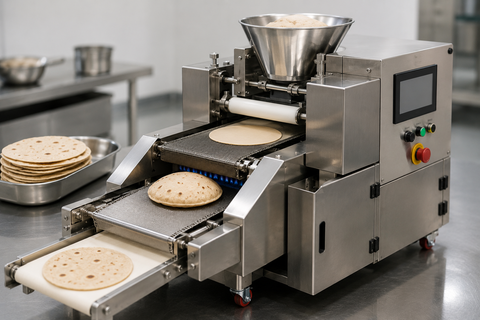
Automatic Chapati Machines: Modern Food Processing
Automatic chapati machines have become an important part of modern food processing, commercial kitchens, institutional catering, and large-scale meal preparation environments.
These machines are designed to automate multiple stages of chapati production, helping organizations prepare consistent flatbreads while managing high-volume food requirements.
Modern chapati production equipment combines dough handling systems, pressing mechanisms, baking units, conveyor systems, temperature controls, and food processing automation technologies. Understanding how these machines operate, their components, applications, and operational considerations can help food processing facilities evaluate automated chapati production systems.
Automatic Chapati Machines at a Glance
Automatic chapati machines are food processing systems designed to perform multiple chapati-making operations such as dough portioning, shaping, pressing, baking, and product transfer. Depending on the configuration, these machines can support continuous production environments in commercial kitchens, food manufacturing facilities, catering operations, and institutional food services.
Key Industry Facts
- Automatic chapati machines support large-scale food production.
- Modern systems can automate dough dividing, flattening, and baking processes.
- Food processing automation helps maintain production consistency.
- Conveyor-based systems support continuous operation.
- Commercial kitchens increasingly adopt automated food preparation equipment.
- Stainless steel construction is commonly used in food processing machinery.
- Temperature control systems help maintain baking consistency.
How Automatic Chapati Machines Work
Automated chapati production involves several coordinated stages.
Basic Production Process
- Dough is prepared according to production requirements.
- Dough enters the feeding system.
- The machine divides dough into uniform portions.
- Dough portions are shaped into balls.
- Pressing units flatten the dough into chapati shapes.
- Baking systems cook the product.
- Conveyors transfer chapatis through the process.
- Finished products move to collection areas.
This integrated workflow supports continuous chapati production.
Main Types of Automatic Chapati Machines
Semi-Automatic Chapati Machines
Semi-automatic systems automate selected production stages while requiring operator involvement for certain tasks.
Common applications include:
- Small catering operations
- Community kitchens
- Educational institutions
- Medium-scale food preparation
Fully Automatic Chapati Machines
Fully automatic systems integrate multiple production stages into a continuous process.
These machines are often used in:
- Large commercial kitchens
- Food production facilities
- Industrial catering operations
- Institutional meal programs
Conveyor-Based Chapati Systems
Conveyor-based equipment continuously moves products through shaping and baking stages.
These systems support consistent workflow management and high-volume production.
Industrial Flatbread Production Systems
Large-scale food manufacturing facilities may use advanced flatbread processing lines that integrate mixing, forming, baking, cooling, and packaging operations.
Comparison of Chapati Machine Types
| Machine Type | Automation Level | Typical Environment | Production Style |
|---|---|---|---|
| Semi-Automatic | Partial | Small Operations | Batch Processing |
| Fully Automatic | High | Commercial Facilities | Continuous Production |
| Conveyor-Based | High | Large Kitchens | Continuous Workflow |
| Industrial Production Line | Advanced | Manufacturing Facilities | Integrated Processing |
Core Components
Dough Feeding System
The feeding system transfers prepared dough into the production process.
Dough Divider
The divider separates dough into consistent portions.
Ball Forming Unit
This unit shapes dough into uniform balls before pressing.
Pressing Mechanism
Pressing systems flatten dough into the required chapati shape and thickness.
Baking Unit
Heating systems cook the chapati under controlled temperature conditions.
Conveyor System
Conveyors move products through production stages while supporting workflow efficiency.
Control Panel
Modern equipment often includes digital controls for operational settings and monitoring.
Industry Applications
Commercial Kitchens
Hotels, restaurants, and large food preparation facilities may utilize automated chapati equipment to support meal production.
Institutional Catering
Schools, universities, hospitals, and other institutions often prepare large meal volumes requiring consistent food production.
Food Manufacturing
Food processing facilities may incorporate flatbread production equipment into broader manufacturing operations.
Community Kitchens
Large community food preparation environments may benefit from production automation and standardized workflows.
Corporate Dining Facilities
Organizations serving large workforces may use automated food preparation systems to support meal operations.
Selection Factors
Production Capacity
Equipment should align with anticipated production requirements.
Automation Requirements
Facilities should evaluate the desired level of process automation.
Available Space
Machine dimensions and facility layout influence installation planning.
Material Construction
Food-grade materials and hygienic design features are important considerations.
Maintenance Requirements
Routine servicing and accessibility should be evaluated before implementation.
Energy Consumption
Energy efficiency may influence operational planning and equipment selection.
Benefits
- Supports consistent chapati production
- Automates repetitive food preparation tasks
- Improves production workflow management
- Supports large-volume food operations
- Integrates food processing automation
- Enhances production consistency
- Supports institutional catering requirements
- Reduces manual handling during production
- Enables continuous processing configurations
- Supports standardized food preparation practices
Challenges and Limitations
Initial Setup Requirements
Implementation may require equipment planning and operator training.
Maintenance Needs
Regular inspection and cleaning are necessary for reliable operation.
Production Flexibility
Some systems may require adjustments when producing different product sizes or specifications.
Space Requirements
Larger equipment configurations may require significant installation space.
Process Optimization
Production performance often depends on dough consistency, operating settings, and workflow design.
Industry Standards and Food Safety
Food processing equipment is commonly designed with hygiene and sanitation considerations.
Important factors include:
- Food-grade materials
- Smooth equipment surfaces
- Cleaning accessibility
- Temperature management
- Operational monitoring
- Food handling procedures
- Preventive maintenance programs
Food safety practices should always align with applicable local regulations and facility requirements.
Safety Considerations
Safe operation is an important part of food processing equipment management.
Key considerations include:
- Operator training
- Equipment guarding
- Emergency stop systems
- Electrical safety procedures
- Routine inspections
- Cleaning protocols
- Safe maintenance practices
- Temperature hazard awareness
- Conveyor safety procedures
Latest Technology Trends
Smart Food Processing Equipment
Digital monitoring systems provide improved visibility into equipment performance.
Automated Process Controls
Advanced control systems help maintain consistent operating conditions.
Energy-Efficient Heating Systems
Manufacturers continue developing more efficient baking technologies.
Production Monitoring
Connected systems can provide operational data for process management and maintenance planning.
Hygienic Equipment Design
Modern food processing machinery increasingly emphasizes sanitation and cleaning accessibility.
Expert Insights
Automatic chapati machines represent a significant development in commercial food processing automation. By integrating dough handling, shaping, baking, and material transfer functions into a coordinated system, these machines support large-scale meal preparation while promoting consistency and operational efficiency. As food production facilities continue adopting automation technologies, chapati manufacturing equipment is becoming increasingly sophisticated and connected.
Key Takeaways
- Automatic chapati machines support high-volume food production.
- Modern systems automate dough handling, shaping, and baking.
- Fully automatic machines enable continuous production workflows.
- Conveyor systems improve operational efficiency.
- Food-grade construction supports hygiene requirements.
- Preventive maintenance contributes to equipment reliability.
- Smart controls are becoming more common in food processing equipment.
- Commercial kitchens and catering facilities are major users of automated chapati systems.
Frequently Asked Questions
What is an automatic chapati machine?
An automatic chapati machine is food processing equipment designed to automate chapati production, including shaping, pressing, and baking operations.
How do automatic chapati machines work?
They process prepared dough through dividing, shaping, pressing, baking, and product transfer stages.
Where are automatic chapati machines used?
They are commonly used in commercial kitchens, catering facilities, food manufacturing operations, and institutional dining environments.
What is the difference between semi-automatic and fully automatic machines?
Semi-automatic systems require some operator involvement, while fully automatic systems perform most production stages automatically.
Why are conveyor systems important?
Conveyors support continuous movement of products through different processing stages.
What materials are commonly used in these machines?
Food-grade stainless steel is commonly used because of its durability and hygiene characteristics.
What factors should be considered when selecting a machine?
Production capacity, automation level, space requirements, maintenance needs, and material construction are important considerations.
How important is maintenance?
Routine maintenance helps support equipment reliability, operational consistency, and food safety practices.
Are modern chapati machines automated?
Many modern systems incorporate automation technologies, digital controls, and production monitoring features.
What industries use automatic chapati machines?
Food processing, catering, hospitality, institutional dining, and commercial kitchen operations commonly use these systems.
Conclusion
Automatic chapati machines have become an important part of modern food processing and large-scale meal preparation. By integrating dough handling, shaping, pressing, baking, and transfer functions, these systems support consistent production workflows across commercial kitchens, catering facilities, and food manufacturing operations.
Advances in automation, process monitoring, hygienic design, and energy-efficient technologies continue to improve the capabilities of automated chapati production equipment. Understanding machine types, operational processes, safety considerations, maintenance requirements, and technology trends provides valuable insight into this growing segment of food processing machinery.

Related Post...
Non-Destructive Testing Equipment Insights: Industrial Inspection
Updated: October 21, 2026
Read More