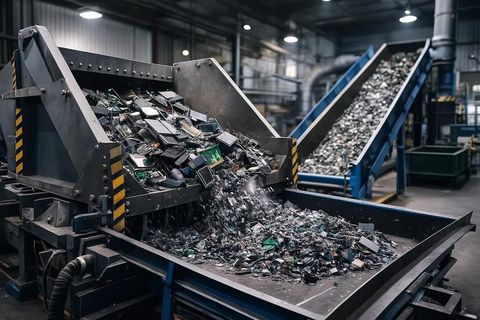
A complete recycling operation normally uses several machines rather than one universal unit. The equipment can include dismantling tools, conveyors, shredders, magnetic separators, eddy-current separators, air classifiers, screening systems, and specialized equipment for circuit-board processing.
The basic concept is:
Collection → Sorting → Dismantling → Shredding → Separation → Material recovery → Residual treatment
The exact process depends on the type of electronic equipment being processed.
An important reason for using specialized machinery is that e-waste contains both valuable materials and potentially hazardous substances. CPCB notes that electronic waste can contain metals such as gold, copper, aluminum and iron alongside substances including lead, cadmium, mercury and other potentially harmful materials.
Why E-Waste Recycling Equipment Matters
Electronic products are becoming increasingly common in households, offices, factories, hospitals, schools, and telecommunications networks.
When obsolete equipment is improperly dismantled or processed, useful materials can be lost and hazardous components may enter the environment.
Modern e-waste recycling equipment can help create a more controlled material-recovery process.
Potential benefits include:
Recovering reusable metals
Separating ferrous and non-ferrous materials
Reducing manual handling of difficult components
Improving material sorting
Supporting safer processing
Reducing the volume of discarded electronics
Creating more consistent processing streams
Supporting documented recycling operations
The equipment itself does not make a recycling facility environmentally compliant. Safe operation also requires appropriate pollution-control systems, worker protection, authorized waste handling, trained personnel, and regulatory compliance.
Main Types of E-Waste Recycling Machinery
Different machines perform different stages of the recycling process.
| Equipment Type | Main Function | Typical Material |
|---|---|---|
| Dismantling equipment | Separates components | Computers, appliances |
| Shredding machine | Reduces material size | Mixed electronic waste |
| Granulator | Produces smaller particles | Plastics, cables, mixed fractions |
| Magnetic separator | Removes ferrous metals | Steel-containing fractions |
| Eddy-current separator | Separates non-ferrous metals | Aluminum and other metals |
| Air classifier | Separates materials by density | Plastic and metal fractions |
| Screening system | Sorts particles by size | Shredded material |
| Cable processing machine | Separates conductor from insulation | Copper and aluminum cables |
| PCB recycling machine | Processes circuit boards | Printed circuit boards |
| Dust-control system | Captures airborne particles | Shredding and separation stages |
A complete e-waste recycling machine installation may combine several of these technologies.
How an E-Waste Recycling Line Works
A typical processing line begins with inspection and sorting.
Large equipment may first be manually dismantled to remove batteries, circuit boards, displays, cables, compressors, or other components that require separate handling.
The remaining material can then enter mechanical processing.
Sorting: Incoming e-waste is categorized by product type and material.
Dismantling: Selected components are removed before mechanical size reduction.
Shredding: An e-waste shredding machine reduces larger items into smaller pieces.
Screening: Material is separated according to particle size.
Magnetic separation: Ferrous metals can be extracted using magnetic systems.
Non-ferrous separation: Eddy-current or other separation technologies can isolate suitable non-ferrous fractions.
Air classification: Differences in density can help separate lighter plastics from heavier material.
Fine recovery: More specialized systems can process circuit boards or metal-rich fractions.
The final output can contain several separate material streams rather than one uniform recycled product.
PCB Recycling Machines
A PCB recycling machine is designed specifically for processing printed circuit boards.
Printed circuit boards can contain valuable metals such as copper and small quantities of precious metals. They can also contain resins, fiberglass and other materials.
A typical PCB-processing system may include:
Primary crushing
Fine grinding
Screening
Magnetic separation
Air separation
Electrostatic separation
Dust collection
The exact configuration depends on the PCB type and intended material-recovery process.
Because circuit boards can contain hazardous substances, mechanical processing should be conducted within an appropriately controlled facility rather than through informal burning or uncontrolled dismantling.
Electronic Scrap Recycling Machines
An electronic scrap recycling machine generally refers to equipment used to process mixed or specific categories of electronic scrap.
The term can cover equipment for:
Computer components
Cables
Circuit boards
Small appliances
Electrical motors
Connectors
Metal-rich electronic fractions
Mixed electronic assemblies
Material identification is important because different products require different processing methods.
For example, a cable-processing system is fundamentally different from a PCB-processing line. Similarly, large appliances can require preliminary dismantling before shredding.
Important Machine Features
When evaluating e-waste recycling machinery, technical specifications should be considered alongside environmental and operational requirements.
Important factors include:
Processing capacity
Feed-size range
Output particle size
Motor power
Blade or cutter configuration
Dust-control arrangement
Noise management
Safety interlocks
Emergency-stop systems
Maintenance access
Material compatibility
Separation efficiency
Automation level
Energy consumption
Space requirements
A machine with high nominal throughput is not automatically suitable for every recycling operation. The actual performance depends on material composition, feed preparation, moisture, particle size, contamination, and downstream separation.
Understanding E-Waste Recycling Machine Price
Searches for e-waste recycling machine price can produce widely different figures because an individual shredder and a complete recycling line are very different systems.
Financial planning should therefore consider the complete equipment configuration.
| Planning Factor | Why It Matters |
|---|---|
| Machine capacity | Determines potential material throughput |
| Equipment stages | More processing stages generally require more equipment |
| Automation | Influences controls and integration |
| Dust control | Important for worker and environmental protection |
| Separation technology | Determines material-stream quality |
| Electrical requirements | Affects facility infrastructure |
| Installation | Equipment may require foundations and integration |
| Maintenance | Includes wear parts and scheduled servicing |
| Building space | Determines layout possibilities |
| Compliance infrastructure | Pollution-control and safety systems may be required |
The most useful comparison is therefore based on complete technical specifications rather than a single headline figure.
E-Waste Recycling Machine Manufacturers and Suppliers
When researching e-waste recycling machine manufacturers or e-waste recycling equipment suppliers, technical documentation should be examined carefully.
Useful information includes:
Machine drawings
Processing specifications
Feed-material requirements
Output specifications
Electrical requirements
Safety documentation
Maintenance instructions
Dust-control details
Spare-parts information
Installation requirements
Testing procedures
For a recycling facility, compatibility between machines can be more important than the specification of an individual machine.
A shredder, separator, conveyor, screening system, and dust collector should work as an integrated process.
Recent Developments in E-Waste Management
India's regulatory framework has continued to evolve around Extended Producer Responsibility, digital recordkeeping, recycling targets, and registered recycling infrastructure.
The E-Waste (Management) Rules, 2022 came into force on 1 April 2023, replacing the earlier 2016 rules. The framework covers manufacturers, producers, refurbishers, dismantlers, and recyclers dealing with specified electrical and electronic equipment.
CPCB's framework uses an online EPR portal and provides for EPR certificates generated from recycling activity. Producers fulfill applicable EPR obligations through certificates associated with registered recyclers under the rules.
The rules specify recycling targets, including a target of 20% from financial year 2025–26 onward based on the relevant sales reference period described in the rules.
This regulatory structure increases the importance of documented and traceable recycling.
The Ministry of Environment, Forest and Climate Change's current rules database also lists amendments to the E-Waste Management Rules, including amendments issued in 2023 and 2024.
Laws and Policies in India
The principal regulatory framework is the E-Waste (Management) Rules, 2022, issued under the Environment (Protection) Act, 1986. CPCB confirms that the rules became effective on 1 April 2023.
The framework establishes Extended Producer Responsibility, under which producers have specified obligations related to e-waste recycling.
Important regulatory elements include:
Registration requirements for relevant stakeholders
Extended Producer Responsibility
Recycling targets
EPR certificates
Registered recyclers
Refurbishing certificates
Environmental compensation provisions
Recordkeeping and returns
CPCB monitoring
State Pollution Control Board oversight
CPCB also states that recycling under the E-Waste Rules is intended to occur through registered recyclers and that the regulator can monitor compliance and take action for violations.
The rules also distinguish e-waste from other regulated waste streams. Batteries, for example, are governed separately under the Battery Waste Management Rules, while radioactive waste falls under the relevant atomic-energy framework.
This distinction matters when designing a recycling facility because not every discarded component should automatically enter the same processing line.
Environmental and Worker-Safety Considerations
Mechanical recycling can create dust, noise, sharp fragments, and potentially contaminated material.
Important controls can include:
Enclosed shredding areas
Dust extraction
Appropriate ventilation
Machine guarding
Emergency stops
Personal protective equipment
Fire protection
Safe material storage
Battery segregation
Hazardous-component identification
Regular equipment inspection
Batteries require particular attention because damaged lithium-ion batteries can create fire and thermal-runaway risks.
Facilities should establish procedures for identifying and isolating batteries before material enters heavy mechanical equipment.
Tools and Useful Resources
Several official and technical resources can help researchers understand e-waste recycling.
CPCB E-Waste Resources: CPCB provides regulations, FAQs, guidelines, EPR information, and technical material relating to e-waste management.
CPCB EPR Portal: The EPR framework provides a centralized digital system for relevant producers, recyclers, refurbishers, and other regulated participants.
MoEFCC Rules Database: The Ministry's rules and regulations pages provide official notifications and amendments relating to e-waste management.
Material-flow spreadsheet: Record incoming e-waste by category and track outputs such as ferrous metal, non-ferrous metal, plastics, PCBs, and residual fractions.
Machine-capacity calculator: Compare incoming material volume with machine throughput while accounting for operating hours, downtime, maintenance, and material variability.
Equipment checklist: Record motor power, feed dimensions, output size, safety features, dust control, electrical requirements, and maintenance intervals.
Practical Checklist for Evaluating Recycling Equipment
Before selecting e-waste recycling machinery, examine the entire processing workflow.
Identify the types of e-waste to be processed.
Separate batteries and other restricted components.
Determine expected material composition.
Establish required throughput.
Define target output fractions.
Select appropriate shredding technology.
Plan magnetic and non-ferrous separation.
Include dust-control systems.
Evaluate machine guarding.
Check electrical requirements.
Consider floor space and material movement.
Review maintenance requirements.
Verify regulatory registration requirements.
Confirm compatibility between equipment stages.
Establish procedures for rejected and hazardous materials.
A process-flow diagram can be especially useful before equipment selection because it identifies where sorting, shredding, separation, storage, and quality checks will occur.
Frequently Asked Questions
What is an electronic waste recycling machine?
It is machinery designed to process discarded electrical and electronic products and separate them into useful material fractions. A complete recycling operation usually combines several types of equipment.
What does an e-waste shredding machine do?
An e-waste shredding machine reduces larger electronic products or components into smaller pieces. The shredded material can then pass through screening and separation equipment.
What is a PCB recycling machine used for?
It processes printed circuit boards to separate their material components. Mechanical systems may use crushing, grinding, screening, magnetic separation, air separation, or other technologies depending on the PCB type.
Are e-waste recycling machines regulated in India?
The recycling activity is regulated under India's E-Waste (Management) Rules, 2022 and related amendments. Relevant recyclers and other stakeholders have registration and compliance obligations under the applicable framework.
Why is dust control important in e-waste recycling?
Shredding and grinding can generate fine particles. Some electronic components may also contain hazardous substances, so appropriate containment, ventilation, dust extraction, protective equipment, and controlled processing are important.
Conclusion
E-waste recycling machines form the mechanical foundation of modern electronic-waste processing. Rather than being one universal machine, an effective recycling system generally combines sorting, dismantling, shredding, screening, magnetic separation, non-ferrous separation, and specialized processing technologies.
Equipment such as an e-waste shredding machine, PCB recycling machine, and electronic scrap processing system can help recover useful materials while reducing the volume of discarded electronics requiring further treatment.
India's regulatory environment makes traceability and environmentally sound recycling increasingly important. The E-Waste (Management) Rules, 2022 established an EPR-based framework, digital registration and certification mechanisms, recycling targets, and oversight by CPCB and State Pollution Control Boards.
For anyone researching an electronic waste recycling machine, the most important considerations are not simply processing capacity or equipment specifications. Material composition, safety, dust control, separation quality, regulatory requirements, facility layout, and integration between processing stages all influence whether a recycling system is appropriate for its intended application.