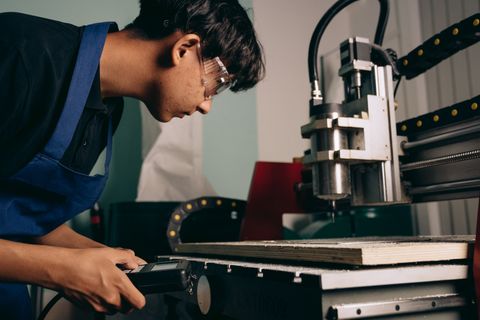
CNC machine rentals refer to arrangements in which a CNC machine is made available for a defined period instead of requiring an organization to immediately acquire the machine as a permanent asset.
This approach can be relevant when a manufacturer needs additional machining capacity for a temporary production requirement, prototype development, a new project, capacity testing, or seasonal demand.
A typical arrangement may involve:
CNC milling machines
CNC turning centres
Vertical machining centres
Horizontal machining centres
3-axis machining systems
5-axis machining systems
CNC routers
Specialized production equipment
The exact arrangement varies according to machine type, duration, tooling requirements, transportation, installation, programming, operator responsibilities, and maintenance arrangements.
Why CNC Machine Rentals Matter Today
Modern manufacturing often requires flexible production capacity. A company may have a temporary increase in orders without wanting to permanently expand its machine inventory.
A rental or leasing arrangement can provide a way to evaluate production requirements before making a longer-term equipment decision.
It may be relevant to:
Small and medium-sized manufacturers
Engineering workshops
Automotive component producers
Aerospace suppliers
Tool and die manufacturers
Research institutions
Prototyping laboratories
Educational and technical institutes
Manufacturers introducing new production lines
The approach can also help organizations compare different machine configurations.
For example, a company producing relatively straightforward components may require a 3 axis CNC machine rental, while components involving multiple complex surfaces may justify evaluating a 5 axis CNC machine rental.
The important question is not simply which machine is more advanced. It is whether the machine's capabilities match the actual geometry, material, tolerance, production volume, and programming requirements.
Main Types of CNC Machines
CNC equipment can be classified according to its machining process and number of controlled axes.
| CNC type | Typical application | Main characteristic |
|---|---|---|
| CNC lathe | Shafts, bushings, cylindrical parts | Rotating workpiece |
| CNC milling machine | General components | Rotating cutting tool |
| Vertical machining centre | Precision components | Vertical spindle |
| Horizontal machining centre | Multi-face production | Horizontal spindle |
| 3-axis CNC | General milling | X, Y and Z movement |
| 5-axis CNC | Complex components | Additional rotary movement |
| CNC router | Wood, plastics, composites | High-speed routing |
| CNC grinding machine | Precision finishing | Abrasive machining |
A 3-axis CNC machine rental is often associated with conventional milling applications where three linear axes provide sufficient access to the workpiece.
A 5-axis CNC machine rental provides additional rotational movement, allowing complicated surfaces to be machined with fewer setups. This can be particularly useful for aerospace components, moulds, turbine-related parts, and complex engineering geometries.
Understanding CNC Machining Equipment
CNC machining equipment rental can involve much more than the machine itself.
A complete production setup may require:
Cutting tools
Tool holders
Workholding fixtures
Coolant systems
Chip-management equipment
Probing systems
Tool measurement
CAD/CAM software
Inspection equipment
Compressed air
Electrical infrastructure
The machine's controller is also important. Different control platforms have different programming conventions, interfaces, and capabilities.
Before selecting equipment, users should confirm compatibility between their existing CAD/CAM workflow, post-processors, tooling, fixtures, and machine controller.
CNC Machining and Production Planning
CNC machining converts digital designs into physical components through programmed tool movements.
A typical workflow includes:
Creating or importing a CAD model.
Preparing the manufacturing process.
Creating toolpaths through CAM software.
Selecting cutting tools and workholding.
Generating and verifying CNC code.
Setting up the machine.
Performing a controlled first-piece inspection.
Running production.
Measuring critical dimensions.
CNC machining services may be relevant when a manufacturer needs completed components rather than direct access to a machine. By contrast, equipment rental or leasing arrangements generally focus on access to the production equipment itself.
These are different models and should not be treated as interchangeable.
CNC Machine Rental Cost Factors
Although financial planning is an important part of equipment selection, CNC machine rental cost does not have one standard value.
Several factors can influence the financial structure:
Machine type
Machine age
Working envelope
Number of axes
Spindle specifications
Machine accuracy
Rental duration
Production capacity
Tooling requirements
Transportation
Installation
Operator arrangements
Maintenance responsibilities
Insurance and risk allocation
Electricity and infrastructure requirements
A useful planning formula is:
Total equipment expenditure = Periodic machine charge + Setup + Tooling + Transportation + Utilities + Inspection + Other agreed requirements
The exact financial arrangement should be documented clearly before equipment is placed into production.
CNC Machine Leasing and Longer-Term Planning
CNC machine leasing is generally associated with longer-duration arrangements than short-term equipment rentals.
A leasing structure may be considered when an organization needs equipment for an extended production period but wants to spread the financial commitment over time.
The agreement should clearly identify:
Contract duration
Machine identification
Installation responsibilities
Maintenance responsibilities
Consumables
Software licensing
Operator requirements
Machine downtime procedures
Insurance
Damage responsibilities
Return or renewal conditions
For an industrial CNC machine rental, these considerations become especially important because large machining centres can require substantial floor space, power capacity, lifting arrangements, coolant management, and environmental controls.
Recent Developments in India's CNC and Machine Tool Industry
India's machine tool sector has continued to expand as manufacturing investment and advanced production technologies receive greater attention.
According to the Indian Machine Tool Manufacturers' Association, India's machine-tool production was provisionally estimated at ₹14,566 crore in FY 2024–25, representing approximately 7% growth. Machine-tool consumption was estimated at ₹31,781 crore, approximately 17% higher than the preceding year.
On February 23, 2026, the Office of the Principal Scientific Adviser and Ministry of Heavy Industries held a stakeholder consultation at CMTI, Bengaluru, concerning a proposed Advanced Manufacturing Systems Mission. CNC machine tools and controllers, advanced machines, robotics, metrology, and related technologies were among the areas discussed.
On March 10, 2026, the 29th PM-STIAC meeting also discussed strengthening India's advanced manufacturing systems ecosystem.
The Union Budget 2026–27 highlighted the capital-goods sector and announced initiatives including new CIE and high-technology tool-room initiatives. The government also reported 8.1% year-on-year growth in capital goods under the Index of Industrial Production in December 2025.
These developments point toward increasing attention to CNC technology, automation, digital manufacturing, robotics, and domestic manufacturing capability.
Laws, Standards, and Policies Affecting CNC Equipment in India
CNC machine users need to consider several areas of Indian regulation, including machinery safety, workplace safety, electrical requirements, environmental rules, and import/export procedures.
One particularly relevant recent development is the Machinery and Electrical Equipment Safety (Omnibus Technical Regulation) Order, 2024 and its subsequent amendments.
An amendment announced on August 19, 2025 stated that the regulation would apply from September 1, 2026 to machines and electrical equipment listed in the order's First Schedule. Covered equipment must conform to the applicable Indian Standards identified in the regulation.
This is particularly relevant when assessing new machinery and imported equipment. The exact applicability depends on whether a specific CNC machine falls within the notified categories and standards.
India's Ministry of Heavy Industries also identifies machine tools as part of the capital-goods sector. Its sector information notes that machine tools include standard CNC machines, gear-cutting equipment, grinding machines, EDM equipment, and other manufacturing machinery.
For workplace operations, manufacturers should also follow applicable occupational safety requirements, machine guarding practices, electrical safety procedures, emergency controls, and worker-training requirements.
Importers should separately check the current Foreign Trade Policy and applicable customs classification and procedures. DGFT's Foreign Trade Policy defines capital goods broadly to include plant, machinery, equipment, machine tools, and related equipment used for manufacturing and technological upgrading.
Government Programs and Manufacturing Modernization
The Ministry of Heavy Industries is implementing Enhancement of Competitiveness in the Indian Capital Goods Sector – Phase II.
According to a March 17, 2026 government update, the program aims to strengthen India's capital-goods ecosystem through research and innovation, skill development, smart manufacturing, Industry 4.0 adoption, and progressive indigenization of technologies.
These priorities are relevant to CNC manufacturing because modern machining increasingly combines conventional machine tools with:
Industrial robotics
Automated material handling
Digital production monitoring
Machine connectivity
Predictive maintenance
Automated inspection
CAD/CAM integration
Data-driven process control
For manufacturers considering temporary equipment access, these technologies can influence the suitability of a machine just as much as spindle speed or working dimensions.
Tools and Resources for CNC Planning
Several resources can help users evaluate CNC equipment systematically.
CAD/CAM software:
CAD systems create digital component models, while CAM platforms generate machining toolpaths. Compatibility with the CNC controller should be confirmed before production.
CNC simulation:
Simulation tools can identify collisions, excessive tool movements, and programming problems before machining begins.
Machine-tool specifications:
Important specifications include:
X, Y, and Z travel
Table dimensions
Maximum workpiece weight
Spindle speed
Spindle power
Tool capacity
Positioning accuracy
Repeatability
Controller type
Tooling calculators:
Feeds-and-speeds calculators can help estimate spindle speed, feed rate, cutting speed, and chip load based on tool geometry and material.
Inspection equipment:
Vernier calipers, micrometers, height gauges, CMMs, optical systems, and other metrology equipment can verify finished dimensions.
IMTMA resources:
The Indian Machine Tool Manufacturers' Association publishes machine-tool industry information and operates training and productivity resources. Its Productivity Institute provides practical training related to CNC programming, operation, metrology, CAD/CAM, cutting tools, and workholding.
Comparing Short-Term Rental, Leasing, and Machining Arrangements
| Arrangement | Primary purpose | Equipment access | Typical planning focus |
|---|---|---|---|
| Short-term rental | Temporary capacity | Direct machine access | Duration and setup |
| Longer-term leasing | Extended equipment use | Direct machine access | Contract and lifecycle |
| CNC machining | Component production | Provider operates equipment | Part specifications |
| Equipment acquisition | Long-term internal capacity | Organization controls equipment | Asset and production planning |
The appropriate arrangement depends on production volume, available expertise, duration, infrastructure, and capital-planning objectives.
Best Practices for CNC Machine Rentals
Before finalizing a CNC equipment arrangement, create a technical checklist.
Confirm:
Machine model and year
Controller type
Axis configuration
Working envelope
Spindle specifications
Accuracy and repeatability
Tooling compatibility
Electrical requirements
Coolant requirements
Software compatibility
Installation requirements
Operator responsibilities
Maintenance arrangements
Safety documentation
Inspection requirements
For complex parts, test the digital manufacturing workflow before production begins.
A short trial component can reveal problems with tool access, fixturing, post-processing, programming, tolerances, and inspection procedures.
Frequently Asked Questions
What are CNC machine rentals?
CNC machine rentals are temporary equipment arrangements that provide access to CNC machining machinery for an agreed period. The exact terms depend on the machine and agreement.
What is the difference between a 3-axis and 5-axis CNC machine?
A 3-axis machine primarily moves along three linear axes. A 5-axis machine adds two rotational axes, allowing more complex surfaces to be machined with fewer setups.
What affects CNC machine rental cost?
Machine specifications, rental duration, tooling, transportation, installation, maintenance responsibilities, infrastructure, and operator requirements can all affect the financial arrangement.
Is CNC machine leasing different from renting?
Generally, leasing refers to a longer-duration equipment arrangement, while rental commonly refers to shorter or more flexible periods. The exact legal and financial structure depends on the agreement.
What should I check before using an industrial CNC machine rental?
Check the machine's capacity, controller, accuracy, tooling, electrical requirements, safety systems, maintenance arrangements, software compatibility, and suitability for the intended material and component geometry.
Conclusion
CNC machine rentals can provide manufacturers with flexible access to advanced machining equipment when production requirements, project duration, or capacity needs do not justify an immediate long-term equipment commitment.
Understanding the difference between 3-axis and 5-axis machines, CNC machining equipment, leasing arrangements, and component-production models is important before selecting an approach.
India's machine-tool sector is undergoing continued technological development, with government and industry initiatives increasingly emphasizing advanced manufacturing, CNC controllers, robotics, smart manufacturing, metrology, and Industry 4.0.
The most practical approach is to begin with the component requirements, material, tolerance, production volume, machine specifications, infrastructure, safety requirements, and applicable regulations. A structured technical assessment can then determine which CNC configuration and equipment arrangement is appropriate for the intended manufacturing application.