Complete AI Framework Guide: Explore Development, Architecture, Libraries & Applications
Artificial intelligence development relies on more than algorithms and datasets. Developers also need software frameworks that provide the tools required to build, train, test, optimize and deploy AI models.
An AI framework provides reusable components for tasks such as mathematical computation, neural-network development, model training, data processing and hardware acceleration. Using a framework can reduce the amount of low-level code required to develop an AI application.
Different frameworks are designed for different purposes. Some focus on traditional machine learning, while others are widely used for deep learning, natural language processing, computer vision or generative AI.
This guide explains how AI frameworks work, their architecture, development process, major libraries, applications and important selection factors.
What Is an AI Framework?
An AI framework is a collection of software libraries, tools and interfaces designed to simplify the development of artificial-intelligence and machine-learning applications.
Depending on the framework, it can provide functionality for:
- Data processing
- Mathematical operations
- Neural networks
- Model training
- Automatic differentiation
- Optimization
- Hardware acceleration
- Model evaluation
- Inference
- Deployment
Instead of implementing every computational function independently, developers can use components already provided by the framework.
How AI Frameworks Work
AI frameworks act as an intermediate software layer between an AI application and the underlying computing hardware.
A simplified workflow is:
Data
 ↓
Data Processing
 ↓
AI Framework
 ↓
Model Architecture
 ↓
Training / Inference
 ↓
CPU / GPU / Accelerator
 ↓
Model Output
 ↓
Application
The framework coordinates many of the mathematical and computational operations involved in this process.
AI Framework Architecture
The architecture of an AI framework varies, but several layers are commonly involved.
Application Layer
This is the application where the trained AI model is used.
Examples include:
- Chatbots
- Recommendation systems
- Image-analysis applications
- Forecasting tools
- Document-processing systems
Model Layer
This layer defines the AI model itself.
It can contain:
- Neural-network layers
- Model parameters
- Activation functions
- Attention mechanisms
- Embeddings
- Pretrained models
Computation Layer
The computation layer handles mathematical operations involving tensors, matrices and other data structures.
Optimization Layer
Optimization components support model training and performance improvements.
Hardware Layer
The framework can interact with available computing resources such as:
- CPUs
- GPUs
- Specialized AI accelerators
Major Types of AI Frameworks
Machine Learning Frameworks
These frameworks support traditional machine-learning tasks such as:
- Classification
- Regression
- Clustering
- Feature processing
- Model evaluation
Scikit-learn is a widely used Python library for these types of workloads.
Deep Learning Frameworks
Deep-learning frameworks are designed for neural networks and large-scale model training.
Common capabilities include:
- Tensor operations
- Neural-network layers
- Automatic differentiation
- Training utilities
- GPU acceleration
TensorFlow and PyTorch are two prominent ecosystems in this area.
Natural Language Processing Frameworks
NLP frameworks and libraries support applications involving text and language.
Common tasks include:
- Text classification
- Translation
- Summarization
- Question answering
- Text generation
- Information extraction
Computer Vision Frameworks
Computer-vision frameworks support image and video processing.
Applications can include:
- Image classification
- Object detection
- Image segmentation
- Image analysis
- Visual inspection
Generative AI Frameworks
Generative AI development commonly uses frameworks and libraries that support pretrained models, inference, fine-tuning and related workflows.
These systems can work with:
- Text
- Images
- Audio
- Video
- Code
Popular AI Frameworks and Libraries
TensorFlow
TensorFlow is an open-source machine-learning ecosystem that provides tools for model development, training and deployment.
It can support:
- Neural networks
- Numerical computation
- Distributed training
- Production deployment
- Hardware acceleration
PyTorch
PyTorch is an open-source machine-learning framework widely used for deep-learning research and application development.
Its capabilities include:
- Tensor computation
- Automatic differentiation
- Neural-network development
- Model training
- GPU acceleration
Scikit-learn
Scikit-learn is primarily focused on traditional machine learning.
It provides tools for:
- Classification
- Regression
- Clustering
- Preprocessing
- Model selection
- Evaluation
Keras
Keras provides a high-level approach to neural-network development.
It can simplify model construction while supporting modern deep-learning workflows.
JAX
JAX is designed for high-performance numerical computing and supports transformations such as automatic differentiation and compilation.
It is used in various research and machine-learning workloads.
Hugging Face Transformers
Hugging Face Transformers provides access to many pretrained models and tools for language, vision, audio and multimodal applications.
It is particularly relevant to transformer-based AI development.
AI Framework Development Process
A typical AI development workflow can involve several stages.
1. Define the Objective
First, identify what the AI system needs to accomplish.
For example:
- Predict a value
- Classify information
- Analyze images
- Generate text
- Detect anomalies
2. Prepare Data
Data is collected and processed according to the requirements of the model.
Preparation may include:
- Cleaning
- Transformation
- Labeling
- Normalization
- Feature preparation
- Dataset splitting
3. Select a Framework
The framework can be selected based on the model type, hardware, programming environment and deployment requirements.
4. Build or Select a Model
Developers can create a model architecture or use an existing pretrained model.
5. Train the Model
Training allows the model to learn patterns from the available dataset.
6. Evaluate the Model
The model is tested against suitable evaluation data and performance metrics.
7. Optimize
Developers can improve performance through changes to:
- Model architecture
- Hyperparameters
- Training strategy
- Data
- Hardware configuration
8. Deploy
The trained model is integrated into the intended application or computing environment.
9. Monitor
Production systems can be monitored for performance, reliability and unexpected changes in data or model behavior.
AI Frameworks and Libraries
The terms framework and library are sometimes used differently.
A library generally provides reusable functions that developers call from their applications.
A framework can provide a broader structure for developing an application or model.
In AI development, these categories can overlap. A complete AI project often combines multiple libraries and frameworks rather than relying on one technology.
AI Frameworks and Hardware Acceleration
Training modern AI models can involve very large numbers of mathematical operations.
GPUs can accelerate many AI workloads because they can perform large numbers of operations in parallel.
Frameworks may support:
- CPU computation
- GPU computation
- Specialized accelerators
- Distributed computing
The available hardware can therefore influence framework selection and model performance.
AI Frameworks for Generative AI
Generative AI systems often combine several technologies.
A simplified architecture can look like:
User Application
      ↓
AI Library / Framework
      ↓
Pretrained Model
      ↓
Inference Engine
      ↓
Hardware
Additional components may include:
- Tokenizers
- Embedding models
- Vector databases
- Retrieval systems
- Model-serving tools
This makes generative AI development more of an ecosystem than a single-framework process.
AI Frameworks and Large Language Models
Large language models require substantial computational resources and specialized software.
AI frameworks and supporting libraries can assist with:
- Model loading
- Training
- Fine-tuning
- Inference
- Tokenization
- Quantization
- Distributed processing
Framework selection can depend on the model architecture, available hardware and intended deployment environment.
AI Frameworks and RAG
Retrieval-Augmented Generation (RAG) combines information retrieval with generative AI.
A basic RAG workflow is:
User Query
 ↓
Search / Retrieval
 ↓
Relevant Information
 ↓
Language Model
 ↓
Generated Response
An AI framework can handle model-related operations, while separate tools may manage embeddings, document processing and vector search.
AI Framework Applications
AI frameworks are used across many industries and technical domains.
Healthcare Technology
Potential applications include:
- Medical image research
- Signal analysis
- Data classification
- Predictive modeling
Healthcare applications require appropriate validation, privacy controls and regulatory consideration.
Finance
AI frameworks can support:
- Fraud analysis
- Risk modeling
- Forecasting
- Document processing
- Anomaly detection
Manufacturing
Applications can include:
- Predictive maintenance
- Visual inspection
- Process monitoring
- Demand forecasting
- Industrial automation
Retail
Retail applications may involve:
- Recommendation systems
- Demand forecasting
- Inventory analysis
- Customer segmentation
- Text analysis
Automotive
AI frameworks can contribute to:
- Computer vision
- Object detection
- Driver-assistance technologies
- Sensor processing
- Predictive maintenance
Enterprise Applications
Organizations can use AI frameworks to develop:
- Document analysis
- Search systems
- Virtual assistants
- Workflow automation
- Forecasting systems
- Knowledge-management applications
Benefits of AI Frameworks
Faster Development
Reusable components can reduce development time.
Reduced Low-Level Work
Developers do not need to implement every mathematical operation from the beginning.
Hardware Support
Many frameworks can take advantage of GPUs and other accelerators.
Pretrained Models
Modern AI ecosystems provide access to pretrained models that can be adapted for specific applications.
Development Ecosystems
Popular frameworks are supported by documentation, libraries and developer communities.
Scalability
Some frameworks provide features for distributed training and large-scale workloads.
Limitations of AI Frameworks
AI frameworks also introduce certain challenges.
Learning Curve
Advanced frameworks can require substantial programming and machine-learning knowledge.
Resource Requirements
Large models can require considerable computing resources.
Compatibility
Framework versions, drivers, libraries and hardware components may have compatibility requirements.
Maintenance
AI ecosystems evolve quickly, which can require dependency updates and ongoing maintenance.
Complexity
A production AI application may require several tools in addition to the primary framework.
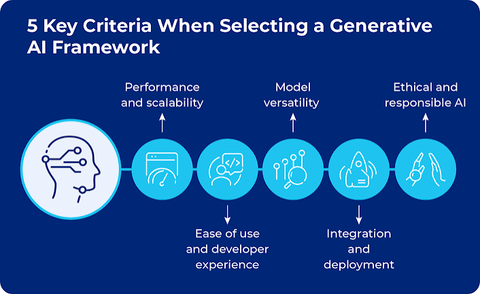
How to Choose an AI Framework
There is no single AI framework that is ideal for every project.
Consider these factors:
Project Type
Identify whether the project involves:
- Traditional machine learning
- Deep learning
- NLP
- Computer vision
- Generative AI
Programming Environment
Python is widely used throughout AI development, but other languages can also be relevant depending on the framework and deployment environment.
Hardware
Consider available CPUs, GPUs and specialized accelerators.
Ecosystem
Look at:
- Documentation
- Libraries
- Pretrained models
- Community resources
- Development tools
Deployment Requirements
Determine whether the model will operate:
- In the cloud
- On a server
- On an edge device
- On a mobile device
- In a browser
Long-Term Maintenance
Consider framework updates, dependency management and compatibility requirements before adopting a technology for a long-term project.
AI Framework Comparison
| Framework / Library | Main Focus | Common Applications |
|---|---|---|
| TensorFlow | Machine learning and deep learning | Model development and deployment |
| PyTorch | Deep learning | Research and AI applications |
| Scikit-learn | Traditional machine learning | Classification, regression and clustering |
| Keras | High-level neural networks | Deep-learning development |
| JAX | Numerical computing and ML | Research and high-performance workloads |
| Transformers | Pretrained AI models | NLP, vision, audio and multimodal applications |
AI Frameworks and MLOps
Developing a model is only one part of an AI project.
MLOps brings development and operational practices together for managing machine-learning systems.
A simplified workflow is:
Data
 ↓
Training
 ↓
Evaluation
 ↓
Model Registry
 ↓
Deployment
 ↓
Monitoring
 ↓
Updates
AI frameworks generally support the model-development stages, while additional MLOps tools can manage deployment, monitoring and lifecycle operations.
Security Considerations
Security is important throughout the AI development lifecycle.
Key areas include:
- Dependency security
- Data protection
- Access control
- API security
- Model integrity
- Infrastructure security
- Secure deployment
Developers should keep frameworks and dependencies updated according to appropriate software-security practices.
Future Trends in AI Frameworks
AI frameworks are evolving alongside new AI architectures and applications.
Multimodal AI
Framework ecosystems are increasingly supporting models that process combinations of text, images, audio and other data.
Generative AI
The growing use of generative models is increasing demand for efficient inference, fine-tuning and deployment tools.
Edge AI
Smaller and optimized models can allow AI processing to move closer to the devices generating data.
Efficient Computing
Model optimization and hardware acceleration are becoming increasingly important as AI workloads grow.
Specialized AI Hardware
Frameworks are adapting to a wider range of processors and accelerators designed for AI workloads.
Frequently Asked Questions
What is an AI framework?
An AI framework is a software toolkit that provides reusable components for developing, training, evaluating and deploying artificial-intelligence models.
What are the most popular AI frameworks?
Commonly used AI development ecosystems include TensorFlow, PyTorch, Scikit-learn, Keras and JAX. Hugging Face Transformers is also widely used for pretrained AI models.
What is the difference between an AI framework and an AI model?
A framework provides software tools for developing or running AI models. An AI model is the trained computational system that produces predictions or other outputs.
Are AI frameworks used for generative AI?
Yes. AI frameworks and supporting libraries can be used for generative AI model development, fine-tuning, inference and deployment.
Can AI frameworks use GPUs?
Many AI frameworks support GPU acceleration, although hardware compatibility varies between frameworks, versions and computing environments.
Which AI framework should beginners learn?
The appropriate starting point depends on the intended area. Scikit-learn can be useful for learning traditional machine learning, while PyTorch, TensorFlow or Keras can be considered for deep-learning development.
Are AI frameworks open source?
Many popular AI frameworks and libraries are open source, although individual licensing terms vary. Developers should review the current license before using a framework commercially.
Why are AI frameworks important?
They provide reusable tools that can simplify model development, training, optimization and deployment, allowing developers to concentrate on the specific AI problem rather than building every computational component from scratch.
Conclusion
AI frameworks provide an important foundation for modern artificial-intelligence development. They bring together tools for model construction, mathematical computation, training, optimization, hardware acceleration and deployment.
Frameworks such as TensorFlow, PyTorch, Scikit-learn, Keras and JAX serve different development needs, while specialized ecosystems such as Hugging Face Transformers support pretrained models and modern AI applications.
Choosing a framework should depend on the project requirements, model type, programming environment, hardware, ecosystem, deployment needs and long-term maintenance.
As AI expands into generative AI, multimodal systems, edge computing, enterprise automation and intelligent applications, frameworks and supporting libraries will continue to play an important role in making these technologies practical for developers.
Disclaimer: This article is intended for general informational and educational purposes only. AI frameworks, software capabilities, versions, hardware compatibility and licensing terms can change over time. Developers should review current official documentation and licensing information before selecting or deploying a framework for a specific project.

Lavit
Our content is designed to attract, persuade, and convert your audience. We help brands grow through strategic, audience-first writing.
September 07, 2026 . 9 min read
Related Post...

Manufacturing Software Explained: Explore ERP, MES, Planning, Automation & Data Management
By: Lavit
Updated: September 08, 2026
Read More
Client Management System Explained: Explore CRM, Client Data, Interactions & Workflow Management
By: Lavit
Updated: September 14, 2026
Read More
Complete AI Framework Guide: Explore Development, Architecture, Libraries & Applications
By: Lavit
Updated: September 07, 2026
Read More