Client Management Software Guide: Explore CRM Features, Automation & Expert Insight
Managing client information becomes increasingly difficult as organizations handle more contacts, conversations, documents, tasks, and ongoing relationships. Spreadsheets, emails, messaging platforms, and separate databases can make information difficult to organize and may create duplicated or outdated records.
Client management software provides a centralized environment for organizing client information and managing interactions. Many modern platforms also include Customer Relationship Management (CRM) capabilities, workflow automation, reporting tools, communication tracking, and integrations.
The purpose of this software is not simply to store contact details. A well-structured system can help organizations maintain consistent records, understand interaction history, coordinate internal activities, and create more organized workflows.
What Is Client Management Software?
Client management software is a digital platform designed to organize information related to clients, customers, accounts, contacts, communications, activities, and business processes.
Depending on the platform, it may include capabilities such as:
- Contact and account management
- Client profiles
- Communication history
- Task management
- Calendar activities
- Workflow automation
- Document organization
- Reporting and analytics
- Customer support tracking
- Team collaboration
- Third-party integrations
- Data security controls
Some platforms are specifically designed for client information management, while others combine these functions with broader CRM, sales, marketing, customer support, or project-management capabilities.
Client Management Software vs CRM
Client management software and CRM platforms are closely related, although their emphasis can differ.
A client management system may primarily focus on maintaining organized client records, communications, documents, tasks, and activities.
A CRM platform generally provides a broader framework for managing customer relationships throughout different stages of an organization's processes.
Common CRM capabilities include:
- Contact management
- Account management
- Interaction tracking
- Pipeline management
- Workflow automation
- Reporting
- Customer support
- Communication tools
- Marketing integrations
In practice, many modern client management platforms incorporate CRM features, making the distinction less important than the specific functions available.
Why Client Management Software Matters
Centralizing client information can improve visibility across an organization.
Without a centralized system, information may be distributed between:
- Email accounts
- Spreadsheets
- Documents
- Messaging applications
- Calendar systems
- Paper records
- Individual employee notes
- Separate databases
This fragmentation can make it difficult to determine which information is current.
A centralized platform can provide a single location where authorized users can access relevant information according to their permissions.
Core Features of Client Management Software
1. Client Profiles
Client profiles form the foundation of many management systems.
A profile may contain:
- Name
- Contact information
- Organization
- Communication preferences
- Account details
- Notes
- Interaction history
- Tasks
- Documents
- Relevant activities
Organizations can customize fields depending on their operational requirements.
2. Contact Management
Contact management helps maintain structured information about individuals and organizations.
Useful capabilities may include:
- Contact categorization
- Custom fields
- Tags
- Search and filtering
- Duplicate detection
- Contact history
- Relationship mapping
This makes it easier to locate specific information without manually searching through multiple files.
3. Communication Tracking
Client interactions can occur through email, telephone calls, meetings, chat, or other communication channels.
A CRM-enabled platform can record relevant interactions against a client profile.
This creates a chronological history that can help authorized team members understand previous discussions and activities.
4. Task and Activity Management
Client-related activities often involve multiple steps.
For example, a team member may need to:
- Review a client request.
- Assign an internal task.
- Collect additional information.
- Complete a follow-up.
- Record the outcome.
Task management features can help coordinate these activities while reducing dependence on individual notes or separate task lists.
5. Calendar Management
Some systems connect client activities with calendars.
Calendar capabilities may support:
- Meetings
- Follow-up reminders
- Appointments
- Deadlines
- Internal activities
- Scheduled communications
Integrating calendar information with client records can provide additional context around ongoing interactions.
Workflow Automation in Client Management
Automation is one of the most important developments in modern client management software.
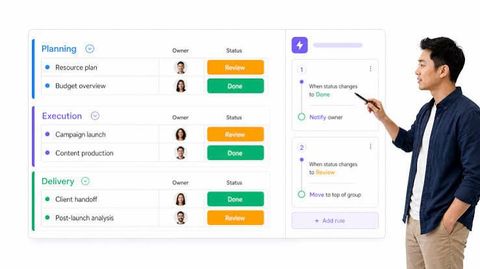
Instead of requiring employees to perform repetitive administrative steps manually, predefined workflows can trigger actions based on specific conditions.
Example workflow
A basic workflow might operate as follows:
New client record → Assign responsible team member → Create task → Schedule follow-up → Update status → Generate activity record
Automation rules can vary considerably between platforms.
Common automated actions include:
- Creating tasks
- Assigning records
- Sending internal notifications
- Updating statuses
- Moving records between workflow stages
- Generating reminders
- Synchronizing information
- Updating fields
Benefits of Automation
Workflow automation can help organizations:
- Reduce repetitive administrative work
- Standardize routine processes
- Improve task consistency
- Reduce missed follow-ups
- Create clearer accountability
- Save time on manual data entry
Automation should still be reviewed periodically because poorly designed workflows can create unnecessary tasks or inaccurate records.
CRM Data Organization
Good client management depends heavily on data quality.
A system may contain thousands of records, but poorly structured information can reduce its usefulness.
Important data-management practices include:
- Standardizing fields
- Removing duplicate records
- Maintaining accurate contact information
- Using consistent categories
- Reviewing outdated information
- Defining data ownership
- Controlling editing permissions
Data validation can also prevent common problems such as incorrectly formatted telephone numbers, incomplete fields, or inconsistent organization names.
Client Segmentation
Segmentation allows organizations to group records according to shared characteristics.
Possible segmentation criteria include:
- Industry
- Organization type
- Geographic region
- Account category
- Relationship stage
- Communication preferences
- Internal ownership
- Activity status
Segmentation can improve reporting and help teams organize workflows according to operational requirements.
Reporting and Analytics
Reporting tools turn stored information into useful summaries.
Depending on the software, dashboards may display:
- Number of active client records
- Recent activities
- Open tasks
- Completed tasks
- Communication activity
- Workflow status
- Response times
- Team workload
- Historical trends
Analytics can help managers identify patterns and operational bottlenecks.
However, dashboards are only as reliable as the underlying data. Incomplete or inconsistent records can produce misleading reports.
Document Management
Client-related work often involves documents, forms, agreements, reports, images, or other files.
Some client management platforms provide document-management capabilities that allow authorized users to associate files with specific client records.
Useful functions may include:
- File categorization
- Document history
- Access permissions
- Version management
- Search
- Cloud storage integration
Organizations should establish clear retention and access policies when handling sensitive or confidential information.
Team Collaboration
Client management software can improve coordination when several employees work with the same client or account.
Team members may be able to view:
- Previous communications
- Assigned tasks
- Current status
- Notes
- Documents
- Upcoming activities
- Internal comments
This reduces dependence on one employee's personal records and can make organizational knowledge easier to share.
Integrations With Other Platforms
Modern CRM and client management systems frequently connect with other applications through integrations or APIs.
Common integration categories include:
- Email platforms
- Calendar applications
- Accounting software
- Help-desk systems
- Project-management tools
- Communication platforms
- Cloud-storage systems
- Analytics platforms
- Marketing applications
Integrations can reduce duplicate data entry and help information move between different parts of an organization's technology environment.
Cloud-Based vs On-Premises Systems
Client management software can generally be deployed through cloud-based, on-premises, or hybrid environments.
Cloud-Based Platforms
Cloud systems are hosted by the software provider and accessed through the internet.
Potential advantages include:
- Remote accessibility
- Centralized updates
- Easier collaboration
- Reduced local infrastructure requirements
- Flexible scalability
On-Premises Systems
On-premises platforms are hosted within an organization's own infrastructure.
They may provide greater control over:
- Infrastructure
- Data location
- System configuration
- Internal access policies
However, organizations typically have greater responsibility for maintenance, backups, updates, and security.
Hybrid Systems
Hybrid environments combine cloud and local infrastructure.
The appropriate approach depends on an organization's technical requirements, regulatory environment, security policies, and existing infrastructure.
Data Security and Privacy
Client management platforms can contain valuable and sometimes confidential information, making security an important consideration.
Important security capabilities may include:
- Role-based access control
- Multi-factor authentication
- Encryption
- Audit logs
- Backup systems
- Session management
- Access monitoring
- Data-retention controls
Organizations should also establish internal policies covering who can access client information, how information is stored, and when records should be reviewed or removed.
For organizations operating in India, privacy and data-handling practices should also be considered alongside applicable requirements, including the Digital Personal Data Protection framework and other relevant regulations.
Artificial Intelligence in Client Management
Artificial intelligence is increasingly being incorporated into CRM and client management platforms.
Potential applications include:
- Summarizing interactions
- Classifying records
- Identifying patterns
- Generating internal notes
- Assisting with data entry
- Predicting workflow requirements
- Searching large collections of records
- Supporting analytics
AI-generated information should be reviewed before being treated as an authoritative client record. Incorrect summaries, classification errors, or incomplete information can affect downstream decisions.
Expert Insights for Choosing Client Management Software
Selecting a platform should begin with organizational requirements rather than the number of features advertised.
1. Identify the Main Workflow
First determine what the system needs to accomplish.
For example:
- Contact organization
- Client support
- Account management
- Project coordination
- Communication tracking
- Internal task management
- Reporting
2. Examine Data Structure
Consider how client information will be organized.
Ask:
- Which fields are necessary?
- Which records should be connected?
- How will duplicates be handled?
- Who can edit information?
- How long should records be retained?
3. Evaluate Automation Carefully
Automation can improve efficiency, but excessive automation can make workflows complicated.
Start with repetitive, clearly defined processes before introducing more advanced automation.
4. Consider Integration Requirements
A platform should fit into the organization's existing technology environment.
Integration requirements may be particularly important when client information is already distributed across several systems.
5. Review Security Controls
Security should be considered from the beginning rather than added later.
Review authentication, permissions, audit capabilities, encryption, backups, and administrative controls.
6. Consider Usability
A sophisticated platform is less useful if employees find it difficult to navigate.
A clear interface, effective search, logical navigation, and simple workflows can improve adoption.
Common Challenges
Client management software can solve organizational problems, but implementation itself can introduce challenges.
Data Migration
Moving information from spreadsheets or legacy systems may require cleaning and restructuring.
Employee Adoption
Employees may initially continue using familiar tools instead of the new platform.
Training and clear internal processes can help improve adoption.
Duplicate Information
Poor synchronization between systems can create duplicate records.
Excessive Customization
Too many custom fields and complicated workflows can make a system difficult to maintain.
Incomplete Data
A centralized platform does not automatically guarantee accurate information. Data-quality processes remain important.
Client Management Software Implementation
A structured implementation approach can reduce unnecessary complexity.
Step 1: Define Objectives
Identify the specific organizational problems the system should address.
Step 2: Map Existing Processes
Document how client information currently moves through the organization.
Step 3: Design the Data Structure
Determine required fields, categories, records, permissions, and relationships.
Step 4: Clean Existing Information
Remove duplicates and correct obvious inconsistencies before migration.
Step 5: Configure Workflows
Start with simple, high-value workflows and expand gradually.
Step 6: Establish Security Policies
Define access levels, authentication requirements, backup procedures, and administrative responsibilities.
Step 7: Train Users
Provide practical training based on real organizational workflows.
Step 8: Monitor and Improve
Review system usage, data quality, workflow performance, and user feedback regularly.
Future Trends in Client Management Software
The client management landscape is continuing to evolve.
Several trends are particularly important.
AI-Assisted CRM
AI is increasingly being used to summarize information, support searches, automate routine activities, and assist with analytics.
Greater Automation
Workflow engines are becoming more sophisticated, allowing organizations to connect multiple steps across different systems.
Unified Data
Organizations increasingly want a consistent view of client information across communication, support, project, and operational systems.
Improved Analytics
Real-time dashboards and predictive analytics are becoming more common.
Privacy-Focused Data Management
As data-protection expectations increase, organizations are placing greater emphasis on consent, access controls, retention, security, and responsible data handling.
Frequently Asked Questions
What is client management software?
Client management software is a digital platform used to organize client information, interactions, tasks, documents, and related activities in a centralized environment.
Is client management software the same as CRM?
They overlap considerably. CRM platforms generally provide broader relationship-management capabilities, while client management systems may focus more specifically on organizing client information and associated activities.
What is workflow automation in CRM?
Workflow automation uses predefined rules to perform repetitive actions automatically, such as creating tasks, assigning records, updating statuses, or generating reminders.
Can client management software integrate with email?
Many platforms can integrate with email systems to record relevant communications and connect messages with client records.
Is client management software useful for small organizations?
Yes. Smaller organizations can use centralized client records, task management, and automation to create more structured workflows. The appropriate level of functionality depends on the organization's requirements.
Does CRM software improve data quality automatically?
No. Software can provide validation and duplicate-detection tools, but organizations still need clear data-entry standards and regular data-quality processes.
Can AI be used in client management?
Yes. Modern platforms may use AI for tasks such as summarization, search, classification, analytics, and workflow assistance. AI-generated information should be reviewed for accuracy.
Conclusion
Client management software provides a centralized way to organize client information, communications, tasks, documents, workflows, and operational activities. When combined with CRM capabilities and automation, it can provide organizations with greater visibility into ongoing relationships and internal processes.
The most effective approach is not necessarily to select the platform with the largest number of features. Instead, organizations should evaluate their workflows, data requirements, security needs, integration environment, automation opportunities, and user experience.
As CRM platforms continue to incorporate artificial intelligence, advanced analytics, automation, and broader integrations, client management software is becoming an increasingly connected component of modern information management.

Related Post...

Complete Manufacturing Software Guide: Explore Production Planning, Inventory, Quality & Automation
Updated: September 08, 2026
Read More
Manufacturing Software Explained: Explore ERP, MES, Planning, Automation & Data Management
Updated: September 08, 2026
Read More
SaaS Integration Platforms Guide: Explore APIs, Automations, Data Flow & Application Connectivity
Updated: September 19, 2026
Read More