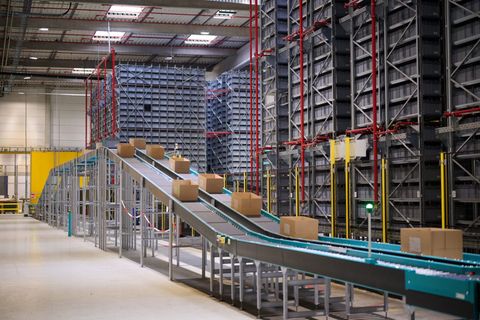
The concept of AGVs emerged to address repetitive internal transport tasks that required consistency, accuracy, and safety. As production volumes increased and facilities became larger and more complex, organizations needed a reliable way to move raw materials, components, and finished goods efficiently. AGVs were developed to reduce dependence on manual handling while maintaining predictable material flow.
At a basic level, an AGV acts as a mobile platform equipped with sensors, controllers, and navigation technology. It connects physical operations with digital control systems, forming a key part of modern industrial automation and smart factory environments.
Importance: Why Automated Guided Vehicles Matter Today
Automated Guided Vehicles play a significant role in today’s industrial and logistics ecosystems. Their importance has grown as industries focus on automation, data-driven operations, and workplace safety.
AGVs matter because they:
-
Improve material handling efficiency by ensuring continuous and accurate movement
-
Support warehouse automation and smart manufacturing strategies
-
Reduce manual handling risks in high-traffic or heavy-load environments
-
Enable predictable workflows that align with production planning systems
Industries affected by AGVs include manufacturing, logistics, automotive assembly, electronics production, pharmaceuticals, and large-scale warehousing. These vehicles help solve challenges such as congestion, handling errors, and inconsistent transport times.
From an operational perspective, AGVs help facilities manage growing volumes without expanding physical space. They also integrate with warehouse management systems and manufacturing execution systems, allowing real-time tracking and optimized routing.
Working Principles: How Automated Guided Vehicles Operate
The operation of an Automated Guided Vehicle is based on a combination of navigation, control logic, and safety systems. While designs vary, the fundamental working principles remain similar.
Navigation Methods Used by AGVs
-
Magnetic guidance: Embedded magnetic tapes or markers guide the vehicle
-
Laser navigation: Reflectors placed around the facility allow precise positioning
-
Vision-based navigation: Cameras interpret visual cues and landmarks
-
Natural navigation: Sensors map surroundings and adapt routes dynamically
Core Components Involved
-
Onboard control unit for route planning and task execution
-
Sensors for obstacle detection and positioning
-
Drive system for movement and load handling
-
Communication interface linked to central control software
AGVs receive tasks from a central system, calculate optimal routes, and move loads while continuously monitoring their surroundings. If an obstacle appears, the vehicle slows down or stops to maintain safety. Once the task is completed, the AGV either proceeds to the next assignment or returns to a standby location.
Recent Updates: Trends and Developments in the Past Year
Over the past year, Automated Guided Vehicle technology has continued to evolve, particularly in the area of intelligence and flexibility.
Key developments observed during 2025 include:
-
Increased use of artificial intelligence for adaptive navigation and route optimization
-
Wider adoption of hybrid AGV and autonomous mobile robot (AMR) systems
-
Improved battery technologies allowing longer operational cycles
-
Enhanced cybersecurity measures for connected industrial vehicles
In mid-2025, several industrial automation platforms introduced cloud-connected AGV monitoring features, enabling predictive maintenance and performance analytics. These updates reflect a broader trend toward data integration and real-time visibility in material handling systems.
Another notable shift has been the standardization of communication protocols, allowing AGVs from different vendors to operate within the same facility ecosystem.
Laws and Policies: Regulatory and Safety Considerations
Automated Guided Vehicles operate within regulatory frameworks designed to ensure workplace safety and system reliability. While regulations vary by country, common principles apply across industrialized regions.
AGVs are generally affected by:
-
Occupational safety and health regulations related to machinery
-
Industrial automation standards covering control systems and emergency stops
-
Guidelines for human–machine interaction in shared workspaces
In many countries, AGVs must comply with machinery safety standards that require:
-
Clearly defined operating zones
-
Audible and visual warning systems
-
Emergency stop mechanisms accessible to personnel
Government programs promoting smart manufacturing and digital infrastructure have indirectly supported AGV adoption by encouraging automation and innovation within industrial sectors.
Tools and Resources Related to Automated Guided Vehicles
A range of tools and resources help organizations and researchers understand, evaluate, and manage AGV systems.
Commonly Used Resources
-
Simulation software for material flow and route planning
-
Warehouse management systems with AGV integration modules
-
Fleet management dashboards for monitoring vehicle performance
-
Safety assessment frameworks for automated transport systems
Educational and Reference Materials
-
Industry standards documentation for industrial automation
-
Technical white papers on navigation and control systems
-
Training modules on automated material handling safety
These tools support informed decision-making and ongoing optimization of AGV-based environments.
Key Facts and Comparisons
| Aspect | Automated Guided Vehicles |
|---|---|
| Primary function | Internal material transport |
| Operating environment | Controlled industrial spaces |
| Navigation type | Fixed or flexible guidance |
| Human interaction | Limited, safety-focused |
| Integration level | High with digital systems |
Another way to visualize AGV impact is through workflow consistency:
-
Manual transport: Variable timing and routing
-
AGV transport: Predictable cycles and standardized paths
This consistency is a core reason AGVs are central to modern logistics automation strategies.
Frequently Asked Questions
What is the main difference between AGVs and traditional vehicles?
AGVs operate autonomously using predefined or adaptive navigation systems, while traditional vehicles require direct human control.
Are Automated Guided Vehicles safe to use around people?
Yes, AGVs are designed with sensors and safety mechanisms that detect obstacles and reduce collision risks in shared environments.
Can AGVs operate continuously?
AGVs can function for extended periods, with operational cycles managed through charging schedules and system monitoring.
Do AGVs require fixed infrastructure?
Some AGVs rely on physical guides like magnetic strips, while others use flexible navigation with minimal infrastructure changes.
How do AGVs support warehouse automation?
They enable automated material movement that aligns with inventory systems, reducing delays and handling errors.
Conclusion
Automated Guided Vehicles represent a foundational technology in modern material handling and industrial automation. By combining navigation systems, digital control, and safety-focused design, AGVs provide reliable internal transport across complex facilities.
Their growing importance reflects broader shifts toward smart manufacturing, data integration, and operational efficiency. As technology continues to advance, AGVs are expected to become even more adaptable, connected, and intelligent, reinforcing their role in future-ready industrial environments.