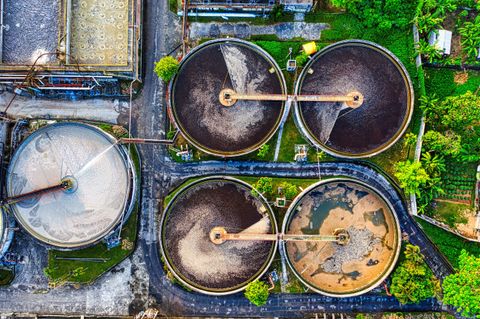
A wastewater recycling plant normally combines several treatment stages rather than relying on a single machine. The exact configuration depends on the wastewater characteristics, required water quality, available space, and intended reuse.
Common treatment stages include:
Screening to remove larger solids
Equalization to balance variations in wastewater flow
Biological treatment to reduce biodegradable organic matter
Filtration to remove suspended particles
Disinfection to reduce microorganisms
Advanced treatment such as ultrafiltration, reverse osmosis, or activated carbon when required
Storage and distribution of treated water
A wastewater treatment plant may therefore be designed primarily for discharge compliance, while a recycling system places additional emphasis on recovering water for useful reuse.
Why Wastewater Recycling Matters Today
Growing urban populations, industrial activity, water shortages, and pressure on freshwater sources have increased interest in water reuse.
A properly designed industrial wastewater recycling system can reduce dependence on freshwater for suitable applications. It can also reduce the volume of treated wastewater requiring final discharge.
The concept is particularly relevant to industries with substantial water requirements, including:
Textile and dyeing operations
Food and beverage processing
Pharmaceutical manufacturing
Chemical industries
Power generation
Metal and engineering facilities
Paper and pulp production
Large commercial and institutional campuses
Municipal wastewater is another important source. Sewage treatment can produce reclaimed water suitable for designated non-potable applications when the treatment level and monitoring program are appropriate.
The main objective is not simply to treat wastewater, but to match the quality of reclaimed water with the intended application.
How a Water Recycling System Works
A water recycling system typically follows a treatment sequence.
Collection and screening: Wastewater enters the system and larger materials are removed.
Primary treatment: Settling or other physical processes remove heavier suspended matter.
Biological treatment: Microorganisms can break down biodegradable organic compounds. Technologies include activated sludge, sequencing batch reactors, moving-bed biofilm reactors, and membrane bioreactors.
Tertiary treatment: Additional filtration, nutrient removal, membrane treatment, or disinfection may be used when higher water quality is required.
Reuse: Treated water is directed toward approved applications according to its quality.
A simplified process looks like this:
| Stage | Main purpose | Typical technologies |
|---|---|---|
| Preliminary | Remove large solids | Screens, grit removal |
| Primary | Reduce suspended solids | Settling tanks |
| Secondary | Reduce organic pollution | SBR, MBBR, activated sludge |
| Tertiary | Improve water quality | Filters, membranes |
| Disinfection | Microbial control | UV, chlorination, ozone |
| Advanced | Higher-quality reuse | RO, UF, activated carbon |
The appropriate process should be determined through wastewater testing and engineering assessment rather than by selecting equipment solely from capacity.
Wastewater Recycling Equipment and Treatment Technologies
Modern wastewater recycling equipment ranges from relatively simple filtration units to highly automated membrane systems.
Common equipment includes:
Bar screens and mechanical screens
Equalization tanks
Aeration systems
Clarifiers
MBBR media
SBR systems
Membrane bioreactors
Pressure sand filters
Activated carbon filters
Ultrafiltration membranes
Reverse-osmosis systems
UV disinfection systems
Chlorination equipment
Sludge dewatering equipment
Online water-quality sensors
Sewage treatment plant equipment is generally selected according to wastewater flow, pollutant loading, treatment objectives, land availability, electricity requirements, and operating conditions.
A wastewater treatment machine may describe a compact treatment unit, but larger facilities normally use an integrated collection of tanks, pumps, biological reactors, filters, controls, and monitoring instruments.
Industrial Wastewater Recycling
Industrial wastewater can be more complicated than domestic sewage because its composition varies substantially between industries.
Some industrial streams may contain:
High concentrations of dissolved solids
Oils and grease
Heavy metals
Dyes
Solvents or specific chemicals
High organic loading
Extreme pH
Suspended solids
Consequently, an industrial wastewater recycling system may require specialized pretreatment before biological or membrane processes.
For example, a facility with high dissolved-salt concentrations may need membrane treatment, while wastewater containing significant oil may require oil-water separation before subsequent treatment.
The goal is to prevent unsuitable contaminants from damaging downstream equipment and to ensure the final reclaimed water meets the requirements of its intended application.
Understanding Wastewater Recycling Plant Cost Factors
Although financial planning is an important part of wastewater projects, there is no universal figure for wastewater recycling plant cost.
Likewise, wastewater treatment plant cost varies significantly between projects.
Important variables include:
Daily wastewater volume
Wastewater composition
Required treatment quality
Biological treatment technology
Membrane requirements
Civil construction
Automation level
Land availability
Electricity requirements
Sludge handling
Laboratory and monitoring requirements
Installation and commissioning requirements
Expected operating period
A useful preliminary planning model is:
Total project expenditure = Civil works + Process equipment + Electrical and automation + Installation + Testing + Long-term operation
This formula is only a planning framework. A detailed engineering assessment is required for a project-specific financial estimate.
Recent Developments in India's Water-Reuse Sector
India has continued to emphasize treated wastewater reuse as part of broader water-security planning.
On December 4, 2025, the Ministry of Jal Shakti stated that States, Union Territories, local bodies, and industrial units are responsible for appropriate treatment of sewage and industrial effluents before discharge. The ministry also highlighted the role of Namami Gange, AMRUT, and other programs in improving wastewater infrastructure and reuse.
On March 17, 2026, the Ministry of Jal Shakti reported that safe reuse of treated water was gaining momentum as a national priority. The update described work toward state-level policies, city action plans, and sector-specific reuse in areas such as industry, agriculture, and power generation.
Government project records also demonstrate increasing emphasis on actual reuse infrastructure. For example, AMRUT 2.0 records include projects involving reuse of treated wastewater after tertiary treatment in cities such as Ludhiana and Jalandhar.
Another AMRUT 2.0 project record lists a planned reuse project involving 42 MLD of treated wastewater from the Chhani sewage treatment plant in Vadodara.
These developments indicate a gradual shift from wastewater treatment alone toward treatment combined with planned reuse.
Laws, Policies, and Government Programs in India
Wastewater management in India is influenced by several environmental laws, standards, policies, and government programs.
The Water (Prevention and Control of Pollution) Act, 1974 provides the principal legal framework for preventing and controlling water pollution. Regulatory oversight involves the Central Pollution Control Board and State Pollution Control Boards.
The Environment (Protection) Act, 1986 and the Environment (Protection) Rules, 1986 also establish environmental standards applicable to various industrial activities. CPCB-published standards include requirements for different categories of effluent and circumstances.
India has also developed a National Framework for Safe Reuse of Treated Waste Water. The framework provides guidance for states developing their own reuse policies.
The National Water Policy 2012 treats recycling and reuse as an important water-management principle and advocates treatment to appropriate standards before reuse.
AMRUT 2.0 and Urban Water Reuse
The Atal Mission for Rejuvenation and Urban Transformation (AMRUT) 2.0 places substantial emphasis on water security, sewerage management, and recycling or reuse of treated used water.
Its operational guidelines include an objective of creating a “new tap of water” through recycled treated used water, with targets relating to city and industrial water demand. The mission also uses City Water Balance Plans and City Water Action Plans for urban water planning.
The Swachh Bharat Mission-Urban 2.0 also includes used-water management, with an objective of ensuring that wastewater is safely contained, transported, and treated and that treated water is reused where appropriate.
For industrial projects, applicable consent requirements and discharge standards should be checked with the relevant State Pollution Control Board or Pollution Control Committee.
Choosing a Wastewater Treatment Plant Manufacturer
When evaluating a wastewater treatment plant manufacturer, technical capability should receive more attention than marketing claims.
Useful evaluation criteria include:
Experience with comparable wastewater characteristics
Treatment technology proposed
Laboratory testing and pilot studies
Equipment specifications
Automation and monitoring capability
Energy requirements
Sludge-management approach
Documentation and operating procedures
Compliance with applicable standards
Availability of technical support and replacement components
The most suitable technology depends on the wastewater itself. A design that works effectively for domestic sewage may not be appropriate for a pharmaceutical, textile, chemical, or metal-processing stream.
Tools and Resources for Wastewater Planning
Several tools can help organizations plan and monitor wastewater projects.
CPCB resources:
CPCB publications provide environmental standards, technical information, monitoring resources, and pollution-control guidance. These are useful for understanding regulatory requirements.
State Pollution Control Board portals:
State boards provide information relating to consent procedures, applicable standards, compliance requirements, and environmental monitoring.
Water-quality laboratory testing:
Before selecting treatment equipment, laboratory analysis can measure parameters such as pH, BOD, COD, TSS, TDS, nutrients, oil and grease, and relevant industry-specific contaminants.
Flow measurement:
Flow meters and daily flow records help establish actual hydraulic loading rather than relying only on theoretical capacity.
Treatment calculators and spreadsheets:
Engineering spreadsheets can help estimate hydraulic retention time, loading rates, membrane capacity, chemical requirements, sludge production, and energy consumption.
SCADA and online monitoring:
Automated monitoring can track flow, pressure, pH, dissolved oxygen, conductivity, turbidity, and other parameters depending on the system.
Practical Planning Checklist
Before selecting a wastewater recycling plant, document the following:
Wastewater source
Average and peak daily flow
Seasonal variations
Major contaminants
Required treated-water quality
Intended reuse application
Available land
Electricity availability
Sludge-handling requirements
Applicable regulatory conditions
Monitoring requirements
Future capacity requirements
The intended reuse application should be defined early. Water intended for industrial cooling may require a different treatment approach from water intended for toilet flushing or irrigation.
Frequently Asked Questions
What is a wastewater recycling plant?
It is an integrated treatment facility that processes wastewater and prepares treated water for an appropriate reuse application or further management.
What is the difference between a wastewater treatment plant and a recycling plant?
A treatment plant may primarily focus on meeting discharge requirements. A recycling plant is additionally designed around recovering treated water for a defined reuse purpose.
Can treated sewage water be reused?
Yes, treated sewage can be reused for designated applications when it has undergone suitable treatment and meets the relevant quality requirements. The appropriate level of treatment depends on how the water will be used.
What determines wastewater recycling plant cost?
Major factors include wastewater volume, contaminant characteristics, treatment technology, civil works, membrane requirements, automation, energy consumption, sludge management, and monitoring requirements.
Is reverse osmosis necessary for every wastewater recycling system?
No. Reverse osmosis is an advanced membrane process used when the required water quality or contaminant profile justifies it. Many recycling applications can use biological treatment, filtration, and disinfection without RO.
Conclusion
Wastewater recycling units are becoming an important part of modern water management because they connect wastewater treatment with planned water reuse.
A successful system begins with understanding the wastewater source, measuring its characteristics, defining the intended reuse application, and selecting treatment stages accordingly.
For industrial facilities, the process may involve specialized pretreatment, biological treatment, filtration, membranes, and advanced monitoring. For municipal applications, sewage treatment and tertiary treatment can create opportunities for non-potable reuse.
India's policy direction increasingly emphasizes treated wastewater reuse. Developments during 2025 and 2026, including safe-reuse initiatives, AMRUT 2.0 projects, and state-level policy activity, demonstrate growing attention to water circularity and resource recovery.
The most reliable planning approach is therefore evidence-based: test the wastewater, define the required water quality, understand applicable regulations, compare treatment technologies, and establish a monitoring framework before finalizing the system design.