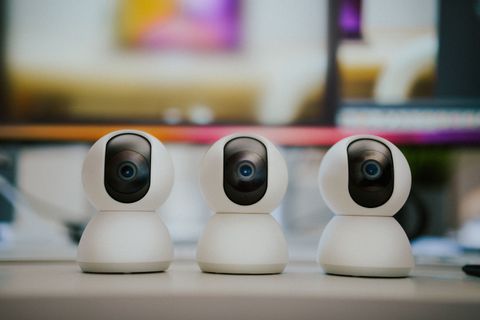
An AI security camera system may detect movement, people, vehicles, objects, unusual activity, or other events. Depending on its design, some analysis takes place directly on the camera, while other processing happens through a network video recorder, computer, or cloud-based platform.
A modern intelligent security camera can therefore function as part of a broader security environment rather than operating only as a recording device.
Common capabilities include:
Person and vehicle detection
Motion analysis
Object classification
Intrusion-zone detection
Line-crossing alerts
Crowd-density analysis
Number-plate recognition
Facial recognition in selected applications
Unusual-activity detection
Video search using descriptive characteristics
Audio-related event detection on supported devices
AI video surveillance combines these capabilities with video management systems. The objective is generally to make large quantities of recorded footage easier to monitor and analyze.
Why AI Video Surveillance Matters Today
Conventional surveillance systems can generate many hours of footage. Reviewing all of it manually can be difficult, particularly in large facilities.
AI can help prioritize events by identifying footage that matches predefined criteria. This can make surveillance workflows more structured for offices, factories, warehouses, educational institutions, transportation facilities, residential communities, and other environments.
A business security camera system may be designed around specific operational requirements rather than simply recording everything continuously.
Important considerations include:
What areas require monitoring
How long recordings should be retained
Who can access footage
Whether remote viewing is required
Whether cameras need low-light capability
Whether analytics should operate locally or remotely
How alerts should be verified
What privacy protections are necessary
A commercial security camera system can involve dozens or hundreds of cameras, making centralized management and access control especially important.
AI does not eliminate the need for human judgment. An algorithmic alert should generally be treated as an indication requiring appropriate verification rather than automatic proof that an incident occurred.
Main Technologies Used in AI Security Cameras
AI surveillance combines several technologies.
Computer vision: Enables systems to interpret visual information such as people, vehicles, shapes, movement, and objects.
Edge AI: Processes information directly on or near the camera. This can reduce the amount of raw video that needs to travel across a network.
Video surveillance software: Provides functions such as live viewing, recording management, event search, camera configuration, user permissions, and analytics.
Facial recognition: Attempts to compare facial characteristics against an authorized database or reference set. This is a particularly sensitive capability because it involves biometric information and can affect identifiable individuals.
Object detection: Identifies categories such as people, vehicles, bags, or other predefined objects.
Behavioral analytics: Attempts to identify patterns such as movement into restricted areas, loitering, crowd formation, or unusual activity.
Smart security camera systems: May combine cameras, mobile applications, network equipment, recording platforms, analytics, and alert mechanisms.
The following table illustrates common differences:
| Technology | Primary function | Typical consideration |
|---|---|---|
| Standard CCTV | Video capture | Recording quality |
| AI camera | Automated video analysis | Accuracy and configuration |
| Edge AI camera | Local processing | Device capability |
| Cloud-connected camera | Remote processing and access | Connectivity and data protection |
| Facial recognition camera | Biometric matching | Privacy and legal considerations |
| AI video platform | Centralized analytics | Integration and access control |
Facial Recognition and Privacy
A facial recognition security camera requires additional consideration because faces can be used to identify individuals.
Facial recognition can have legitimate applications in controlled environments, but accuracy can vary according to lighting, camera angle, image quality, database quality, and algorithm characteristics.
Organizations considering biometric surveillance should establish clear policies covering:
Purpose of biometric processing
Who can access biometric information
Retention periods
Accuracy testing
Human review
Security safeguards
Data deletion
Individual rights where applicable
Documentation of authorized use
Facial recognition should not automatically be treated as equivalent to ordinary motion detection. Its potential impact on privacy is considerably greater.
Recent Developments in AI and Camera Security
Cybersecurity has become an increasingly important part of camera management during 2026.
On 23 February 2026, CERT-In published a critical vulnerability note concerning certain Honeywell CCTV products. The reported issue could allow an unauthenticated remote attacker to bypass authentication controls and gain unauthorized access to video feeds. CERT-In recommended applying appropriate updates.
On 25 May 2026, CERT-In reported an information-exposure vulnerability affecting specified CP-Plus Wi-Fi cameras. The vulnerability could expose cryptographic information, wireless credentials, and configuration data, illustrating why firmware and network security are important even for connected cameras.
On 27 July 2026, CERT-In published another vulnerability note concerning the CP PLUS EZ-P21 IP camera. The reported issues included arbitrary code execution and improper authentication that could potentially allow unauthorized access to video snapshots.
CERT-In also reported vulnerabilities in certain TP-Link smart security cameras during 2026, including issues involving hard-coded cryptographic keys and exposure of geolocation information.
These developments demonstrate that an AI security camera should be treated as a networked computing device, not merely as a physical camera.
Another significant development occurred on 15 October 2026, when CERT-In warned about AI agents being used as attack vectors against Indian ICT assets. The advisory illustrates the broader shift toward AI-assisted cyber activity and the need for stronger monitoring and access controls across connected technology.
AI Security Camera System: Key Components
A complete AI surveillance environment can contain several interconnected components.
| Component | Purpose |
|---|---|
| Camera | Captures video |
| AI processor | Analyzes visual information |
| Network | Transfers data between devices |
| NVR/VMS | Records and manages video |
| Analytics engine | Performs event detection |
| Storage | Retains recordings |
| User interface | Provides viewing and management |
| Mobile application | Enables authorized remote access |
| Cybersecurity controls | Protect accounts and devices |
The system should be designed as a complete architecture rather than treating each camera independently.
For example, a camera with strong image quality may still create security problems if administrator accounts use weak credentials or firmware is not maintained.
Laws, Policies, and Regulations in India
AI security cameras in India are affected by privacy, cybersecurity, electronic-product, and data-protection requirements.
The Digital Personal Data Protection Act, 2023 establishes obligations for organizations processing digital personal data, including requirements concerning reasonable security safeguards and personal-data breach handling. The Act also contains specific provisions concerning children and significant data fiduciaries.
The Digital Personal Data Protection Rules, 2025 were notified in November 2025. The rules use a phased commencement structure, with different provisions becoming applicable at different times. MeitY's 2025–26 annual report describes the framework as introducing an 18-month phased timeline for implementation.
This is relevant when surveillance footage contains identifiable individuals. Organizations should assess whether their particular camera data falls within applicable personal-data requirements and establish appropriate governance.
For CCTV hardware, BIS has also established relevant standards. BIS's compulsory-certification information lists CCTV cameras and CCTV recorders under the applicable electronics and information-technology equipment framework using IS/IEC 62368 Part 1:2023.
BIS also maintains the IS 16910 series covering video surveillance systems used in security applications. The series addresses areas including system components, interfaces, application guidance, transmission, and image-quality performance.
In April 2024, BIS published essential security requirements for CCTV systems addressing areas such as physical protection, authentication, role-based access control, encrypted data transmission, software security, updates, and penetration testing.
These requirements highlight an important principle: surveillance security involves both physical protection and cybersecurity.
Tools and Resources for AI Surveillance Planning
Several resources can help organizations plan and manage an AI surveillance environment.
Video management software: Used for camera configuration, live monitoring, recording, event searches, user management, and analytics.
Network monitoring tools: Help identify unusual traffic, unavailable cameras, unauthorized connections, and other network events.
Firmware-management tools: Help administrators track camera versions and apply security updates.
Storage calculators: Estimate recording-storage requirements using camera count, resolution, frame rate, compression, retention period, and recording schedule.
Camera placement templates: Useful for documenting camera locations, viewing angles, monitored zones, blind spots, and installation heights.
Privacy assessment checklists: Can document the purpose of surveillance, data access, retention, biometric use, and authorized personnel.
BIS Know Your Standard: BIS provides a searchable portal where users can look up standards by Indian Standard number or keyword and review related documents, amendments, certification information, and laboratories.
CERT-In vulnerability advisories: Organizations can monitor CERT-In vulnerability notes for security issues affecting specific camera models and firmware versions. Recent 2026 notices demonstrate the practical value of monitoring such updates.
Best Practices for an AI Security Camera System
A well-planned system should consider security from the beginning.
Useful practices include:
Change default administrator credentials
Use strong authentication
Apply firmware updates promptly
Separate cameras from sensitive business networks where appropriate
Encrypt data transmissions
Limit administrator permissions
Maintain an inventory of camera models
Document retention periods
Review remote-access permissions
Disable unnecessary functions
Monitor unusual network activity
Test backup and recovery procedures
Regularly review AI detection accuracy
Establish a process for handling false alerts
Document authorized facial-recognition use where applicable
Organizations should also periodically test whether cameras can still perform their intended function. A technically advanced camera is not necessarily effective if it is poorly positioned, incorrectly configured, or generating excessive false alerts.
Frequently Asked Questions
What is an AI security camera?
An AI security camera is a surveillance camera that uses artificial intelligence or computer-vision technology to analyze video and identify predefined events, objects, or patterns.
How is AI video surveillance different from CCTV?
Traditional CCTV primarily captures and records video. AI video surveillance adds automated analysis, such as person detection, vehicle recognition, intrusion alerts, or other configured analytics.
What is a facial recognition security camera?
It is a camera system capable of analyzing facial characteristics and comparing them with stored reference information. Because this can involve identifiable or biometric information, additional privacy and governance considerations may apply.
Are AI security cameras vulnerable to cyberattacks?
Yes. Connected cameras can contain software, network interfaces, authentication systems, and firmware that may contain vulnerabilities. CERT-In published several camera-related vulnerability notices during 2026, demonstrating the importance of updates and cybersecurity controls.
What should businesses consider before deploying AI surveillance?
They should consider the purpose of surveillance, camera placement, data retention, access controls, cybersecurity, applicable privacy requirements, AI accuracy, and whether biometric functions are genuinely necessary.
Conclusion
AI security cameras have developed from simple recording devices into intelligent systems capable of analyzing video and identifying predefined events.
An AI security camera system can combine cameras, video surveillance software, recording platforms, analytics, network infrastructure, and access controls. Technologies such as edge AI, object detection, behavioral analytics, and facial recognition can provide different forms of automated analysis.
At the same time, intelligent surveillance introduces additional responsibilities. Cameras are connected computing devices, and recent CERT-In vulnerability notices in 2026 demonstrate that weak authentication, outdated firmware, and software vulnerabilities can expose surveillance systems to unauthorized access.
Privacy is equally important. India's DPDP framework provides a developing legal structure for digital personal-data protection, while BIS standards address CCTV safety, surveillance-system performance, and cybersecurity-related requirements.
The most effective approach is therefore not simply to select a camera with the largest number of AI features. Organizations should begin with a clearly defined purpose, appropriate camera placement, controlled access, secure networking, documented retention practices, regular firmware maintenance, and careful consideration of privacy.
When these elements are addressed together, AI video surveillance can become a more structured component of a broader security and risk-management framework.