VR Training Simulations: Essential Features and Insights
VR Training Simulations use virtual reality technology to create interactive environments where people can practise skills and learn procedures. These simulations allow participants to experience realistic situations through digital environments, headsets, and motion controllers. People explore this technology to understand its applications in education, healthcare, manufacturing, aviation, and workplace training.
Key Takeaways
- VR Training Simulations create interactive environments for practical learning experiences.
- Virtual reality allows learners to practise procedures in controlled settings.
- Different industries use simulations for technical and safety training.
- Performance tracking helps instructors evaluate learning progress and user behaviour.
Related Searches
What are VR Training Simulations and how do they work?
Benefits of virtual reality training for employees
VR training vs traditional training methods
How are VR Training Simulations used in education?
Virtual reality training applications across different industries
What equipment is required for VR training?
In This Guide
- Understanding VR Training Simulations
- Why VR Training Simulations Matter Today
- Recent Developments in Virtual Reality Training
- VR Training Laws and Policies in India
- VR Training Methods: Comparison and Overview
- Tools and Resources for VR Training Simulations
- Frequently Asked Questions
- Conclusion
Understanding VR Training Simulations
VR Training Simulations are digital learning environments that use virtual reality technology to recreate real-world situations. Participants interact with computer-generated surroundings through a headset, controllers, or other tracking equipment. These environments can represent workplaces, classrooms, industrial facilities, vehicles, and emergency situations.
The development of VR training is connected with early flight simulators and computer-based visualisation systems. Aviation training used simulation technology to help pilots understand aircraft controls and practise different flying conditions without operating an actual aircraft.
As computer graphics, motion tracking, and display technology developed, virtual environments became more interactive. This expanded their use into medical education, engineering, manufacturing, construction, and professional development.
How Do VR Training Simulations Work?
A typical VR training system combines hardware and software to create an interactive learning experience. The headset displays a three-dimensional environment, while tracking technology detects the user's movements and adjusts the virtual scene.
The process generally involves these components:
- VR headset: Displays the virtual environment and provides an immersive visual experience.
- Motion controllers: Allow users to interact with digital objects and perform simulated actions.
- Tracking sensors: Monitor head, hand, and sometimes body movements.
- Simulation software: Creates the virtual environment, instructions, tasks, and training scenarios.
- Audio systems: Provide spoken instructions, environmental sounds, and other audio feedback.
- Assessment tools: Record selected actions, task completion, and performance information.
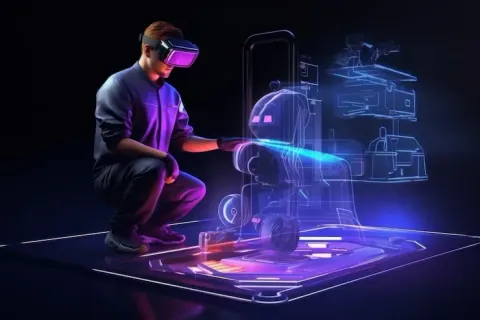
For example, a trainee learning industrial equipment operation may enter a virtual factory. They can examine machinery, follow operating instructions, and practise identifying potential hazards within the simulated environment.
What Are the Main Types of VR Training?
VR training can be divided into different categories according to the learning objective.
- Procedural training: Teaches sequences of actions, such as equipment operation or medical procedures.
- Safety training: Simulates workplace hazards and emergency situations.
- Technical training: Helps learners understand machinery, engineering systems, and equipment components.
- Soft skills training: Creates situations for practising communication, teamwork, and decision-making.
- Educational training: Uses interactive environments to explain scientific, historical, and technical subjects.
Why VR Training Simulations Matter Today
Traditional learning methods often involve classroom instruction, demonstrations, printed materials, and practical exercises. Although these methods remain important, some activities are difficult to recreate because they involve complex equipment, unusual situations, or potential physical hazards.
VR Training Simulations address some of these challenges by allowing participants to practise selected activities within controlled digital environments. They are relevant to students, instructors, employees, healthcare professionals, engineers, and organisations involved in technical education.
What Problems Do VR Training Simulations Address?
Several learning challenges explain the growing interest in virtual reality.
1. Limited practical exposure: Some learners cannot regularly access specialised equipment or realistic training environments. Virtual simulations provide opportunities to explore selected situations digitally.
2. Safety concerns: Certain industrial and emergency scenarios involve physical hazards. Simulations allow participants to practise decision-making without recreating those hazards physically.
3. Repeated practice: Learners can repeat selected scenarios and review their actions. This supports familiarity with procedures and helps identify areas requiring further instruction.
4. Complex learning concepts: Three-dimensional visual environments can help explain machinery, anatomy, engineering structures, and other subjects that are difficult to understand through text alone.
5. Performance assessment: Instructors can examine recorded actions, task completion, and responses to simulated situations.
However, virtual practice does not replace every form of practical instruction. Physical activities requiring actual equipment handling, sensory feedback, or real-world interaction may still need supervised practice.
Recent Developments in Virtual Reality Training
Between 2024 and 2026, VR training development has increasingly focused on artificial intelligence, improved interaction, realistic environments, and digital performance assessment.
Which New Technologies Are Changing VR Training?
Several developments are influencing the design of training simulations.
- Artificial intelligence integration: AI can support adaptive scenarios, virtual characters, and interactive instructions based on learner responses.
- Advanced motion tracking: Improved tracking technology helps virtual environments respond more naturally to body and hand movements.
- Haptic technology: Specialised gloves and controllers provide simulated touch or vibration feedback during selected activities.
- Digital twins: Virtual representations of physical equipment and facilities help learners explore operational processes.
- Cloud-based platforms: Network-based systems support the distribution and management of training content across different locations.
- Mixed reality integration: Some training environments combine virtual elements with views of the physical surroundings.
Another developing area is personalised learning. Simulation software can adjust scenario difficulty or provide additional instructions based on selected performance indicators.
Healthcare education, industrial safety, aviation, and technical education continue to explore these applications. However, their effectiveness depends on training design, equipment capabilities, learner requirements, and appropriate evaluation.
VR Training Laws and Policies in India
India does not currently have one dedicated national law covering every aspect of VR training. Instead, different legal and policy frameworks may apply depending on the industry, type of training, personal information collected, and equipment used.
Which Indian Regulations Are Relevant to VR Training?
Several frameworks are important to understand.
Information Technology Act, 2000: This legislation provides a legal framework for electronic records and addresses certain cyber offences. It may be relevant to digital training platforms and information security.
Digital Personal Data Protection Act, 2023: This legislation establishes requirements for processing digital personal data. VR platforms collecting identifiable learner information may need to consider its applicable provisions.
Occupational Safety, Health and Working Conditions Code, 2020: This framework addresses workplace safety and working conditions. Its applicability depends on implementation and relevant provisions. VR training may supplement workplace safety education but does not automatically satisfy every training requirement.
National Education Policy, 2020: This policy encourages technology integration, experiential learning, and improvements in educational delivery.
Skill India Mission: This government initiative supports vocational education and skill development. Digital learning and simulation-based approaches can contribute to technical training activities.
Bureau of Indian Standards (BIS): Applicable Indian standards may address electrical safety, electronic equipment, and related technical requirements.
Organisations must consider the specific regulations applicable to their activities. Using a virtual simulation does not automatically establish compliance with workplace, educational, or industry-specific requirements.
VR Training Methods: Comparison and Overview
Different training approaches have different purposes, equipment requirements, and learning characteristics.
| Training method | Main approach | Interaction level | Common application |
|---|---|---|---|
| Classroom training | Instructor-led explanations | Limited physical interaction | Theory and concepts |
| Video training | Recorded demonstrations | Mostly passive | Process familiarisation |
| Computer simulation | Digital scenarios on screens | Keyboard and mouse | Technical learning |
| VR training | Immersive digital environments | Interactive 3D experience | Practical scenario training |
| AR training | Digital information over real surroundings | Physical and digital interaction | Equipment guidance |
| Hands-on training | Practice with physical equipment | Direct physical interaction | Practical skill development |
VR Training vs Traditional Training
Traditional training usually combines explanations, demonstrations, and supervised practical activities. It provides direct interaction with instructors, equipment, and physical environments.
VR training introduces interactive digital scenarios that can be repeated and adjusted. It is particularly relevant when learners need to understand spatial relationships, practise selected procedures, or experience situations that are difficult to recreate.
Both approaches have limitations. VR may not reproduce realistic weight, resistance, temperature, or physical sensations, while traditional training may require specialised facilities and equipment.
Tools and Resources for VR Training Simulations
Different software platforms and hardware resources support the development, delivery, and assessment of virtual training environments.
- Unity: A development platform used to create interactive three-dimensional environments and training applications.
- Unreal Engine: A real-time 3D development platform used for detailed virtual environments and simulations.
- Meta Quest: A VR headset family used for immersive applications and interactive experiences.
- SteamVR: A platform supporting compatible virtual reality hardware and applications.
- Blender: Three-dimensional modelling software used to create objects, environments, and digital assets.
- OpenXR: An industry standard that supports compatibility between VR applications and different hardware platforms.
- Moodle: A learning management system that can organise training materials and learner assessments.
- Learning Analytics Dashboards: Tools that present information about participation, progress, and assessment results.
The choice of tools depends on the training objective, available hardware, software compatibility, and technical requirements.
Frequently Asked Questions
What are VR Training Simulations used for?
They are used for practical learning in aviation, healthcare, manufacturing, education, construction, and workplace safety.
How do VR Training Simulations work?
They combine headsets, tracking equipment, controllers, and software to create interactive digital training environments.
Are VR Training Simulations better than traditional training?
They provide different learning experiences. VR supports immersive practice, while traditional methods provide direct physical interaction and instructor guidance.
What equipment is needed for VR training?
Common equipment includes a VR headset, controllers, tracking systems, compatible hardware, and simulation software.
Can beginners use VR Training Simulations?
Yes. Many training environments include guided instructions and introductory scenarios that help new users understand virtual interactions.
Conclusion
VR Training Simulations combine virtual reality technology with interactive learning methods to recreate practical situations. They are used across education, healthcare, aviation, manufacturing, and workplace safety. Developments in AI, motion tracking, and digital twins continue to expand their applications. Their effectiveness depends on suitable training design, user accessibility, and the combination of virtual and real-world practice.

Related Post...

Explore MQTT Protocol: Features, Architecture and Communication Process
Updated: November 28, 2026
Read More