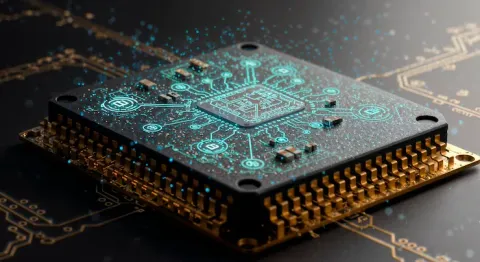
Explore FPGA-Based AI Systems for Modern Artificial Intelligence Applications
FPGA-Based AI systems combine artificial intelligence algorithms with programmable hardware to process information efficiently. They use Field-Programmable Gate Arrays (FPGAs) to perform tasks such as image recognition, data processing, and real-time decision-making. People explore this technology to understand how AI hardware works and how it differs from traditional processors. Its applications include industrial automation, healthcare equipment, telecommunications, robotics, and intelligent monitoring.
Key Takeaways
- FPGAs provide configurable hardware for different artificial intelligence workloads.
- FPGA-based accelerators can process selected AI tasks in parallel.
- Hardware configuration allows developers to customise processing operations.
- FPGA and GPU architectures differ in flexibility and processing methods.
Related Searches
What are FPGA-Based AI systems and how do they work?
How does FPGA accelerate artificial intelligence?
FPGA vs GPU for AI applications
What are the applications of FPGA-based machine learning?
How to develop AI models using FPGA hardware?
What are the advantages and limitations of FPGA technology?
In This Guide
- What Are FPGA-Based AI Systems and How Do They Work?
- Why Are FPGA-Based AI Systems Important?
- Recent Developments in FPGA-Based AI Technology
- Indian Regulations and Policies for FPGA-Based AI Systems
- FPGA vs GPU vs CPU: Technology Comparison
- Tools and Resources for FPGA-Based AI Development
- Frequently Asked Questions About FPGA-Based AI
- Conclusion
What Are FPGA-Based AI Systems and How Do They Work?
Understanding FPGA Technology
An FPGA is an integrated circuit whose internal digital logic can be configured after manufacturing. Unlike a conventional processor, which follows a fixed hardware architecture, an FPGA allows developers to configure logic blocks and connections for specific processing requirements.
FPGAs contain programmable logic blocks, memory resources, and configurable interconnections. These elements can be arranged to perform mathematical operations, data movement, and control functions required by an application.
How Does FPGA-Based AI Processing Work?
Artificial intelligence models perform calculations involving numbers, weights, and data patterns. FPGA hardware can be configured to execute selected operations, including matrix multiplication and convolution, which are commonly used in neural networks.
The general process involves:
- Model development: An AI model is created and trained using an appropriate development framework.
- Model preparation: The trained model is converted into a format suitable for hardware implementation.
- Hardware design: Developers map selected operations onto FPGA logic and memory resources.
- Configuration: A hardware configuration file, commonly called a bitstream, is loaded onto the FPGA.
- Data processing: Input information is transferred to the configured hardware.
- Output generation: The FPGA produces results that can be used by another application or system.
Some designs use lower numerical precision, such as 8-bit integers, to reduce hardware requirements. This approach requires accuracy testing because numerical changes can affect model predictions.
Why Are FPGA-Based AI Systems Important?
Artificial intelligence applications increasingly need to process information close to where it is collected. Cameras, industrial sensors, medical equipment, and connected devices may need to analyse information without sending every data item to a remote computer.
FPGA-based systems address selected requirements through configurable processing, parallel operations, and predictable hardware execution. Their usefulness depends on the workload, design complexity, power requirements, and development resources.
What Problems Can FPGA-Based AI Systems Address?
- Real-time image processing: Analysing camera information for object detection and visual inspection.
- Industrial monitoring: Processing sensor readings to identify unusual equipment behaviour.
- Edge computing: Running selected AI operations near the data source.
- Telecommunications: Supporting signal processing and network-related calculations.
- Robotics: Processing information from cameras and sensors for machine control.
- Medical imaging: Accelerating selected image-processing operations in specialised equipment.
Who Uses FPGA-Based AI Technology?
FPGA-based AI technology is relevant to hardware engineers, embedded-system developers, researchers, telecommunications specialists, and industrial technology teams. Universities also use FPGA development boards to teach digital electronics, computer architecture, and hardware acceleration.
It is particularly relevant when an application needs customised data processing or predictable execution. However, developing an FPGA-based AI system generally requires knowledge of digital logic, programming, and hardware design.
Recent Developments in FPGA-Based AI Technology
Recent developments in FPGA technology focus on improving AI inference, hardware configuration, and integration with edge computing systems. Research during 2024–2026 has increasingly examined how programmable hardware can support neural networks, including transformer-based models.
What Are the Current FPGA-Based AI Trends?
Several developments are influencing this field:
- Edge AI processing: More applications perform AI calculations near cameras, sensors, and connected devices.
- Model quantisation: Lower numerical precision helps reduce memory and hardware requirements.
- High-Level Synthesis: Developers can convert suitable programming descriptions into hardware designs.
- Transformer acceleration: Researchers are exploring FPGA architectures for selected language-model operations.
- Hardware optimisation: Improved data movement and memory management help address processing limitations.
- Hybrid computing: FPGA devices are increasingly considered alongside CPUs, GPUs, and other accelerators.
These developments do not mean FPGAs are suitable for every AI workload. Hardware capacity, model size, development complexity, and application requirements remain important factors.
Indian Regulations and Policies for FPGA-Based AI Systems
India's semiconductor and artificial intelligence ecosystem operates within several policy and regulatory frameworks. The Ministry of Electronics and Information Technology (MeitY) oversees important national initiatives related to electronics manufacturing, semiconductor development, and digital technology.
Which Indian Policies Are Relevant?
The following frameworks are particularly relevant:
- National Policy on Electronics 2019: Provides a framework for strengthening electronics design and manufacturing capabilities.
- Semicon India Programme: Supports semiconductor manufacturing, chip design, research, and ecosystem development.
- India Semiconductor Mission: Coordinates initiatives related to semiconductor manufacturing and technology development.
- IndiaAI Mission: Supports artificial intelligence development, computing infrastructure, research, and innovation.
- BIS Compulsory Registration Scheme: Certain notified electronic products must meet applicable registration and conformity requirements.
- Digital Personal Data Protection Act, 2023: Relevant when AI applications process digital personal data within the Act's scope.
The Information Technology Act, 2000, may also apply to relevant electronic records and cybersecurity-related matters.
These frameworks do not establish one universal approval requirement for every FPGA development board. Applicable requirements depend on the finished product, its intended application, wireless capabilities, and whether personal information is processed.
FPGA vs GPU vs CPU: Technology Comparison
Different processors handle AI workloads through different hardware architectures. Understanding these differences helps explain why developers select particular platforms for specific applications.
What Is the Difference Between FPGA, GPU, and CPU?
| Feature | FPGA | GPU | CPU |
|---|---|---|---|
| Architecture | Programmable digital logic | Parallel processing cores | General-purpose processor cores |
| Configuration | Hardware logic can be customised | Primarily software-controlled | Primarily software-controlled |
| Parallel processing | Configurable parallel operations | Large-scale parallel calculations | Limited parallelism compared with GPUs |
| AI applications | Customised inference acceleration | Training and inference | General AI execution |
| Flexibility | Hardware-level flexibility | Software-level flexibility | Broad software compatibility |
| Development | Requires hardware design knowledge | Uses specialised programming frameworks | Uses general programming environments |
| Common applications | Embedded AI and signal processing | Deep learning and graphics | General computing and control |
When Should Each Technology Be Used?
- FPGA: Appropriate when customised processing, predictable timing, or hardware-level flexibility is required.
- GPU: Commonly used for computationally intensive neural network training and inference.
- CPU: Suitable for general computing, application control, and workloads with varied instructions.
Some systems combine these technologies. A CPU may manage the application, a GPU may handle intensive model calculations, and an FPGA may process selected real-time operations.
Tools and Resources for FPGA-Based AI Development
Developing FPGA-based AI applications involves software frameworks, hardware design environments, simulation platforms, and testing tools. These resources support different stages, from model preparation to hardware implementation.
Which Tools Are Used for FPGA AI Development?
- AMD Vitis AI: Supports AI model deployment and acceleration on compatible AMD adaptive computing platforms.
- AMD Vivado Design Suite: Used for FPGA design, synthesis, implementation, and hardware configuration.
- Intel FPGA AI Suite: Supports mapping compatible AI models onto supported Intel FPGA platforms.
- Intel Quartus Prime: Provides tools for FPGA design and implementation.
- Xilinx PYNQ: Provides a Python-based environment for compatible programmable hardware boards.
- TensorFlow: Supports machine learning model development and training.
- PyTorch: Provides a framework for building and training neural networks.
- Verilog and VHDL: Hardware description languages used to define digital circuits.
Tool compatibility varies according to FPGA architecture, hardware generation, software version, and model requirements.
Frequently Asked Questions About FPGA-Based AI
1. What are FPGA-Based AI systems used for?
They accelerate selected artificial intelligence operations in applications such as image processing, robotics, industrial monitoring, and edge computing.
2. How does FPGA accelerate AI processing?
It uses configurable digital circuits to execute selected mathematical operations in parallel.
3. Is FPGA better than GPU for AI?
Neither is universally better. FPGAs support customised hardware processing, while GPUs provide extensive parallel computing capabilities.
4. Can beginners develop FPGA-Based AI projects?
Yes. Beginners can start with development boards, basic digital logic, and simple machine learning demonstrations.
5. Do FPGA-Based AI systems require programming?
Yes. Development commonly involves hardware description languages, software programming, and specialised design tools.
Conclusion
FPGA-Based AI systems combine programmable hardware with artificial intelligence to support customised computing applications. Their capabilities include parallel processing, configurable logic, and selected real-time AI operations. FPGAs, GPUs, and CPUs have different architectural strengths and limitations. Indian semiconductor and AI initiatives provide a broader policy framework for research, development, and electronics innovation.

Related Post...


AI-Powered Data Labeling Tools: Features, Uses and Trends in 2026
Updated: November 25, 2026
Read More
The Complete Guide to Email Marketing for Better Customer Engagement
Updated: November 27, 2026
Read More