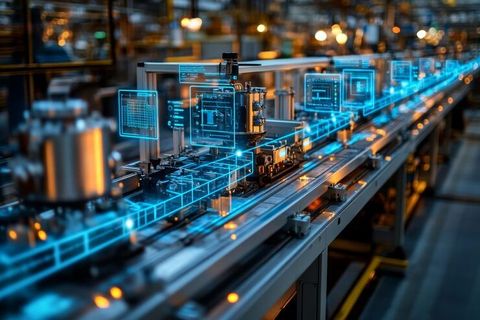
Smart Factories: Technology, Benefits, Applications & Future Trends
A smart factory is a modern manufacturing facility that uses advanced digital technologies, connected machines and automated systems to improve industrial production. It combines technologies such as Artificial Intelligence (AI), the Internet of Things (IoT), robotics, cloud computing and data analytics to create an intelligent manufacturing environment.
Traditional factories often depend on manual operations, separate machinery controls and periodic equipment inspections. Although these methods remain important in many industries, they can make it difficult to monitor every production activity in real time.
Smart factories address these limitations by connecting machines, production equipment and computer systems. They collect information from different manufacturing processes and use it to support better operational decisions.
The concept of smart factories is closely associated with Industry 4.0, also known as the Fourth Industrial Revolution. This industrial transformation focuses on digital connectivity, intelligent automation and the integration of physical and digital technologies.
The main technologies used in smart factories include:
- Artificial Intelligence (AI): Analyses manufacturing data and supports intelligent decision-making.
- Internet of Things (IoT): Connects machines, sensors and industrial equipment.
- Industrial Robotics: Performs repetitive, precise and physically demanding manufacturing activities.
- Digital Twin Technology: Creates virtual representations of physical machines, equipment or production processes.
- Cloud Computing: Stores and processes industrial information through connected computing platforms.
- Big Data Analytics: Examines large volumes of manufacturing information to identify patterns and operational problems.
- Predictive Maintenance: Uses equipment data to identify possible machinery problems before failures occur.
Together, these technologies help factories become more connected, automated and data-driven.
Importance – Why Smart Factories Matter Today
Smart factories are becoming important because modern manufacturing requires consistent product quality, efficient production, equipment reliability and better management of industrial resources.
They affect manufacturers, industrial engineers, production managers, equipment operators, maintenance teams and supply chain organisations.
1. Improved Manufacturing Productivity
Smart factory systems monitor production activities and identify delays, equipment interruptions and inefficient processes.
Automated production lines can coordinate different manufacturing operations, helping factories maintain more consistent workflows.
2. Predictive Maintenance and Equipment Reliability
Unexpected machinery failures can interrupt production and affect manufacturing schedules.
Smart factories use sensors to monitor equipment conditions such as vibration, temperature, pressure and operating speed.
Analytical systems examine this information and identify unusual patterns that may indicate developing equipment problems.
This allows maintenance teams to investigate potential issues before major interruptions occur.
3. Better Quality Control
Quality control is an important part of manufacturing.
Smart factories use cameras, sensors and AI-based inspection systems to identify defects and inconsistencies during production.
For example, machine vision technology can inspect product dimensions, surface conditions, packaging and assembly accuracy.
Automated inspection helps reduce dependence on manual checking alone.
4. Improved Energy Management
Industrial production requires electricity for machinery, lighting, cooling and other equipment.
Smart energy management systems monitor electricity consumption across different production areas.
They help identify unusual energy usage, inefficient equipment and opportunities to improve industrial energy efficiency.
5. Workplace Safety
Smart factories can use connected sensors, automated equipment and monitoring systems to support industrial safety.
Examples include:
- Gas leakage detection.
- Temperature and environmental monitoring.
- Automated safety barriers.
- Emergency equipment monitoring.
- Worker location monitoring in restricted areas.
- Robotic systems for hazardous operations.
These technologies support safety management but do not replace established workplace safety procedures.
6. Better Inventory and Supply Chain Management
Smart manufacturing systems can connect production equipment with inventory and warehouse management platforms.
This helps organisations monitor raw materials, work-in-progress products and finished goods.
Connected tracking systems also improve visibility across manufacturing and distribution activities.
7. Support for Industrial Sustainability
Smart factories can monitor water consumption, electricity usage, material waste and production efficiency.
These insights help manufacturers understand their environmental performance and identify opportunities to use industrial resources more responsibly.
Smart Factory Technologies and Their Applications
Different technologies work together to create a connected manufacturing environment.
| Technology | Industrial application |
|---|---|
| Artificial Intelligence | Production analysis and quality inspection |
| Industrial IoT | Real-time machine monitoring |
| Robotics | Automated assembly and material handling |
| Digital Twins | Virtual production simulation |
| Cloud Computing | Industrial data management |
| Machine Vision | Automated product inspection |
| Big Data Analytics | Manufacturing performance analysis |
| 5G Connectivity | Communication between connected devices |
Examples Across Industrial Sectors
Smart factory technology can be applied across several manufacturing industries.
- Automobile manufacturing: Robotic assembly, automated painting and vehicle quality inspection.
- Textile manufacturing: Fabric inspection, machine monitoring and production tracking.
- Pharmaceutical manufacturing: Process monitoring, environmental control and production documentation.
- Food processing: Automated packaging, temperature monitoring and product inspection.
- Electronics manufacturing: Precision assembly, circuit board inspection and component tracking.
- Steel manufacturing: Equipment monitoring, process automation and production data analysis.
These applications demonstrate how smart manufacturing can support different industrial requirements.
Recent Updates – Smart Factory Developments in India (2025–2026)
India has continued strengthening its manufacturing technology ecosystem through Industry 4.0 programmes, advanced manufacturing initiatives and industrial digitalisation.
Several developments during the past year are particularly relevant.
1. Advanced Manufacturing Systems Consultation – 23 February 2026
The Office of the Principal Scientific Adviser and the Ministry of Heavy Industries organised a stakeholder consultation at the Central Manufacturing Technology Institute (CMTI), Bengaluru, on 23 February 2026.
The consultation focused on developing a coordinated strategy for advanced manufacturing systems.
Key areas included:
- CNC machine tools and controllers.
- Advanced manufacturing machinery.
- Industrial robotics and robotic arms.
- Testing and measurement infrastructure.
- Additive manufacturing, including 3D and 4D printing.
The consultation brought together government representatives, manufacturers, research organisations and technology developers.
2. Development of Indigenous Industrial AIoT – 27 May 2026
On 27 May 2026, the Technology Development Board under the Department of Science and Technology announced support for IDT Innovation Technologies Pvt. Ltd., Nagpur.
The initiative focuses on developing industrial Artificial Intelligence and Internet of Things (AIoT) devices.
Its objectives include predictive maintenance, energy optimisation, resource efficiency and improved industrial productivity.
This development highlights India's growing interest in developing domestic smart manufacturing technologies.
3. Expansion of SAMARTH Industry 4.0 Centres – August 2026
On 4 August 2026, the Ministry of Heavy Industries reported developments under the SAMARTH Udyog Bharat 4.0 initiative.
Four Smart Advanced Manufacturing and Rapid Transformation Hub (SAMARTH) centres had supported more than 2,700 industries through awareness and demonstration activities.
Approximately 33,000 professionals had also received training through more than 300 programmes.
These centres help Indian manufacturers understand and explore technologies associated with smart factories and Industry 4.0.
4. Continued Focus on Digital Manufacturing – 12 August 2026
The Ministry of Heavy Industries reported further skill-development activities under the Scheme for Enhancement of Competitiveness in the Indian Capital Goods Sector.
The activities included Industry 4.0 awareness, advanced manufacturing training and specialised engineering programmes.
Such initiatives are important because smart factories require technical knowledge alongside modern industrial equipment.
5. Growth of AI-Based Manufacturing
During 2025 and 2026, the integration of AI with industrial automation became an important manufacturing trend.
AI-based inspection, digital twins, predictive analytics and collaborative robotics are increasingly relevant to modern production environments.
These technologies support more informed manufacturing decisions and greater operational visibility.
Overall, recent developments indicate that India is strengthening its industrial capabilities through advanced manufacturing, workforce training and indigenous technology development.
Laws or Policies – Smart Factory Regulations in India
Smart factories operate within India's existing legal and regulatory framework for manufacturing, workplace safety, digital information and cybersecurity.
The following laws and initiatives are relevant.
1. Information Technology Act, 2000
The Information Technology Act, 2000 provides a legal framework for electronic records and various digital activities in India.
Smart factories use connected systems, digital production records and computer networks. Organisations must consider applicable provisions relating to unauthorised access and cybersecurity.
2. Digital Personal Data Protection Act, 2023
The Digital Personal Data Protection Act, 2023 establishes a framework for processing digital personal data.
Smart factories may collect employee information through biometric access systems, workplace monitoring devices and connected wearable technology.
Organisations should consider applicable privacy obligations when processing identifiable personal information.
3. Digital Personal Data Protection Rules, 2025
The Indian government notified the Digital Personal Data Protection Rules on 14 November 2025.
The rules establish requirements relating to digital personal data protection, including responsibilities for organisations handling personal information.
Their provisions have different commencement dates, so manufacturers should consider the applicable implementation schedule.
4. Occupational Safety, Health and Working Conditions Code, 2020
The Occupational Safety, Health and Working Conditions Code, 2020 came into force on 21 November 2025.
It establishes a framework for workplace safety, occupational health and working conditions.
Smart factory technologies such as safety sensors, automated barriers and industrial monitoring systems can support compliance with applicable workplace safety requirements.
5. CERT-In Cybersecurity Directions
The Indian Computer Emergency Response Team (CERT-In) issued cybersecurity directions on 28 April 2022 under the Information Technology Act.
These directions include requirements concerning specified cybersecurity incident reporting, time synchronisation and ICT system logs.
Manufacturers operating connected production systems should assess their applicability and maintain suitable cybersecurity arrangements.
6. Make in India Initiative
Launched on 25 September 2014, Make in India supports domestic manufacturing, innovation and industrial development.
The initiative encourages the development of manufacturing capabilities across multiple sectors.
7. SAMARTH Udyog Bharat 4.0
The Ministry of Heavy Industries established SAMARTH centres to promote Industry 4.0 awareness and advanced manufacturing technologies.
The initiative focuses on digital manufacturing, industrial automation, training and technology demonstration, including support for understanding smart factory applications.
Tools and Resources – Helpful Smart Factory Technologies
Several software platforms and technical resources help manufacturers understand, plan and monitor smart factory systems.
1. Siemens Industrial Automation Tools
Siemens provides industrial automation and digital manufacturing technologies used in production control, simulation and industrial engineering.
2. Microsoft Azure Digital Twins
A digital modelling platform used to represent physical environments, equipment and connected industrial systems.
3. AWS IoT
A cloud technology ecosystem for connecting devices, collecting industrial information and managing connected equipment.
4. Node-RED
A visual programming environment used to connect sensors, industrial devices and digital applications.
5. Grafana
A data visualisation platform used to create dashboards and monitor manufacturing information, machine performance and operational indicators.
6. Autodesk Fusion
A computer-aided design and manufacturing platform used for product design, engineering and manufacturing workflows.
7. Smart Factory Planning Templates
Useful documents for industrial planning include:
- Smart factory readiness assessment.
- Industrial automation checklist.
- Machine maintenance schedule.
- Production monitoring dashboard template.
- Manufacturing quality inspection sheet.
- Industrial energy monitoring report.
- Cybersecurity assessment checklist.
- Digital transformation roadmap.
These resources help manufacturers organise their digital transformation activities and evaluate the performance of connected production systems.
FAQs – Smart Factories
1. What is a smart factory?
A smart factory is a manufacturing facility that uses connected machines, sensors, artificial intelligence, robotics and data analytics to monitor and improve production processes.
2. What is the difference between a traditional factory and a smart factory?
Traditional factories often depend more on manual inspections and separate machine control systems. Smart factories use connected technologies, real-time monitoring and automated data analysis to coordinate manufacturing activities.
3. What technologies are used in smart factories?
The main technologies include Artificial Intelligence, Industrial IoT, robotics, digital twins, cloud computing, machine vision, big data analytics and industrial automation.
4. What are the main benefits of smart manufacturing?
Smart manufacturing supports improved production monitoring, predictive maintenance, quality control, energy management, equipment reliability and industrial safety.
5. Are smart factories suitable for small and medium-sized industries?
Yes. Small and medium-sized manufacturers can adopt selected smart manufacturing technologies according to their operational requirements. They may begin with machine monitoring, digital production records, automated inspection or energy monitoring before expanding to more advanced systems.
Conclusion
Smart factories represent an important development in modern industrial manufacturing. By combining artificial intelligence, robotics, Industrial IoT, digital twins and data analytics, they create connected production environments that support better operational decisions.
These technologies help manufacturers improve production monitoring, equipment reliability, product quality, energy management and workplace safety.
In India, government initiatives such as SAMARTH Udyog Bharat 4.0, Make in India and advanced manufacturing programmes are supporting the development of a stronger digital manufacturing ecosystem.
However, smart factory implementation requires suitable infrastructure, technical expertise, reliable connectivity, data protection and strong cybersecurity practices.
As industrial technology continues to develop, smart factories are expected to play an increasingly important role in Industry 4.0 and the future of manufacturing in India.

Related Post...
Smart Factories: Technology, Benefits, Applications & Future Trends
Updated: November 26, 2026
Read More
Internet of Things (IoT) in Industries: Applications, Benefits & Future Trends
Updated: November 26, 2026
Read More
Generative AI in Manufacturing: Applications, Benefits & Future Trends
Updated: November 26, 2026
Read More