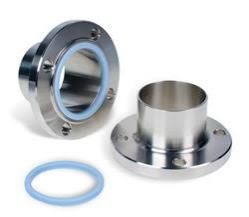
PTFE O-Rings UK Guide: Explore Types, Properties, Applications & Technical Specifications
PTFE O-rings are specialised sealing components used in industrial systems where chemical resistance, temperature tolerance and low friction are important. PTFE stands for polytetrafluoroethylene, a fluoropolymer known for its resistance to many chemicals and its ability to operate across a wide temperature range
In the UK, PTFE O-rings are used in applications involving chemical processing, pharmaceutical manufacturing, food production, fluid handling and industrial equipment. They are available in different dimensions and material formulations to suit specific sealing requirements.
Unlike conventional rubber O-rings, solid PTFE has very limited elasticity. This difference affects how the ring is designed, installed and used. Understanding its properties and limitations is therefore important when assessing whether PTFE is suitable for a particular sealing application.
This guide explains the main types, material characteristics, applications, technical specifications and standards associated with PTFE O-rings in the UK.
1. What Are PTFE O-Rings?
A PTFE O-ring is a circular sealing component with a round cross-section, manufactured from polytetrafluoroethylene. It is designed to sit within a groove or sealing arrangement and help prevent liquids or gases from passing through a connection.
PTFE is a thermoplastic material rather than an elastomer. It does not stretch and recover in the same way as conventional rubber materials such as nitrile or fluorocarbon rubber.
Many solid PTFE O-rings are produced by machining rather than conventional elastomer moulding. This manufacturing approach allows a wide range of internal diameters and cross-sectional sizes to be produced, including special dimensions.
The main dimensions used to identify an O-ring are:
Internal diameter (ID): The diameter measured across the inside of the ring.
Cross-sectional diameter (CS): The thickness of the circular ring material.
Outer diameter (OD): The overall diameter measured across the outside of the ring.
These measurements help determine whether the ring is compatible with the intended groove and sealing arrangement.
2. Types of PTFE O-Rings and Related Sealing Designs
PTFE sealing products are available in different material formulations and constructions. The correct choice depends on the operating environment, sealing movement, pressure and required chemical compatibility.
Virgin PTFE O-Rings
Virgin PTFE is manufactured without added reinforcing fillers. It offers broad chemical resistance, low friction and good resistance to ageing and weather exposure.
It is commonly considered for static sealing arrangements in chemical, pharmaceutical and other industrial environments.
Modified PTFE O-Rings
Modified PTFE formulations are designed to improve selected material characteristics. Depending on the formulation, they may provide improved gas-tightness, mechanical performance or surface properties.
The exact characteristics depend on the manufacturer's material specification, so modified PTFE grades should not be treated as interchangeable.
Filled PTFE Sealing Rings
Filled PTFE contains additional materials such as glass fibre, carbon or other specialised fillers. These additions can change properties such as wear resistance, compressive behaviour and dimensional stability.
Common filler categories include:
| Material formulation | General characteristics |
|---|---|
| Glass-filled PTFE | Can improve wear resistance and mechanical strength |
| Carbon-filled PTFE | Can improve wear and deformation resistance |
| Graphite-filled PTFE | Used in selected applications requiring improved friction and wear characteristics |
| Bronze-filled PTFE | Can improve mechanical and wear-related properties in suitable applications |
The suitability of a filled formulation depends on the chemical environment. Fillers may affect chemical compatibility, electrical properties and suitability for regulated applications.
Expanded PTFE (ePTFE)
Expanded PTFE is produced through a specialised expansion process that creates a porous, flexible structure. It is commonly used in gasket and joint-sealing applications.
Although it is related to solid PTFE, ePTFE is not simply another name for a conventional machined PTFE O-ring. Its construction and sealing behaviour are different.
Spring-Energised PTFE Seals
Spring-energised seals use a PTFE sealing jacket combined with a spring element. The spring helps maintain contact with the sealing surface, particularly where pressure, movement or low friction requirements need careful control.
These components are a separate sealing design rather than ordinary solid PTFE O-rings.
3. Key Properties of PTFE O-Rings
PTFE is selected for its combination of chemical, thermal and surface characteristics. However, these advantages must be considered alongside its mechanical limitations.
Chemical Resistance
PTFE has excellent resistance to many industrial chemicals, including numerous acids, bases, solvents and corrosive fluids.
This property makes it relevant to chemical processing and fluid-handling equipment. However, compatibility should still be checked for the exact chemical, concentration, temperature and operating conditions.
Some substances, including molten alkali metals and certain highly reactive fluorine compounds, can attack PTFE.
Temperature Resistance
PTFE can operate across a wide temperature range. The precise limits depend on the material grade, design, pressure and application.
Manufacturer information commonly describes PTFE sealing applications with upper operating temperatures around 250–260°C, while some specialised formulations and applications have different limits.
Low-temperature performance also varies by product and design. Always consult the technical datasheet rather than relying on a single temperature figure for every PTFE O-ring.
Low Friction
PTFE has a naturally low coefficient of friction. This property can reduce resistance between contacting surfaces and is useful in selected sealing arrangements.
However, low friction does not automatically make a solid PTFE O-ring suitable for every moving application. Its limited elasticity and wear behaviour must also be considered.
Low Water Absorption
PTFE absorbs very little water compared with many other engineering materials. This helps it maintain its material characteristics in many wet environments.
Resistance to Ageing and Weathering
PTFE has good resistance to ultraviolet exposure, ozone and many environmental ageing effects. This can be useful in equipment exposed to demanding surroundings.
Limited Elastic Recovery
One of the most important limitations of solid PTFE is its low elasticity. Unlike rubber, it does not readily return to its original shape after deformation.
Under sustained mechanical loading, PTFE can undergo creep or cold flow. This behaviour can affect sealing pressure and long-term dimensional stability.
4. Industrial Applications of PTFE O-Rings in the UK
PTFE O-rings are used in equipment where conventional elastomer seals may not provide the required chemical or temperature resistance.
Chemical Processing
Chemical processing equipment may handle corrosive liquids, solvents and gases. PTFE sealing components are considered for selected connections, covers, valves and other static sealing arrangements.
Material compatibility must be checked against the actual process media.
Pharmaceutical Manufacturing
Pharmaceutical production equipment may require sealing materials with defined chemical, temperature and cleanliness characteristics.
PTFE is used in some pharmaceutical applications because of its chemical resistance and suitability for selected cleaning and sterilisation processes. Any regulatory or product-contact requirements must be verified for the specific grade.
Food and Beverage Processing
PTFE sealing materials are used in certain food-processing systems, including equipment that handles liquids and cleaning chemicals.
A PTFE material should not automatically be considered suitable for every food-contact application. The exact product, formulation, manufacturing controls and applicable compliance documentation need to be checked.
Medical and Laboratory Equipment
Laboratory and specialised medical equipment may use PTFE components where chemical compatibility, low friction or material stability is required.
The final suitability depends on the equipment design and the applicable regulatory requirements.
Pumps and Valves
PTFE sealing components may be used in selected pump and valve assemblies, particularly where chemical resistance is a major consideration.
However, solid PTFE O-rings are generally more suitable for static sealing than applications involving continuous reciprocating or rotating movement. Specialised PTFE seal designs may be more appropriate for dynamic applications.
Industrial Fluid Systems
Fluid-handling systems in manufacturing and processing environments may use PTFE sealing components in connections, covers and other static arrangements.
The operating pressure, temperature, fluid composition and installation design all influence performance.
5. PTFE O-Ring Technical Specifications
Technical specifications vary between manufacturers and material grades. The following table provides general reference information rather than guaranteed operating limits.
| Technical parameter | General information |
|---|---|
| Base material | Polytetrafluoroethylene (PTFE) |
| Standard formulation | Virgin, unfilled PTFE |
| Appearance | Commonly white or natural in colour; filled grades may differ |
| Cross-section | Circular |
| Main dimensions | Internal diameter and cross-sectional diameter |
| Manufacturing method | Commonly machined |
| Chemical resistance | Excellent resistance to many chemicals |
| Friction | Naturally low |
| Elasticity | Low compared with rubber |
| Water absorption | Very low |
| Temperature capability | Application and grade dependent; some manufacturer specifications extend to approximately 260°C |
| Common sealing arrangement | Primarily static sealing |
| Available dimensions | Standard and specially machined sizes |
Pressure Ratings
Pressure capability depends on the seal geometry, groove dimensions, material formulation, temperature and mechanical support.
Some manufacturer catalogues specify working pressures up to 25 MPa for particular PTFE O-ring designs. This should not be treated as a universal rating.
Pressure-related considerations include:
The size and shape of the sealing groove.
The clearance between mating components.
The possibility of PTFE deformation or extrusion.
The temperature of the operating medium.
The duration of pressure exposure.
Temperature Ratings
Temperature limits should always be taken from the relevant manufacturer's datasheet. A ring that performs adequately at room temperature may behave differently under sustained heat or pressure.
The combined effects of temperature, pressure and chemical exposure should be evaluated rather than considering each parameter independently.
6. UK O-Ring Dimensions and Relevant Standards
PTFE O-rings supplied in the UK may be available in metric and imperial dimensions. Selecting the correct size is important because solid PTFE cannot be stretched or compressed to the same extent as an elastomer O-ring.
Common Dimension Systems
UK sealing specifications may refer to several established dimension systems.
| Standard or system | General purpose |
|---|---|
| ISO 3601 | International O-ring dimensions and related requirements |
| BS 1806 | British imperial O-ring size references |
| BS 4518 | British metric O-ring size references |
| AS568 | American standard O-ring size series |
| JIS B 2401 | Japanese O-ring size standard |
These references may appear in supplier catalogues and engineering drawings. Before selecting a replacement, confirm the exact dimensions and the applicable edition or specification.
A dimensional reference alone does not confirm that a particular PTFE formulation is suitable for the application.
Measuring a PTFE O-Ring
The main measurements to confirm are:
Internal diameter.
Cross-sectional diameter.
Outer diameter, where required.
Groove width and depth.
Installation orientation and available clearance.
The dimensions should be checked against the equipment drawing or manufacturer's installation recommendations.
7. Installation and Design Considerations
PTFE O-rings require more careful installation than many conventional rubber seals because the material has limited elasticity.
Groove Design
The groove must be designed around the actual dimensions and deformation characteristics of the selected PTFE grade.
A suitable groove helps position the ring and maintain the intended sealing arrangement. Manufacturer design tables should be used when determining groove width, depth and corner radii.
Limited Stretching and Compression
PTFE O-rings should not be stretched or compressed excessively during installation. Significant deformation can affect the ring's dimensions and sealing performance.
Where possible, designs that allow straightforward access to the groove can make installation easier.
Cold Flow and Creep
PTFE can deform gradually under sustained pressure, even without high temperatures. This behaviour is commonly described as cold flow or creep.
The design should account for possible deformation, particularly in flange and static sealing arrangements.
Surface Condition
The sealing surfaces should be clean and free from damage that could interfere with contact. Scratches, burrs and contamination may affect sealing performance.
Installation Inspection
Before assembly, check for:
Incorrect dimensions.
Surface damage or machining defects.
Contamination or foreign particles.
Deformation caused by handling.
Compatibility with the intended sealing groove.
Installation instructions should follow the component manufacturer's technical documentation.
8. PTFE O-Rings Compared with Rubber O-Rings
PTFE and elastomer O-rings are designed for different material requirements. Neither is universally suitable for every application.
| Feature | PTFE O-rings | Conventional rubber O-rings |
|---|---|---|
| Elasticity | Low | Generally high |
| Chemical resistance | Excellent against many chemicals | Depends strongly on rubber formulation |
| Friction | Naturally low | Varies by compound and surface finish |
| Elastic recovery | Limited | Generally better |
| Static sealing | Common application | Common application |
| Dynamic sealing | Special designs may be needed | Widely used in suitable designs |
| Installation | Requires careful dimensional control | Usually more flexible during installation |
| Material options | Virgin, modified and filled formulations | NBR, EPDM, FKM, silicone and others |
For example, nitrile rubber is commonly used in selected oil and fuel applications, while EPDM is often considered for suitable water, steam and weathering environments. FKM is used in many applications involving heat and certain chemicals.
The correct choice depends on the exact operating conditions, not simply on the material name.
9. Factors to Consider When Selecting PTFE O-Rings in the UK
A structured selection process helps avoid compatibility and installation problems.
Chemical Compatibility
Identify the exact fluid or gas, its concentration and any cleaning chemicals that may contact the seal. Check compatibility against manufacturer data.
Operating Temperature
Consider normal operating temperatures, temperature fluctuations and short-duration exposure to higher or lower temperatures.
Pressure Conditions
Record the operating pressure, pressure changes and any potential pressure spikes. Confirm that the selected design is appropriate for the groove and clearance conditions.
Static or Dynamic Use
Determine whether the seal will remain stationary or experience repeated movement. Standard solid PTFE O-rings are commonly used for static sealing, while specialised designs may be required for dynamic applications.
Dimensions and Tolerances
Confirm the internal diameter, cross-section and groove dimensions. Do not assume that a rubber O-ring of the same nominal size will have an equivalent fit when replaced with solid PTFE.
Documentation and Compliance
For food, pharmaceutical, drinking-water or other regulated environments, check the documentation for the exact material grade and finished component.
Depending on the application, relevant documentation may include material identification, batch traceability, conformity declarations and product-contact compliance information.
10. Frequently Asked Questions
1. What are PTFE O-rings used for?
PTFE O-rings are used in selected static sealing applications where resistance to chemicals, temperature exposure and low friction are important. Common sectors include chemical processing, pharmaceutical manufacturing, food production and industrial fluid systems.
2. Are PTFE O-rings suitable for high temperatures?
Some PTFE grades can operate at temperatures approaching 260°C under specified conditions. The actual limit depends on the formulation, pressure, seal design and exposure duration.
3. Are PTFE O-rings suitable for dynamic applications?
Conventional solid PTFE O-rings have limited elasticity and are generally used for static sealing. Specialised PTFE seal designs, including spring-energised constructions, may be considered for certain dynamic applications.
4. What is the difference between virgin and filled PTFE?
Virgin PTFE does not contain reinforcing fillers and offers broad chemical resistance. Filled PTFE includes additional materials to modify properties such as wear resistance, stiffness and deformation behaviour. The fillers can also affect chemical compatibility.
5. Which standards are relevant to PTFE O-ring sizes in the UK?
Commonly referenced dimension systems include ISO 3601, BS 1806 and BS 4518. Other international references, such as AS568 and JIS B 2401, may also appear in technical documentation.
6. Can a rubber O-ring be replaced with a PTFE O-ring?
Not automatically. PTFE has much lower elasticity than conventional rubber, so the groove, dimensions, installation method and sealing arrangement may need to be reviewed before replacement.
Conclusion
PTFE O-rings are specialised sealing components valued for their chemical resistance, low friction and ability to operate across a wide range of temperatures. They are used in selected applications throughout the UK's chemical, pharmaceutical, food-processing and industrial sectors.
Their limited elasticity and tendency to deform under sustained loading make correct sizing, groove design and installation particularly important. Understanding the differences between virgin, modified and filled PTFE can also help when evaluating material suitability.
For engineering applications, the final selection should be based on the manufacturer's technical datasheet, chemical compatibility information, dimensional requirements and actual operating conditions.
Technical Disclaimer: This guide is intended for general educational and technical information. The specifications and operating ranges described are indicative and may vary by manufacturer, material formulation and sealing design. Always verify product documentation and obtain an appropriate engineering assessment before using a sealing component in a safety-critical or regulated system.

Related Post...

Hydraulic Power Systems: Fundamentals, Component, and Practicals Knowledges
Updated: November 04, 2026
Read More
Nitrile O-Rings Guide: Explore Types, Sizes, Properties & Industrial Applications
Updated: November 17, 2026
Read More
Enterprise B2B CRM Explained: Learn the Basics, Features, Benefits, and Best Practice
Updated: November 13, 2026
Read More