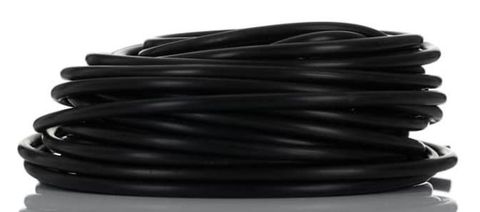
Nitrile O-Rings Guide: Explore Types, Sizes, Properties & Industrial Applications
Nitrile O-rings are widely used sealing components in industrial equipment, hydraulic systems, automotive assemblies, and machinery. Made from nitrile butadiene rubber (NBR), these circular elastomeric rings are designed to prevent liquids or gases from leaking between connected components.
Their popularity comes from their resistance to many petroleum-based oils and fuels, good mechanical strength and flexibility across a range of operating conditions. They are available in different dimensions, hardness levels and compound formulations to suit different sealing requirements.
Understanding their construction, material properties, sizing standards and limitations helps explain why nitrile O-rings are used in so many industrial applications.
1. What Are Nitrile O-Rings?
A nitrile O-ring is a circular rubber sealing component with a round cross-section. It is generally installed in a specially designed groove between two connected surfaces.
When the assembly is tightened, the O-ring becomes compressed. This creates contact pressure against the surrounding surfaces, helping prevent fluid or gas from passing through the connection.
Nitrile rubber is also known as NBR or Buna-N. It is produced from two main chemical components: acrylonitrile and butadiene. The proportion of acrylonitrile influences properties such as oil resistance and low-temperature flexibility.
Nitrile O-rings are commonly found in:
Hydraulic cylinders and pumps
Automotive fuel and lubrication systems
Industrial compressors
Pneumatic equipment
Gearboxes and engines
Industrial valves and pipe connections
2. Types of Nitrile O-Rings
Nitrile O-rings are available in several material formulations and physical configurations. The appropriate type depends on operating temperature, fluid exposure, pressure and mechanical movement.
Standard NBR O-Rings
Standard NBR O-rings are commonly used in general industrial sealing applications. They provide a useful balance of flexibility, oil resistance, mechanical strength and abrasion resistance.
They are frequently found in hydraulic systems, automotive equipment, pumps and machinery that operate with compatible petroleum-based fluids.
High-Acrylonitrile NBR O-Rings
Nitrile rubber formulations can contain different proportions of acrylonitrile. Higher acrylonitrile content generally improves resistance to petroleum oils and fuels.
However, this can reduce low-temperature flexibility. Material selection therefore involves balancing chemical resistance against the required flexibility and operating conditions.
Low-Temperature NBR O-Rings
Low-temperature nitrile compounds are designed to retain flexibility in colder environments than many standard formulations.
They may be considered for equipment exposed to lower temperatures, but their suitability depends on the exact compound and the application's fluid and pressure conditions.
High-Temperature NBR O-Rings
Some NBR formulations are developed for improved heat resistance. These compounds may operate at higher temperatures than standard grades, depending on the fluid and exposure conditions.
The manufacturer's technical data should always be checked because temperature limits vary between formulations.
Hydrogenated Nitrile Rubber (HNBR) O-Rings
HNBR is a related elastomer produced by hydrogenating the polymer structure of conventional nitrile rubber. It generally offers improved heat, ageing and mechanical performance compared with standard NBR.
HNBR is used in applications where additional resistance to heat, mechanical wear or environmental exposure is required. It is a distinct material family and should not be treated as interchangeable with ordinary NBR.
3. Important Properties of Nitrile O-Rings
The performance of an O-ring depends on its material formulation and the conditions in which it operates.
| Property | Description |
|---|---|
| Oil resistance | Good resistance to many mineral oils, petroleum oils and greases |
| Fuel compatibility | Suitable for several petroleum-based fuels, depending on composition |
| Mechanical strength | Good tensile and tear properties in many formulations |
| Abrasion resistance | Helps withstand wear in suitable dynamic applications |
| Flexibility | Allows compression and recovery during sealing |
| Compression set | Resistance to permanent deformation after compression varies by compound |
| Temperature performance | Depends on formulation, fluid and operating conditions |
| Weather resistance | Standard NBR generally has limited ozone and outdoor weather resistance |
Oil and Fuel Resistance
One of the main reasons NBR is used in sealing applications is its resistance to many petroleum-based oils, greases and fuels.
This makes it useful in hydraulic equipment, lubrication systems, engines and other machinery where contact with compatible petroleum products is expected.
However, not every fuel or chemical is compatible with every nitrile compound. Aromatic hydrocarbons and certain solvents can cause swelling or deterioration.
Mechanical Strength
Nitrile rubber offers useful tensile strength, tear resistance and abrasion resistance. These characteristics help O-rings withstand mechanical contact and repeated movement in appropriately designed sealing systems.
Compression Set Resistance
Compression set describes the permanent deformation that remains after a rubber component has been compressed and the load is removed.
A lower compression set generally indicates better recovery. This property matters because an O-ring needs to maintain sufficient contact pressure to continue sealing over time.
Temperature Resistance
Temperature capability varies by compound. Many standard NBR grades are used in a general operating range of approximately -34°C to 100°C, but some specialised formulations have different limits.
Actual performance also depends on the fluid, pressure, exposure duration and mechanical conditions. A temperature range should therefore be treated as a material-specific guideline rather than a universal guarantee.
Limitations of NBR
Standard nitrile rubber has some important limitations:
Limited resistance to ozone and prolonged outdoor weather exposure.
Poor compatibility with several ketones and polar solvents.
Limited suitability for some aromatic hydrocarbons.
Temperature capability may be insufficient for high-heat environments.
Compatibility with certain brake fluids and specialised hydraulic fluids must be checked.
These limitations make material compatibility testing and manufacturer guidance important when selecting a sealing component.
4. Nitrile O-Ring Sizes and Standards
O-ring size is one of the most important factors in achieving an effective seal. A ring that is too large, too small or incorrectly matched to its groove may leak or become damaged.
Understanding O-Ring Dimensions
O-rings are generally specified using two main dimensions:
Inside diameter (ID): The diameter of the open space inside the ring.
Cross-section (CS): The thickness of the circular rubber profile.
The outside diameter can be calculated using the inside diameter and twice the cross-section.
For example, an O-ring with an inside diameter of 20 mm and a cross-section of 3 mm has an approximate outside diameter of 26 mm.
Common Sizing Systems
Several sizing systems are used internationally:
| Standard | Main purpose |
|---|---|
| AS568 | Defines standard inch-based O-ring sizes commonly used in North America |
| ISO 3601 | Covers O-ring dimensions, tolerances and related requirements |
| BS 1806 | An established British inch-based O-ring size reference |
| Metric sizing | Uses millimetres for inside diameter and cross-section |
ISO 3601 includes different parts addressing O-ring dimensions, housing dimensions, quality acceptance criteria and elastomeric material requirements.
Shore Hardness
O-ring hardness indicates how resistant the rubber is to indentation. It is commonly measured using a Shore A durometer for elastomeric materials.
Typical NBR O-ring formulations include 70 and 90 hardness grades, although other formulations are available.
70 Shore A: Commonly used for general-purpose sealing applications.
90 Shore A: A harder formulation that may be considered for certain higher-pressure or extrusion-sensitive applications.
Hardness alone does not determine suitability. Groove dimensions, pressure, temperature and material properties must also be considered.
5. Industrial Applications of Nitrile O-Rings
Nitrile O-rings are used across industries because many machines require dependable seals around compatible oils, fuels and lubricants.
Automotive Industry
Automotive systems use O-rings in fuel-related assemblies, oil systems, pumps, filters and other mechanical connections.
NBR formulations are selected where their chemical and temperature properties match the specific operating environment.
Hydraulic Systems
Hydraulic machinery uses pressurised fluid to transmit force. O-rings can help seal connections in pumps, cylinders, valves and other hydraulic components.
Material hardness and groove design are particularly important in these applications because pressure can force rubber into gaps between connected surfaces.
Pneumatic Equipment
Pneumatic systems use compressed air or gas to operate machinery. Nitrile O-rings may be used in compatible valves, cylinders, fittings and air-handling equipment.
Their selection depends on pressure, temperature, lubrication and exposure to other substances.
Industrial Pumps and Compressors
Pumps and compressors contain multiple connections and moving components that may require sealing. NBR O-rings are used in suitable equipment where compatibility with lubricants and operating conditions is established.
Manufacturing Machinery
Manufacturing equipment may use O-rings in gear assemblies, hydraulic controls, lubrication systems and machine connections.
Their role is to help contain fluids and maintain separation between internal and external environments.
Agriculture and Construction Equipment
Agricultural machinery, excavators, loaders and other heavy equipment often use hydraulic systems. Nitrile seals may be found in compatible pumps, cylinders, valves and fittings.
The correct formulation is important because these machines can experience vibration, pressure changes, temperature variation and exposure to outdoor conditions.
6. Nitrile O-Rings vs Other Common O-Ring Materials
NBR is not the only elastomer used in industrial sealing. Other materials may be more appropriate when operating conditions involve different chemicals or temperatures.
| Material | Key characteristics | Common considerations |
|---|---|---|
| NBR | Good resistance to many petroleum oils and fuels | Limited ozone and weather resistance |
| HNBR | Improved heat and mechanical performance compared with standard NBR | Compound-specific compatibility |
| FKM | Good resistance to many oils, fuels and elevated temperatures | Compatibility and low-temperature limits vary |
| EPDM | Good resistance to water, steam and many weather conditions | Generally unsuitable for petroleum oils |
| Silicone (VMQ) | Flexible across a broad temperature range | Limited abrasion and tear resistance in many grades |
The best material depends on the exact fluid, temperature, pressure, movement and expected operating life. No single elastomer is suitable for every application.
7. How to Select the Right Nitrile O-Ring
Selecting an O-ring involves more than matching its material name and dimensions. Several technical factors should be considered.
Identify the Operating Fluid
Determine whether the O-ring will contact mineral oil, fuel, grease, water, hydraulic fluid or another chemical.
Check a compatibility chart for the exact NBR compound and fluid. General material descriptions are not sufficient for every chemical mixture.
Check Temperature Conditions
Identify the minimum and maximum operating temperatures, including short-term temperature changes.
The chosen compound should maintain suitable flexibility and sealing properties throughout the expected temperature range.
Consider Pressure
System pressure affects O-ring deformation and the possibility of extrusion into gaps. Hardness, groove design, clearance and the use of backup rings may be relevant in higher-pressure systems.
Measure the Correct Dimensions
Confirm the inside diameter, cross-section and groove dimensions. Also check the applicable standard and tolerances.
Using an incorrectly sized O-ring can lead to stretching, excessive compression, twisting or leakage.
Select the Appropriate Hardness
The hardness grade should suit the pressure, sealing geometry and movement involved. A harder compound may be useful in certain conditions, but it is not automatically better for every application.
Review Manufacturer Specifications
Technical datasheets provide information about temperature limits, hardness, chemical compatibility and mechanical performance. These details should be reviewed before the component is selected.
8. Installation and Maintenance Considerations
Correct installation can help reduce premature wear and sealing problems.
Installation Guidelines
Inspect the O-ring for cuts, cracks, contamination and visible defects.
Clean the groove and mating surfaces before installation.
Confirm that the O-ring dimensions match the equipment specification.
Use a compatible lubricant when the design or manufacturer recommends it.
Avoid twisting, stretching or sharply bending the ring during installation.
Protect the O-ring from sharp edges and damaged threads.
Follow the equipment manufacturer's assembly instructions.
Common Causes of O-Ring Failure
| Failure type | Possible cause |
|---|---|
| Swelling | Incompatible fluid or chemical exposure |
| Cracking | Heat, ageing or environmental exposure |
| Flattening | Compression set or prolonged compression |
| Cuts and tears | Sharp edges or incorrect installation |
| Abrasion | Excessive movement or unsuitable surface finish |
| Extrusion | High pressure or excessive clearance |
| Hardening | Thermal ageing or material incompatibility |
Storage Practices
O-rings should be stored in conditions that limit unnecessary material deterioration.
General storage practices include keeping them away from direct sunlight, ozone-producing equipment, excessive heat and incompatible chemicals. They should also be protected from dust, sharp objects and unnecessary deformation.
Manufacturer storage guidance should take priority, especially for specialised compounds.
9. Frequently Asked Questions
1. What does NBR stand for in O-rings?
NBR stands for nitrile butadiene rubber. It is an elastomer made from acrylonitrile and butadiene and is commonly used in sealing components.
2. Are nitrile O-rings suitable for oil applications?
Yes. NBR generally provides good resistance to many mineral oils, petroleum oils and greases. The exact fluid and compound should still be checked for compatibility.
3. What is the usual temperature range of nitrile O-rings?
Many standard NBR compounds are used at approximately -34°C to 100°C. Specialised grades may have different operating limits, so the manufacturer's datasheet should be consulted.
4. What is the difference between NBR and HNBR O-rings?
Both are nitrile-based elastomers, but HNBR is hydrogenated to improve certain properties, including heat and mechanical performance. Their chemical compatibility and temperature limits are compound-specific.
5. How are nitrile O-rings measured?
The two primary dimensions are inside diameter and cross-section. The outside diameter can be calculated from these measurements, but the groove dimensions and applicable sizing standard must also be checked.
Conclusion
Nitrile O-rings are important sealing components used in automotive systems, hydraulic machinery, pumps, compressors and manufacturing equipment. Their resistance to many petroleum-based fluids, useful mechanical properties and availability in different sizes make them suitable for a wide range of industrial applications.
However, their performance depends on the exact rubber formulation, dimensions, hardness, operating temperature and chemical exposure. Understanding these factors helps explain how nitrile O-rings are selected, installed and maintained in different sealing systems.
Disclaimer: This article is intended for general educational and technical information. Actual material compatibility, dimensional requirements and operating limits should be verified using the equipment manufacturer's specifications and the relevant O-ring compound datasheet.

Related Post...

Industrial Sealing Rings Guide: Overview, Details, and Key Informations
Updated: November 13, 2026
Read More
System Integration Challenges Guide: Explore Common Problems, Causes & Solutions
Updated: November 17, 2026
Read More
Enterprise B2B CRM Explained: Learn the Basics, Features, Benefits, and Best Practice
Updated: November 13, 2026
Read More