Overhead EOT Crane Overview: Types & Applications
Overhead EOT cranes are among the most widely used material handling systems in manufacturing facilities, warehouses, steel plants, power stations, construction projects, and industrial production environments.
EOT stands for Electric Overhead Traveling crane, a system designed to lift, move, position, and transport heavy loads within a defined workspace.
Modern overhead crane systems combine electric hoists, bridge structures, trolley mechanisms, crane controls, and safety technologies to support efficient material movement. These cranes help industries handle heavy equipment, raw materials, production components, and finished products while improving workflow organization and operational efficiency.
Understanding overhead EOT crane systems, their configurations, components, applications, safety considerations, and maintenance requirements can help organizations evaluate suitable lifting solutions for industrial operations.
Overhead EOT Crane at a Glance
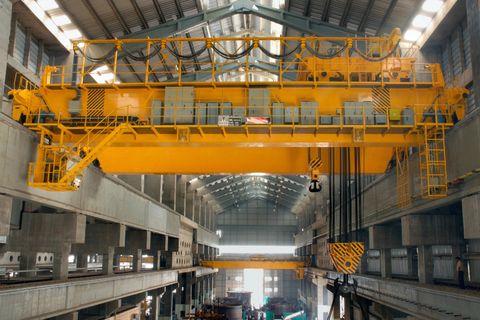
An overhead EOT crane is a material handling system that travels on elevated runway beams and moves loads horizontally and vertically within a facility. The crane consists of a bridge, trolley, hoist, control system, and supporting runway structure. These cranes are commonly used in manufacturing, metal processing, logistics facilities, warehouses, power plants, and industrial production environments.
Understanding Overhead EOT Crane Systems
An overhead EOT crane operates above the working area using a bridge structure that moves along runway rails. A trolley carrying the hoist travels across the bridge, allowing loads to be positioned accurately throughout the operating area.
The combination of bridge travel, trolley movement, and vertical hoisting enables the crane to reach multiple locations within a facility without occupying valuable floor space.
Modern industrial crane systems can be integrated with automation controls, load monitoring equipment, wireless controls, and advanced safety technologies to support demanding lifting operations.
Major Types of Overhead EOT Cranes
Different EOT crane configurations are designed for specific industrial requirements.
Single Girder EOT Cranes
Single girder cranes use one main bridge beam to support the trolley and hoist system.
These cranes are commonly used for:
- Warehouses
- Fabrication workshops
- Manufacturing facilities
- Assembly operations
- Maintenance areas
Their design often provides an effective solution for moderate lifting requirements.
Double Girder EOT Cranes
Double girder cranes use two bridge girders to support the trolley.
Advantages may include:
- Higher lifting capacities
- Larger spans
- Increased lifting heights
- Enhanced structural strength
- Support for heavy-duty operations
These cranes are frequently used in steel processing, heavy manufacturing, power generation, and large industrial facilities.
Top Running Cranes
Top running cranes travel on rails mounted above runway beams.
They are commonly selected when facilities require larger lifting capacities and maximum hook coverage.
Under Running Cranes
Under running cranes operate beneath supporting structures.
They are often used where building design or operational requirements favor suspended crane configurations.
Core Components of an Overhead EOT Crane
Several components work together to create a reliable industrial lifting system.
Bridge Structure
The bridge forms the primary horizontal support system of the crane.
It spans the working area and carries the trolley and hoist assembly.
Hoist System
The hoist performs the vertical lifting operation.
Electric wire rope hoists and electric chain hoists are commonly used depending on capacity and application requirements.
Trolley Mechanism
The trolley moves across the bridge structure and positions the hoist over the required lifting location.
Runway System
Runway beams guide crane movement throughout the operating area.
Proper runway alignment is important for smooth crane operation.
Control System
Modern crane controls may include:
- Pendant controls
- Radio remote controls
- Cabin controls
- Variable frequency drives
- Automated control systems
Safety Equipment
Safety devices may include overload protection, emergency stop systems, limit switches, collision avoidance systems, and load monitoring technologies.
How an Overhead EOT Crane Works
The crane performs three primary movements:
- The hoist raises and lowers the load.
- The trolley moves across the bridge.
- The bridge travels along runway rails.
These combined movements allow operators to position loads accurately throughout the work area.
Advanced industrial crane systems may also integrate load positioning assistance, motion control technology, and automation features.
Applications Across Industries
Overhead EOT cranes support a wide range of industrial operations.
Manufacturing Facilities
Manufacturing plants use cranes to transport raw materials, production components, tooling, and finished products.
Steel Processing
Steel mills frequently use heavy-duty cranes for handling coils, plates, structural materials, and fabricated components.
Warehousing Operations
Warehouses utilize overhead lifting equipment for material transfer, equipment handling, and storage support.
Power Plants
Power generation facilities often rely on cranes for equipment maintenance, component installation, and operational support.
Construction Equipment Manufacturing
Large components and fabricated assemblies may require overhead lifting systems during production and assembly processes.
Logistics and Material Handling
Industrial logistics operations use EOT cranes to support organized movement of heavy materials within facilities.
Selecting the Right Overhead Crane
Several factors should be evaluated before selecting an overhead EOT crane.
Lifting Capacity
The crane should be capable of handling the maximum expected load safely.
Span Requirements
Bridge span should match the dimensions of the operating area.
Lifting Height
Required hook travel and vertical clearance should be evaluated carefully.
Duty Cycle
Operational frequency influences equipment design and component selection.
Facility Structure
Building dimensions, runway support, and available installation space affect crane selection.
Future Expansion
Organizations should consider potential growth when planning material handling infrastructure.
Automation in Modern Crane Systems
Industrial automation continues to influence overhead crane technology.
Modern crane automation may include:
- Automated positioning
- Load monitoring systems
- Smart controls
- Remote operation
- Anti-sway technology
- Predictive maintenance monitoring
- Real-time diagnostics
- Industrial IoT connectivity
These technologies help improve operational visibility and equipment performance.
Safety Considerations
Safety remains one of the most important aspects of crane operation.
Important safety measures include:
- Operator training
- Load capacity compliance
- Routine inspections
- Emergency stop systems
- Overload protection
- Safe lifting procedures
- Equipment monitoring
- Runway inspections
- Proper rigging practices
- Preventive maintenance programs
Safety planning should address the complete lifting operation rather than focusing solely on the crane itself.
Maintenance Best Practices
Routine maintenance helps maintain reliability and operational performance.
Inspect Hoist Components
Wire ropes, chains, hooks, and lifting devices should be examined regularly.
Check Electrical Systems
Motors, control panels, wiring, and safety devices should be inspected according to maintenance schedules.
Monitor Structural Components
Bridge girders, trolley assemblies, runway systems, and supporting structures should be evaluated for wear or damage.
Lubricate Moving Parts
Proper lubrication supports smooth operation and helps reduce component wear.
Review Safety Devices
Limit switches, overload protection systems, and emergency controls should be tested regularly.
Maintain Service Records
Accurate maintenance documentation helps track equipment history and support preventive maintenance planning.
Benefits of Overhead EOT Cranes
Overhead crane systems provide several operational advantages.
- Supports efficient material handling
- Maximizes floor space utilization
- Handles heavy industrial loads
- Improves workflow organization
- Supports manufacturing operations
- Integrates with industrial automation systems
- Enables controlled load positioning
- Reduces manual material movement
- Supports warehouse operations
- Provides flexible lifting coverage
- Improves operational productivity
- Supports large-scale industrial processes
The specific benefits depend on crane design, application requirements, facility layout, and operational practices.
Latest Developments in EOT Crane Technology
Modern overhead crane systems continue to evolve through automation, intelligent monitoring, and connected industrial technologies.
Advanced sensors can monitor load conditions, equipment status, operating cycles, and maintenance requirements. Predictive maintenance systems help identify potential issues before significant downtime occurs.
Industrial IoT integration, anti-sway controls, smart diagnostics, automated positioning, and remote monitoring technologies are increasingly becoming part of modern crane installations.
These developments support safer and more efficient material handling operations across industrial facilities.
Frequently Asked Questions
What does EOT crane stand for?
EOT stands for Electric Overhead Traveling crane, a lifting system designed to move heavy loads within industrial facilities.
What is the difference between single girder and double girder cranes?
Single girder cranes use one bridge beam, while double girder cranes use two bridge beams and are often suitable for heavier lifting requirements.
Where are overhead EOT cranes commonly used?
They are widely used in manufacturing plants, warehouses, steel processing facilities, power plants, logistics centers, and industrial production environments.
How does an overhead crane move loads?
The hoist lifts the load vertically, the trolley moves across the bridge, and the bridge travels along runway rails.
What safety features are commonly used?
Overload protection, emergency stop systems, limit switches, collision avoidance systems, and load monitoring technologies are common safety features.
Why is preventive maintenance important?
Routine maintenance helps identify wear, mechanical issues, electrical problems, and safety concerns before they affect operations.
Can overhead cranes be automated?
Yes. Modern systems can include automated positioning, smart controls, load monitoring, remote operation, and predictive maintenance technologies.
Key Takeaways
- Overhead EOT cranes are widely used for industrial material handling.
- Single girder and double girder cranes serve different lifting requirements.
- Hoists, trolleys, bridges, and runway systems are key components.
- Modern cranes integrate automation and monitoring technologies.
- Safety procedures are essential for lifting operations.
- Preventive maintenance supports long-term equipment reliability.
- Industrial IoT and smart diagnostics are shaping future crane systems.
Conclusion
Overhead EOT cranes are essential material handling systems used across manufacturing, logistics, steel processing, power generation, and industrial production facilities. Their ability to lift, transport, and position heavy loads efficiently makes them a valuable component of modern industrial operations.
Understanding crane types, system components, safety requirements, automation technologies, and maintenance practices helps organizations evaluate suitable lifting solutions for their operational needs. As industrial automation continues to advance, overhead EOT cranes are becoming increasingly intelligent, connected, and capable of supporting complex material handling environments.

Related Post...
Non-Destructive Testing Equipment Insights: Industrial Inspection
Updated: October 06, 2026
Read More