Modern Bottling Machines Explained: What Happens From Filling to Capping
Modern bottling machines are automated systems that clean, fill, close, and label containers in a continuous line. People search for them to understand how everyday drinks, oils, and household liquids end up in sealed, uniform bottles. This guide explains the process in plain language, along with the main filling methods and the rules that apply in India.
Key takeaways
- A bottling line moves containers through rinsing, filling, capping, labeling, and inspection stations.
- Filling methods differ because thin, fizzy, and thick liquids behave differently inside a machine.
- Sensors and cameras check fill level, caps, and labels while the line runs.
- Indian food, packaging, and measurement rules apply to bottled products, depending on the product type.
Related searches
- how does a bottling machine work
- automatic vs semi-automatic bottling machine difference
- types of filling methods explained
- bottling line stages explained
- how are bottles filled and sealed in factories
- is bottling machine safe for food-grade liquids
In this guide
- What Are Modern Bottling Machines and How Did They Develop?
- Why Do Modern Bottling Machines Matter Today?
- What Are the Recent Trends in Bottling Technology?
- Which Indian Rules Apply to Bottling Operations?
- Gravity vs Pressure vs Piston Filling: Differences Explained
- Tools and Resources for Learning More
- FAQs About Modern Bottling Machines
- Conclusion
What Are Modern Bottling Machines and How Did They Develop?
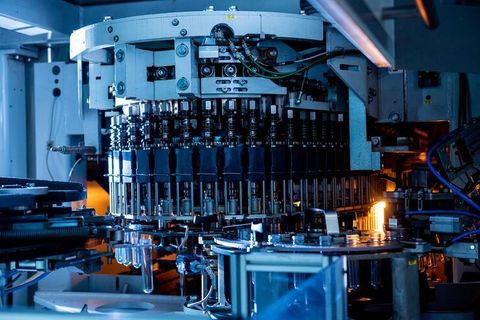
A bottling machine moves containers along a line so each one is cleaned, filled, closed, and labeled in a repeating cycle. The idea grew out of hand filling, where workers poured liquids through funnels and pressed corks into place one container at a time.
As demand for packaged drinks, oils, sauces, and household liquids grew, factories linked mechanical stages into one line. Today's equipment adds sensors, servo motors, and programmable logic controllers, which are small industrial computers that coordinate every station.
How does a bottling machine work step by step?
Most lines follow the same basic order, though details change with the product and container.
- Rinsing: Empty bottles are turned upside down and cleaned with water, air, or a sanitizing solution.
- Filling: Each bottle is aligned under a nozzle, and liquid flows in until the target volume or level is reached.
- Capping: A machine places and tightens, crimps, or presses a closure to seal the bottle.
- Labeling and coding: Labels, batch numbers, and dates are applied, often with printers or laser markers.
- Inspection and packing: Cameras and sensors check fill level, cap position, and label placement before bottles are grouped into cartons.
What happens inside the filling station?
The filling station is where product meets container, so its design matters most. Gravity fillers let thin liquids such as water flow down under their own weight. Pressure fillers use a slightly pressurized tank, which helps fizzy drinks keep their gas. Piston fillers push out measured portions of thick products such as sauces, while flow-meter fillers measure liquid as it passes through a pipe.
Why Do Modern Bottling Machines Matter Today?
Packaged liquids are part of daily life, from drinking water and milk to cooking oil and cleaning products. Automated lines help producers fill many containers with consistent volume, which matters because people expect each bottle to match its label.
Hygiene is another reason. Closed filling stations limit how long a product is exposed to air and handling, which lowers the chance of contamination.
Who is affected by bottling technology?
- Consumers receive sealed products with uniform quantities and clear labels.
- Small and mid-sized producers use compact or semi-automatic machines to bring more consistency to their work.
- Factory workers handle fewer repetitive manual tasks but need training to run and maintain equipment.
- Communities are affected by packaging waste and water use.
Which everyday problems does it address?
Automation reduces uneven fill levels, spills, loose caps, and the physical strain of repetitive manual filling. It also makes it easier to trace a product back to its production batch.
What Are the Recent Trends in Bottling Technology?
Between 2024 and 2026, the general direction has been toward smarter, more flexible, and more resource-conscious lines.
- Data monitoring: Machines record output, stoppages, and fill accuracy so operators can spot problems early.
- Vision inspection: Cameras check caps, labels, and fill levels in real time.
- Quick changeover: Adjustable parts let one line handle several bottle sizes with less downtime.
- Lighter packaging: Producers are testing thinner bottles and recycled-content plastic, which machines must handle gently.
- Efficiency: Newer designs aim to reduce water, compressed air, and electricity use.
- Compact modular units: Smaller machines are designed for producers with limited floor space.
Which Indian Rules Apply to Bottling Operations?
Several Indian bodies set rules for bottled products. The points below are general information, not professional or legal advice, and requirements vary by product.
- Food safety: The Food Safety and Standards Authority of India (FSSAI) sets hygiene, licensing, and labeling requirements for food and beverages under the Food Safety and Standards Act, 2006.
- Quantity declarations: The Legal Metrology (Packaged Commodities) Rules, 2011 require packages to declare net quantity, date of manufacture, and other details.
- Quality standards: The Bureau of Indian Standards (BIS) publishes standards for products such as packaged drinking water, and some products require certification.
- Plastic packaging: The Plastic Waste Management Rules, 2016, and their later amendments set responsibilities for producers using plastic packaging, including extended producer responsibility.
- Workplace safety: The Factories Act, 1948 covers safe operation of machinery in registered factories.
Gravity vs Pressure vs Piston Filling: Differences Explained
| Filling method | How it works | Typical liquids | Key point |
|---|---|---|---|
| Gravity | Liquid flows down into the bottle through a nozzle | Water, thin juices | Simple design, suited to low-viscosity liquids |
| Pressure (counter-pressure) | Bottle is pressurized to match the tank before liquid enters | Fizzy drinks | Helps keep dissolved gas in the liquid |
| Piston | A cylinder draws in and pushes out a set volume | Sauces, creams, thick oils | Handles thick products with set portions |
| Flow meter | A sensor measures liquid volume as it passes | Milk, cleaning liquids | Volume can be adjusted through settings |
| Vacuum | Air is drawn from the bottle so liquid fills to a set level | Glass-bottled liquids, some oils | Fill level appears consistent across bottles |
Tools and Resources for Learning More
- FSSAI website and its FoSCoS portal for food business licensing and labeling information
- Department of Consumer Affairs, Legal Metrology section, for packaged commodity rules
- Bureau of Indian Standards website and standards catalog
- Central Pollution Control Board, for plastic waste management and producer responsibility information
- Indian Institute of Packaging, for packaging education and testing information
- Equipment manuals and technical standards documents published by machine makers
FAQs About Modern Bottling Machines
What is a modern bottling machine?
It is an automated system that rinses, fills, caps, labels, and inspects containers in sequence, using sensors and controllers to keep each step consistent.
How does a bottling machine work for different liquids?
The filling method changes with the liquid. Thin liquids use gravity, fizzy drinks use pressure, and thick products use pistons.
What is the difference between semi-automatic and automatic bottling machines?
Semi-automatic machines need an operator to place or move bottles between steps. Automatic lines move bottles through all stations without manual handling.
Are modern bottling machines safe for food-grade liquids?
Machines built for food use rely on stainless steel or approved materials and are cleaned between runs. Safety also depends on maintenance and hygiene practices.
Do modern bottling machines work with plastic and glass bottles?
Many can, though parts such as grippers, nozzles, and cappers are usually adjusted or changed for each material and size.
Conclusion
Modern bottling machines combine mechanical stations, sensors, and controllers to move containers through cleaning, filling, sealing, labeling, and inspection. The filling method varies with the liquid, and each method suits particular products. These systems matter because they support consistent quantities, hygiene, and traceability in everyday packaged goods. In India, food, measurement, quality, plastic, and factory rules shape how bottled products are produced and presented.

Related Post...
Plasma Cutting Machines: Types, Working Principles, Uses & Safety Guide
Updated: November 27, 2026
Read More