LLM Workflow Guide: Explore AI Models, Automation, Integration & Enterprise Applications
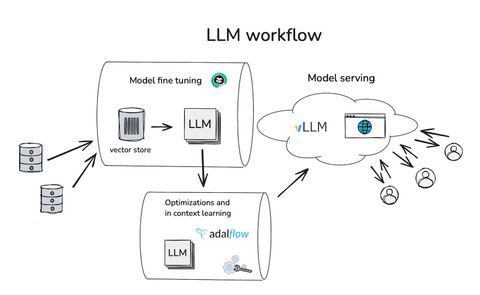
Large Language Model (LLM) workflows describe the structured processes used to connect AI language models with data, applications, tools and business systems. Instead of using an LLM only as a standalone chatbot, organizations can incorporate models into automated workflows that receive information, process requests, retrieve relevant data, perform actions and generate outputs.
LLM workflows can range from simple prompt-and-response applications to sophisticated enterprise systems involving retrieval-augmented generation, APIs, databases, workflow automation, human review and multiple AI models.
This guide explores the fundamentals of LLM workflows, AI models, automation, integration technologies, workflow architecture, security considerations and enterprise applications.
What Is an LLM Workflow?
An LLM workflow is a sequence of connected steps in which a large language model processes information and contributes to a defined task or business process.
A basic workflow may look like:
Input → Prompt → LLM → Output
A more advanced workflow may look like:
User Input → Data Retrieval → Context Processing → LLM → Tool/API Action → Validation → Final Output
The exact architecture depends on the application.
How LLM Workflows Work
An LLM workflow generally consists of several stages.
1. Input
The workflow first receives information from a user, application, document, database or another system.
Inputs can include:
- Text
- Documents
- Questions
- Customer messages
- Structured data
- API requests
- Images in multimodal systems
2. Processing
The input may be cleaned, classified, transformed or enriched before reaching the model.
3. Context Retrieval
Some workflows retrieve relevant information from databases, documents or knowledge bases.
4. Model Processing
The LLM analyzes the available instructions and context and generates a response or structured result.
5. Tool or System Interaction
The workflow can connect the model to external tools or APIs.
6. Validation
The generated result can be checked before being delivered or used by another system.
7. Output
The final result may be returned to a user, stored in a database or passed to another application.
Core Components of an LLM Workflow
A production LLM workflow can contain multiple technical components.
Large Language Model
The LLM is the central reasoning and language-processing component.
Models can be used for tasks such as:
- Text generation
- Classification
- Summarization
- Extraction
- Translation
- Question answering
- Code generation
- Structured data generation
Different models vary in capabilities, context limits, speed, multimodal support and resource requirements.
Prompt
A prompt provides instructions and contextual information to the model.
Prompts can contain:
- System instructions
- User requests
- Examples
- Retrieved information
- Output requirements
- Constraints
Effective prompts help establish what the model should do and how the result should be structured.
Context
Context provides information that the model needs to complete a task.
It can come from:
- User input
- Previous interactions
- Documents
- Databases
- APIs
- Knowledge bases
Context management becomes increasingly important as workflows become more complex.
APIs
Application Programming Interfaces allow an LLM workflow to communicate with external applications.
APIs can connect AI systems with:
- CRM platforms
- ERP systems
- Databases
- Search systems
- Communication platforms
- Analytics systems
- Internal applications
Databases
Databases provide persistent storage for information used by applications.
An LLM workflow may retrieve or update information from:
- Relational databases
- Document databases
- Data warehouses
- Knowledge bases
- Vector databases
LLM Workflow Architecture
A typical architecture can contain the following layers:
User/Application Layer
↓
Workflow Orchestration Layer
↓
LLM Layer
↓
Data and Retrieval Layer
↓
Tools and API Layer
↓
Enterprise Systems
Each layer has a different role.
Application Layer
This is where users interact with the AI system.
Examples include:
- Web applications
- Mobile applications
- Internal portals
- Chat interfaces
- Customer-support interfaces
Orchestration Layer
The orchestration layer controls the sequence of workflow operations.
It can determine:
- Which model to use
- When to retrieve data
- Which tool to call
- How to process results
- When human approval is required
Model Layer
The model layer contains one or more AI models used for processing.
A workflow may use different models for different tasks.
Data Layer
The data layer provides information needed by the workflow.
This may include:
- Enterprise documents
- Databases
- Knowledge repositories
- Customer information
- Product information
Integration Layer
The integration layer connects the AI workflow with external systems.
It may use:
- REST APIs
- Webhooks
- Database connections
- Messaging systems
- Enterprise integration platforms
LLM Workflow vs Simple Chatbot
A simple chatbot generally responds to user prompts using a language model.
An LLM workflow can perform multiple connected operations.
| Feature | Simple Chatbot | LLM Workflow |
|---|---|---|
| User interaction | Common | Common |
| External data | Limited or optional | Frequently integrated |
| API actions | Limited | Common |
| Automation | Basic | Advanced |
| Multi-step processing | Limited | Common |
| Database integration | Optional | Often important |
| Validation | Basic | Can be multi-stage |
| Enterprise integration | Limited | Extensive |
Retrieval-Augmented Generation
Retrieval-Augmented Generation (RAG) is a widely used architecture for connecting LLMs with external information.
A simplified RAG workflow is:
Question → Search/Retrieval → Relevant Information → LLM → Answer
Instead of relying exclusively on information encoded during model training, the workflow retrieves relevant information from an external knowledge source.
RAG can be useful for:
- Internal documentation
- Product information
- Technical manuals
- Policies
- Research collections
- Knowledge bases
Vector Databases in LLM Workflows
Vector databases can store numerical representations of information called embeddings.
These representations can be used to identify semantically similar content.
A typical retrieval process may involve:
- Converting documents into embeddings
- Storing the embeddings
- Converting a user query into an embedding
- Searching for similar information
- Passing relevant results to the LLM
Vector search can support semantic retrieval rather than relying only on exact keyword matches.
LLM Workflow Automation
Automation allows LLM workflows to perform tasks with limited manual intervention.
Examples include:
- Email classification
- Document summarization
- Data extraction
- Content categorization
- Customer-query routing
- Report generation
- Internal knowledge retrieval
- Workflow notifications
Automation should generally include appropriate validation and controls for important business processes.
AI Agents and LLM Workflows
An AI agent is an AI-based system that can use models, tools and contextual information to pursue a task.
An agentic workflow can involve:
Goal → Reasoning → Tool Selection → Action → Observation → Next Step
Unlike a simple prompt-response system, an agentic workflow may determine which tools or actions are needed during execution.
However, agentic architectures can introduce additional complexity, including:
- Tool-selection errors
- Unexpected actions
- Higher latency
- Increased resource usage
- Security risks
Multi-Agent LLM Workflows
Some applications use multiple specialized AI agents.
For example:
Research Agent → Analysis Agent → Writing Agent → Review Agent
Each agent can perform a particular role.
Potential applications include:
- Research
- Software development
- Document processing
- Data analysis
- Business intelligence
Multi-agent systems require careful coordination and monitoring.
LLM Workflow Integration
Integration allows AI systems to become part of existing business processes.
CRM Integration
An LLM workflow can interact with customer relationship management systems to support:
- Customer-query classification
- Record summarization
- Information extraction
- Follow-up recommendations
- Customer communication workflows
ERP Integration
Enterprise resource planning systems contain business information related to areas such as:
- Finance
- Inventory
- Procurement
- Operations
- Human resources
LLM workflows can provide natural-language interfaces for selected ERP data and processes when appropriate access controls are implemented.
Email Integration
Email systems can be connected to workflows for tasks such as:
- Classification
- Summarization
- Information extraction
- Routing
- Draft generation
Document Management Integration
LLM workflows can process documents and extract structured information.
Examples include:
- Contracts
- Reports
- Invoices
- Technical documentation
- Policies
- Research documents
Workflow Orchestration
Orchestration coordinates multiple steps within an AI workflow.
An orchestration system may determine:
- Which task runs first
- Which model is called
- When retrieval occurs
- Which API is used
- How errors are handled
- When the workflow ends
For complex applications, orchestration becomes a major part of the system architecture.
Structured Outputs
LLMs can be instructed to return information in structured formats rather than free-form text.
For example, a workflow might request:
- JSON
- Tables
- Classified categories
- Extracted fields
- Database-ready records
Structured outputs make it easier to connect LLMs with software systems.
Function Calling and Tool Use
Function calling allows a model to request a predefined software function.
For example:
User request → LLM → Function request → API → Result → LLM → Response
Possible tools include:
- Search
- Calculator
- Database query
- Calendar
- CRM
- Inventory system
- Internal knowledge base
Tools should have clearly defined permissions and input validation.
LLM Workflow Memory
Some applications need information from previous interactions.
Memory can be implemented through different mechanisms.
Short-Term Context
Information from the current interaction is provided directly to the model.
Persistent Memory
Selected information can be stored externally and retrieved later.
Conversation History
Previous messages can be included when relevant.
Memory architecture should account for privacy, relevance and data-retention requirements.
LLM Workflow Security
Security is particularly important when LLMs interact with business systems.
Potential risks include:
- Prompt injection
- Unauthorized data access
- Sensitive information exposure
- Insecure tool execution
- Malicious documents
- Improper permissions
- Data leakage
- Excessive system privileges
Security controls should be implemented across the complete workflow rather than only at the model layer.
Access Control
AI workflows should operate with clearly defined permissions.
For example, an AI assistant may be permitted to:
- Read selected documents
- Search a knowledge base
- Create a draft
but not necessarily:
- Delete records
- Modify financial data
- Approve transactions
The principle of least privilege can help reduce unnecessary access.
Data Privacy in LLM Workflows
Organizations should determine:
- What information enters the workflow
- Where information is stored
- Who can access it
- How long information is retained
- Which external systems receive it
Sensitive organizational information requires appropriate technical and governance controls.
Human-in-the-Loop Workflows
Not every AI decision should be fully automated.
A human-in-the-loop workflow can require human approval for important actions.
For example:
AI Analysis → Recommendation → Human Review → Approval → Action
This approach can be useful for higher-risk processes.
LLM Workflow Evaluation
LLM applications need evaluation beyond traditional software testing.
Evaluation can examine:
- Accuracy
- Relevance
- Completeness
- Consistency
- Safety
- Response format
- Tool-use accuracy
- Retrieval quality
Test datasets can be used to compare workflow performance over time.
Monitoring LLM Workflows
Production workflows should be monitored for:
- Response latency
- Error rates
- Model failures
- API failures
- Token usage
- Retrieval quality
- Tool calls
- Unexpected outputs
Monitoring helps teams identify performance and reliability problems.
LLM Workflow Cost Considerations
LLM workflows can consume resources through:
- Model inference
- API calls
- Data retrieval
- Vector database operations
- Storage
- Monitoring
- Workflow execution
Optimization strategies can include:
- Selecting appropriate models
- Limiting unnecessary context
- Caching repeated requests
- Reducing redundant model calls
- Using smaller models for simpler tasks
LLM Workflow Performance
Performance depends on several factors.
Model Latency
Different models can have different response times.
Context Size
Large prompts can increase processing requirements.
Number of Workflow Steps
More steps can increase total execution time.
External APIs
Third-party API response times can affect the workflow.
Retrieval
Large or inefficient searches can add latency.
Efficient workflow architecture should balance accuracy, complexity and response time.
Common LLM Workflow Patterns
Prompt-and-Response
The simplest pattern:
Input → LLM → Output
Useful for straightforward language tasks.
Retrieval-Augmented Workflow
Input → Retrieval → LLM → Output
Useful when external information is required.
Tool-Calling Workflow
Input → LLM → Tool → Result → LLM → Output
Useful when the AI needs external capabilities.
Human Approval Workflow
Input → LLM → Recommendation → Human Review → Action
Useful for controlled business processes.
Multi-Step Workflow
Input → Classification → Retrieval → Processing → Validation → Output
Useful for complex tasks requiring multiple stages.
LLM Workflows in Enterprise Applications
LLM workflows can support many enterprise functions.
Customer Support
Potential applications include:
- Query classification
- Knowledge retrieval
- Response generation
- Ticket summarization
- Escalation routing
Human Resources
Potential applications include:
- Policy search
- Document summarization
- Employee-question routing
- Internal knowledge assistance
Finance
Possible applications include:
- Document extraction
- Report summarization
- Financial-document classification
- Data-query interfaces
Financial workflows require particularly strong controls when AI systems influence decisions or access sensitive information.
Legal and Compliance
LLM workflows can support:
- Document review
- Policy retrieval
- Clause identification
- Compliance research
Human review can remain important for high-impact legal decisions.
Software Development
LLMs can assist with:
- Code generation
- Code explanation
- Documentation
- Testing assistance
- Issue classification
- Code review support
LLM Workflow for Document Processing
A document workflow can follow this architecture:
Document Upload → Text Extraction → Classification → Information Extraction → Validation → Database
For large document collections, retrieval systems can be added.
LLM Workflow for Research
A research-oriented workflow might include:
- Receive research question
- Search relevant sources
- Retrieve documents
- Extract important information
- Organize findings
- Generate a structured summary
- Validate references
The workflow should distinguish between generated information and verified source material.
LLM Workflow for Content Creation
A content workflow can include:
Topic → Research → Outline → Draft → Review → Formatting → Publication
Different AI models or workflow stages can be used for different tasks.
Human review can help maintain factual accuracy, editorial quality and brand consistency.
LLM Workflow for Data Extraction
LLMs can extract structured fields from unstructured documents.
For example:
Document → LLM → Structured Fields → Validation → Database
Possible fields include:
- Names
- Dates
- Categories
- Addresses
- Product information
- Identifiers
Validation is important because model-generated extraction may contain errors.
LLM Workflow vs Traditional Automation
| Feature | Traditional Automation | LLM Workflow |
|---|---|---|
| Structured inputs | Strong | Strong |
| Unstructured text | Limited | Strong |
| Natural-language interaction | Limited | Strong |
| Rule-based processing | Strong | Can be combined |
| Flexible language tasks | Limited | Strong |
| External tools | Common | Common |
| Human review | Possible | Often useful |
| Predictability | Usually high | Can vary |
The two approaches can be combined rather than treated as alternatives.
Combining LLMs with RPA
Robotic Process Automation (RPA) can automate structured, repetitive tasks, while LLMs can process unstructured language.
A combined workflow might be:
Document → LLM Extraction → Validation → RPA → Enterprise Application
This architecture can connect language-based AI capabilities with established business automation.
Challenges of LLM Workflows
Despite their capabilities, LLM workflows present several challenges.
Accuracy
Models can generate incorrect information.
Hallucinations
An LLM may produce plausible but unsupported information.
Integration Complexity
Connecting AI systems with existing enterprise applications can require substantial engineering.
Security
Tool access and sensitive data create additional security requirements.
Reliability
AI outputs can be less deterministic than traditional software.
Monitoring
Production AI workflows require specialized monitoring and evaluation.
Governance
Organizations need policies governing AI usage, data access and human oversight.
Best Practices for Building LLM Workflows
Define the Objective
Start with a specific business or user problem.
Use the Right Model
Choose models based on task requirements rather than using the largest model for every task.
Keep Workflow Steps Clear
Separate complex tasks into manageable stages when appropriate.
Validate Important Outputs
Use rules, software checks or human review for critical operations.
Restrict Tool Permissions
Give AI workflows only the access they require.
Monitor Performance
Track errors, latency, usage and output quality.
Protect Data
Apply appropriate authentication, authorization, encryption and data-handling practices.
Design for Failure
Plan for:
- Model errors
- API failures
- Missing data
- Invalid outputs
- Timeout conditions
Future of LLM Workflows
LLM workflows are moving toward increasingly integrated AI systems.
Future developments may include:
- More capable reasoning models
- Multimodal workflows
- Agentic systems
- Automated workflow orchestration
- Better enterprise retrieval
- More reliable structured outputs
- AI-assisted software development
- Greater integration with business applications
- Improved observability and governance
The direction of development is increasingly focused on connecting AI models with tools, data and real-world business processes rather than treating LLMs as standalone text-generation systems.
Key Facts About LLM Workflows
- LLM workflows connect language models with applications, data and tools.
- A workflow can contain multiple processing stages.
- RAG allows models to use external information.
- APIs connect AI workflows with enterprise systems.
- Tool calling allows models to interact with predefined functions.
- Structured outputs simplify integration with software systems.
- Human-in-the-loop processes can provide additional control.
- Security and access management are essential for enterprise deployments.
- Monitoring helps evaluate production workflow performance.
- Automation can reduce repetitive manual processes.
- Different models can be used for different workflow tasks.
- Enterprise workflows can combine LLMs with traditional automation technologies.
Frequently Asked Questions
What is an LLM workflow?
An LLM workflow is a sequence of connected steps that uses a large language model together with prompts, data, tools, applications or other systems to complete a task.
How does an LLM workflow differ from a chatbot?
A chatbot primarily focuses on conversational interaction, while an LLM workflow can include data retrieval, API calls, automation, validation and enterprise-system integration.
What is RAG in an LLM workflow?
Retrieval-Augmented Generation is an architecture that retrieves relevant external information and provides it to an LLM as context for generating a response.
Can LLMs connect to business applications?
Yes. LLM workflows can connect with business applications through APIs, databases, webhooks and integration systems, subject to appropriate security controls.
What is an AI agent?
An AI agent is a system that can use an AI model, tools and contextual information to pursue a defined task, potentially taking multiple steps before producing a result.
Are LLM workflows fully automated?
Some workflows can be highly automated, while others include human review or approval steps. The appropriate level depends on the task and its risk.
Why is human review important?
Human review can provide an additional control for decisions or outputs where errors could have significant consequences.
What is function calling?
Function calling allows an AI model to request a predefined function or tool so that an application can perform an external action or retrieve information.
What are common enterprise applications of LLM workflows?
Applications include customer support, document processing, research, software development, knowledge management, data extraction and internal business assistance.
What are the major challenges of LLM workflows?
Common challenges include accuracy, hallucinations, security, data privacy, integration complexity, monitoring, reliability and governance.
Conclusion
LLM workflows represent a shift from using AI models as standalone conversational systems toward integrating them into structured digital processes.
A modern workflow can combine LLMs, prompts, retrieval systems, databases, APIs, automation, business applications, validation mechanisms and human oversight. This makes it possible to apply language-model capabilities to a wide range of enterprise processes.
Technologies such as RAG, function calling, workflow orchestration, AI agents, structured outputs and Infrastructure as Code can contribute to increasingly sophisticated AI architectures. At the same time, organizations need to address security, privacy, accuracy, monitoring and governance when deploying these systems.
The most effective LLM workflow is not necessarily the most complex one. It is the architecture that uses the appropriate model, data, tools and automation for a clearly defined task while maintaining appropriate controls and reliability.
Disclaimer: This article is intended for general educational and informational purposes only. LLM capabilities, model architectures, APIs and AI technologies change rapidly. Enterprise implementations should be evaluated according to their specific technical, security, privacy, regulatory and operational requirements.

Lavit
Our content is designed to attract, persuade, and convert your audience. We help brands grow through strategic, audience-first writing.
August 10, 2026 . 8 min read
Related Post...

Complete IASToday Master Plus Guide: Explore Program Structure, Resources & Learning Tools
By: Lavit
Updated: August 10, 2026
Read More
Latest Automotive Technology Guide: Explore EVs, AI, ADAS, Connected Cars & Future Mobility
By: Lavit
Updated: August 11, 2026
Read More
Electric Vehicles Explained: An Informative Guide to Basic, Technology, and Everyday Use
By: Lavit
Updated: August 18, 2026
Read More