Laser Wood Cutting Machines: Complete Guide to Basics, Technologies, Processes, Facts, and Best Practices
Laser wood cutting machines are used in woodworking, furniture production, interior decoration, craft manufacturing and customised product manufacturing. They use a concentrated laser beam to cut or engrave wooden materials according to a digital design. CNC control guides the laser head along programmed paths, helping produce detailed patterns, lettering, shapes and components.
A laser wood cutting machine can process materials such as plywood, medium-density fibreboard (MDF), solid wood, veneer and selected engineered wood sheets, provided the material is compatible with the machine and its extraction system.
A CO2 laser wood cutting machine is commonly used for wood processing because its wavelength is well absorbed by many non-metallic materials. Industrial systems may include larger working areas, higher-power laser sources, automatic material handling and advanced ventilation.
This guide explains the working principle, components, machine types, materials, applications, selection factors and safety practices associated with laser wood cutting.
1. What Is a Laser Wood Cutting Machine?
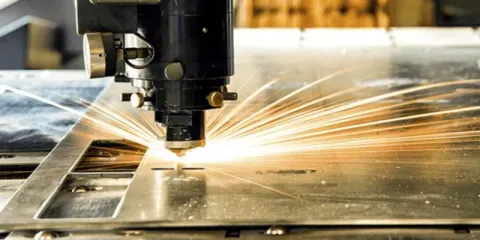
A laser wood cutting machine is equipment that uses a focused laser beam to cut or engrave wooden materials. The beam heats a small area of the surface, causing the material to decompose, vaporise or burn along the programmed cutting path.
The machine generally includes a laser source, optical system, cutting head, CNC controller, working table, motion system and fume extraction arrangement.
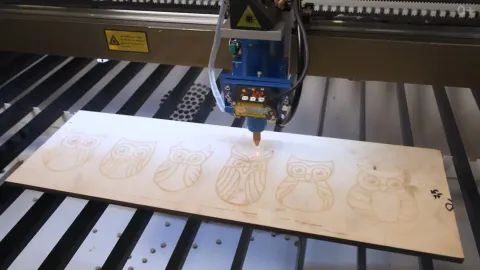
Unlike conventional saws and cutting tools, laser processing does not require a blade to make physical contact with the wood. The laser follows a digital path, allowing the machine to produce intricate designs and narrow cuts.
Key characteristics include:
Digital control of cutting and engraving patterns.
Ability to produce detailed shapes and lettering.
Contact-free processing.
Compatibility with several wood-based materials.
Repeatable cutting paths when correctly configured.
Ability to combine cutting and engraving operations.
The quality of the finished component depends on wood density, moisture content, thickness, resin and adhesive composition, laser power, speed, focus and air assistance.
2. How Does a Laser Wood Cutting Machine Work?
A CNC laser wood cutting machine converts a digital drawing into a physical cut or engraved pattern.
Typical working process:
Design preparation: A drawing or pattern is created using CAD or vector-design software.
File preparation: The design is converted into a compatible machine file.
Material inspection: The operator checks the wood type, thickness, surface condition and suitability for laser processing.
Material positioning: The sheet or wooden piece is placed securely on the working table.
Laser generation: The laser source produces a beam at the required operating settings.
Beam focusing: Mirrors and lenses direct and concentrate the beam onto the material.
Cutting or engraving: The CNC controller moves the laser head along the programmed design.
Air assistance: A directed air stream helps remove smoke and debris from the cutting area and can reduce local heat accumulation.
Fume extraction: Smoke and airborne by-products are collected through the machine's extraction system.
Finished-part inspection: The cut edges, dimensions and engraved details are checked.
Laser cutting wood involves thermal decomposition and combustion effects, not simply mechanical separation. Airflow, focus and material properties therefore have an important influence on edge quality and charring.
3. Main Components of a Laser Wood Cutting Machine
Component | Main function |
|---|---|
Laser source | Generates the laser beam |
Optical mirrors | Direct the beam through the optical path |
Focusing lens | Concentrates the beam onto the wood surface |
Laser head | Holds and directs the focusing assembly |
CNC controller | Executes programmed cutting and engraving instructions |
Motion system | Moves the laser head along the required axes |
Servo or stepper motors | Control mechanical movement |
Working table | Supports the wooden sheet |
Air-assist system | Directs air towards the cutting area |
Chiller or cooling system | Maintains suitable temperatures in designated components |
Exhaust fan | Draws smoke and airborne by-products away |
Filtration system | Captures selected airborne particles and contaminants |
Control panel | Allows operators to monitor machine settings |
Industrial systems may also include automatic focusing, honeycomb or slatted worktables, rotary attachments, camera positioning, material sensors and automatic loading arrangements.
4. Types of Laser Wood Cutting Machines
Laser wood cutting equipment is available in different configurations depending on material thickness, production volume, working area and required detail.
4.1 CO2 Laser Wood Cutting Machine
A CO2 laser wood cutting machine uses a gas-based laser source that generates infrared laser radiation. Wood absorbs this energy effectively, making CO2 systems suitable for many cutting and engraving applications.
Key characteristics:
Suitable for plywood, MDF, solid wood and selected acrylic materials.
Supports cutting and engraving operations.
Available in desktop and industrial configurations.
Can produce detailed patterns and decorative designs.
Requires suitable cooling and fume extraction arrangements.
4.2 CNC Laser Wood Cutting Machine
A CNC laser wood cutting machine uses computer numerical control to guide the laser head according to digital design instructions.
It can produce repeated components, intricate shapes, decorative patterns and lettering. CNC operation also supports accurate positioning and repeatable production when the machine is properly calibrated.
4.3 Industrial Laser Wood Cutting Machine
An industrial laser wood cutting machine is designed for regular production in furniture, interior component and woodworking facilities. It may have a larger working table, higher laser output, enclosed processing area, automatic material handling and integrated extraction equipment.
4.4 Plywood Laser Cutting Machine
A plywood laser cutting machine is configured to process layered wood sheets. It is used for decorative panels, models, furniture components, partitions and craft products.
Plywood contains adhesive layers, so its composition and manufacturer's material documentation should be checked before processing. Different adhesive systems can produce different smoke and residue characteristics.
4.5 MDF Laser Cutting Machine
An MDF laser cutting machine is designed for processing medium-density fibreboard. MDF is made from wood fibres combined with binding materials under heat and pressure.
It is used for decorative lettering, panels, models and selected furniture components. MDF can produce significant smoke and darkened edges during laser processing, making extraction and material assessment particularly important.
4.6 Desktop and Small-Format Laser Machines
Compact machines are used for smaller components, engraving, prototypes and customised decorative work. Their working area and cutting capacity are generally more limited than those of industrial systems.
5. Laser Technologies Used for Wood Processing
Different laser sources and configurations are available for wood cutting and engraving.
CO2 laser technology
CO2 lasers are widely used for non-metallic materials, including wood, acrylic, paper and selected textiles. Their infrared wavelength is absorbed effectively by many organic materials.
Diode laser technology
Diode laser systems are often used for engraving and selected thin-material cutting applications. Their cutting capability depends on optical output, wavelength, focus, material type and thickness.
Fiber laser technology
Fiber lasers are primarily associated with metal processing and are not the usual first choice for conventional wood cutting. Their suitability for wood-based applications must be established using the specific system's approved material capabilities.
Cutting and engraving compared
Operation | Purpose | Typical result |
|---|---|---|
Vector cutting | Follows a line or outline through the material | Separate wooden parts |
Surface engraving | Processes the upper surface | Text, patterns and decorative marks |
Raster engraving | Scans across an area in rows | Shaded designs and filled graphics |
Score marking | Creates a shallow line | Assembly guides and decorative outlines |
The same machine may perform several of these operations, but each requires suitable settings and a compatible material.
6. Materials Processed by Laser Wood Cutting Machines
A laser cutting machine for wood can process different natural and engineered wood materials. Their suitability depends on thickness, adhesive content, moisture, density and machine capability.
Material | Common applications | Important consideration |
|---|---|---|
Plywood | Decorative panels, models and furniture components | Adhesive composition and layer consistency |
MDF | Lettering, panels and decorative designs | Smoke extraction and edge charring |
Solid wood | Signs, ornaments and wooden components | Grain, knots and moisture variation |
Veneer | Decorative surface patterns | Thin material requires careful handling |
Birch plywood | Models, craft components and panels | Layer quality and adhesive compatibility |
Bamboo sheets | Decorative items and selected panels | Density and material composition |
Particleboard | Selected decorative components | Binder composition and emissions |
Plywood laser cutting
Plywood consists of multiple wood layers bonded together. The laser must cut through both the wood and adhesive layers. Variations in thickness, glue distribution and surface quality can affect the finished edge.
MDF laser cutting
MDF offers a relatively uniform structure, which can help produce consistent patterns. However, its binding materials and fine wood fibres can generate smoke and residue. The material should only be processed when its composition is known and suitable for the equipment.
Solid wood cutting
Solid wood varies according to species, grain direction, density, resin content and moisture. These differences can affect cutting depth, edge appearance and the amount of charring.
7. Important Technologies and Features
Modern laser wood cutting machines combine optical systems, software and automation to improve positioning and process control.
Automatic focus adjustment: Helps maintain the correct focal position for the material.
Air-assist control: Regulates airflow directed towards the cutting area.
CNC motion control: Guides the laser head along the programmed path.
Camera positioning: Helps align the design with the actual material position.
Rotary attachments: Allow selected machines to process cylindrical objects.
Material sensors: Help monitor selected operating or positioning conditions.
Exhaust and filtration systems: Remove smoke and capture selected airborne contaminants.
Digital design software: Supports drawing preparation, layout and cutting-path generation.
An industrial machine may also include automated sheet feeding, material positioning and production monitoring features.
8. Applications of Laser Wood Cutting Machines
Laser wood cutting is used across several manufacturing and design activities.
Industry or activity | Typical applications |
|---|---|
Furniture manufacturing | Decorative panels, inserts and selected components |
Interior design | Wall patterns, partitions and decorative elements |
Architecture and modelling | Scale models and structural mock-ups |
Sign manufacturing | Wooden lettering and engraved signs |
Craft production | Ornaments, patterns and personalised items |
Education | Design models and fabrication projects |
Packaging | Selected wooden inserts and display components |
Product development | Prototypes and precision-cut parts |
The technology is especially useful for components that require intricate outlines, small cut-outs or repeated decorative patterns.
9. Factors to Consider When Selecting a Machine
Selecting a laser wood cutting machine requires an assessment of the materials, design requirements and production environment.
Material compatibility: Confirm that the machine is approved for the intended wood and adhesive composition.
Material thickness: Identify the usual and maximum sheet thickness.
Laser source: Consider CO2, diode or other technology according to the application.
Laser output: Match the source rating to the required cutting and engraving tasks.
Working area: Check that the table accommodates the largest material sheet.
Cutting accuracy: Review positioning accuracy and repeatability specifications.
CNC software: Check compatibility with CAD, vector and machine-control file formats.
Air assistance: Assess airflow adjustment and nozzle design.
Extraction capacity: Confirm that smoke and airborne by-products can be effectively removed.
Cooling system: Check cooling requirements and operating-temperature limits.
Safety enclosure: Review protective covers, interlocks and emergency stops.
Maintenance: Consider lens cleaning, mirror alignment, exhaust filters and replacement components.
Before selecting a machine, conduct controlled sample trials using the actual material. Review cut-through consistency, edge charring, dimensional accuracy and extraction performance.
10. Quality Control in Laser Wood Cutting
Quality checks help maintain consistent dimensions, edge appearance and finished-product quality.
Common inspection activities include:
Dimensional inspection: Check the length, width and shape of finished components.
Cut-through inspection: Confirm that the laser has separated the material completely.
Edge inspection: Look for excessive charring, roughness and uneven cutting.
Engraving inspection: Check the depth, clarity and alignment of engraved details.
Surface inspection: Identify smoke stains, burn marks and unwanted residue.
Repeatability checks: Compare several components produced using the same program.
Material verification: Confirm that the correct wood type and thickness were used.
Vernier callipers, measuring scales, templates and other suitable measuring instruments can be used according to the required dimensions.
11. Recent Developments and Industry Trends
Laser wood processing continues to develop through improvements in automation, software and extraction systems.
Important trends include:
Improved CNC software: More advanced design tools support complex patterns, nesting and repeatable cutting paths.
Automatic material positioning: Camera-assisted alignment helps position designs on irregular or previously marked sheets.
Enhanced air-assist systems: Better airflow control can help reduce excessive heat accumulation and residue around cutting paths.
Integrated extraction: Modern systems increasingly combine exhaust arrangements and filtration with the cutting enclosure.
Multi-function machines: Some systems combine cutting, engraving and rotary processing.
Digital production monitoring: Connected controls help record machine activity, operating settings and production information.
These developments can improve workflow and process consistency. However, they do not eliminate the need for material testing, fire prevention and regular machine inspection.
12. Safety Requirements and Indian Standards
Laser wood cutting involves several hazards, including laser radiation, fire, hot surfaces, moving parts and smoke from heated wood and adhesives. Safety arrangements must address all these risks.
Laser radiation safety
CO2 laser systems commonly use infrared radiation, which is not visible to the human eye. Direct or reflected exposure can cause serious injuries.
Important precautions include:
Use a suitable protective enclosure.
Maintain functional door interlocks and safety switches.
Restrict access to trained and authorised operators.
Never look directly into an active laser beam.
Use appropriate protective eyewear where required by the risk assessment.
Follow approved procedures for optical-system maintenance.
ISO 11553-1:2020 specifies laser radiation safety requirements for laser processing machines. The standard was reviewed and confirmed as current in 2025.
Fire prevention
Wood is combustible, and laser cutting can create sparks, hot particles and glowing residue. A small flare-up can develop into a larger fire if the machine is left unattended.
Recommended precautions include:
Never leave an operating laser cutter unattended.
Keep the cutting table clear of accumulated wood residue.
Inspect the exhaust duct and extraction system regularly.
Maintain suitable fire-detection and emergency arrangements.
Keep combustible materials away from the machine.
Follow the equipment manufacturer's procedures for handling flare-ups.
Material and fume safety
Not every wood-based sheet is suitable for laser processing. Some coatings, adhesives and chemical treatments can release hazardous or corrosive by-products.
Verify material composition before cutting.
Do not process unknown plastics, coated sheets or chemically treated materials without confirming compatibility.
Never laser-cut PVC or vinyl because heating these materials can release corrosive and harmful gases.
Use effective extraction and suitable filtration.
Do not assume that an open machine cover or ordinary room ventilation is sufficient.
Material compatibility guidance specifically warns against processing PVC and vinyl in laser systems.
Indian standards and regulatory considerations
The Bureau of Indian Standards publishes safety guidance for machinery and woodworking equipment. Relevant references include:
IS 16819:2018 / ISO 12100:2010: General machinery safety principles, including risk assessment and risk reduction.
IS 18057 (Part 1):2023: Common safety requirements for woodworking machines. Its scope should be checked before applying it to a particular laser system.
ISO 11553-1:2020: Laser processing machine radiation safety requirements.
BIS+1
The Machinery and Electrical Equipment Safety (Omnibus Technical Regulation) Order, 2024 was withdrawn by the Ministry of Heavy Industries through a notification dated 14 January 2026, published on 16 January 2026. Its earlier proposed implementation date of 1 September 2026 should therefore not be treated as an active requirement under that withdrawn order.
Manufacturers and operators should verify applicable state factory rules, fire-safety requirements, electrical safety provisions and current BIS notifications before making compliance decisions.
13. Best Practices for Operating Laser Wood Cutting Machines
Following consistent operating procedures helps maintain cutting quality and reduce operational risks.
Inspect the material: Verify wood type, thickness, moisture condition and adhesive composition.
Prepare the design: Check dimensions, cutting paths and engraving details before starting.
Clean the working table: Remove accumulated dust, chips and residue.
Inspect the optics: Check lenses and mirrors according to the manufacturer's maintenance instructions.
Set suitable parameters: Use approved power, speed and focus settings for the material.
Check air assistance: Confirm that airflow is directed correctly towards the cutting area.
Verify extraction: Ensure that the exhaust system is operating before processing begins.
Monitor cutting: Watch for abnormal smoke, excessive charring or flare-ups.
Inspect finished parts: Check dimensions, cut-through and edge quality.
Maintain the machine: Clean optical components and inspect filters, ducts and cooling systems.
Train operators: Provide training on machine controls, fire precautions and emergency procedures.
Maintain records: Document material details, machine settings, inspections and maintenance activities.
Operators should not bypass protective enclosures, safety interlocks or emergency controls to increase production speed.
14. Tools and Resources
The following resources can help manufacturers and operators understand machine operation, material preparation and safety.
Resource | Purpose |
|---|---|
Bureau of Indian Standards (BIS) | Indian machinery and woodworking safety standards |
International Organization for Standardization (ISO) | Laser processing machine safety standards |
CAD software | Preparation of digital drawings |
Vector design software | Creation of cutting and engraving patterns |
CAM software | Preparation of machine cutting instructions |
Material data sheets | Verification of wood and adhesive composition |
Measuring instruments | Inspection of finished component dimensions |
Fume extraction systems | Removal of smoke and airborne by-products |
Machine maintenance manuals | Approved operating and maintenance procedures |
15. Frequently Asked Questions
1. What is a laser wood cutting machine used for?
It is used to cut and engrave wooden materials such as plywood, MDF, veneer and selected solid woods. Common applications include decorative panels, furniture components, models, lettering and craft products.
2. Which laser is commonly used for wood cutting?
CO2 lasers are commonly used because their infrared wavelength is well absorbed by many wood-based materials. Diode systems are also used for selected engraving and thin-material applications.
3. Can a plywood laser cutting machine process MDF?
Some machines can process both materials, but the cutting settings and results may differ. MDF has a different density and binding composition, so material testing and suitable extraction are important.
4. Why do laser-cut wooden edges become dark?
Dark edges are generally caused by heat and combustion during processing. Laser power, cutting speed, focus, airflow, material composition and moisture can influence the amount of charring.
5. Is a laser wood cutting machine suitable for industrial production?
Yes. Industrial systems can be used for regular woodworking and decorative-component production. Their suitability depends on working area, laser output, material thickness, automation and extraction capacity.
Conclusion
Laser wood cutting machines are useful tools for woodworking, furniture manufacturing, interior decoration and customised component production. They combine focused laser energy with CNC control to create detailed cuts, patterns and engraved designs.
A CO2 laser wood cutting machine is widely used for plywood, MDF, solid wood and other compatible non-metallic materials. Machine selection should consider material composition, thickness, working area, laser output, cutting accuracy and extraction requirements.
Safe and consistent operation depends on material verification, suitable cutting settings, effective ventilation, fire precautions and regular maintenance. By following approved operating procedures and relevant safety standards, manufacturers can maintain reliable cutting quality and a safer working environment.
Disclaimer: This article is intended for general educational and informational purposes only. Machine specifications, material compatibility, operating parameters and applicable regulations may vary by equipment and location. Consult qualified technical professionals, equipment manufacturers and relevant authorities before making operational or compliance decisions. The information is not intended to provide guarantees or to sell or promote any product, brand or organisation.

Related Post...
Sachet Packing Machines: Discover Information, Facts, Tips, Resources, and Expert Advice
Updated: November 23, 2026
Read More
Shrink Wrapping Machines: Explore Overview, Basics, Explanation, Knowledge, and Key Details
Updated: November 23, 2026
Read More