Industrial Air Compressors: Types, Components, Working Principles & Applications
Industrial air compressors are important machines used in manufacturing plants, workshops, processing facilities and other industrial environments. They convert electrical or mechanical power into compressed air, which can be used to operate pneumatic equipment, control machinery, transport materials and support production processes.
Different industries require different compressed-air systems depending on their pressure, airflow, operating hours and air-quality requirements. Some facilities use piston compressors for intermittent operations, while others rely on rotary screw or centrifugal compressors for continuous industrial demand.
Understanding the types, components and working principles of industrial air compressors helps explain how these systems support modern industrial operations. This guide explores their main technologies, applications, maintenance requirements and selection considerations.
1. What Are Industrial Air Compressors?
An industrial air compressor is a mechanical machine that draws atmospheric air into a compression chamber and increases its pressure by reducing its volume or adding kinetic energy.
The compressed air is then supplied through a distribution system to equipment and machinery that require pneumatic power.
Industrial compressed air is commonly used for:
Operating pneumatic tools and machinery.
Supporting automated production lines.
Controlling pneumatic valves and actuators.
Spray painting and surface finishing.
Packaging and material handling.
Cleaning and drying industrial equipment.
Supporting selected process and laboratory operations.
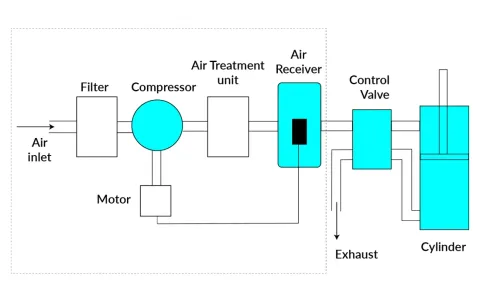
A complete compressed-air installation may include the compressor, electric motor, air receiver, air dryer, filters, pressure regulators, piping and monitoring equipment.
2. Main Types of Industrial Air Compressors
Industrial air compressors are broadly classified into two categories: positive displacement compressors and dynamic compressors. These categories are based on how they increase the pressure of air.
Positive Displacement Compressors
Positive displacement compressors trap a specific quantity of air inside a chamber and mechanically reduce its volume. This increases the air pressure before it is discharged.
Common types include:
A. Reciprocating or Piston Compressors
Reciprocating compressors use pistons that move inside cylinders to compress air. The piston movement is driven by a crankshaft and connecting rod.
During the intake stroke, air enters the cylinder through an inlet valve. During the compression stroke, the piston moves upward, reducing the available volume and increasing pressure. The compressed air then exits through a discharge valve.
Common applications include:
Industrial maintenance workshops.
Small manufacturing operations.
Automotive workshops.
High-pressure, lower-flow applications.
Intermittent pneumatic equipment.
B. Rotary Screw Compressors
Rotary screw compressors use two rotating helical elements, commonly called male and female rotors, to compress air.
Air enters the compression chamber and becomes trapped between the rotors. As the rotors rotate, the available space decreases and air pressure increases before discharge.
These compressors are widely used in industrial environments because they can support continuous compressed-air demand.
Common applications include:
Automotive manufacturing.
Packaging facilities.
Textile production.
Metalworking operations.
General manufacturing plants.
Industrial automation.
C. Scroll Compressors
Scroll compressors use two spiral-shaped elements. One remains stationary while the other moves in an orbital pattern, trapping and gradually compressing air.
They are generally compact and operate with relatively low vibration. Oil-free scroll designs are available for applications requiring tighter control of oil contamination.
Common applications include:
Laboratories.
Medical and dental facilities.
Electronics manufacturing.
Instrumentation systems.
Smaller industrial operations.
D. Rotary Vane Compressors
Rotary vane compressors contain a rotor with sliding vanes fitted inside a housing. As the rotor turns, the vanes create chambers that change in volume, compressing the trapped air.
Depending on their design and operating conditions, they can be used in selected industrial and commercial applications.
Dynamic Compressors
Dynamic compressors increase air pressure by accelerating continuously flowing air and converting its velocity energy into pressure energy.
A. Centrifugal Compressors
Centrifugal compressors use a rapidly rotating impeller to accelerate incoming air outward. A diffuser then slows the air and converts part of its kinetic energy into static pressure.
They are commonly used in facilities that require large volumes of compressed air and relatively continuous operation.
Applications include:
Large manufacturing plants.
Chemical processing facilities.
Power generation.
Steel production.
Petrochemical operations.
Large industrial utility systems.
B. Axial Compressors
Axial compressors move air along the direction of the rotating shaft. Multiple rows of rotating and stationary blades progressively increase the air pressure.
They are generally associated with specialised high-flow applications, including gas turbines and certain large industrial processes.
3. Main Components of an Industrial Air Compressor
An industrial air compressor contains several mechanical, electrical and control components. Their arrangement varies according to the compressor technology and system design.
| Component | Main function |
|---|---|
| Electric motor or engine | Supplies mechanical power to the compressor |
| Compression element | Increases the pressure of incoming air |
| Air intake filter | Removes airborne particles before compression |
| Intake valve | Controls the entry of air into the compression chamber |
| Discharge valve | Allows compressed air to leave the compression chamber |
| Cooling system | Helps control operating temperature |
| Lubrication system | Reduces friction and wear in lubricated designs |
| Oil separator | Separates lubricant from compressed air in oil-injected systems |
| Air receiver tank | Stores compressed air and helps manage demand fluctuations |
| Pressure switch or controller | Monitors and regulates compressor operation |
| Safety relief valve | Releases pressure when the system exceeds its specified safety limit |
| Air dryer and filters | Reduce moisture and contaminants in the compressed-air supply |
Not every compressor includes all these components within the same enclosure. Some air-treatment and storage equipment is installed separately as part of the complete compressed-air system.
4. Working Principles of Industrial Air Compressors
The working principle depends on the type of compressor, but most industrial compressed-air systems follow a common sequence.
Step 1: Air Intake
The compressor draws atmospheric air through an intake opening. An intake filter helps remove dust and other particles before the air enters the compression section.
Step 2: Air Compression
The compression mechanism increases the pressure of the incoming air.
In a piston compressor, a moving piston reduces the volume of air inside a cylinder. In a rotary screw compressor, rotating elements progressively reduce the available chamber volume. In a centrifugal compressor, a rotating impeller increases air velocity before a diffuser converts kinetic energy into pressure.
Step 3: Cooling
Compression increases air temperature. Cooling equipment may be used to reduce the temperature of the compressed air before it moves further through the system.
Depending on the installation, cooling may take place between compression stages or after the final compression stage.
Step 4: Moisture Separation and Air Treatment
As compressed air cools, some of its water vapour condenses into liquid. Moisture separators, dryers and filters help remove water and other contaminants.
The required treatment depends on the quality of air needed by the industrial process.
Step 5: Storage and Distribution
Compressed air may be stored in an air receiver before being distributed through pipes to different machines and workstations.
The receiver helps manage short-term variations in demand and can reduce frequent compressor cycling in suitable systems.
Step 6: Pressure Regulation and Usage
Pressure regulators and control valves help provide the required pressure at individual points of use.
The compressed air can then operate pneumatic tools, cylinders, actuators, automated equipment and other industrial systems.
5. Applications of Industrial Air Compressors
Industrial air compressors support a wide range of manufacturing and processing activities.
Manufacturing and Assembly
Compressed air operates pneumatic tools, fastening equipment, actuators and selected automated assembly systems.
It can also support material handling and production-line operations.
Automotive Industry
Automotive facilities use compressed air for pneumatic tools, spray painting, tyre equipment, assembly operations and maintenance activities.
Air quality is particularly important in painting and finishing processes because moisture or oil contamination can affect surface quality.
Food and Beverage Processing
Compressed air may be used in packaging equipment, pneumatic controls, product handling and selected processing operations.
Where compressed air may contact products or product-contact surfaces, suitable air-quality requirements and contamination controls are important.
Pharmaceutical Manufacturing
Pharmaceutical facilities use compressed air in equipment operation, packaging, instrumentation and certain production processes.
Applications with strict purity requirements may require appropriately designed oil-free compressors, dryers, filters and validated air-quality controls.
Textile Industry
Compressed air supports pneumatic looms, yarn handling, automated equipment and other textile production processes.
Construction and Infrastructure
Portable and stationary compressors can operate pneumatic breakers, drills, fastening tools and other construction equipment.
Chemical and Petrochemical Industries
Industrial compressors support pneumatic controls, instrumentation, equipment operation and selected process applications. Some facilities also use specialised compressors for gases other than atmospheric air.
6. Understanding Compressed-Air Quality
Air quality is an important part of industrial compressor system design. Compressed air may contain moisture, particles, oil aerosols and other contaminants depending on the intake environment and compressor technology.
Different applications require different levels of air treatment.
Moisture Control
Atmospheric air contains water vapour. When compressed air cools, water can condense inside pipes, tanks and equipment.
Air dryers and moisture separators help reduce water-related problems such as corrosion, equipment damage and process interruptions.
Particle Filtration
Air filters remove selected solid particles from compressed air. Filter requirements depend on the size and type of contaminants that need to be controlled.
Oil Contamination Control
Oil-injected compressors use lubricant within their compression systems. Air-treatment equipment can help remove oil carryover, but the required level of control depends on the application.
Oil-free compressors are available for processes with stricter contamination requirements. However, the complete air system must still be designed to manage moisture and particles.
Air Quality Standards
ISO 8573 is an international series of standards covering compressed-air contaminants and purity classes.
Organisations can use appropriate classifications to define air-quality requirements for their processes rather than assuming that one compressor design meets every application.
7. Energy Efficiency in Industrial Air Compressor Systems
Compressed-air systems can consume significant amounts of electricity in industrial facilities. Their energy performance depends on compressor design, operating conditions, pressure settings, distribution networks and air demand.
Several practices can help improve system efficiency.
Leak detection: Identify and repair leaks in pipes, hoses, fittings and connections.
Pressure management: Avoid operating at higher pressure than the application requires.
Correct sizing: Match compressor capacity to actual air demand.
Variable speed drives: Some compressors adjust motor speed to match changing demand.
Air receiver management: Use suitable storage to help manage fluctuations in air consumption.
Regular maintenance: Maintain filters, cooling equipment and other components according to manufacturer guidance.
System monitoring: Track pressure, airflow, operating hours and electricity consumption.
A well-maintained distribution system is just as important as the compressor itself. Poorly designed piping and pressure losses can reduce the efficiency of the entire installation.
8. Maintenance of Industrial Air Compressors
Regular maintenance helps maintain reliable operation and identify developing problems before they cause major interruptions.
Maintenance schedules should follow the manufacturer's instructions and the operating conditions of the equipment.
Routine Inspection
Check the compressor for unusual noise, vibration, temperature changes, visible leaks and warning indicators.
Filter Maintenance
Inspect intake and air-treatment filters. Clean or replace them according to the manufacturer's recommendations.
Lubrication Checks
For lubricated compressors, monitor lubricant condition and levels. Use the specified lubricant and follow the recommended replacement schedule.
Cooling System Inspection
Check cooling fans, radiators, heat exchangers and ventilation areas for obstructions or contamination.
Drainage and Moisture Management
Inspect automatic and manual condensate drains. Ensure that accumulated moisture is removed through an appropriate drainage arrangement.
Safety System Checks
Safety relief valves, pressure controls and other protective devices should be inspected and tested according to applicable requirements and manufacturer instructions.
Recordkeeping
Maintain records of inspections, filter changes, repairs, operating hours and unusual performance conditions. These records can help identify recurring problems and support maintenance planning.
9. Common Problems in Industrial Air Compressor Systems
Industrial compressors may experience operating problems due to mechanical wear, poor maintenance, unsuitable operating conditions or incorrect system design.
| Common problem | Possible contributing factors |
|---|---|
| Low air pressure | Air leaks, restricted filters or insufficient compressor capacity |
| Excessive temperature | Cooling problems, poor ventilation or lubrication issues |
| Unusual noise | Loose components, bearing wear or mechanical problems |
| Excessive moisture | Inadequate drying or condensate drainage |
| Frequent starting and stopping | Incorrect control settings or unsuitable receiver capacity |
| Reduced airflow | Blocked filters, leaks or compressor wear |
| High energy consumption | Leaks, excessive pressure settings or inefficient operation |
These are general possibilities rather than definitive diagnoses. Equipment should be inspected by qualified personnel before repairs or adjustments are carried out.
10. Important Factors When Selecting an Industrial Air Compressor
Selecting an industrial air compressor requires an understanding of the process and the complete compressed-air system.
Required Airflow
Airflow is commonly measured in cubic metres per minute (m³/min), litres per second (L/s) or cubic feet per minute (CFM).
The system should provide sufficient airflow for the equipment that may operate simultaneously.
Operating Pressure
Pressure is commonly measured in bar, kilopascals (kPa) or pounds per square inch (PSI).
The required operating pressure should be based on the needs of connected equipment and pressure losses throughout the distribution network.
Operating Pattern
Determine whether the compressor will operate intermittently, continuously or under changing demand.
Piston compressors may suit intermittent applications, while rotary screw and centrifugal compressors are commonly considered for continuous industrial requirements.
Air Quality Requirements
Identify whether the process requires oil-free, dry or filtered air. The complete treatment system should be designed around the application's contamination limits.
Installation Environment
Consider available floor space, ventilation, ambient temperature, noise levels and maintenance access.
Energy Performance
Review expected electricity consumption, control methods and operating conditions. Evaluating the complete lifecycle of the system can provide a more useful comparison than considering compressor capacity alone.
11. Frequently Asked Questions
1. What are the main types of industrial air compressors?
The main types include reciprocating or piston compressors, rotary screw compressors, scroll compressors, rotary vane compressors, centrifugal compressors and axial compressors. They differ in compression principles, airflow capacity and industrial applications.
2. What is the working principle of an industrial air compressor?
An industrial air compressor draws atmospheric air into a compression mechanism and increases its pressure. The compressed air is then cooled, treated, stored where required and distributed to equipment that uses pneumatic power.
3. What are the major components of an industrial air compressor?
Common components include the motor, compression element, intake filter, valves, cooling system, lubrication system, pressure controller and safety relief valve. A complete compressed-air installation may also include an air receiver, dryer and filters.
4. Which industries use industrial air compressors?
Industrial compressors are used in manufacturing, automotive production, construction, textiles, food and beverage processing, pharmaceuticals, chemicals and petrochemical operations.
5. Why is compressed-air treatment important?
Compressed-air treatment helps control moisture, particles and oil contamination. Suitable treatment can protect equipment, support product quality and meet the air-purity requirements of specific industrial processes.
Conclusion
Industrial air compressors provide a dependable source of compressed air for many manufacturing, processing and engineering operations. Different technologies, including piston, rotary screw, scroll and centrifugal compressors, are designed to support different airflow, pressure and operating requirements.
Understanding compressor components and working principles helps explain how these machines operate as part of a complete compressed-air system. Air treatment, energy efficiency, routine maintenance and correct equipment selection are equally important for reliable industrial performance.
A well-designed compressed-air system should match the actual needs of the process while maintaining appropriate safety, air quality and operating efficiency.
Disclaimer: This article is intended for general educational and informational purposes. Compressor specifications, operating procedures, safety requirements and maintenance schedules vary by equipment design and application. Always consult the manufacturer's technical documentation and qualified industrial personnel before installation, operation or maintenance.

Related Post...
Industrial Air Compressors: Types, Components, Working Principles & Applications
Updated: November 12, 2026
Read More
Tyre Building Machine Buying Guide: Explore Machine Types, Features & Expert Insights
Updated: July 29, 2026
Read More