Foodservice Chemicals and Sanitizers for Safer Commercial Kitchens
Choosing suitable foodservice chemicals is an important part of maintaining.
Foodservice Chemicals and Sanitizers
Restaurants, hotels, catering businesses, and institutional kitchens use specialized cleaning products to manage grease, remove food residues, and sanitize appropriate surfaces. Commercial kitchen sanitizers are designed for specific applications and must be used according to their product instructions.
Businesses researching foodservice chemicals suppliers often compare product types, costs, safety information, and intended uses before purchasing. Understanding these factors helps kitchen operators select appropriate cleaning solutions while maintaining consistent sanitation practices. Different chemicals perform different functions, so using the correct product for each task is essential.
What Are Foodservice Chemicals?
Foodservice chemicals are cleaning and sanitation products used in food preparation and service environments. They include detergents, degreasers, sanitizers, dishwashing chemicals, and other specialized cleaning formulations.
These products are developed for particular cleaning requirements. For example, a commercial degreaser helps remove accumulated cooking grease, while a food contact surface sanitizer is intended for reducing microorganisms on suitable surfaces when used according to its label.
Why Commercial Kitchens Need Specialized Products
Commercial kitchens handle food throughout the day, creating regular cleaning requirements. Grease, food particles, moisture, and frequent surface contact can contribute to hygiene challenges when cleaning procedures are inconsistent.
Specialized commercial kitchen cleaning supplies help address different cleaning tasks. Selecting products according to their intended applications supports organized cleaning routines and helps businesses follow applicable food safety requirements.
Importance of Commercial Kitchen Cleaning and Sanitizing
Cleaning and sanitizing are related but different processes. Cleaning removes visible dirt, grease, and food residues, while sanitizing reduces microorganisms on suitable surfaces to levels established by applicable standards.
Understanding this difference is important when selecting restaurant cleaning chemicals. A surface should generally be cleaned before sanitizing because remaining food debris and grease can interfere with sanitizer effectiveness.
Common Areas Requiring Regular Attention
Commercial kitchens have several areas that require consistent cleaning and sanitation procedures, including:
Food preparation counters: Require appropriate cleaning and sanitizing between relevant food preparation activities.
Cooking equipment: Needs products suitable for removing grease and food residues.
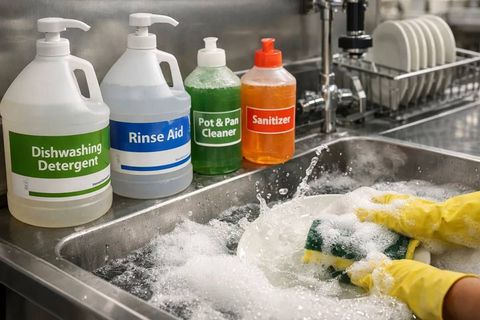
Dishwashing areas: Require appropriate detergents and rinse products for effective dishwashing.
Floors and drains: Need suitable cleaning products to manage grease, moisture, and accumulated debris.
Storage areas: Require regular cleaning to prevent the buildup of dust, spills, and food residues.
Benefits of Appropriate Sanitation Practices
Using suitable foodservice sanitation products can support cleaner working environments and consistent hygiene procedures. Clear cleaning schedules also help employees understand which products should be used in different areas.
Proper sanitation practices are especially important for surfaces that come into contact with food. Businesses should follow local food safety regulations and the instructions provided by product manufacturers.
Types of Foodservice Chemicals Available
Different cleaning products serve different purposes. Understanding their applications makes it easier to compare commercial cleaning chemical options and avoid using unsuitable products.
Commercial Kitchen Degreasers
Commercial degreasers are formulated to remove cooking oils, grease, and stubborn residues from suitable equipment and surfaces. They are commonly used around cooking stations, extraction areas, and other locations where grease accumulates.
Product compatibility is important because some formulations may not be appropriate for particular materials. Users should check the label before applying a degreaser to equipment or surfaces.
Food Contact Surface Sanitizers
Food contact surface sanitizers are designed for use on approved food preparation surfaces. Their purpose is to reduce microorganisms when applied at the specified concentration and contact time.
Some products require rinsing after application, while others may be designed for no-rinse use under specific conditions. Always follow the manufacturer's directions and applicable food safety requirements.
Commercial Dishwashing Chemicals
Commercial dishwashing chemicals support cleaning in professional dishwashing systems. These may include detergents, rinse aids, and products designed for specific water conditions.
The correct product depends on the dishwasher model, water quality, operating temperature, and manufacturer's recommendations.
General Purpose Cleaning Products
General-purpose cleaners are used for routine cleaning of suitable surfaces. They help remove everyday dirt, spills, and residues in areas that do not require specialized chemical formulations.
They should not automatically be treated as sanitizers. Separate sanitizing procedures may still be necessary.
Comparing Foodservice Cleaning Products Before Buying
When comparing foodservice chemicals, businesses should evaluate product suitability rather than focusing only on price. Different formulations may have different dilution requirements, packaging sizes, and application methods.
| Product Type | Main Application | Important Buying Consideration |
|---|---|---|
| Commercial degreaser | Removing cooking grease | Surface compatibility |
| Surface sanitizer | Sanitizing approved surfaces | Contact time and dilution |
| Dishwashing detergent | Cleaning dishes and utensils | Machine compatibility |
| Rinse aid | Supporting dish rinsing | Water conditions |
| General-purpose cleaner | Routine surface cleaning | Intended application |
This comparison provides a general overview. Actual product specifications and usage instructions should always be checked before purchase.
Factors to Consider When Choosing a Foodservice Chemicals Supplier
Selecting a suitable foodservice chemicals supplier involves more than comparing available products. Businesses should review product information, documentation, handling requirements, and supply arrangements.
Product Labels and Safety Documentation
Check whether products provide clear usage instructions, dilution information, storage requirements, and relevant safety documentation. Safety Data Sheets (SDS) provide information about hazards, protective measures, handling, and emergency procedures.
Products intended for food contact surfaces should clearly identify their approved applications and any rinsing requirements.
Cost and Packaging Options
Commercial cleaning chemical prices can vary depending on concentration, container size, formulation, and supplier arrangements. A lower purchase price does not always represent a lower operating cost.
Businesses can compare the cost per prepared solution, where applicable, rather than comparing container prices alone. Packaging should also suit available storage space and expected usage.
Supplier Reliability and Product Availability
A reliable commercial chemical distributor should provide accurate product information and consistent supply arrangements. Businesses may also consider delivery schedules, available documentation, and the ability to supply products that match their cleaning procedures.
Safe Storage and Handling Practices
Commercial cleaning chemicals must be handled carefully to reduce exposure risks and prevent accidental contamination. Staff should receive appropriate training before using unfamiliar products.
Important precautions include:
Store chemicals in clearly labelled, designated areas away from food.
Follow the recommended dilution and application instructions.
Use appropriate protective equipment when required.
Never mix different cleaning chemicals unless the manufacturer specifically permits it.
Keep containers closed when not in use.
Follow product-specific instructions for spills and accidental exposure.
Proper storage and handling are essential parts of an effective kitchen cleaning program.
Frequently Asked Questions
What Are the Best Chemicals for Commercial Kitchen Cleaning?
The appropriate products depend on the cleaning task. Degreasers, detergents, surface sanitizers, and general-purpose cleaners each serve different purposes.
How Do I Choose Commercial Kitchen Sanitizers?
Check the intended surface, approved application, required concentration, contact time, and rinsing instructions. The product should be suitable for the relevant food safety requirements.
Where Can Businesses Buy Foodservice Chemicals?
Businesses can compare products through foodservice chemical distributors, commercial cleaning suppliers, and manufacturers. Reviewing product labels and safety documentation is important before purchasing.
Are Food Grade Cleaning Chemicals Different From Regular Cleaners?
Products intended for food-related environments must be suitable for their specified applications. The term food grade should not automatically be interpreted as meaning that a product is safe for direct food contact.
How Often Should Commercial Kitchens Be Sanitized?
Frequency depends on the surface, activity, food safety procedures, and applicable regulations. Food contact surfaces generally require cleaning and sanitizing at appropriate intervals.
Conclusion
Foodservice chemicals and sanitizers play important roles in commercial kitchen cleaning routines. Choosing suitable products requires understanding their applications, safety instructions, costs, and compatibility with kitchen equipment.

Related Post...

Concrete Boom Pumps: Guide to Smarter Placement and Faster Results
Updated: September 26, 2026
Read More
Rough Terrain Forklifts: Tips to Know Before Choosing the Right Equipment
Updated: September 26, 2026
Read More
Concrete Batching Plants: Discover Critical Details Before You Choose
Updated: September 26, 2026
Read More