The idea of artificial intelligence in art and creativity has developed alongside advancements in computing and machine learning. Early systems focused on basic automation, while modern AI creative applications are capable of generating complex visuals, compositions, and layouts.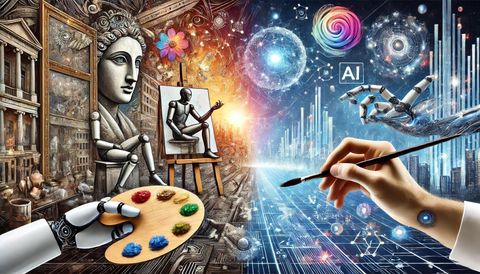
Today, AI content creation tools are used across different creative fields. From generating digital artwork to assisting in music composition and design workflows, these tools support both beginners and experienced creators. Their purpose is not to replace creativity but to enhance and streamline the creative process.
Importance
AI creative tools are important because they make creative processes more accessible and efficient. People who may not have advanced technical skills can still experiment with art, music, and design using structured AI assistance.
These tools are relevant to a wide audience:
- Designers use AI design tools to speed up layout creation and visual experimentation
- Musicians explore AI music tools to generate melodies and sound patterns
- Artists use AI art generators to create visual concepts and variations
The importance of generative AI creativity also lies in reducing repetitive tasks. For example, adjusting design elements, generating variations, or testing multiple ideas can be done more quickly with AI support.
In everyday scenarios, AI creative platforms help individuals explore creativity without needing deep technical knowledge. This makes creative expression more inclusive and adaptable.
Types of AI Creative Tools
AI creative tools can be grouped based on their primary function and output.
AI Art Generators
AI art generators create visual content such as illustrations, digital paintings, and graphics based on user input.
- Generate images from text descriptions
- Modify existing visuals
- Experiment with different artistic styles
AI Music Tools
AI music tools focus on generating and editing audio content.
- Create melodies and sound patterns
- Assist in composition and arrangement
- Provide background music generation
AI Design Tools
AI design tools support layout creation and visual composition.
- Assist in creating social media graphics and presentations
- Suggest layouts and color schemes
- Automate repetitive design tasks
AI Writing and Content Tools
These tools help generate written content and creative text.
- Draft articles, captions, and scripts
- Suggest ideas and structure
- Improve clarity and readability
How AI Creative Tools Work
Understanding how AI creative tools function helps explain their capabilities.
Data and Training
AI systems are trained on large datasets that include images, text, and audio. This allows them to learn patterns and relationships within creative content.
Input and Output Process
Users provide input such as text prompts, sketches, or parameters. The system processes this input and generates outputs based on learned patterns.
Iteration and Refinement
Many AI content creation tools allow users to refine results by adjusting inputs or selecting preferred outputs. This iterative process supports creative exploration.
Comparison of AI Creative Tool Types
| Tool Type | Main Output | Common Use Case | Interaction Style |
|---|---|---|---|
| AI Art Generators | Images | Visual concept creation | Prompt-based |
| AI Music Tools | Audio | Composition and sound design | Parameter-based |
| AI Design Tools | Layouts | Graphic and UI design | Template-assisted |
| AI Writing Tools | Text | Content generation | Input-guided |
Recent Updates
AI creative tools are evolving rapidly with improvements in quality, usability, and integration. One major trend is the development of more advanced generative AI creativity systems that produce detailed and realistic outputs.
Another trend is integration across platforms. Many creative AI platforms now combine multiple features, allowing users to work on art, music, and design within a single environment.
There is also increased focus on user control. Tools are offering more customization options, enabling users to guide outputs more precisely. This helps balance automation with human creativity.
Laws or Policies
The use of AI creative tools is influenced by regulations related to data usage, copyright, and digital content.
Copyright Considerations
Content generated using AI may raise questions about ownership and originality. Laws are evolving to address how such content is classified.
Data Usage Regulations
AI systems must comply with rules related to how training data is collected and used. This includes respecting privacy and intellectual property rights.
Ethical Guidelines
Guidelines often focus on transparency, responsible use, and avoiding misuse of AI-generated content. These help ensure that AI creative applications are used appropriately.
Tools and Resources
Various tools and resources support the use of AI creative tools across different domains.
Creative Platforms
Platforms combine multiple AI creative applications, allowing users to experiment with art, music, and design in one place.
Learning Resources
Educational materials explain how artificial intelligence in art works and how to use AI tools effectively.
Template Libraries
Pre-designed templates help users create structured designs and layouts more easily.
Workflow Tools
Project management and collaboration tools help organize creative work and track progress.
FAQs
What are AI creative tools used for?
AI creative tools are used for generating art, music, design, and written content by using artificial intelligence to assist in the creative process.
How do AI art generators work?
AI art generators analyze patterns in visual data and create images based on user input such as text descriptions or style preferences.
Are AI music tools useful for beginners?
AI music tools can help beginners explore composition by generating melodies and providing structured guidance.
What is generative AI creativity?
Generative AI creativity refers to the use of artificial intelligence systems to produce original content such as images, audio, or text.
Can AI design tools replace human creativity?
AI design tools support and enhance creative workflows, but they do not replace human ideas, decision-making, and interpretation.
Conclusion
AI creative tools are transforming how art, music, and design are created and explored. They provide accessible ways to experiment with creative ideas and streamline workflows. Understanding how these tools work and their different types helps clarify their role in modern creativity. As technology continues to evolve, AI creative applications are becoming an integral part of digital content creation.