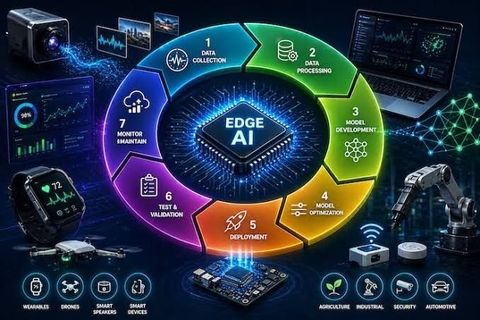
These processing units can be integrated into industrial machines, cameras, robots, vehicles, medical equipment, smart appliances, and other connected devices. Depending on the application, they may use central processing units (CPUs), graphics processing units (GPUs), neural processing units (NPUs), or specialized AI accelerators.
The main purpose of edge AI computing is to support responsive data processing while managing network bandwidth, data privacy, and computing requirements.
For example, a machine vision computer in a manufacturing plant can inspect products as they move along a production line. Its AI model can identify visible defects locally, allowing the system to flag potential problems without transmitting every image to a cloud platform.
What Are the Main Types of Edge AI Hardware?
Different AI processing units serve different workloads. Selecting a suitable architecture depends on the model size, required processing speed, power consumption, operating environment, and software compatibility.
CPU-based Edge AI computers
A CPU-based edge AI computer handles general computing tasks, device control, data processing, and lightweight AI workloads. It may be suitable for applications involving moderate model complexity or systems that need flexible software support.
Edge GPU computers
An Edge GPU computer uses parallel processing capabilities to handle workloads such as computer vision, image classification, video analytics, and neural network inference. GPUs can process many operations simultaneously, making them useful for demanding AI applications.
Neural processing units and AI accelerators
An NPU or dedicated AI accelerator is designed to execute specific neural network operations efficiently. These processors can help improve performance per watt for supported models, although actual results depend on model architecture, hardware, and software optimization.
Industrial AI computers
An Industrial AI computer is designed for demanding operating environments, including factories, warehouses, and outdoor installations. Depending on its design, it may support extended temperature ranges, vibration resistance, industrial connectivity, and long-term operation.
NVIDIA Jetson computers
NVIDIA Jetson is a family of embedded computing platforms used to develop edge AI and robotics applications. Jetson systems combine processing hardware with software tools for applications such as computer vision, robotics, and intelligent machines.
These categories can overlap. For example, an industrial AI computer may contain a GPU, while a compact NVIDIA Jetson system can serve as an embedded AI computer for machine vision or robotics.
Why Edge AI Processing Units Matter
Edge AI computing is important when systems need to interpret data quickly, operate despite limited connectivity, or keep sensitive information close to its source.
Key benefits include:
Low-latency processing: Local inference can reduce the delay associated with sending data to a remote server and waiting for a response.
Reduced network traffic: Devices can transmit selected results instead of continuously uploading large volumes of images or sensor data.
Greater operational continuity: Some applications can continue making local predictions during network interruptions, provided their hardware and software operate independently.
Data privacy: Keeping selected data on a local device can reduce unnecessary transfers, although local processing alone does not guarantee privacy.
Flexible deployment: Compact systems can be installed in factories, vehicles, cameras, robots, and remote monitoring equipment.
These advantages depend on the workload and system design. Edge AI devices still require appropriate power, cooling, maintenance, security controls, and model updates.
Common Applications Across Industries
Edge AI processing units support a growing range of applications where local data analysis is useful.
Industry | Example application | Role of edge AI |
|---|---|---|
Manufacturing | Visual quality inspection | Identifies possible defects in images |
Healthcare | Medical image analysis | Assists with selected local image-processing tasks |
Agriculture | Crop and plant monitoring | Detects visible crop conditions from images |
Transportation | Driver assistance | Processes camera and sensor data |
Warehousing | Autonomous mobile robots | Supports navigation and object recognition |
Smart cities | Traffic monitoring | Analyzes vehicle movements and traffic patterns |
Energy | Equipment monitoring | Identifies unusual patterns in sensor readings |
An Edge AI system may also combine several functions, including sensor collection, data filtering, model inference, and communication with other machines.
Understanding Edge AI Inference
Edge AI inference is the process of using a trained AI model to make predictions on a local device. Unlike model training, which adjusts model parameters using data, inference applies an existing model to new inputs.
For example, a machine vision computer can receive an image from a camera, run an object-detection model, and identify whether a component appears damaged.
Inference performance depends on several factors:
Model size and complexity.
Processor architecture and available memory.
Input resolution and the number of simultaneous data streams.
Software optimization and supported numerical formats.
Thermal limits and power settings.
Developers commonly evaluate latency, throughput, accuracy, memory use, and energy consumption together. A system that processes one image quickly may still struggle when handling multiple cameras at once.
Recent Updates in Edge AI Technology
Recent developments during 2025 and 2026 show a growing focus on compact AI computing, robotics, and running more capable models directly on devices.
January 5, 2026 — Jetson T4000 and JetPack 7.1
NVIDIA published technical information about Jetson T4000 and JetPack 7.1, highlighting accelerated inference for edge computing and robotics. The announcement discussed support for demanding language-model and vision-language workloads within a defined power envelope. Actual performance depends on the model, workload, and configuration.
March 10, 2026 — Generative AI at the edge
NVIDIA described the use of open AI models on Jetson platforms for physical AI applications, including robotics and industrial systems. This reflects a broader trend toward local processing for tasks involving perception, interaction, and decision support.
July 15, 2026 — New Jetson Thor modules
NVIDIA introduced Jetson T3000 and T2000 modules based on its Thor architecture, aimed at robotics, visual AI, and edge workloads. The announcement illustrates the industry's effort to support more demanding AI applications in compact computing systems.
These announcements are manufacturer-reported developments, not independent proof that every application will achieve the same performance. Hardware selection should be based on verified specifications and representative workload testing.
Laws, Policies, and Government Initiatives in India
Edge AI processing units may be affected by policies covering electronics manufacturing, cybersecurity, data protection, telecommunications, and industry-specific safety requirements. The applicable rules depend on how a device is used and what information it processes.
Information Technology Act, 2000: This law provides a legal framework for electronic records and certain cyber-related offences. Relevant provisions may apply to the operation and security of connected computing systems.
Digital Personal Data Protection Act, 2023: India's data protection framework addresses the processing of digital personal data. Where an Edge AI system handles personal information, applicable legal requirements should be assessed, including the relevant commencement notifications and rules.
CERT-In cybersecurity directions: Directions issued by India's Computer Emergency Response Team in April 2022 establish requirements for specified cybersecurity incident reporting and related information retention for covered entities. Organizations should assess their applicability to the systems they operate.
India Semiconductor Mission and electronics policies: Government initiatives support the development of semiconductor manufacturing, chip design, and electronics production. The IndiaAI Mission, approved in March 2024, also supports the wider national AI ecosystem. These initiatives provide relevant policy context for India's AI hardware development.
Organizations deploying industrial AI computers should also consider applicable electrical safety, machinery safety, and sector-specific requirements. Compliance should be assessed against current official notifications rather than assumed from a device's technical specifications.
Tools and Resources for Learning Edge AI
The following resources help students, engineers, and technology teams explore hardware architecture, model deployment, and system evaluation.
NVIDIA Jetson Developer Resources: provides platform information, developer resources, and software documentation.
NVIDIA TensorRT: explains techniques for optimizing supported neural network inference.
OpenVINO: covers model optimization and inference across supported hardware.
ONNX: explains a common format for representing machine learning models.
OpenCV: provides information about image processing and computer vision.
IndiaAI:publishes information about India's AI ecosystem and national initiatives.
When evaluating an Edge AI computer, compare its supported AI frameworks, processor performance, memory capacity, power requirements, thermal design, connectivity, and security-update arrangements. Test representative workloads before making deployment decisions.
Frequently Asked Questions
What is an Edge AI processing unit?
It is a computing component designed to run AI workloads near the location where data is generated, reducing dependence on remote computing for supported tasks.
How does Edge AI inference work?
A trained AI model receives new data, processes it on a local device, and produces a prediction or classification. Examples include identifying objects in images and detecting unusual sensor readings.
What is the difference between an Edge GPU computer and an industrial AI computer?
An Edge GPU computer is characterized by its use of GPU acceleration. An industrial AI computer is designed for industrial operating requirements. A single device can belong to both categories.
What is a NVIDIA Jetson computer used for?
NVIDIA Jetson computers support embedded AI applications such as robotics, machine vision, autonomous machines, and intelligent monitoring. Their suitability depends on the specific model and workload.
How can organizations choose an appropriate Edge AI system?
They should evaluate inference speed, model accuracy, memory, power consumption, operating conditions, software compatibility, cybersecurity, and the expected workload. Practical testing is essential.
Conclusion
Edge AI processing units bring artificial intelligence closer to the devices and environments where data originates. Edge AI computers, Edge GPU computers, machine vision computers, industrial AI computers, and NVIDIA Jetson platforms address different combinations of performance, power, and deployment requirements.
As local inference becomes more capable, these systems are increasingly relevant to manufacturing, robotics, agriculture, transportation, and connected infrastructure. Their successful use depends on selecting suitable hardware, optimizing models, protecting data, and meeting applicable technical and legal requirements.
Understanding these fundamentals helps readers evaluate Edge AI technologies objectively and identify appropriate applications for reliable, secure, and efficient computing at the edge.