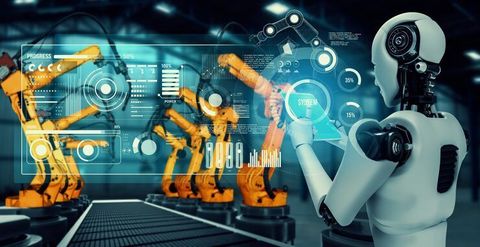
Discover How Humanoid Robots Are Reshaping Manufacturing and Industrial Workflows
Artificial intelligence is moving beyond computers, mobile applications, and digital platforms into the physical world. This development, known as Physical AI, combines artificial intelligence with machines, sensors, robotics, and advanced computing systems. It allows machines to understand their surroundings, make decisions, and perform physical activities with limited human direction.
Humanoid robots are an important part of this development. Designed with human-like bodies, arms, hands, and sometimes legs, these machines can interact with objects and move through environments originally designed for people. Their development is connected to advances in machine learning, computer vision, motion control, and industrial automation.
What Is Physical AI?
Physical AI refers to artificial intelligence systems that interact with the real world rather than processing information alone. These systems collect information through cameras, sensors, and other electronic components before using AI models to determine how to respond.
For example, a robot working inside a manufacturing facility may identify a component, calculate its position, pick it up, and move it to another workstation. It can also respond to changes in the position of objects or unexpected obstacles.
Three important technologies support Physical AI:
Perception: Cameras and sensors help machines recognize objects, people, surfaces, and changes in their surroundings.
Decision-making: AI models process information and determine suitable actions based on instructions and environmental conditions.
Physical movement: Motors, actuators, and robotic mechanisms translate decisions into movements such as walking, lifting, gripping, and placing objects.
Together, these technologies allow robots to perform activities that require more environmental awareness than traditional automated equipment.
How Humanoid Robots Developed
Industrial robotics originally focused on machines designed for specific repetitive activities. Traditional robotic arms, for example, became widely used in automotive manufacturing for welding, painting, material handling, and assembly.
However, these machines generally operate within predefined workspaces and follow programmed movements. Humanoid robots introduce another approach by combining flexible movement with AI-based environmental understanding.
Research in robotics, mechanical engineering, and artificial intelligence has gradually improved their balance, coordination, object recognition, and movement. Modern systems also use simulation environments and real-world training data to improve their ability to perform physical activities.
Physical AI and Industrial Robotics
Industrial robotics and Physical AI are closely connected, but they are not identical. Traditional industrial robots commonly follow predetermined instructions, while Physical AI systems can use environmental information to adjust their actions.
Humanoid robots are one category within this wider technological field. Other examples include autonomous mobile robots, intelligent robotic arms, and machines that perform inspection or material-handling activities.
Their development is contributing to a wider transition towards smart manufacturing, where machines, software, production equipment, and human workers operate through connected systems.
Importance
Physical AI matters because manufacturing and other industrial sectors face several operational challenges. These include repetitive physical activities, workplace safety concerns, changing production requirements, and difficulties maintaining consistent production processes.
Humanoid robots could help address some of these challenges by performing selected activities in environments already designed for human workers. However, their usefulness depends on reliability, accuracy, safety, and the nature of the task.
Reducing Repetitive Physical Activities
Many manufacturing processes involve repeated lifting, carrying, sorting, and positioning of components. These activities can place physical demands on workers, particularly when performed repeatedly throughout a shift.
Humanoid robots may assist with selected repetitive tasks, allowing employees to concentrate on monitoring, equipment supervision, quality checks, and activities requiring human judgment.
Supporting Workplace Safety
Industrial environments can contain heavy equipment, hot surfaces, moving machinery, and potentially hazardous materials. Robots can be assigned certain activities in controlled environments where direct human involvement may create additional risks.
However, robots also introduce safety concerns. Unexpected movements, mechanical failures, sensor errors, and interactions with people must be considered before deployment.
Improving Manufacturing Flexibility
Traditional automation often requires changes to equipment or production layouts when manufacturers introduce different products. Humanoid robots are being developed to perform several activities using a similar physical structure.
For example, one robot could potentially move components, organize materials, and operate compatible equipment. Its actual capabilities depend on its software, attachments, training, and operating environment.
Effects on Workers and Industries
The development of Physical AI affects several groups:
Manufacturing employees: Their responsibilities may increasingly involve robot supervision, technical monitoring, and equipment coordination.
Factory managers: They must evaluate production requirements, workplace safety, and automation integration.
Engineers: They develop robotic systems, control software, sensors, and AI models.
Educational institutions: They may need to update technical training to include robotics, automation, and AI-related skills.
Consumers: Changes in manufacturing processes can influence product availability, production consistency, and industrial supply chains.
The technology may change the distribution of workplace responsibilities, but its long-term effect on employment will depend on adoption levels, economic conditions, and workforce development.
Recent Updates
Physical AI has received increased attention between 2024 and 2026 as manufacturers and technology companies have moved from laboratory demonstrations towards industrial testing. Improvements in AI models, robotic hardware, simulation, and sensor technology are helping humanoid robots perform more complex activities.
Humanoid Robots Enter Manufacturing Environments
Automotive manufacturing has become an important testing ground for humanoid robotics. Companies are exploring whether human-shaped machines can perform activities such as moving components, handling materials, and supporting assembly operations.
BMW has conducted humanoid robot pilot activities at its Spartanburg facility in the United States and introduced further testing plans at its Leipzig facility in Germany. These initiatives examine how robots can be integrated into existing production environments.
Other developments include:
Siemens and Humanoid: In 2026, the companies reported testing a humanoid robot at Siemens' electronics facility in Erlangen, Germany, where it performed autonomous logistics activities.
Hexagon and Schaeffler: Their collaboration progressed towards wider industrial deployment of AEON humanoid robots following earlier factory testing.
Hyundai and Boston Dynamics: Their Atlas humanoid robotics programme is focused on industrial applications, including component sequencing and manufacturing activities.
Hitachi: Its Physical AI research has explored how robots can learn and adjust movement behaviour in real industrial environments.
These developments demonstrate growing industrial interest, although pilot projects should not be confused with widespread commercial deployment.
Improvements in AI Training and Simulation
An important development is the use of virtual environments to train robots before introducing them into physical workplaces.
Simulation allows developers to test movements, object handling, environmental changes, and possible equipment failures without repeatedly conducting physical experiments. Data generated through simulations can help improve robot control systems.
Another development is the use of vision-language-action models. These systems connect visual information, natural-language instructions, and physical movements, helping robots interpret tasks and determine appropriate actions.
Growth of Smart Manufacturing
Physical AI is becoming part of broader smart manufacturing programmes. These programmes connect production machinery, sensors, software platforms, and automated systems to create more coordinated industrial environments.
The following table summarizes the relationship between emerging technologies and their industrial applications.
Technology | Industrial application | Potential benefit |
|---|---|---|
Humanoid robots | Material handling and assembly | Flexible physical operations |
Computer vision | Component inspection | Improved defect identification |
AI-powered robotic arms | Product handling | Adaptive movement |
Digital twins | Production simulation | Virtual process testing |
Autonomous mobile robots | Internal material movement | Coordinated factory logistics |
Predictive monitoring | Equipment condition analysis | Earlier identification of faults |
Despite these developments, several challenges remain. Battery capacity, movement speed, gripping accuracy, maintenance requirements, and reliable operation across different environments continue to influence industrial adoption.
Laws or Policies
The development of Physical AI and humanoid robots is influenced by workplace safety regulations, machinery requirements, artificial intelligence legislation, and industrial standards. Regulations differ between countries, so manufacturers must consider the rules applicable to their operating locations.
International Robotics Safety Standards
The International Organization for Standardization (ISO) develops standards relating to industrial robotics and machinery safety.
Two important standards are:
ISO 10218-1:2025: Covers safety requirements for industrial robots, including their design and risk reduction.
ISO 10218-2:2025: Addresses safety requirements for industrial robot applications and robot cells, including integration, commissioning, operation, and maintenance.
These standards help manufacturers and system integrators assess potential risks when introducing robots into production environments.
European Union Regulations
The European Union has introduced regulatory frameworks covering artificial intelligence and machinery.
The EU AI Act establishes requirements for certain AI applications based on their potential risks. Some AI systems used in regulated industrial contexts may fall within its high-risk categories, depending on their intended purpose and applicable product legislation.
The EU Machinery Regulation (EU) 2023/1230 establishes updated safety requirements for machinery and is scheduled to apply from January 20, 2027. Its provisions are relevant to manufacturers integrating advanced robotic systems into industrial equipment.
United States Regulations
In the United States, the Occupational Safety and Health Administration (OSHA) oversees workplace safety requirements. Employers must consider risks associated with industrial robots, automated machinery, and human-machine interactions.
Relevant safety considerations include:
Physical barriers and restricted operating areas.
Emergency stop mechanisms.
Equipment inspection and maintenance.
Employee training and operating procedures.
Risk assessments for human-robot interaction.
India's Industrial Robotics Framework
In India, industrial automation is influenced by machinery safety requirements, manufacturing regulations, and standards developed by the Bureau of Indian Standards (BIS).
The government-backed Make in India and Production Linked Incentive programmes support manufacturing development in selected sectors. These initiatives contribute to the wider industrial environment in which automation and robotics are being adopted.
BIS also develops standards related to machinery integration and industrial automation. Manufacturers introducing humanoid robots must consider applicable safety requirements, electrical standards, and workplace regulations.
Tools and Resources
Understanding Physical AI requires knowledge of robotics, artificial intelligence, industrial automation, and workplace safety. Several technical platforms and information resources help students, engineers, manufacturers, and researchers explore these subjects.
Robotics Simulation Platforms
Simulation platforms allow developers to create virtual industrial environments and test robotic movements.
Examples include:
NVIDIA Isaac Sim: Supports robotics simulation, synthetic data generation, and AI-based robot development.
Gazebo: Provides a simulation environment for testing robotic systems and their interactions with surroundings.
ROS 2: An open-source framework used to develop robotic applications and connect different hardware and software components.
Webots: Supports robot modelling, simulation, and experimentation in virtual environments.
Industrial Automation Resources
Industry professionals can use established technical platforms to understand automation systems and manufacturing technologies.
International Organization for Standardization (ISO): Provides information about international robotics and machinery safety standards.
International Federation of Robotics (IFR): Publishes industrial robotics information, market studies, and automation statistics.
Bureau of Indian Standards (BIS): Provides information about Indian standards relating to machinery and industrial systems.
OSHA: Publishes workplace safety information and guidance concerning industrial machinery and robotics.
Learning and Technical Development
Educational resources can help readers understand how Physical AI systems are developed and applied.
Useful learning areas include:
Robotics fundamentals and mechanical engineering.
Artificial intelligence and machine learning.
Computer vision and object recognition.
Sensor integration and motion control.
Industrial automation and safety assessment.
Programming frameworks for robotic applications.
Understanding these areas provides a foundation for studying how intelligent machines interact with real-world industrial environments.
FAQs
What is Physical AI in manufacturing?
Physical AI combines artificial intelligence with physical machines, sensors, and robotic systems. It enables machines to understand their surroundings, make decisions, and perform activities in manufacturing environments.
How are humanoid robots different from traditional industrial robotics?
Traditional industrial robots usually perform specific programmed activities, such as welding or painting. Humanoid robots have human-like physical structures and are being developed to handle different tasks within environments designed for people.
Can humanoid robots work alongside human employees?
Yes. Humanoid robots can be designed to operate in shared industrial environments. However, appropriate safety assessments, protective measures, monitoring, and operating procedures are necessary before human-robot collaboration.
Which industries can benefit from Physical AI?
Potential applications include:
Automotive manufacturing.
Electronics production.
Warehousing and logistics.
Aerospace manufacturing.
Industrial equipment assembly.
Quality inspection and material handling.
Will humanoid robots replace human workers?
Humanoid robots may automate selected repetitive and physically demanding activities. However, human supervision, technical expertise, problem-solving, maintenance, and decision-making will remain important in many industrial environments. The overall employment impact will vary across industries.
Conclusion
Physical AI is changing how intelligent machines interact with manufacturing environments and other industrial workplaces. Humanoid robots, advanced sensors, machine learning, and industrial robotics are contributing to the development of smart manufacturing systems. Although recent industrial trials demonstrate progress, technical limitations, workplace safety, regulatory requirements, and workforce adaptation remain important considerations. The future development of this technology will depend on its practical capabilities and responsible integration into industrial operations.

Related Post...
AI Chip Production Insights: Understanding the Global Semiconductor Race
Updated: November 28, 2026
Read More
Overview of Sensor-Driven Autonomous Robotics, Applications, and Smart Systems
Updated: November 24, 2026
Read More
AI Killer Robots: An Overview of Global Efforts to Agree on Restrictions
Updated: November 28, 2026
Read More