Overview of Sensor-Driven Autonomous Robotics, Applications, and Smart Systems
Sensor-driven autonomous robotics is an emerging area of robotics that combines advanced sensors, artificial intelligence (AI), machine learning, and automated control systems to help robots understand their surroundings and perform tasks with limited human intervention. These technologies allow robotic systems to detect objects, recognize obstacles, measure distances, identify environmental changes, and make decisions based on real-time information.
Unlike traditional robots that follow fixed instructions, autonomous robots can respond to changing conditions. They use information collected through cameras, LiDAR, ultrasonic sensors, radar, and other technologies to navigate environments and complete complex operations.
Sensor-driven robotics is becoming increasingly important in manufacturing, healthcare, agriculture, logistics, transportation, and infrastructure management. As artificial intelligence and industrial automation develop, these systems are creating new possibilities for improving operational accuracy, workplace safety, and productivity.
Understanding Sensor-Driven Autonomous Robotics
What Makes a Robot Autonomous?
An autonomous robot is a machine capable of performing specific activities by interpreting information from its environment and selecting appropriate actions. Sensors act as the robot's primary information-gathering components.
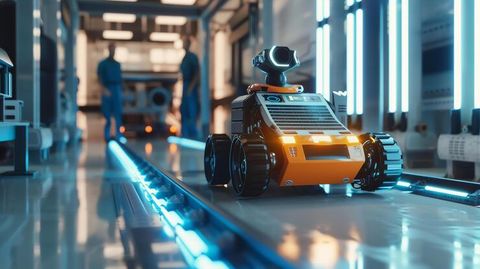
For example, an autonomous mobile robot operating inside a warehouse can identify shelves, detect nearby workers, calculate distances, and select a suitable route without requiring continuous manual direction.
Most autonomous robotic systems combine four essential capabilities:
Perception: Collecting information about the surrounding environment.
Processing: Analyzing sensor information using computing systems and AI algorithms.
Decision-making: Selecting actions based on environmental conditions and programmed objectives.
Movement and control: Operating motors, robotic arms, wheels, or other mechanical components.
These capabilities work together to support intelligent robotic operations.
Major Sensor Technologies
Different sensor technologies provide different types of environmental information. Combining several sensors often improves the reliability of autonomous navigation and object detection.
Sensor Technology | Primary Function | Common Application |
|---|---|---|
LiDAR | Measures distances using laser light | Autonomous navigation |
Cameras | Captures visual information | Object recognition |
Ultrasonic sensors | Detects nearby objects using sound waves | Obstacle avoidance |
Radar | Measures object distance and movement | Autonomous vehicles |
Infrared sensors | Detects infrared radiation | Temperature monitoring |
IMU sensors | Measures acceleration and rotation | Robotic positioning |
GPS/GNSS | Provides location information | Outdoor navigation |
Sensor fusion is another important concept. It combines information from multiple sensors to create a more complete understanding of the environment. This approach can reduce the limitations associated with relying on a single sensor.
Why Sensor-Driven Autonomous Robotics Matters Today
Improving Industrial Automation
Manufacturing facilities increasingly use autonomous robotic systems to perform repetitive, precise, and physically demanding operations. These systems can monitor production environments, identify material locations, and support automated assembly processes.
Industrial automation applications include:
Robotic welding and precision assembly.
Automated quality inspection.
Machine vision for defect identification.
Predictive maintenance through sensor monitoring.
Autonomous material handling and transportation.
Combining industrial robotics with AI-based inspection can help manufacturers identify production irregularities earlier and maintain consistent operating conditions.
Supporting Warehouse and Logistics Operations
Warehouses use autonomous mobile robots (AMRs) to transport materials, organize inventory, and navigate complex indoor environments.
Unlike automated guided vehicles that often depend on predefined routes, advanced AMRs can use LiDAR navigation, computer vision, and simultaneous localization and mapping (SLAM) to understand their surroundings.
This technology is particularly relevant to warehouse automation, robotic picking systems, inventory management, and supply chain operations.
Applications Across Different Industries
Industry | Robotic Application | Main Benefit |
|---|---|---|
Healthcare | Autonomous hospital robots | Internal transportation |
Agriculture | Crop-monitoring robots | Field monitoring |
Manufacturing | Intelligent robotic arms | Production consistency |
Logistics | Autonomous warehouse robots | Material movement |
Construction | Inspection robots | Site monitoring |
Transportation | Autonomous vehicles | Environmental awareness |
Energy | Inspection robots | Infrastructure monitoring |
Improving Safety and Operational Accuracy
Autonomous robots can monitor hazardous environments where human access may involve additional risks. Examples include chemical processing facilities, mining operations, high-temperature industrial environments, and infrastructure inspection sites.
However, sensor-based detection does not automatically guarantee safety. Reliable operation also requires appropriate system design, emergency stopping mechanisms, cybersecurity protection, regular maintenance, and human supervision.
Recent Developments and Technology Trends
Advances in AI-Powered Robotic Perception
During 2025 and 2026, robotics development increasingly focused on combining artificial intelligence with physical machines. This approach, often called physical AI, allows robots to interpret their surroundings and respond to real-world situations.
Modern systems are increasingly exploring vision-language-action models, which connect visual information, natural-language instructions, and robotic movements.
These developments could help robots perform tasks in environments that are less predictable than traditional industrial production lines. However, practical deployment still requires extensive testing and safety validation.
Development of Advanced Sensor Fusion
Sensor fusion is becoming an important area of autonomous robotics research. It combines information from different sensing technologies to improve object recognition, localization, and environmental understanding.
A 2025 MassRobotics survey highlighted the importance of combining cameras, LiDAR, and inertial measurement units. Its findings reported that 67.5% of surveyed respondents used LiDAR alongside cameras.
This development demonstrates the growing importance of multi-sensor perception in advanced robotic navigation.
Updated Industrial Robot Safety Standards in 2025
In February 2025, the International Organization for Standardization published revised editions of ISO 10218-1 and ISO 10218-2.
The updated standards address industrial robot safety and the integration of robotic applications. The revisions also incorporate requirements concerning collaborative applications and functional safety.
These changes are relevant to manufacturers developing robotic arms, autonomous production equipment, and collaborative robotic systems.
Growth of Humanoid and Autonomous Mobile Robots
Humanoid robots and autonomous mobile robots continued attracting attention throughout 2025 and 2026.
The Stanford AI Index 2026 reported increasing activity in humanoid robotics during 2025, including industrial pilot projects and manufacturing applications. However, these developments do not mean humanoid robots have achieved widespread industrial adoption.
Other emerging developments include:
Compact AI processors for real-time sensor analysis.
Improved 3D vision and depth perception.
Autonomous inspection systems.
More advanced robotic manipulation.
Digital twins for simulation and performance monitoring.
Improved navigation in dynamic environments.
These trends indicate a gradual movement toward more adaptable and context-aware robotic systems.
Laws, Policies, and Industrial Safety Requirements
International Robotics Safety Standards
There is no single worldwide law governing every type of autonomous robot. Requirements depend on the country, industry, intended application, and level of automation.
However, international technical standards provide important guidance for robotic design, integration, and operational safety.
ISO 10218-1:2025 addresses safety requirements for industrial robots, including safe design and protective measures.
ISO 10218-2:2025 covers industrial robot applications and robot cells, including integration, commissioning, operation, maintenance, and safeguarding.
These standards are particularly relevant to industrial automation manufacturers and organizations introducing robotic equipment into production environments.
European Union Regulations
The European Union has established regulatory frameworks covering machinery safety and artificial intelligence.
Important regulations include:
EU Machinery Regulation 2023/1230: Establishes safety requirements for machinery and related products. Its main application date is 20 January 2027.
EU Artificial Intelligence Act: Establishes requirements for AI systems according to their risk classification. Certain AI systems used as safety components of machinery can fall under high-risk requirements.
General Data Protection Regulation (GDPR): May apply when robotic systems collect or process identifiable personal information.
Organizations developing AI-powered autonomous robots must consider the applicable requirements for risk management, human oversight, data protection, and technical documentation.
United States Workplace Safety
In the United States, the Occupational Safety and Health Administration (OSHA) oversees workplace safety requirements relevant to robotic operations.
Although OSHA does not have one specific standard covering the entire robotics industry, several existing requirements can apply to robotic installations.
Examples include:
Machine guarding requirements under 29 CFR 1910.212.
Control of hazardous energy under 29 CFR 1910.147.
Personal protective equipment requirements.
Workplace training and hazard assessment requirements.
ANSI and ISO robotics standards also provide technical guidance for industrial robot design and integration.
Regulatory Considerations in Other Countries
Countries such as India, Japan, China, Canada, and the United Kingdom have their own machinery safety, workplace protection, and technology-related regulatory frameworks.
Organizations introducing autonomous robotic equipment should review applicable national requirements, electrical safety provisions, workplace regulations, and data protection obligations.
Regulatory compliance should be considered during the design and planning stages rather than after a robotic system has entered operation.
Tools and Resources for Autonomous Robotics
Developing sensor-driven autonomous robotics requires specialized software, hardware, simulation environments, and testing frameworks. These resources help engineers understand robotic perception, navigation, sensor integration, and automated decision-making.
Robotics Development Platforms
The following platforms are commonly used in robotics research and development.
Tool or Platform | Main Purpose | Application |
|---|---|---|
ROS 2 | Robotics middleware | Robot communication and control |
Gazebo | Robotics simulation | Testing navigation and sensors |
NVIDIA Isaac Sim | AI robotics simulation | Autonomous robot development |
OpenCV | Computer vision | Image processing and object detection |
MATLAB and Simulink | Engineering simulation | Control systems and sensor analysis |
Point Cloud Library (PCL) | 3D data processing | LiDAR-based perception |
RViz | Robotics visualization | Sensor data and robot mapping |
RoboDK | Robot simulation and programming | Industrial robot applications |
Important Robotics Technologies
Several technologies work together to support autonomous robotic operations.
Simultaneous Localization and Mapping (SLAM): Helps robots estimate their position while creating maps of unfamiliar environments.
Machine Vision: Uses cameras and AI algorithms to identify objects, recognize patterns, and interpret visual information.
Edge Computing: Processes sensor information directly on or near robotic hardware, reducing dependence on remote computing infrastructure.
Digital Twin Technology: Creates virtual representations of physical robotic systems for simulation, monitoring, and performance analysis.
Sensor Calibration: Ensures that sensors provide accurate measurements and that information from different sensing devices is properly aligned.
Resources for Learning and Research
People interested in autonomous robotics can explore several educational and technical resources:
Robotics engineering textbooks covering sensors, control systems, and automation.
University research publications about autonomous navigation and machine perception.
Technical documentation for ROS 2 and OpenCV.
Industrial robotics safety guidelines from ISO.
Simulation tutorials covering Gazebo and NVIDIA Isaac Sim.
Research papers on LiDAR, computer vision, and AI-based sensor fusion.
These resources provide foundational knowledge for understanding autonomous navigation, industrial robot integration, and advanced robotic perception.
Frequently Asked Questions
1. What Is Sensor-Driven Autonomous Robotics?
Sensor-driven autonomous robotics is a technology that enables robots to understand their surroundings and perform tasks using information collected from sensors. It combines technologies such as LiDAR, cameras, radar, artificial intelligence, and automated control systems to support independent operation.
2. Which Sensors Are Commonly Used in Autonomous Robots?
Common sensors include LiDAR, ultrasonic sensors, cameras, radar, infrared sensors, GPS/GNSS, and inertial measurement units. Each technology provides different environmental information. Many advanced robotic systems combine multiple sensors to improve navigation and object detection.
3. How Does Artificial Intelligence Improve Autonomous Robotics?
Artificial intelligence helps robots interpret sensor information, recognize objects, identify environmental patterns, and make decisions. Machine learning algorithms can also support adaptive navigation and improve performance through training data and repeated testing.
However, AI decisions must be evaluated carefully, particularly when robots operate near people or in hazardous environments.
4. Which Industries Use Autonomous Robotic Systems?
Autonomous robotic systems are used in manufacturing, agriculture, healthcare, logistics, transportation, construction, mining, and energy infrastructure. Applications include automated material handling, crop monitoring, equipment inspection, warehouse navigation, and industrial assembly.
5. What Are the Main Challenges of Sensor-Driven Robotics?
Important challenges include sensor accuracy, environmental interference, navigation errors, cybersecurity, hardware reliability, and system integration.
For example, cameras may experience difficulties in poor lighting, while LiDAR performance can be affected by certain environmental conditions. Combining different sensor technologies, maintaining equipment, and conducting regular safety assessments can help address these challenges.
Conclusion
Sensor-driven autonomous robotics is becoming an important part of modern industrial automation and intelligent machine development. By combining advanced sensors, artificial intelligence, machine learning, and robotic control systems, autonomous machines can understand their environments and perform increasingly complex activities.
Applications across manufacturing, healthcare, agriculture, logistics, and infrastructure demonstrate the potential of this technology to improve operational accuracy, support workplace safety, and manage repetitive processes.
Recent developments in sensor fusion, physical AI, autonomous navigation, and humanoid robotics are expanding the capabilities of robotic systems. At the same time, updated safety standards and regulatory frameworks highlight the importance of responsible development and human oversight.
Looking ahead, continued progress in AI computing, sensor technology, and robotic engineering is expected to make autonomous systems more adaptable and capable. Their successful implementation will depend not only on technological advancement but also on reliable testing, appropriate safety measures, and compliance with applicable regulations.

Related Post...

AI Marketing Automation Basics: Key Strategies, Trends, and Applications
Updated: November 24, 2026
Read More
Explore AI Sustainability and Energy Impact: Trends, Challenges, and Opportunities
Updated: November 04, 2026
Read More
Cloud Resource Optimization: Key Insights into Modern Cloud Computing
Updated: November 03, 2026
Read More