Straddle Carrier Machines: Explore Overview, Basics, Explanation, Knowledge, and Key Details
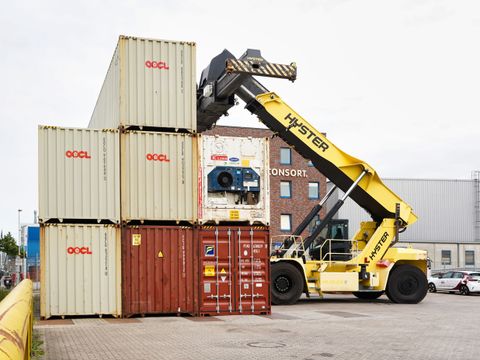
Straddle carrier machines are specialised material-handling vehicles used to lift, transport and stack shipping containers in ports, container terminals and intermodal logistics facilities. Their design allows them to drive over a container, lift it using a spreader and carry it between designated storage or transfer areas.
A straddle carrier machine combines a tall supporting frame, lifting equipment, wheels, a power system and operator controls. Unlike a conventional forklift, it carries a container suspended within its frame rather than lifting it from beneath with forks. This arrangement makes it useful for moving containers through terminal areas where flexible handling and efficient space utilisation are important.
A container straddle carrier may be powered by diesel, hybrid or electric systems. Some terminals also use automated models that operate through computer-based guidance and control systems. Understanding these machine types, their working principles, specifications and safety requirements helps explain their role in modern container logistics.
Main Components of a Straddle Carrier Machine
A modern container handling straddle carrier consists of several integrated mechanical, electrical and control systems.
Component | Main function |
|---|---|
Main supporting frame | Provides the structure that surrounds and carries the container |
Spreader | Connects to the container's corner fittings and lifts it |
Twistlocks | Secure the spreader to the container's corner castings |
Hydraulic lifting system | Raises and lowers the spreader and container |
Wheel and steering assemblies | Support movement and manoeuvring |
Power unit | Supplies energy for travel and lifting operations |
Operator cabin | Provides controls, displays and visibility |
Braking system | Controls movement and holds the machine stationary |
Load monitoring system | Monitors container weight and lifting conditions |
Safety sensors | Detect obstacles and support collision prevention |
The spreader is one of the most important components. It is designed to engage with the container's corner fittings through twistlocks. Some models use adjustable spreaders to handle different container lengths, while specialised twin-lift configurations can handle two 20-foot containers together.
Types of Straddle Carrier Machines
Straddle carriers are classified according to their power system, operating method, stacking capability and intended terminal application.
1. Conventional Diesel-Electric Straddle Carrier
This type uses a diesel engine to generate electrical power for its drive and lifting systems. It is designed for regular container movement and stacking in port environments.
2. Hybrid Straddle Carrier
A hybrid straddle carrier combines an engine-driven power source with electrical energy storage. Regenerative systems can recover energy during braking or container lowering and reuse it during other operations. This can reduce fuel consumption compared with conventional configurations.
3. Electric Straddle Carrier
An electric straddle carrier uses battery-based electrical power for its travel and lifting systems. It can reduce local exhaust emissions and operating noise compared with diesel-powered equipment. Its suitability depends on battery capacity, charging arrangements, duty cycle and terminal infrastructure.
4. Automated Straddle Carrier
An automated straddle carrier operates through computer-based guidance, sensors and terminal control systems. It can receive container movement instructions from a terminal operating system and perform programmed transport tasks with limited or no onboard manual operation.
5. Shuttle Straddle Carrier
A shuttle carrier is designed mainly for horizontal container movement between terminal areas. It generally has lower stacking capability than a full-height straddle carrier and is often used to transfer containers between quay cranes, yard equipment and designated exchange points.
6. High-Stacking Straddle Carrier
Some models are designed to stack containers several levels high. Depending on the configuration, certain machines can stack up to four containers high. Actual stacking height depends on the machine, container dimensions, ground conditions and terminal layout.
How Does a Container Straddle Carrier Work?
A container straddle carrier follows a controlled lifting and transportation cycle.
Approaching the container: The operator or automated guidance system positions the machine over the container.
Spreader alignment: The spreader is adjusted to match the container's length and positioned above its corner fittings.
Locking: Twistlocks engage with the container's corner castings to secure the load.
Lifting: The hydraulic or electric lifting system raises the container into the supporting frame.
Transportation: The machine travels along the designated terminal route while maintaining the approved load position.
Stacking or transfer: The carrier positions the container over a storage location, truck chassis or transfer point.
Lowering and release: The container is lowered onto the designated supports and the twistlocks are released after confirming that it is safely positioned.
Some machines can move diagonally using crab steering or turn within a compact area. These capabilities help with manoeuvring in busy container yards.
Applications of Straddle Carriers for Ports and Terminals
A straddle carrier for container terminals is used in different parts of the cargo-handling process.
Application area | Typical operation |
|---|---|
Seaports | Moving containers between quay cranes and storage yards |
Container terminals | Stacking and retrieving loaded or empty containers |
Intermodal terminals | Transferring containers between road and rail transport |
Inland container depots | Moving containers between storage and dispatch areas |
Rail yards | Handling containers near rail-mounted lifting equipment |
Truck exchange areas | Loading and unloading containers from road vehicles |
Reefer container areas | Moving refrigerated containers to designated electrical connection areas |
A key advantage is that the same equipment type can support several container movement tasks. It can collect containers from a quay crane, transport them to a storage area and place them on the ground or a road vehicle. This helps separate crane lifting operations from horizontal container movement.
Specifications to Consider When Selecting a Straddle Carrier
The correct machine depends on the terminal's container volume, yard design, stacking requirements and operating schedule.
Specification | Importance |
|---|---|
Rated lifting capacity | Defines the permitted container load |
Stacking height | Indicates how many container levels the machine can handle |
Spreader configuration | Determines compatible container sizes and lifting arrangements |
Travel speed | Influences container movement cycles |
Lifting and lowering speed | Affects handling time |
Turning radius | Determines manoeuvrability in terminal lanes |
Steering arrangement | Supports turning and positioning |
Power system | Determines energy source and operating characteristics |
Battery capacity | Important for electric carrier operating cycles |
Ground clearance | Influences movement across terminal surfaces |
Safety systems | Support obstacle detection, load monitoring and controlled operation |
Example Capacity Range
Manufacturer-published information for Kalmar straddle carriers describes model configurations with rated capacities in the range of approximately 40 to 60 tonnes. Some models can use twin-lift spreaders to handle two 20-foot containers simultaneously. These figures are model-specific and should not be treated as universal ratings.
Recent Developments and Technology Trends
Straddle carrier technology is changing as terminal operators focus on energy efficiency, automation and improved container movement.
Battery-powered equipment: Electric models are gaining attention as ports work to reduce local emissions and dependence on conventional fuel systems.
Hybrid power systems: Regenerative energy recovery can reuse energy from braking and lowering operations.
Automated container movement: Automated carriers can integrate with terminal operating systems to receive instructions and follow planned routes.
Collision avoidance: Sensors, cameras and warning systems help detect nearby equipment, vehicles and obstacles.
Digital fleet monitoring: Connected systems can record machine activity, energy use, operating hours and maintenance information.
Advanced steering: Crab steering and other manoeuvring arrangements can help machines operate in confined terminal spaces.
In a 2025 technical overview, Kalmar described hybrid drive as a common configuration for new straddle carriers and reported growing interest in battery-powered machines. The article also documented electric and automated carrier configurations in commercial terminal operations.
Indian Regulations and Safety Standards
Straddle carrier operations in India involve port workplace safety, container-handling procedures, equipment inspections and applicable technical standards.
1. Draft Occupational Safety, Health and Working Conditions (Dock Work) Central Regulations, 2026
The Ministry of Labour and Employment published draft Dock Work Central Regulations through G.S.R. 119(E), dated 9 February 2026. The draft includes specific provisions for landside straddle carriers, designated operating grids, safe manoeuvring areas, marked driver waiting zones and communication between equipment operators and truck drivers.
Important: This notification is a draft regulation, not a final operative regulation. It should be treated as a proposed regulatory framework rather than an already enforceable set of final dock-work rules.
2. ISO 14829:2002
ISO 14829:2002, Freight containers — Straddle carriers for freight container handling — Calculation of stability, specifies calculations used to determine straddle carrier stability under different operating conditions. The ISO catalogue identifies this edition as current following its 2019 confirmation.
3. ISO 22915-1:2024 and ISO 22915-3:2021
These standards belong to the ISO series covering industrial truck stability verification. ISO 22915-1:2024 provides general stability verification requirements, while ISO 22915-3:2021 addresses reach and straddle trucks with rated capacities up to 5,000 kg. The latter should not be confused with the much larger container straddle carriers used in ports.
4. Port Safety Guidance
The International Labour Organization's Safety and Health in Ports code of practice provides guidance on port equipment, container yards, pedestrian separation and safe cargo-handling arrangements. Port operators can also consult industry guidance from organisations such as PEMA and ICHCA for recommended equipment safety features.
Best Practices for Safe Straddle Carrier Operations
Safe operation requires suitable terminal planning, trained operators and regular equipment inspections.
Inspect the machine: Check the frame, tyres, brakes, spreader, twistlocks, hydraulic systems and warning devices before operation.
Confirm container weight: Verify container information and ensure the load remains within the machine's rated capacity.
Check twistlocks: Confirm that all required locking points are properly engaged before lifting.
Follow marked routes: Use designated travel lanes and container exchange grids.
Separate pedestrians: Restrict unauthorised access to operating zones and provide clearly marked safe areas.
Monitor overhead clearance: Check for electrical lines, structures, stacked containers and other obstructions.
Use collision prevention systems: Maintain sensors, cameras, alarms and emergency-stop arrangements.
Control speed: Adjust movement to the load, visibility, surface conditions and traffic density.
Maintain communication: Coordinate with truck drivers, signal personnel and other equipment operators.
Follow maintenance schedules: Inspect lifting systems, steering, brakes, batteries and electrical components according to manufacturer instructions.
The 2026 Indian draft dock-work regulations specifically discuss straddle carrier grids, designated safe areas and visibility of truck drivers during container exchange operations. These are useful planning considerations, although the notification remains a draft.
Tools and Resources for Straddle Carrier Machines
The following resources can help terminal planners, equipment operators and logistics professionals understand straddle carrier requirements:
International Organization for Standardization (ISO): Stability standards and technical references for container-handling equipment.
International Labour Organization (ILO): Port safety guidance and recommendations for cargo-handling operations.
Port Equipment Manufacturers Association (PEMA): Technical information and recommended safety practices for port equipment.
International Cargo Handling Coordination Association (ICHCA): Guidance on safe container-handling operations.
Manufacturer manuals: Equipment specifications, load charts, inspection schedules and operating instructions.
Terminal operating systems: Software used to coordinate container locations, equipment assignments and yard movements.
Frequently Asked Questions
1. What is a straddle carrier machine used for?
A straddle carrier machine is used to lift, transport and stack shipping containers in ports, container terminals and intermodal yards. It carries containers underneath its supporting frame.
2. How many containers can a straddle carrier stack?
The stacking height depends on the machine design. Some full-size models can stack containers up to four high, while shuttle carriers are generally designed for horizontal transport and lower stacking capability.
3. What is the difference between an electric and hybrid straddle carrier?
An electric straddle carrier uses battery-based electrical power for its operating systems. A hybrid straddle carrier combines an engine-driven power source with electrical energy storage and may recover energy during braking or lowering.
4. What is an automated straddle carrier?
An automated straddle carrier uses computer-based guidance, sensors and terminal control software to carry out container movement tasks with limited or no onboard manual operation.
5. Where are straddle carriers commonly used in India?
They may be used in container ports, intermodal terminals, inland container depots and other cargo-handling facilities where containers must be moved between transport and storage areas.
Conclusion
Straddle carrier machines are important equipment in modern container logistics. Their supporting frame, lifting spreader, twistlocks and manoeuvrable wheel arrangements allow them to transport and stack containers efficiently within port and terminal environments.
Understanding the differences between a conventional container straddle carrier, electric straddle carrier, automated straddle carrier and shuttle carrier helps terminal planners identify suitable equipment for different operations. Machine capacity, stacking height, steering arrangements, power systems and safety features are important selection considerations.
As container terminals continue to adopt hybrid power, battery technology, digital monitoring and automated handling systems, straddle carriers are likely to remain an important part of container transportation and yard management.
Disclaimer
This article is intended for general informational and educational purposes only. Machine specifications, lifting capacities, operating procedures and regulatory requirements may vary by manufacturer, model, project and location. Always consult official technical documentation, applicable regulations and qualified equipment professionals before making operational decisions. This content does not provide guarantees and is not intended to sell or promote any product, brand or organisation.

Related Post...
Motor Scraper Machines: Explore Overview, Basics, Explanation, Knowledge, and Key Details
Updated: November 24, 2026
Read More
Tunnel Boring Machines: Complete Guide to Basics, Technologies, Processes, Facts, and Best Practices
Updated: November 24, 2026
Read More