Setting Up a Car Service Garage: Equipment Checklist and Budget
Starting a car service garage can be a practical business opportunity for entrepreneurs interested in the automobile sector. Cars require regular servicing, oil changes, brake inspections, tyre replacement, battery checks and mechanical repairs. These needs create opportunities for independent garages that provide reliable service at reasonable prices. However, setting up a garage involves more than renting a shop and hiring mechanics. The business needs suitable equipment, trained technicians, sufficient working space, electricity, vehicle access and a system for managing customer jobs. The investment also depends on the type of workshop. A small mechanical garage requires fewer machines than a multi-brand service centre offering wheel alignment, air-conditioning repairs, denting and painting.
1. Decide What Type of Car Garage You Want to Start
The first step is deciding which services the garage will provide. This helps determine the equipment budget and the amount of space required.
A. Basic car repair garage
A basic garage handles common mechanical jobs, including:
Engine oil and filter replacement
Brake pad replacement
Battery inspection
Suspension repairs
Clutch-related repairs
General vehicle inspection
Basic electrical troubleshooting
This model can start with one service bay, a hydraulic lift or suitable lifting equipment, hand tools and a basic diagnostic scanner.
It is generally suitable for entrepreneurs starting with limited capital.
B. Multi-brand car service centre
A multi-brand service centre works on vehicles from different manufacturers. It provides more services than a basic repair garage.
Common services include:
Periodic car servicing
Engine diagnostics
Brake and suspension repairs
Wheel balancing
Tyre replacement
AC servicing
Battery replacement
Electrical repairs
This model requires more specialised equipment and trained technicians.
C. Tyre and wheel alignment workshop
This garage focuses on tyre-related services and wheel geometry.
Its main services include:
Tyre replacement
Wheel balancing
Computerised wheel alignment
Tyre rotation
Puncture repairs
Wheel inspection
It requires a tyre changer, wheel balancer, alignment equipment and a suitable vehicle lift or alignment platform.
D. Denting and painting workshop
A body repair workshop handles exterior vehicle damage.
Its services may include:
Dent removal
Panel repair
Bumper repair
Scratch removal
Surface preparation
Vehicle painting
Colour matching
This model requires additional equipment such as welding machines, paint preparation tools, spray equipment and a properly designed paint booth.
Paint-related operations also require appropriate ventilation, fire protection and environmental compliance.
E. Full-service automobile workshop
A full-service garage combines mechanical repairs, diagnostics, tyre services, AC repairs and bodywork.
It requires more space, equipment and skilled workers. The investment can be significantly higher than a basic workshop.
2. Equipment Checklist for Starting a Car Service Garage
The equipment should be selected according to the services planned for the first year. Buying every machine immediately can increase investment without creating enough additional revenue.
1. Hydraulic car lift
A hydraulic lift raises a car so technicians can work underneath it.
It is useful for:
Oil changes
Brake repairs
Suspension inspection
Exhaust repairs
Undercarriage inspection
Common options include two-post lifts, four-post lifts and scissor lifts.
A two-post lift is commonly used in general repair workshops. Before purchasing one, check the rated lifting capacity, floor foundation, ceiling clearance, installation requirements and safety locking system.
Indicative cost: ₹80,000–₹1.5 lakh for some basic commercial models. Heavy-duty or specialised lifts can cost more.
2. Air compressor
An air compressor supplies compressed air to pneumatic tools and other equipment.
It can be used for:
Tyre inflation
Cleaning certain workshop components
Operating pneumatic tools
Supporting tyre-changing equipment
Spray applications where suitable
For a small garage, a suitable piston compressor may be sufficient. Larger workshops may need higher-capacity systems.
Indicative cost: ₹20,000–₹60,000, depending on motor power, tank size and specifications.
3. OBD diagnostic scanner
Modern cars contain electronic control units that monitor different vehicle systems.
An OBD diagnostic scanner connects to the vehicle's diagnostic port and helps technicians read fault codes and live data.
Depending on the model, it may support:
Engine fault diagnosis
ABS system checks
Airbag system checks
Transmission diagnostics
Service resets
Battery and charging system checks
Not every scanner supports every vehicle brand or advanced function. Check vehicle coverage and software subscription costs before buying.
Indicative cost: ₹15,000–₹80,000 for many entry and mid-level options. Advanced multi-brand diagnostic systems can cost more.
4. Mechanic hand tools
Hand tools are essential for almost every mechanical repair.
A basic workshop toolkit should include:
Socket and ratchet sets
Combination spanners
Screwdrivers
Pliers
Torque wrenches
Allen keys
Hammers
Pullers
Measuring tools
Specialised vehicle repair tools
A tool cabinet helps organise equipment and reduces the chances of losing frequently used items.
Indicative cost: ₹20,000–₹60,000 for a useful starter collection, depending on quality and range.
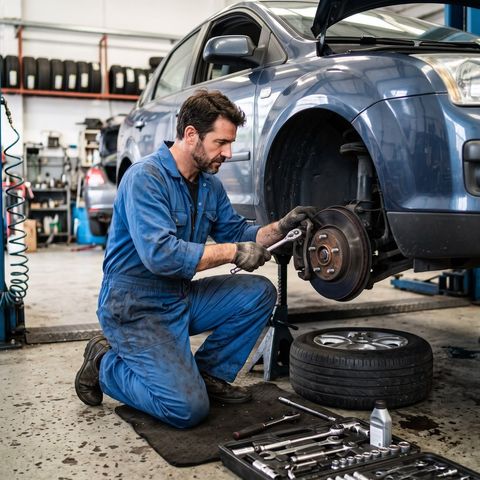
5. Hydraulic floor jack and jack stands
These tools help raise and support vehicles during certain repair jobs.
They are useful when a hydraulic lift is unavailable or when a vehicle needs to be raised for specific tasks.
Important safety requirements include:
Use equipment rated for the vehicle's weight.
Place jack stands at the manufacturer's recommended support points.
Never work underneath a vehicle supported only by a hydraulic jack.
Inspect lifting equipment regularly.
Indicative combined budget: ₹10,000–₹30,000, depending on capacity and quality.
6. Battery tester and charger
Battery testing helps identify weak batteries and charging system problems.
A battery tester can measure battery condition and voltage, while a charger helps recharge suitable batteries.
Some advanced systems also test the alternator and starter motor.
Indicative cost: ₹5,000–₹25,000 for basic testing and charging equipment.
7. Tyre changer machine
A tyre changer removes and installs tyres on wheel rims.
It is useful for garages offering tyre replacement and related services.
Important features include:
Suitable rim size range
Pneumatic operation
Bead-breaking capacity
Compatibility with alloy wheels
Protective tools for different wheel finishes
Indicative cost: ₹30,000–₹1.2 lakh or more, depending on automation and capacity.
8. Wheel balancing machine
Wheel balancing helps distribute weight evenly around a wheel and tyre assembly.
Incorrect balancing can contribute to steering vibration and uneven tyre wear.
A wheel balancer is normally purchased alongside a tyre changer if the workshop plans to provide complete tyre services.
Indicative cost: ₹40,000–₹1 lakh or more.
9. Computerised wheel alignment machine
Wheel alignment equipment measures wheel angles and helps technicians adjust them according to vehicle specifications.
Common measurements include:
Camber
Caster
Toe
Incorrect alignment can affect tyre wear, steering behaviour and vehicle handling.
A computerised alignment system is a useful addition for a multi-brand workshop, but it may not be necessary on the first day.
Indicative cost: ₹1.5–4 lakh for some systems, with advanced 3D equipment costing more.
10. Car AC service machine
An AC service machine helps technicians recover refrigerant, perform suitable system servicing and recharge vehicle air-conditioning systems.
The machine must be compatible with the refrigerant used in the vehicles being serviced.
Different refrigerants require appropriate equipment and handling procedures. Technicians should be trained in safe refrigerant recovery and charging.
Indicative cost: ₹40,000–₹1.2 lakh or more, depending on features and compatibility.
11. Additional garage equipment
A workshop also needs smaller tools and supporting equipment.
Equipment | Purpose | Indicative cost |
|---|---|---|
Oil drain trolley | Collect used engine oil | ₹8,000–₹20,000 |
Engine hoist | Lift heavy engine components | ₹20,000–₹50,000 |
Pressure washer | Exterior vehicle cleaning | ₹15,000–₹40,000 |
Grease gun | Apply lubricant | ₹1,000–₹5,000 |
Workbench and storage | Organise tools and parts | ₹15,000–₹40,000 |
Impact wrench | Remove and tighten suitable fasteners | ₹5,000–₹15,000 |
Inspection lamp | Improve visibility during repairs | ₹1,000–₹5,000 |
Vacuum cleaner | Interior cleaning | ₹5,000–₹15,000 |
All equipment prices are broad planning estimates. Supplier quotations, taxes, installation and machine specifications can change the final amount.
3. How Much Space Is Required for a Car Garage?
Space requirements depend on the number of service bays, vehicle movement, equipment and services offered.
A workshop should have enough room for technicians to open car doors, move tool trolleys and work safely around vehicles.
The following are approximate planning ranges:
Garage type | Suggested space |
|---|---|
Basic single-bay garage | 500–800 sq. ft. |
Small multi-brand workshop | 800–1,200 sq. ft. |
Two- or three-bay service centre | 1,500–2,500 sq. ft. |
Full-service workshop | 3,000–5,000+ sq. ft. |
Important areas inside a garage
1. Vehicle reception area
This is where customers arrive, discuss problems and hand over their vehicles. It should have enough room for vehicle inspection and customer interaction.
2. Mechanical repair bays
These areas contain lifts, tools and other equipment. Each bay should have adequate clearance for vehicle movement and technician access.
3. Diagnostic section
A dedicated area for computerised vehicle checks can help technicians work without interrupting other repair jobs.
4. Parts storage
Filters, lubricants, brake pads, belts, bulbs and other commonly used components should be stored in an organised manner.
5. Washing area
If the garage offers vehicle washing, it should have suitable drainage, water supply and wastewater management arrangements.
6. Customer waiting area
A small reception and waiting space can improve the customer experience.
7. Parking and vehicle delivery area
The garage should provide space for vehicles waiting for inspection, repair or delivery. This is especially important when multiple jobs are handled at the same time.
4. Estimated Investment to Start a Car Service Garage in India
The total investment depends on location, equipment quality, rent, workshop size and the services provided.
A small mechanical garage can begin with essential equipment. A larger multi-brand service centre needs more machines, staff and working capital.
A. Basic garage setup budget
This example assumes a small workshop with one service bay and general mechanical repair services.
Expense | Estimated budget |
|---|---|
Hydraulic lift | ₹80,000–₹1.5 lakh |
Air compressor | ₹20,000–₹40,000 |
Diagnostic scanner | ₹15,000–₹40,000 |
Hand tools and tool cabinet | ₹30,000–₹60,000 |
Jack and jack stands | ₹10,000–₹20,000 |
Battery tester and charger | ₹5,000–₹15,000 |
Oil drain and supporting equipment | ₹10,000–₹20,000 |
Electrical and workshop fit-out | ₹40,000–₹80,000 |
Rent deposit and initial expenses | ₹40,000–₹1 lakh |
Initial spare parts and consumables | ₹30,000–₹60,000 |
Signage and basic marketing | ₹10,000–₹20,000 |
Working capital | ₹50,000–₹1 lakh |
Indicative planning estimate. Actual costs depend on premises, equipment specifications and local supplier quotations.
A basic garage may require approximately ₹4–8 lakh to start, depending on how much equipment and working capital are included. Some leaner setups may cost less if the owner already has suitable premises or equipment.
B. Multi-brand service centre budget
This model provides general servicing, diagnostics, tyre services and AC repairs.
Expense | Estimated budget |
|---|---|
Two hydraulic lifts | ₹1.6–3 lakh |
Air compressor | ₹30,000–₹60,000 |
Diagnostic scanners | ₹40,000–₹1 lakh |
Hand tools and pneumatic tools | ₹60,000–₹1 lakh |
Tyre changer | ₹30,000–₹1.2 lakh |
Wheel balancer | ₹40,000–₹1 lakh |
AC service equipment | ₹40,000–₹1.2 lakh |
Electrical and interior fit-out | ₹1–2 lakh |
Initial spare parts stock | ₹75,000–₹1.5 lakh |
Rent deposit and setup costs | ₹1–2 lakh |
Licences, safety and signage | ₹30,000–₹60,000 |
Working capital | ₹1.5–2.5 lakh |
A multi-brand workshop may require approximately ₹9–18 lakh or more. Adding computerised wheel alignment, advanced diagnostic equipment or body repair facilities can increase the budget.
C. Full-service workshop budget
A larger workshop offering mechanical repairs, tyre services, wheel alignment, AC work and body repairs may need an investment of ₹25–50 lakh or more.
A paint booth, specialised body repair equipment, additional lifts and advanced diagnostic systems can increase the total substantially.
5. Monthly Running Costs of a Car Service Garage
Once the garage starts operating, it will have regular expenses even when customer traffic changes.
The main expenses include rent, employee salaries, electricity, consumables, maintenance and spare parts.
Example of monthly operating expenses
Consider a small multi-brand garage with one service bay and a team of two mechanics and one helper.
Expense | Illustrative monthly cost |
|---|---|
Shop rent | ₹20,000 |
Two mechanics | ₹36,000 |
One helper | ₹12,000 |
Electricity | ₹6,000 |
Water and cleaning | ₹2,000 |
Lubricants and workshop consumables | ₹10,000 |
Equipment maintenance | ₹3,000 |
Marketing and administration | ₹4,000 |
Miscellaneous expenses | ₹3,000 |
Total | ₹96,000 |
Illustrative example only. Salaries and rent vary significantly by city and staff experience. Spare parts purchased for individual customer jobs, loan repayments, taxes and owner salary are not included.
Major operating expenses explained
Employee salaries: Skilled mechanics are one of the most important parts of the business. Their experience affects repair quality, customer satisfaction and the number of jobs completed.
Electricity: Lifts, compressors, diagnostic equipment, lighting and washing machines consume electricity.
Consumables: Engine oil, grease, cleaning materials, brake cleaner, filters and other supplies are used during regular operations.
Maintenance: Lifts, compressors and diagnostic equipment require periodic inspection and servicing.
Spare parts: A garage may keep common parts in stock and purchase specialised components when customers require them.
Marketing: Local advertising, signage, online listings and customer communication help generate business.
6. How to Estimate Revenue and Profit
A garage earns revenue through labour charges, servicing packages, diagnostics, parts sales and specialised services.
The amount depends on the number of vehicles handled each day and the average billing value.
Illustrative monthly revenue calculation
Assume a small garage handles:
4 vehicles per day
Average service and labour billing of ₹1,500 per vehicle
26 working days per month
Monthly labour and service revenue:
4 × ₹1,500 × 26 = ₹1,56,000
If monthly operating expenses are ₹96,000, the illustrative operating surplus is ₹60,000.
This is not a guaranteed profit estimate. The calculation excludes parts revenue and related parts costs, taxes, loan payments, depreciation and owner compensation. The actual result depends on the type of jobs, pricing, technician productivity and customer volume.
Services that can generate additional revenue
Engine oil and filter replacement
Brake servicing
AC inspection and servicing
Battery testing and replacement
Tyre replacement
Wheel balancing
Wheel alignment
Suspension repairs
Computerised diagnostics
Vehicle cleaning
A garage should price each service after considering technician time, consumables, equipment costs and local competition.
7. Licences and Registrations for a Car Service Garage in India
The registrations and permissions required depend on the state, municipality, size of the workshop and services offered.
Common requirements to check include:
Business registration or suitable proprietorship arrangements
Shop and Establishment registration, where applicable
Municipal trade licence, where required
GST registration based on applicable rules
Udyam registration, if eligible
Fire safety requirements
State Pollution Control Board permissions, where applicable
Waste oil storage and disposal arrangements
Local building, land-use and commercial activity permissions
Waste oil and environmental management
Car garages generate used engine oil, oil filters, batteries, contaminated materials and other workshop waste.
These materials should not be disposed of through ordinary drains or mixed with household waste.
Used oil and other regulated waste should be stored safely and handed over through authorised collection or recycling channels, as applicable.
Workshops offering painting, washing or other specialised services may face additional environmental requirements.
Before starting operations, confirm applicable approvals with the local municipal authority and the relevant State Pollution Control Board.
8. Staff Required to Run a Car Service Garage
The number of employees depends on the size of the garage and the services offered.
A small workshop may start with two mechanics and one helper. A larger centre needs more specialised technicians and customer-facing staff.
Position | Main responsibility |
|---|---|
Senior mechanic | Handle complex mechanical repairs |
General mechanic | Perform servicing and repairs |
Workshop helper | Assist technicians and organise tools |
Service advisor | Record customer complaints and explain work |
Diagnostic technician | Identify electronic and mechanical faults |
Store assistant | Manage spare parts and inventory |
For a small garage, some responsibilities can be managed by the owner.
However, vehicle diagnosis, electrical repairs and safety-critical work should be handled by appropriately trained personnel.
9. How to Select the Right Location
Location can influence customer traffic, rent and long-term business performance.
Before renting a workshop, consider the following factors.
Vehicle movement
A location near residential areas, commercial markets or busy roads may provide access to potential customers. However, convenient entry and exit are also important.
Nearby competition
Check how many garages operate in the area and what services they offer. A location with existing workshops may still have demand, but the business needs a clear service advantage.
Parking availability
Customers need enough space to leave vehicles for inspection and repairs. Limited parking can create operational problems.
Electricity and water
Check the available power connection, sanctioned electrical load, water supply and drainage.
Building suitability
Measure the ceiling height, entrance width, floor condition and usable area. A building suitable for a retail shop may not be suitable for a vehicle lift.
Commercial permissions
Confirm that the property can legally be used as an automobile repair workshop before signing the rental agreement.
10. Common Mistakes to Avoid When Starting a Garage
New garage owners sometimes spend too much on equipment before understanding customer demand.
The following mistakes can increase financial pressure:
Buying expensive machines too early: Wheel alignment and advanced diagnostic systems may remain unused if customer demand is low.
Hiring without checking experience: Inexperienced technicians can lead to incorrect repairs and customer complaints.
Ignoring floor strength: Hydraulic lifts require suitable foundations and professional installation.
Choosing a poor location: Limited parking, difficult access and unsuitable building conditions can affect daily operations.
Keeping too much spare parts inventory: Slow-moving parts can lock up working capital.
Not maintaining job records: Without proper job cards, repair details and customer approvals can become difficult to track.
Underestimating working capital: A garage needs money for wages, rent and supplies while customer payments are still coming in.
Ignoring equipment servicing: Poorly maintained lifts and tools can create safety risks and operational delays.
11. A Practical Equipment Buying Plan for New Garage Owners
Instead of purchasing every machine at once, equipment can be added in stages.
Stage 1: Essential equipment
Start with the tools required for common mechanical jobs.
Hydraulic lift or suitable lifting equipment
Air compressor
Diagnostic scanner
Hand tools
Floor jack and jack stands
Battery tester
Oil drain trolley
Basic electrical testing equipment
Stage 2: Additional services
After building a regular customer base, consider adding:
Tyre changer
Wheel balancer
AC service machine
Pressure washer
Engine hoist
Additional diagnostic equipment
Stage 3: Workshop expansion
When the workload supports further investment, consider:
Computerised wheel alignment
Additional hydraulic lifts
Advanced diagnostic systems
Dedicated electrical repair section
Body repair equipment
Paint booth, where permitted
This approach helps control initial spending and allows the business to invest according to actual customer demand.
Frequently Asked Questions
1. How much money is required to start a car service garage in India?
A basic car repair garage may require approximately ₹4–8 lakh. A multi-brand service centre may need ₹9–18 lakh or more. A full-service workshop with advanced machinery and body repair facilities can require ₹25–50 lakh or higher.
2. Which machines are essential for a basic car garage?
The essential equipment includes a hydraulic lift, air compressor, diagnostic scanner, mechanic hand tools, floor jack, jack stands, battery tester and oil drain equipment.
3. How much space is required for a car service garage?
A basic single-bay garage may need approximately 500–800 sq. ft. A small multi-brand workshop may require 800–1,200 sq. ft., while larger service centres need more space.
4. Is a hydraulic lift necessary for a car garage?
A hydraulic lift is useful for regular underbody repairs, oil changes, suspension inspections and brake work. However, the choice depends on the services offered and the availability of suitable lifting equipment.
5. Can a car garage operate without wheel alignment equipment?
Yes. A garage can initially focus on mechanical servicing and repairs while referring alignment work to another workshop. Wheel alignment equipment can be added when customer demand justifies the investment.
6. How many mechanics are needed for a small garage?
A small workshop may start with two mechanics and one helper. The requirement increases with the number of service bays and the range of repairs offered.
7. Which services should a new car garage offer first?
General servicing, oil changes, brake repairs, battery checks, suspension inspection and basic diagnostics are practical starting services. Specialised work can be introduced as the team gains experience and equipment.
8. Is a multi-brand car service centre profitable?
It can be profitable when the workshop has regular customers, skilled technicians, suitable pricing and good control over operating costs. Results depend on local competition, repair volume and equipment utilisation.
Conclusion
Setting up a car service garage requires a clear understanding of the services to be offered, equipment requirements, workshop space and monthly expenses. A small mechanical garage can begin with essential tools and one service bay, while a multi-brand workshop needs additional machines and specialised staff.
For new entrepreneurs, starting with common repair and maintenance services can help control investment. Equipment such as tyre changers, wheel balancers and alignment machines can be added when customer demand increases.

Related Post...
Setting Up a Car Service Garage: Equipment Checklist and Budget
Updated: November 28, 2026
Read More