Rolling Machine: Guide to Types, Uses and Operation
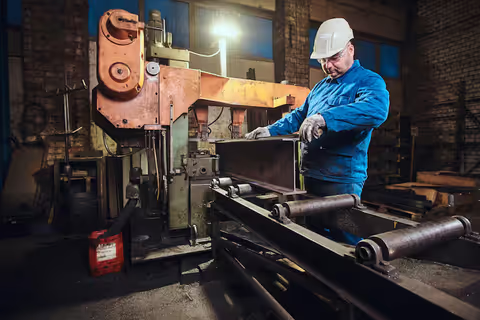
A Rolling Machine is industrial equipment used to change the shape, thickness, or curvature of metal and other materials through controlled mechanical pressure. Rolling machines are widely associated with metalworking, where plates, sheets, bars, and other forms are passed between rotating rolls.
Depending on their design, they can produce flat sheets, cylindrical shapes, curved plates, structural sections, and other forms used in manufacturing and construction. Understanding how a Rolling Machine works helps explain many processes used to prepare metal for industrial applications.
Context
What Is a Rolling Machine?
A Rolling Machine uses one or more rotating rolls to apply pressure to a workpiece. As material moves through the roll gap, mechanical force changes its dimensions or shape. The exact result depends on the roll arrangement, material characteristics, machine configuration, and operating parameters.
Rolling is part of a larger group of metal-forming processes. Unlike machining, which removes material to create a particular shape, rolling generally changes the existing material without intentionally removing significant amounts of it.
Origins of Rolling Technology
The development of rolling technology is closely connected with the history of metalworking. Early rolling equipment was relatively simple and was used to produce thinner metal sections and more consistent dimensions. As mechanical power, metallurgy, and manufacturing technology developed, rolling equipment became larger, more controlled, and more specialized.
Modern machines can incorporate hydraulic systems, electric drives, computerized controls, sensors, and automated adjustment mechanisms. These developments allow operators to monitor important variables during forming.
How a Rolling Machine Works
The basic rolling process involves placing a material between rotating rolls. The rolls rotate in directions that move the material through the working area while applying pressure.
Several factors determine the result:
- Roll diameter and arrangement influence the mechanical action.
- Roll gap affects the resulting thickness or shape.
- Material thickness affects the required forming conditions.
- Material strength and ductility influence how much deformation can occur.
- Rolling speed affects process behavior and production flow.
- Temperature can influence the material's resistance to deformation.
Some rolling operations are performed at room temperature, while others use heated material. These are generally described as cold rolling and hot rolling, although the exact temperature range depends on the material and process.
Main Types of Rolling Machines
Rolling Machine configurations vary according to the intended forming operation. Two-roll systems use a pair of rolls, while three-roll and four-roll systems use additional rolls to improve control or accommodate particular forming requirements.
Plate rolling machines are commonly used to curve metal plates into cylindrical or conical shapes. Section rolling machines can form structural profiles, while specialized rolling equipment is used for tubes, bars, rings, and other products.
Importance
Role in Manufacturing
Rolling is important because many industrial products begin as metal stock that needs controlled forming before further processing. The process can produce consistent dimensions and geometries suitable for later fabrication, welding, cutting, or assembly.
Industries using rolling technology include construction, transportation, energy equipment, general manufacturing, shipbuilding, metal fabrication, and infrastructure development.
Forming Plates and Sheets
Plate rolling is particularly useful when flat metal must be converted into curved components. Cylindrical shells, tanks, ducts, structural components, and other fabricated forms may require controlled plate curvature.
The forming sequence may involve several passes through the rolls. Operators may gradually increase deformation rather than attempting to achieve the final shape in a single operation.
Material Considerations
Different metals respond differently to rolling. Carbon steel, stainless steel, aluminum alloys, copper alloys, and other materials have different strength, ductility, thickness, and temperature characteristics.
Important considerations include:
- Material grade and mechanical properties
- Initial thickness
- Required final dimensions
- Required radius or profile
- Surface condition
- Material temperature
- Grain direction where relevant
- Springback after forming
Springback occurs when elastic deformation causes a material to partially return toward its original shape after pressure is removed. Machine settings may therefore account for the expected change after forming.
Machine Configuration and Applications
| Machine Type | Typical Material Form | Common Application |
|---|---|---|
| Two-roll machine | Sheet or strip | Basic forming operations |
| Three-roll machine | Plate or sheet | Cylindrical and curved shapes |
| Four-roll machine | Plate | Controlled plate forming |
| Section rolling machine | Structural profiles | Curved structural sections |
| Tube rolling machine | Tubes or pipes | Diameter and shape control |
| Ring rolling machine | Ring-shaped stock | Large circular components |
Process Control
Accurate rolling requires control over several mechanical parameters. Roll alignment, pressure, speed, material positioning, and workpiece geometry can influence the final result.
Modern equipment may use sensors and electronic control systems to monitor machine conditions. Operators can use measurements to identify deviations and maintain consistent process conditions.
Recent Updates
Increased Automation
Recent developments in Rolling Machine technology have focused on automation and digital process control. Electronic controls can coordinate roll movement, hydraulic pressure, speed, and other operating variables.
Automated positioning can reduce manual adjustment during repeated forming operations. However, the appropriate degree of automation depends on machine design, production requirements, material characteristics, and workplace conditions.
Digital Monitoring
Sensors are increasingly used to collect information about pressure, position, temperature, motor operation, vibration, and other machine parameters. Data can be displayed through control interfaces or stored for later analysis.
Digital monitoring can also support maintenance planning by identifying changes in equipment behavior. This approach is related to broader industrial trends involving condition monitoring and connected manufacturing systems.
Energy and Resource Management
Manufacturers are also examining energy use during metal-forming processes. Electric drives, variable-speed control, improved hydraulic systems, and process optimization can influence energy consumption.
Material utilization is another consideration. Accurate forming can help reduce unnecessary processing and material handling, although actual resource performance depends on machine configuration and production conditions.
Advanced Control and Simulation
Computer-based simulation is increasingly used to study forming behavior before physical production. Numerical models can examine deformation, stress distribution, springback, and potential forming difficulties.
Such analysis can be useful when developing complex shapes or processing materials with demanding mechanical characteristics. It can also help engineers compare different process parameters before applying them to production equipment.
Safety and Condition Monitoring
Modern industrial equipment increasingly incorporates protective systems such as emergency stops, guarding, interlocks, and monitoring devices. These features are intended to reduce exposure to moving components and unexpected machine movement.
Condition monitoring can also track vibration, temperature, hydraulic pressure, and other indicators associated with machine operation. Maintenance records and inspection schedules remain important parts of equipment management.
Laws or Policies
Industrial Safety in India
In India, Rolling Machine installations are subject to workplace safety requirements applicable to industrial establishments. The Occupational Safety, Health and Working Conditions Code, 2020 forms part of India's framework for occupational safety and working conditions.
Actual requirements can vary according to the establishment, workforce, state-level implementation, machine configuration, and industrial activity. Machine guarding, safe operating procedures, training, maintenance, and emergency arrangements are important areas of workplace safety.
Electrical and Machine Requirements
Rolling equipment can contain motors, control panels, sensors, hydraulic systems, and other electrical or mechanical components. Applicable BIS and IEC standards may be relevant depending on the machine and its installation.
Electrical protection, grounding, control-system safety, and electromagnetic compatibility may also need consideration. The specific standards applicable to a machine should be identified from its design, operating environment, and intended use.
Environmental Considerations
Metal-forming operations can involve lubricants, hydraulic fluids, cleaning materials, noise, and metal waste. Environmental requirements may therefore apply depending on the facility and its activities.
The Environment (Protection) Act, 1986 and requirements administered through the Central Pollution Control Board and relevant State Pollution Control Boards form part of India's environmental framework. Specific obligations depend on the industrial process and location.
Tools and Resources
Engineering Calculations
Rolling-process calculations can help estimate roll force, torque, deformation, reduction, and related parameters. Engineering references and material-property databases can provide information about yield strength, tensile strength, ductility, and other characteristics.
CAD and Simulation Software
Computer-aided design tools can be used to create the intended component geometry. Forming simulation software can then help examine how material may deform under particular rolling conditions.
Measurement Equipment
Common measurement tools include:
- Vernier calipers and micrometers for dimensional checks
- Thickness gauges for sheet and plate measurements
- Radius gauges for curved components
- Digital indicators for alignment checks
- Temperature instruments for heated forming
- Vibration monitoring instruments for machine condition assessment
Standards and Technical References
Bureau of Indian Standards publications can provide information about applicable Indian standards. ISO and IEC publications can also be relevant to quality management, safety, electrical systems, and machine-related requirements.
Machine manuals, maintenance records, material specifications, engineering drawings, inspection templates, and manufacturer documentation are additional resources used during operation and maintenance.
FAQs
What is a Rolling Machine used for?
A Rolling Machine is used to deform material through rotating rolls. Applications include forming plates, sheets, bars, tubes, rings, and structural sections into required dimensions or curved profiles.
How does a Rolling Machine work?
A Rolling Machine passes material between rotating rolls that apply controlled mechanical pressure. The roll arrangement, gap, speed, material properties, and forming sequence determine the resulting shape.
What are the main types of Rolling Machine?
Common configurations include two-roll, three-roll, and four-roll machines. Specialized Rolling Machine designs are also used for sections, tubes, rings, sheets, and other material forms.
What materials can be processed using a Rolling Machine?
Depending on machine design, rolling can be used with materials such as carbon steel, stainless steel, aluminum alloys, copper alloys, and other metals. The machine must be appropriate for the material's thickness and mechanical properties.
What safety measures are important for Rolling Machine operation?
Important measures include appropriate machine guarding, emergency-stop systems, safe material handling, inspection, operator training, and controlled access to moving components. Workplace procedures should follow applicable Indian safety requirements and equipment documentation.
Conclusion
A Rolling Machine changes the dimensions or shape of material by applying controlled pressure through rotating rolls. Different configurations are used for plates, sheets, tubes, bars, rings, and structural sections. Modern Rolling Machine systems increasingly incorporate automation, sensors, digital monitoring, simulation, and electronic controls. Safe operation depends on appropriate machine configuration, material knowledge, process control, maintenance, and applicable workplace requirements.

Related Post...
Rotational Moulding Machines: Explore Moulding Technology, Materials and Production Applications
Updated: September 29, 2026
Read More
Modern Spinning Machines: Insights Into Spinning Technology, Yarn Production and Textile Applications
Updated: September 29, 2026
Read More