Modern Spinning Machines: Insights Into Spinning Technology, Yarn Production and Textile Applications
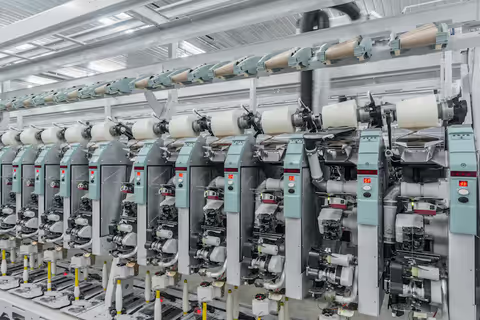
Modern Spinning Machines are industrial textile machines used to convert prepared fibers into yarn through controlled drafting, twisting, winding, and related processes.
They are used with materials such as cotton, polyester, viscose, wool, and blended fibers. Modern systems combine mechanical components, electronic controls, sensors, automation, and monitoring technologies to produce yarn with defined thickness, strength, twist, and other characteristics.
Context
What Are Modern Spinning Machines?
Spinning is the process of converting loose fibers into a continuous yarn. Before spinning begins, fibers normally undergo preparation stages such as opening, cleaning, blending, carding, and drawing. The prepared fiber strand is then processed through spinning equipment that reduces its thickness and introduces twist.
Modern Spinning Machines are designed to perform these operations with controlled mechanical movement and electronic monitoring. Depending on the spinning method, the machine may use a spindle, rotor, air stream, or another mechanism to create yarn.
The development of industrial spinning equipment is closely connected with the growth of mechanized textile production. Earlier spinning methods depended heavily on manual movement, while industrial machinery introduced continuous production, mechanical drafting, controlled twisting, and automated yarn handling.
How Modern Spinning Machines Work
A typical spinning process begins when a prepared fiber strand enters the drafting system. Drafting reduces the mass of fibers per unit length by drawing the fibers between rollers moving at different speeds.
After drafting, the fibers are formed into yarn through twisting or another yarn-forming mechanism. The finished yarn is then wound onto a package suitable for storage, transportation, dyeing, weaving, knitting, or other textile processes.
The general sequence can include:
Fiber preparation
Carding and drawing
Roving or sliver preparation where applicable
Drafting
Yarn formation
Twist insertion
Winding
Electronic monitoring and quality inspection
The exact sequence depends on the spinning technology and the type of fiber being processed.
Main Types of Spinning Machines
Several spinning technologies are used in modern textile production. Ring spinning uses a spindle and traveler arrangement to insert twist while forming yarn. It is suitable for a broad range of natural and synthetic fibers.
Rotor spinning uses centrifugal forces inside a rotor to collect fibers and form yarn. It can handle certain short fibers efficiently and has a different production structure from ring spinning.
Air-jet spinning uses controlled airflow to form yarn around a central fiber bundle. This method can provide high production speeds for suitable fiber types and yarn structures.
| Spinning Technology | Main Yarn-Formation Method | Common Characteristics |
|---|---|---|
| Ring spinning | Spindle and traveler | Versatile yarn production |
| Rotor spinning | Rotating rotor | Suitable for many short-fiber applications |
| Air-jet spinning | High-speed airflow | Rapid yarn formation |
| Compact spinning | Modified ring-spinning arrangement | Improved fiber control |
| Open-end spinning | Rotor-based fiber collection | Continuous yarn formation |
| Specialty spinning | Application-specific mechanism | Used for particular yarn structures |
Each method produces yarn with different characteristics. Fiber length, yarn count, strength, twist, surface appearance, production requirements, and downstream application influence the appropriate spinning technology.
Importance
Consistent Yarn Production
Textile manufacturers require yarn with reasonably consistent characteristics. Variations in yarn thickness, twist, strength, or surface structure can affect subsequent weaving, knitting, dyeing, and finishing operations.
Modern machines use controlled drafting systems and sensors to monitor production conditions. Automated adjustments can help maintain specified operating parameters, although the actual performance depends on machine design, fiber quality, maintenance, and process settings.
Processing Different Fibers
Spinning equipment can be configured for different fiber materials. Cotton, polyester, viscose, wool, acrylic, and blended fibers have different physical characteristics and may require different preparation and spinning conditions.
Fiber length, fineness, moisture, strength, friction, and cleanliness can influence machine settings. A spinning system designed for one fiber type may therefore require changes before processing another material.
Production Planning
Industrial spinning involves multiple connected stages. A disruption in carding, drawing, roving, spinning, or winding can affect the following stages.
Modern production systems can collect information about spindle operation, yarn breaks, production quantities, machine status, and selected quality parameters. This information can help operators understand production conditions and identify recurring process variations.
Applications Across Textiles
Yarn produced by spinning machines can be used in many textile applications, including:
Woven fabrics
Knitted fabrics
Home textiles
Apparel fabrics
Technical textiles
Industrial fabrics
Sewing threads
Blended textile materials
The intended end use influences yarn specifications such as count, twist, strength, elongation, and surface characteristics.
Comparison of Spinning Technologies
The following table provides a general comparison of commonly used technologies.
| Factor | Ring Spinning | Rotor Spinning | Air-Jet Spinning |
|---|---|---|---|
| Yarn formation | Spindle and traveler | Rotor | Airflow |
| Twist formation | Mechanical twisting | Rotor action | Air-induced structure |
| Fiber suitability | Broad range | Many short fibers | Selected fiber ranges |
| Automation potential | High | High | High |
| Typical package formation | Bobbin or related package | Direct package | Direct package |
| Process characteristics | Detailed control of yarn structure | Continuous production | High-speed yarn formation |
These are broad descriptions. Individual machine models can have different capabilities, configurations, and operating requirements.
Recent Updates
Greater Automation
From 2024 through 2026, textile spinning technology has continued moving toward greater automation and digital monitoring. Sensors and electronic controllers can monitor machine conditions, production information, yarn breaks, spindle behavior, and selected process parameters.
Automated doffing and material handling can reduce repeated manual intervention during package changes. The level of automation varies among spinning technologies and production lines.
Artificial Intelligence and Data Analysis
Artificial intelligence and data analytics are increasingly being examined for textile manufacturing. Machine data can be analyzed to identify patterns associated with yarn breaks, vibration, temperature changes, or other operating conditions.
Predictive analysis can support maintenance planning by identifying unusual equipment behavior before a larger process interruption occurs. Such systems depend on suitable sensor data, historical records, model quality, and appropriate human review.
Energy Monitoring
Spinning machinery contains many rotating components, motors, fans, drafting systems, and air-handling equipment. Energy monitoring has therefore become an important part of textile factory management.
Digital measurement can help facilities track electricity use across machines or production areas. This information can be analyzed alongside production output to understand energy patterns within the spinning process.
Digital Quality Monitoring
Modern spinning systems increasingly integrate electronic quality monitoring. Sensors and yarn-monitoring devices can detect selected irregularities, thickness variations, yarn breaks, and other characteristics.
Some production environments connect these measurements with central software platforms. This creates digital production records that can be reviewed alongside machine conditions and material information.
Resource Efficiency
Textile producers are also examining fiber waste, compressed-air use, electricity consumption, and material recovery. Better process control can help manage waste generation and maintain consistent production conditions.
The exact environmental performance depends on fiber type, machine configuration, factory infrastructure, operating practices, and downstream processes.
Laws or Policies
Textile Standards in India
Textile production in India is influenced by standards issued by the Bureau of Indian Standards and by broader industrial, environmental, and workplace requirements. Relevant standards can address yarn characteristics, textile testing methods, fiber identification, and product specifications.
The applicable standard depends on the yarn and intended application. Manufacturers should therefore identify the relevant specification rather than applying one testing framework to every type of yarn.
Workplace Safety
Spinning mills contain rotating machinery, electrical equipment, moving belts, high-speed spindles, compressed air, noise, and airborne textile fibers. Workplace safety measures are therefore important during machine operation and maintenance.
India's Occupational Safety, Health and Working Conditions Code, 2020 provides a broader statutory framework for occupational safety and working conditions, subject to its implementation and applicable rules. State-level requirements may also apply.
Environmental Requirements
Textile facilities can generate fiber waste, wastewater, noise, and other industrial impacts depending on their processes. Environmental requirements can vary according to the facility, location, scale, and activities conducted.
The Central Pollution Control Board and State Pollution Control Boards provide environmental frameworks relevant to industrial facilities. Specific requirements should be checked according to the manufacturing process and local regulatory conditions.
Electrical and Machinery Safety
Modern spinning machines use motors, control panels, sensors, drives, and other electrical equipment. Proper electrical protection, machine guarding, emergency controls, maintenance procedures, and grounding are important parts of industrial safety planning.
Applicable standards and workplace requirements depend on the equipment and facility configuration.
Tools and Resources
Yarn Testing Instruments
Textile laboratories use instruments to evaluate yarn characteristics such as count, tensile strength, elongation, twist, evenness, hairiness, and irregularities.
The appropriate test method depends on the yarn type and applicable specification. Results should be interpreted according to the relevant testing standard.
Machine Monitoring Systems
Digital monitoring platforms can collect information about spindle speed, yarn breaks, production quantities, machine status, and selected environmental conditions. Such information can help operators understand production patterns.
Maintenance Records
Maintenance schedules and digital records can track lubrication, component inspections, spindle condition, belt checks, sensor inspection, and replacement activities. Organized records can help identify repeated equipment issues.
Production Planning Tools
Spreadsheets and manufacturing software can be used to record fiber batches, machine settings, yarn counts, production quantities, quality measurements, and process observations.
Useful records can include:
Fiber type and blend ratio
Machine configuration
Yarn count
Twist settings
Production quantity
Yarn-break information
Quality-test results
Maintenance observations
These records help connect raw-material characteristics with machine performance and finished-yarn properties.
FAQs
What are Modern Spinning Machines?
Modern Spinning Machines are textile production machines that convert prepared fibers into yarn through processes such as drafting, twisting, yarn formation, and winding. They use mechanical systems, electronic controls, and sensors to manage production.
What are the main types of Modern Spinning Machines?
Common technologies include ring spinning, rotor or open-end spinning, air-jet spinning, and compact spinning. Each uses a different yarn-formation mechanism and has different applications.
How do Modern Spinning Machines improve yarn production?
They use controlled drafting, automated movement, electronic monitoring, and process controls to maintain defined operating conditions. Their actual performance depends on fiber quality, machine configuration, maintenance, and process settings.
Which fibers can Modern Spinning Machines process?
Depending on the machine, spinning systems can process cotton, polyester, viscose, wool, acrylic, and blended fibers. Fiber length, strength, fineness, moisture, and other properties influence the required settings.
What technologies are used in modern textile spinning?
Modern systems can include sensors, programmable controls, automated doffing, digital production monitoring, energy measurement, machine-data analysis, and selected artificial intelligence applications.
Conclusion
Modern Spinning Machines convert prepared fibers into yarn through controlled drafting, twisting, yarn formation, and winding processes. Ring, rotor, air-jet, compact, and specialty spinning technologies provide different approaches for producing yarn from various fiber types. Developments from 2024 through 2026 have emphasized automation, digital monitoring, data analysis, energy measurement, and resource management. Textile standards, workplace safety requirements, environmental rules, and product-specific testing frameworks also influence spinning operations in India.

Related Post...
Glass Bottle Manufacturing Machines: An Informative Guide to Types, Processes and Applications
Updated: September 26, 2026
Read More
Rotational Moulding Machines: Explore Moulding Technology, Materials and Production Applications
Updated: September 29, 2026
Read More
Automatic Liquid Filling Machines: Explore Types, Filling Methods and Applications
Updated: September 26, 2026
Read More