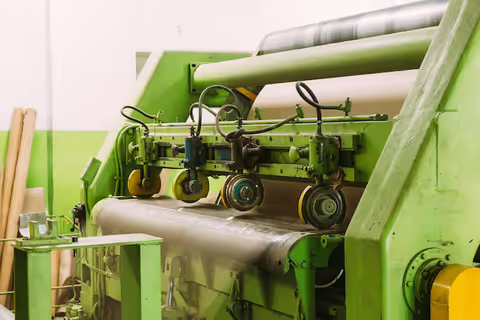
Online Ore Analyzers: Exploring Technologies, Components and Measurement Techniques
Online ore analyzers are measurement systems used to determine the composition or quality of mineral-bearing material while it is moving through a mining or mineral-processing operation.
Unlike laboratory analysis, which usually requires samples to be collected and tested separately, online ore analyzers can examine material continuously or at frequent intervals. This helps operators understand changes in ore characteristics and maintain more consistent process conditions.
Context
What Are Online Ore Analyzers?
Online ore analyzers are instruments designed to measure selected physical or chemical characteristics of ore without requiring every sample to be removed from the production stream. They are commonly installed around conveyors, transfer points, crushers, stockpiles, or processing stages.
Depending on their design, these systems can measure elements, mineral composition, moisture, density, or other characteristics. The measurement method depends on the material and the information required by the processing operation.
Common technologies include X-ray fluorescence, prompt gamma neutron activation analysis, laser-based measurement, near-infrared spectroscopy, and other sensor-based methods. Each technique works differently and has specific strengths and limitations.
How Did Online Ore Analysis Develop?
Traditional mineral analysis relied heavily on physical sampling followed by laboratory preparation and testing. Laboratory methods remain important because they can provide detailed measurements under controlled conditions, but they may require more time between sample collection and the availability of results.
The development of online measurement introduced a way to observe material characteristics closer to the point where processing decisions are made. Improvements in detectors, electronics, computing, conveyor instrumentation, and data analysis have helped these systems become part of automated mineral-processing environments.
How Do Online Ore Analyzers Work?
An analyzer is positioned so that it can examine material as it passes through a defined measurement area. Sensors collect signals associated with the ore, and software processes those signals to estimate selected properties.
A simplified measurement sequence includes:
- Material movement: Ore travels through a conveyor, chute, or another controlled material path.
- Signal generation: A sensor or radiation source interacts with the material, depending on the analytical technique.
- Detection: Detectors capture the resulting signal.
- Data processing: Software interprets the measured information.
- Result generation: The system produces composition or quality information for monitoring and process control.
The result may then be combined with information from other plant instruments, laboratory measurements, and production records.
Importance
Why Online Ore Analyzers Matter
Ore composition can change significantly as mining progresses through different geological zones. Variations in mineral content, moisture, gangue material, or elemental composition can influence crushing, grinding, separation, blending, and other processing stages.
Online ore analyzers help make these changes visible while material is moving through the operation. Continuous or frequent measurements can provide information between laboratory sampling points and create a more detailed picture of material variation.
Applications in Mining and Processing
Online ore analyzers can be used at several stages of a mineral-processing operation. Their application depends on the type of ore, measurement technology, plant layout, and analytical objective.
| Application area | Information commonly measured | General purpose |
|---|---|---|
| Mine-to-plant feed | Elemental or mineral composition | Monitor incoming material |
| Conveyor streams | Grade-related measurements | Observe material variation |
| Crushing circuits | Composition and material characteristics | Track changes after size reduction |
| Grinding circuits | Selected mineral properties | Support process monitoring |
| Blending operations | Elemental composition | Maintain feed consistency |
| Concentrate streams | Selected elements or minerals | Monitor product characteristics |
| Stockpiles | Composition estimates | Understand material variability |
Benefits for Process Understanding
One important role of online analysis is improving the amount of information available about a moving material stream. Instead of relying only on occasional samples, operators can compare measurements over time and identify changes in ore characteristics.
These measurements can also be compared with laboratory results. Laboratory testing and online analysis serve different purposes, so both can contribute to a broader quality-control process.
Limitations and Challenges
Online ore analyzers are not suitable for every material or measurement requirement. Their performance can be affected by particle size, material distribution, moisture, surface conditions, calibration, sensor positioning, and other factors.
Representative sampling is also important. If the material reaching the analyzer does not represent the broader stream, the resulting measurement may not accurately describe the entire production flow.
For this reason, analyzer data generally needs to be interpreted alongside calibration information, reference samples, laboratory measurements, and operating conditions.
Recent Updates
Greater Digital Integration
A current trend in online ore analyzers is closer integration with digital plant-control systems. Measurement results can be transferred into monitoring platforms where operators can compare composition data with throughput, moisture, equipment conditions, and other process variables.
This creates a more connected view of mineral-processing operations without requiring each measurement to be considered separately.
Improved Sensor and Detector Technology
Advances in detectors, signal processing, optical systems, and computing have supported improvements in measurement speed and data handling. Modern instruments can process larger quantities of sensor information and apply more sophisticated analytical models.
These developments are particularly relevant where ore composition changes rapidly or where multiple measurements need to be considered together.
Automation and Data Analysis
Automation is another important direction. Online analyzers can be connected with process-control systems so measurement information becomes part of broader plant monitoring.
Machine-learning techniques are also being investigated for applications such as pattern recognition, calibration support, anomaly detection, and prediction of material characteristics. Such approaches still require appropriate reference data and validation because geological materials can vary considerably.
Environmental and Resource Considerations
Mineral-processing operations are also placing greater attention on energy, water, and material efficiency. More detailed information about ore composition can contribute to better understanding of how feed characteristics relate to downstream processing conditions.
The analyzer itself does not automatically reduce resource use. Its role is primarily to provide measurement information that can be considered alongside other operational data.
Laws or Policies
Indian Regulatory Framework
In India, the use of online ore analyzers can intersect with several areas of mining, environmental protection, workplace safety, and measurement practices. Requirements depend on the mineral, facility, technology, and location.
The Ministry of Mines and the Indian Bureau of Mines are important authorities within the mining regulatory framework. Mining operations can also be subject to requirements concerning mine planning, mineral conservation, reporting, and operational safety.
Environmental Requirements
Mineral-processing facilities may fall under environmental rules administered through the Ministry of Environment, Forest and Climate Change, the Central Pollution Control Board, and relevant State Pollution Control Boards.
Depending on the facility, regulations can address air emissions, water use, wastewater, solid waste, hazardous materials, and other environmental aspects. Analyzer installations may therefore need to be considered as part of the wider environmental and industrial setup.
Radiation-Related Equipment
Some online ore analyzers use radiation-based analytical techniques. Where ionizing radiation sources or radiation-generating equipment are involved, applicable requirements from the Atomic Energy Regulatory Board may be relevant.
The exact regulatory requirements depend on the equipment design, radiation source, installation, and operating environment. Safety procedures should therefore follow the applicable technical and regulatory framework.
Standards and Measurement Practices
Standards from organizations such as the Bureau of Indian Standards, ISO, and ASTM may provide useful guidance for sampling, analytical methods, calibration, testing, and mineral characterization.
Regulatory compliance and analytical accuracy are separate considerations. An instrument can provide rapid measurements while still requiring appropriate calibration, validation, maintenance, and quality-control procedures.
Tools and Resources
Analytical Instruments
Online ore analyzers can use different measurement technologies depending on the material and analytical objective. Common equipment categories include:
- X-ray fluorescence analyzers for elemental analysis
- Prompt gamma neutron activation systems for selected elemental measurements
- Near-infrared sensors for suitable mineral and moisture applications
- Laser-based sensors for selected material characteristics
- Moisture sensors for monitoring water content
- Conveyor weighing systems for material-flow information
Supporting Equipment
The analyzer is normally part of a larger measurement arrangement. Conveyors, sampling systems, detectors, calibration references, industrial computers, communication networks, and environmental enclosures can all influence the measurement process.
Laboratory instruments such as X-ray diffractometers, X-ray fluorescence spectrometers, atomic spectroscopy equipment, moisture analyzers, and particle-size measurement systems can provide reference information for calibration and verification.
Software and Data Platforms
Data-logging platforms and industrial control systems can collect analyzer results alongside other process variables. Statistical analysis tools can then be used to identify trends, compare measurements, and investigate unusual readings.
Technical documents from equipment manufacturers, mineral-processing research organizations, universities, government agencies, BIS, ISO, ASTM, and mining authorities can also provide useful background information on analytical methods and measurement practices.
FAQs
What are online ore analyzers used for?
Online ore analyzers are used to measure selected characteristics of ore while material is moving through a mining or processing operation. Depending on the technology, they can provide information about elemental composition, mineral characteristics, moisture, or related properties.
How do online ore analyzers measure ore composition?
Different online ore analyzers use different analytical principles. X-ray-based systems examine signals produced when material interacts with X-rays, while neutron, optical, or spectroscopic systems use other forms of interaction and detection. The measured signals are processed to estimate specific material properties.
Are online ore analyzers a replacement for laboratory testing?
They generally serve a different purpose. Online analysis provides rapid information about moving material, while laboratory testing can provide detailed measurements using controlled sample preparation and analytical procedures. Laboratory results can also be used as reference data for calibration and verification.
Where are online ore analyzers installed?
They may be installed above or around conveyors, transfer points, crushers, stockpiles, or selected processing streams. Installation depends on the material flow, measurement technology, required measurement area, and operating environment.
What affects online ore analyzer accuracy?
Factors can include calibration quality, particle-size distribution, moisture, material presentation, sensor condition, geological variability, sampling practices, and installation geometry. Regular comparison with appropriate reference measurements can help identify measurement differences.
Conclusion
Online ore analyzers provide a way to examine selected characteristics of mineral material while it moves through mining and processing operations. They use technologies such as X-ray, neutron, optical, and spectroscopic measurement to generate information about composition or related properties. Recent developments emphasize digital integration, improved sensing, automation, and data analysis. Their effective use depends on suitable installation, calibration, representative material measurement, and compliance with applicable technical and regulatory requirements.

Related Post...
Mezzanine Flooring: A Complete Guide to Optimizing Industrial, Commercial, and Warehouse Space
Updated: October 12, 2026
Read More
Industrial Operator Training Simulators: Key Facts About Simulation and Operator Learning
Updated: September 15, 2026
Read More
Modular Cleanroom Panels: Insights Into Panel Materials and Cleanroom Design
Updated: September 22, 2026
Read More