LPG vs. Induction: What It Really Costs a Family of Four Each Month
For a family of four, the answer depends on cooking habits, electricity rates, LPG prices, the type of induction cooktop, and how efficiently the household uses energy. LPG may be more convenient for some traditional cooking methods, while induction can offer better energy efficiency and lower running costs in certain situations. The important thing is to compare the complete monthly expense rather than looking only at the price of a gas cylinder or the electricity consumed by an induction cooktop.
LPG vs. Induction: Understanding the Difference
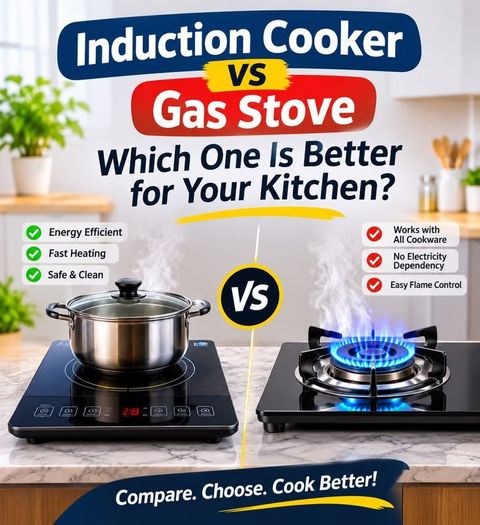
LPG and induction cooktops use different methods to produce heat.
LPG cooking uses liquefied petroleum gas as fuel. The gas burns inside the burner and transfers heat to the bottom and sides of the cooking vessel.
Induction cooking uses electricity to create a magnetic field. This field heats compatible cookware directly instead of heating a burner or heating element first.
This difference affects how much energy each system uses and how much heat is lost during cooking.
How LPG Cooking Works
LPG is supplied through cylinders or a piped gas connection. When the burner is switched on, gas mixes with air and burns to produce a flame.
The flame heats the cooking vessel, which then transfers heat to the food.
LPG cooktops can work with many common kitchen vessels, including stainless steel, aluminium, and traditional cookware, depending on their construction and design.
How Induction Cooking Works
An induction cooktop uses an electromagnetic system to heat the cooking vessel.
It generally requires cookware with a magnetic base. Stainless steel vessels that are induction-compatible and cast-iron cookware usually work.
Induction cooking offers several practical features:
Adjustable temperature settings
Fast heating for many cooking tasks
Automatic shut-off on many models
No open flame
Easier surface cleaning
Digital timers on selected models
However, the cookware must be compatible, and the cooktop needs a suitable electrical connection.
How Much Does LPG Cost a Family of Four Per Month?
The monthly LPG expense depends on how often the family cooks at home.
A family that prepares breakfast, lunch, dinner, tea, and snacks daily may use more gas than a household that regularly eats outside or orders food.
In many Indian households, a standard domestic LPG cylinder contains 14.2 kg of gas.
A cylinder may last around 30 to 60 days for a family of four, although actual consumption varies considerably.
For budgeting, consider these examples:
Cooking pattern | Approximate cylinder duration | Monthly LPG use |
|---|---|---|
Light cooking | 60 days | 0.5 cylinder |
Moderate cooking | 45 days | 0.67 cylinder |
Frequent cooking | 30 days | 1 cylinder |
These are illustrative household estimates, not fixed consumption standards.
The monthly LPG expense can be calculated using:
Monthly LPG cost = Cylinder price × Monthly cylinder consumption
For example, if a domestic cylinder costs ₹900:
Light cooking: ₹450 per month
Moderate cooking: ₹600 per month
Frequent cooking: ₹900 per month
The actual cylinder price differs by city and can change over time. Families should use the current domestic LPG price applicable to their location rather than relying on an old price estimate.
How Much Electricity Does an Induction Cooktop Use?
Induction cooktops are usually rated between 1,000 watts and 2,000 watts, although some models have higher power ratings.
A 1,500-watt cooktop has a maximum rated power of 1.5 kW. If it operates at full power for one hour, it consumes 1.5 units of electricity.
However, the cooktop does not necessarily draw its maximum power continuously. Power use changes with the temperature setting, cooking time, vessel, and food being prepared.
For a family of four, an illustrative monthly consumption estimate might look like this:
Daily cooking time at an average 1.5 kW load | Monthly electricity use |
|---|---|
1 hour | 45 units |
1.5 hours | 67.5 units |
2 hours | 90 units |
2.5 hours | 112.5 units |
3 hours | 135 units |
These figures are simple calculations based on the assumed average load. Actual electricity consumption can be lower or higher.
Monthly Induction Cooking Cost at Different Electricity Rates
Electricity prices vary by state, distribution company, consumer category, and monthly consumption slab. Some households also receive subsidies or free electricity up to a specified limit.
The following table shows what induction cooking could cost at different electricity rates.
Monthly consumption | ₹5 per unit | ₹7 per unit | ₹9 per unit |
|---|---|---|---|
45 units | ₹225 | ₹315 | ₹405 |
67.5 units | ₹338 | ₹473 | ₹608 |
90 units | ₹450 | ₹630 | ₹810 |
112.5 units | ₹563 | ₹788 | ₹1,013 |
135 units | ₹675 | ₹945 | ₹1,215 |
This is the additional energy cost attributable to cooking, assuming the household pays the stated marginal rate for those units. The actual increase in the electricity bill can differ because of slab pricing, fixed charges, taxes, and subsidies.
LPG vs. Induction: Monthly Cost Comparison for a Family of Four
Now let's compare both cooking methods using an illustrative household budget.
For this example, assume:
Family size: Four people
Cooking: Three meals daily, with tea and occasional snacks
LPG cylinder size: 14.2 kg
Illustrative LPG price: ₹943 per cylinder
Induction consumption: 90–135 units per month
Electricity rate: ₹7 per unit
The LPG and electricity figures below are estimates. The amount a household actually uses depends on its cooking routine.
Expense | LPG | Induction |
|---|---|---|
Monthly energy use | 0.7–1 cylinder | 90–135 units |
Monthly running cost | ₹660–₹943 | ₹630–₹945 |
Fuel or energy storage | Cylinder | Electricity supply |
Regular maintenance | Burner and regulator checks | Cooktop and electrical checks |
Special cookware | Usually not required | Required if existing vessels are incompatible |
At these assumptions, the monthly running costs can be quite close.
Induction may cost less when the household uses relatively few electricity units or receives a favourable tariff. LPG may be cheaper when the household receives a subsidy or consumes less gas than expected.
The comparison also changes when electricity rates are high or the induction cooktop is used for long periods.
A Realistic Monthly Budget: Three Household Scenarios
A single estimate does not fit every family. Cooking habits can make a major difference.
Scenario 1: A Family That Cooks Light Meals
This household prepares simple meals, uses fewer burners, and occasionally eats outside.
Expense | Estimated monthly cost |
|---|---|
LPG: Half a cylinder at ₹943 | ₹472 |
Induction: 60 units at ₹7 | ₹420 |
In this situation, induction may have a small running-cost advantage.
Scenario 2: A Family That Cooks Three Meals Daily
This household prepares breakfast, lunch, and dinner at home and uses the cooktop regularly.
Expense | Estimated monthly cost |
|---|---|
LPG: 0.8 cylinder at ₹943 | ₹754 |
Induction: 100 units at ₹7 | ₹700 |
The difference is small. The final cost depends on actual fuel consumption and the household's electricity tariff.
Scenario 3: A Family With Frequent Cooking
This household cooks several dishes daily, prepares tea frequently, and uses the stove for longer periods.
Expense | Estimated monthly cost |
|---|---|
LPG: One cylinder at ₹943 | ₹943 |
Induction: 135 units at ₹9 | ₹1,215 |
In this example, LPG is less expensive to operate.
These scenarios show why families should calculate their own energy use instead of assuming induction is always cheaper.
Why Is Induction More Energy Efficient Than LPG?
Induction cooking is generally more energy-efficient because it transfers heat directly to compatible cookware.
With LPG, some heat escapes around the sides of the vessel and into the surrounding air.
With induction, the magnetic field heats the cookware itself, reducing heat loss during cooking.
An efficiency comparison cited by NITI Aayog puts induction cooking at approximately 84% efficiency and LPG cooking at around 55–57%. Actual performance depends on the cooktop, cookware, vessel size, and cooking method.
This efficiency advantage does not automatically mean a lower monthly bill. The price of electricity compared with LPG remains an important factor.
Initial Cost of Switching From LPG to Induction
Families already using LPG may need to spend money before switching to induction.
The main expenses include:
1. Induction Cooktop
A basic single-burner induction cooktop may cost approximately ₹1,500–₹3,500. More advanced models can cost more.
Price depends on power rating, brand, controls, safety features, and warranty.
2. Induction-Compatible Cookware
Not every kitchen vessel works with induction.
Compatible cookware generally needs a magnetic base. Families may need to purchase:
Induction-compatible pressure cookers
Stainless steel pots
Compatible frying pans
Suitable cooking utensils
A basic cookware replacement budget might be around ₹2,000–₹4,000, depending on what the household already owns.
3. Electrical Connection
A suitable electrical socket and wiring are important, especially for higher-powered cooktops.
Some households may need an electrician to inspect the wiring or install a suitable socket.
The total initial investment could be around ₹3,500–₹8,000 for a basic setup, depending on the appliance and cookware required.
Which Cooking Method Is Better for Indian Food?
Both LPG and induction can handle everyday Indian cooking, but they offer different practical advantages.
Cooking activity | LPG | Induction |
|---|---|---|
Making tea | Convenient | Convenient |
Boiling milk | Suitable | Suitable |
Cooking rice | Suitable | Suitable |
Preparing dal | Suitable | Suitable |
Making roti | Familiar and flexible | Depends on compatible cookware and method |
Deep frying | Suitable | Suitable with compatible cookware |
Slow cooking | Easy to control visually | Possible with suitable temperature settings |
Traditional cooking vessels | Broad compatibility | Requires magnetic-compatible vessels |
LPG may be more convenient for households that use traditional round-bottomed vessels, certain types of tawa, or direct-flame cooking.
Induction is useful for boiling, simmering, frying, and preparing many everyday dishes. However, it cannot produce an open flame.
Other Factors Families Should Consider
Monthly cost is important, but it is not the only factor when choosing a cooking system.
1. Electricity Supply
Induction cooktops depend on electricity. A power cut can interrupt cooking unless the household has an appropriate backup system.
LPG can be useful during power interruptions because it does not need an electrical supply for normal burner operation.
2. Kitchen Safety
Induction cooktops do not produce an open flame during normal operation. Their surfaces can still become hot from the cooking vessel, so users should follow the manufacturer's safety instructions.
LPG requires proper cylinder handling, regulator maintenance, ventilation, and attention to gas leaks.
3. Cleaning and Maintenance
Induction cooktops usually have a flat surface that is easy to wipe clean.
LPG burners may need regular cleaning because food spills can block burner openings or affect flame performance.
4. Cooking Speed
Induction can heat compatible cookware quickly, particularly when boiling water or preparing dishes that require rapid heating.
LPG also provides quick heat and allows users to adjust the flame visually.
5. Long-Term Appliance Costs
An induction cooktop has electrical components that may require repair or replacement. LPG stoves also need maintenance, and regulators or hoses may need replacement according to safety guidance.
Families should consider appliance quality, warranty, and repair availability when comparing long-term costs.
Can a Family Use Both LPG and Induction?
Yes. Many households can benefit from using both cooking methods rather than choosing only one.
For example, a family could use induction for:
Boiling water
Making tea
Cooking rice
Preparing dal
Reheating food
LPG could be used for:
Preparing rotis
Cooking with traditional vessels
Dishes requiring direct flame
Cooking during power cuts
This approach is often called fuel stacking, where a household uses more than one cooking energy source.
It can provide flexibility and reduce dependence on a single source of energy. However, the household should still calculate the combined costs and avoid keeping unused appliances running unnecessarily.
How Can Families Reduce Their Monthly Cooking Expenses?
Whether a household uses LPG, induction, or both, a few simple practices can help control energy consumption.
Use Pressure Cookers
Pressure cookers can reduce cooking time for foods such as rice, dal, and vegetables.
Match the Vessel to the Burner
Use cookware that matches the size of the LPG burner or induction cooking zone. This helps reduce wasted heat.
Cover Pots While Cooking
Keeping a lid on the vessel can help food cook faster and reduce energy loss.
Prepare Multiple Items Efficiently
Plan meals so that food requiring similar cooking temperatures can be prepared together.
Avoid Unnecessary Heating
Switch off the cooktop when cooking is complete. Avoid keeping food at a high temperature longer than necessary.
Check LPG Burners and Connections
A clean burner with a proper flame helps support efficient operation. Any suspected gas leak should be addressed immediately by following the supplier's safety instructions.
Monitor Electricity Consumption
Families using induction can check their electricity meter or bill to understand how many additional units are being consumed.
Frequently Asked Questions
1. Is induction cheaper than LPG in India?
It depends on the LPG cylinder price, electricity tariff, cooking hours, and energy consumption. Induction can be cheaper in households with favourable electricity rates, but LPG may cost less in other situations.
2. How many electricity units does an induction cooktop use in a month?
A family of four might use approximately 60–135 units per month for induction cooking, depending on the number of cooking hours, power settings, and meal preparation habits. Actual consumption can differ.
3. How long does one LPG cylinder last for a family of four?
A 14.2 kg cylinder may last around 30–60 days in a family of four. The duration depends on cooking frequency, food habits, and burner usage.
4. Can an induction cooktop replace an LPG stove completely?
Yes, provided the household has compatible cookware, a suitable electrical connection, and a reliable power supply. However, some traditional cooking methods may be less convenient on induction.
5. Does induction cooking increase the electricity bill significantly?
It can increase the bill because cooking adds electricity consumption. The actual increase depends on the cooktop's energy use and the household's electricity tariff.
6. Can normal stainless steel utensils be used on induction?
Some stainless steel utensils are compatible, while others are not. A simple check is to place a magnet against the bottom of the vessel. If it sticks firmly, the vessel is more likely to work, although the cooktop manufacturer's compatibility guidance should also be checked.
7. Is induction cooking safe for daily use?
Induction cooking is generally suitable for everyday household use when the appliance is used according to the manufacturer's instructions. Users should keep the surface clean, use compatible cookware, and avoid damaged electrical connections.
8. Is LPG better during power cuts?
Yes. LPG cooking does not depend on the household electricity supply for normal burner operation. This can make it useful during power interruptions.
Conclusion
For a family of four in India, the monthly cost of LPG and induction cooking can be surprisingly similar. Induction offers higher energy efficiency, easy cleaning, and convenient temperature controls. LPG offers flexibility with traditional cookware and does not depend on electricity.
The actual savings depend on local energy prices and daily cooking habits. A household paying a low electricity tariff may find induction economical, while a family with higher electricity rates or subsidised LPG may prefer gas.
Before switching, families should compare their current LPG consumption with the expected electricity units required for cooking. They should also account for the cost of an induction cooktop, compatible cookware, and any electrical upgrades.

Related Post...
LPG vs. Induction: What It Really Costs a Family of Four Each Month
Updated: November 25, 2026
Read More
Secure Your Loved Ones Future Today with Life Insurance – Here’s How!
Updated: November 25, 2026
Read More