Industrial Water Pumps Explained: Basics, Uses and Key Insights
Industrial water pumps are mechanical devices designed to move water through pipelines, tanks, treatment systems, cooling circuits, and other industrial equipment. They are widely used where controlled water flow, pressure, or circulation is required.
Understanding industrial water pumps involves looking at pump types, operating principles, flow requirements, pressure, efficiency, and application conditions.
The right pump arrangement depends on factors such as required flow rate, total head, water quality, temperature, piping configuration, and operating schedule. Modern pumping systems increasingly focus on energy efficiency, variable-speed control, monitoring, and system-level performance rather than considering the pump as an isolated component.
Context
An industrial water pump converts mechanical energy into hydraulic energy to move water from one location to another. Most systems use an electric motor as the prime mover, although other drive arrangements can be used in particular industrial environments. Pump performance is commonly described using flow rate, head, efficiency, speed, and power.
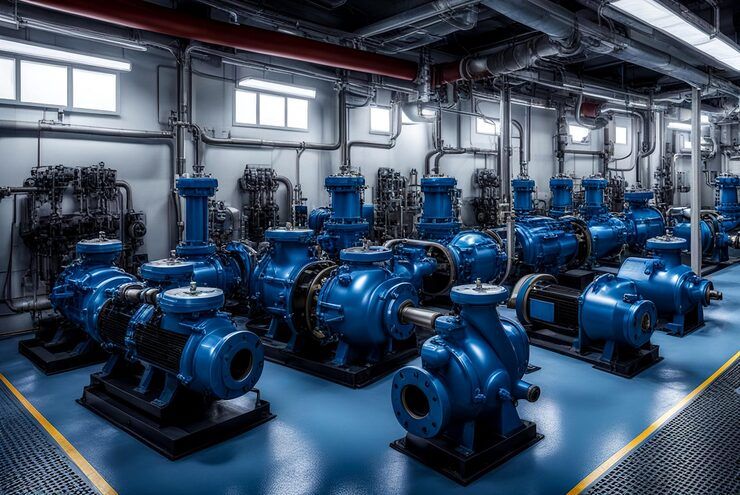
Centrifugal pumps are among the most widely used designs for industrial water applications. They use a rotating impeller to increase the velocity of water, which is then converted into pressure as the water passes through the pump casing. Positive-displacement pumps operate differently by moving a defined volume of liquid during each operating cycle.
Common industrial water pump categories include:
- Centrifugal pumps for general water circulation and transfer
- Multistage pumps for applications requiring higher pressure
- Submersible pumps for applications where the pump operates below the water level
- Vertical pumps for certain deep-water and process applications
- End-suction pumps for general transfer duties
- Split-case pumps for larger flow requirements
Pump selection normally starts with the hydraulic requirements rather than the equipment itself. Engineers consider the required flow, static head, friction losses, pipe dimensions, fittings, elevation changes, and operating conditions before determining the appropriate pump characteristics.
| Pump factor | What it indicates | Why it matters |
|---|---|---|
| Flow rate | Quantity of water moved per unit time | Determines system capacity |
| Head | Energy added to water, often expressed in metres | Determines pressure capability |
| Efficiency | Hydraulic output compared with input power | Helps evaluate energy performance |
| Speed | Pump rotational speed | Influences flow, head, and power |
| NPSH | Suction pressure requirement | Helps reduce cavitation risk |
| Motor power | Electrical or mechanical input requirement | Indicates drive capacity |
Importance
Industrial water pumps influence the reliability and efficiency of many industrial processes. Manufacturing facilities may use them for cooling, process-water circulation, boiler-related systems, cleaning operations, fire protection, and wastewater movement. Water-treatment facilities depend on pumping systems for intake, filtration, distribution, and wastewater processes.
A poorly matched pump can create excessive flow, insufficient pressure, vibration, cavitation, or unnecessary energy consumption. Oversized pumps may also operate away from their best efficiency point, while undersized equipment may struggle to meet the required hydraulic duty.
Pump performance can affect several groups:
- Plant engineers responsible for system design
- Facility managers monitoring equipment performance
- Water and wastewater operators
- Process engineers managing fluid movement
- Energy managers evaluating electricity consumption
- Maintenance teams monitoring vibration, seals, bearings, and motors
The U.S. Department of Energy recommends a system-level approach that considers the interaction between pumps, motors, controls, piping, valves, and changing demand. Its pumping-system resources include guidance on pump selection, adjustable-speed pumping, parallel systems, efficiency testing, and system assessment.
Recent Updates
Recent developments in industrial water pumping increasingly emphasize energy efficiency, digital monitoring, variable-speed operation, and improved system controls. The International Energy Agency's 2025 industrial efficiency analysis identifies motor-system upgrades and variable-speed drives as important measures for improving efficiency in applications with variable loads.
Variable-frequency drives can adjust motor speed according to changing flow or pressure requirements. This can be particularly useful where demand varies during different production periods. However, a variable-speed drive is not automatically appropriate for every application; system characteristics and operating conditions determine whether speed control provides an efficiency advantage.
Another development is connected monitoring. Sensors and control systems can provide information about pressure, flow, vibration, motor performance, and operating status. When integrated with building or energy management systems, these measurements can help operators identify changing conditions and investigate abnormal performance.
Recent pumping-system approaches also place greater emphasis on correct sizing. Instead of selecting equipment only for maximum theoretical demand, engineers can analyze operating profiles and consider multiple pumps, variable-speed operation, or staged operation where appropriate.
The U.S. Department of Energy's current pump resources include assessment tools such as the Pumping System Assessment Tool and guidance covering adjustable-speed pumping and pump-system optimization.
Laws or Policies
Rules for industrial water pumps vary considerably by country, application, pump category, and motor configuration. Operators should therefore check the standards applicable to their location and intended use.
In India, the Bureau of Indian Standards maintains several standards covering pumps and pumping equipment. Examples include IS 8034:2018 for submersible pumpsets, IS 14220:2018 for openwell submersible pumpsets, IS 9079:2018 for monoset pumps for clear, cold water, and IS 17018 Part 1:2018 for centrifugal pumps used in solar photovoltaic water-pumping systems.
IS 9079:2018 specifies requirements for monoset pumps used for clear, cold water in agricultural and water-supply applications. The BIS product manual describes testing, inspection, construction, performance, and marking requirements associated with the standard.
Internationally, the European Union has ecodesign requirements for certain rotodynamic water pumps under Commission Regulation (EU) No 547/2012. The regulation establishes minimum efficiency and information requirements for covered pump categories.
In the United States, federal energy-efficiency rules and test procedures apply to specific categories of pumps and related equipment. For example, the U.S. Department of Energy issued a 2024 final rule concerning circulator pumps, with compliance requirements scheduled for May 22, 2028.
Because regulations can change, technical teams should verify the latest applicable requirements with the relevant national standards body, regulator, or official government publication before specifying equipment.
Tools and Resources
Several technical resources can help users understand and evaluate industrial water pumps.
Useful resources include:
- Pumping System Assessment Tool for evaluating pumping-system performance
- Pump-system selection and sizing guides
- Manufacturer pump curves and technical documentation
- BIS standards and pump-related publications in India
- Energy-efficiency guidance from the U.S. Department of Energy
- IEA reports covering industrial energy efficiency
- EPA resources concerning energy use in water and wastewater facilities
Pump curves are particularly important because they show the relationship between flow and head under specified operating conditions. Engineers can compare the required system duty with the pump curve to determine whether the selected pump can operate appropriately.
The U.S. EPA also provides resources for water and wastewater facilities to establish energy-use baselines and assess energy-intensive processes such as pumping and aeration.
FAQs
What is an industrial water pump?
An industrial water pump is equipment designed to move water through industrial systems. It can be used for transfer, circulation, cooling, treatment, drainage, and other controlled water-flow applications.
What are the main types of industrial water pumps?
Common types include centrifugal, multistage, submersible, vertical, end-suction, and split-case pumps. The appropriate type depends on flow, head, water conditions, installation arrangement, and operating requirements.
How is pump efficiency evaluated?
Pump efficiency compares the useful hydraulic output with the input power required to operate the pump. Engineers may also evaluate motor efficiency, drive efficiency, pipe losses, control methods, and the overall pumping system.
Why are variable-speed drives used with pumps?
Variable-speed drives can adjust pump speed when system demand changes. They are particularly relevant to variable-flow applications, although their suitability depends on the complete hydraulic and electrical system.
What information is needed for pump selection?
Important information includes required flow rate, total head, water temperature, fluid characteristics, suction conditions, pipe layout, operating schedule, motor requirements, and applicable technical standards.
Conclusion
Industrial water pumps are important components in water-transfer, cooling, treatment, manufacturing, and wastewater systems. Their performance depends not only on the pump itself but also on motors, piping, controls, valves, operating conditions, and system design.
Modern industrial pumping increasingly emphasizes efficient operation, variable-speed control, monitoring, correct sizing, and compliance with applicable technical standards. Understanding these fundamentals helps engineers, facility operators, and other users evaluate pumping systems using consistent technical information.
For any specific installation, hydraulic calculations and applicable standards should be reviewed before equipment is selected or operating parameters are changed. Official standards organizations and government energy-efficiency resources provide useful references for evaluating requirements and system performance.

Related Post...

Video Creation AI Facts: Discover Important Information About AI Video Technology
Updated: September 17, 2026
Read More
Starlink Internet Plans Insights: Explore Speed, Latency, Availability, and Network Performance
Updated: October 13, 2026
Read More
Machine Learning Insights: Explore Modern Techniques, Models, Tools and Practical Uses
Updated: September 22, 2026
Read More