EV Manufacturing Equipment Overview: Basics, Processes, and Key Details
Electric vehicle (EV) manufacturing equipment includes the machines, systems, inspection tools, and automation technologies used to produce electric vehicles and their major components.
These systems support activities ranging from battery cell production and motor assembly to body manufacturing, electronics integration, testing, and final vehicle inspection.
As EV production expands globally, manufacturers are adopting increasingly automated and precise equipment. Understanding the basics of EV manufacturing equipment helps readers understand how electric vehicles are assembled, how production quality is maintained, and how modern factories are adapting to new battery and vehicle technologies.
Context
EV manufacturing equipment refers to the industrial machinery and supporting systems used throughout an electric vehicle production facility. Unlike conventional vehicles, EVs rely heavily on batteries, electric motors, power electronics, battery-management systems, and high-voltage electrical components.
The manufacturing process is normally divided into several major stages. Each stage requires specialized equipment designed for accuracy, repeatability, safety, and production efficiency.
Common equipment categories include:
- Battery cell and module production equipment
- Battery pack assembly systems
- Electric motor manufacturing machines
- Stator and rotor assembly equipment
- Power electronics assembly systems
- Welding and joining equipment
- CNC machining systems
- Automated material-handling systems
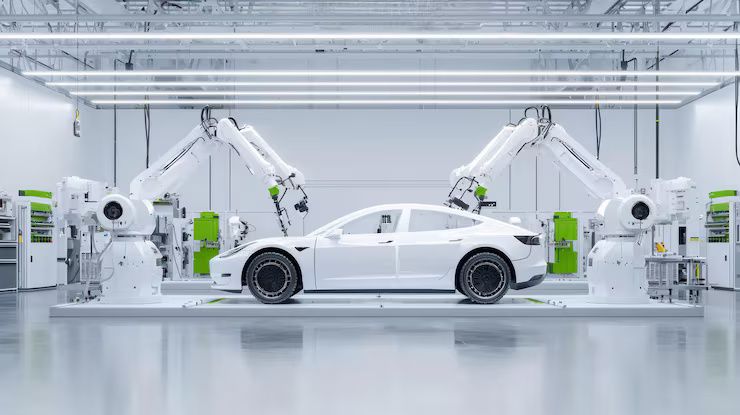
- Robotic assembly equipment
- Inspection and testing systems
Battery production is one of the most technically demanding areas. Equipment may be used for electrode preparation, coating, drying, calendaring, cell assembly, electrolyte filling, formation, aging, and testing. The exact process depends on the battery chemistry and cell format.
Vehicle assembly also involves equipment used for body joining, paint preparation, component installation, electrical connections, software configuration, and end-of-line testing.
Modern factories often connect production equipment with industrial software. Sensors collect information about temperature, pressure, torque, electrical performance, and other variables. This information can help production teams identify process deviations and maintain consistent manufacturing conditions.
Importance
EV manufacturing equipment matters because electric vehicles require precise integration of mechanical, electrical, electronic, and software-based components. Small variations in battery assembly, electrical connections, or thermal systems can affect vehicle performance and reliability.
Equipment selection also affects factory layout and production processes. Battery systems, for example, may require controlled environments and specialized safety measures because manufacturing involves electrically active materials and potentially hazardous substances.
Several groups are affected by developments in EV manufacturing equipment:
- Vehicle manufacturers
- Battery producers
- Component manufacturers
- Factory automation teams
- Quality-control departments
- Engineers and production planners
- Regulators and safety organizations
- Researchers developing new battery technologies
Automation is another important factor. Robots and automated systems can perform repetitive tasks with consistent positioning and force. Human workers remain important for equipment supervision, maintenance, process engineering, quality analysis, and other activities requiring judgment.
Equipment used for EV production must also accommodate different vehicle architectures. Battery-electric vehicles, plug-in hybrid vehicles, and other electrified platforms can have different component arrangements and production requirements.
Recent Updates
EV manufacturing equipment continues to evolve alongside battery chemistry, vehicle architecture, and factory automation.
One significant development is the expansion of automated battery assembly. Manufacturers are using increasingly integrated systems for cell handling, module formation, pack assembly, electrical testing, and thermal-system integration.
Another development is the growing use of advanced inspection technologies. Machine vision, laser measurement, electrical testing, and automated dimensional inspection can examine components without relying entirely on manual checks.
Digital production systems are also becoming more common. Connected equipment can collect production information and provide data for process monitoring. In some facilities, digital twins and simulation tools are used to study production layouts and equipment behavior before physical changes are introduced.
Battery cell formats are also influencing equipment design. Cylindrical, prismatic, and pouch cells have different manufacturing and assembly requirements. Newer battery concepts may require additional changes to coating, formation, handling, welding, and pack-assembly equipment.
Structural battery-pack concepts have also influenced vehicle manufacturing. When the battery structure becomes more integrated with the vehicle body, assembly processes can change because battery installation, body joining, thermal management, and electrical integration become more closely connected.
Equipment manufacturers are additionally focusing on energy efficiency, automated quality control, flexible production lines, and faster changeovers between product configurations.
Laws or Policies
EV manufacturing facilities must follow applicable workplace, environmental, electrical, chemical-handling, machinery-safety, and transportation regulations. Requirements differ by country, region, facility type, and manufacturing process.
Battery production receives particular regulatory attention because batteries contain chemical materials and store significant electrical energy. Facilities may need procedures covering chemical handling, ventilation, fire protection, waste management, emergency response, and battery transportation.
In the United States, workplace requirements may involve the Occupational Safety and Health Administration, while environmental requirements can involve the Environmental Protection Agency. Battery transportation may also be subject to hazardous-material transportation rules.
In the European Union, EV and battery production is influenced by frameworks covering battery sustainability, environmental performance, chemicals, product safety, and waste management. The EU Battery Regulation establishes requirements relating to areas such as sustainability, labeling, recycling, and battery information.
India has also introduced policies supporting electric mobility and domestic manufacturing. Programs such as the Production Linked Incentive framework for automobile and auto-component manufacturing and initiatives related to advanced automotive technology have influenced investment in EV and battery production.
Factories should verify applicable rules with relevant national and regional authorities because regulatory requirements can change and may differ according to the materials, machinery, production volume, and location involved.
Tools and Resources
Several types of resources can help readers understand EV manufacturing equipment and production processes.
Government and standards organizations provide technical and regulatory information. Examples include national workplace-safety authorities, environmental agencies, transportation regulators, and recognized standards organizations.
Useful resources may include:
- Battery manufacturing process guides
- Industrial safety documentation
- Electrical testing standards
- Machinery documentation
- Battery recycling regulations
- Factory-layout planning tools
- Energy-monitoring software
- Manufacturing process calculators
- Engineering simulation platforms
- Equipment maintenance documentation
Technical standards can help engineers establish consistent approaches to testing, electrical safety, quality control, and manufacturing processes. Equipment documentation is also important because operating requirements vary significantly between machine types.
Industry research publications can provide information about emerging battery chemistries, automation systems, production methods, and factory development. Academic papers and technical conferences are particularly useful for understanding newer manufacturing approaches that may still be under development.
FAQs
What is EV manufacturing equipment?
EV manufacturing equipment includes machinery and automated systems used to produce electric vehicles and their components. It can cover battery production, motor assembly, electronics, body manufacturing, inspection, and final vehicle testing.
What equipment is used for EV battery manufacturing?
Battery manufacturing can involve electrode coating systems, drying equipment, calendaring machines, cell assembly equipment, electrolyte-filling systems, formation equipment, aging systems, inspection equipment, and battery testing systems.
Why is automation important in EV manufacturing?
Automation can improve repeatability, process monitoring, material handling, and production consistency. It is particularly useful for repetitive operations that require controlled force, positioning, welding, or measurement.
What safety issues are associated with EV manufacturing equipment?
Important considerations can include high-voltage electricity, battery materials, chemicals, thermal hazards, moving machinery, and stored electrical energy. Facilities generally require appropriate protective systems, procedures, training, and emergency controls.
How is EV manufacturing equipment changing?
Equipment is becoming more connected, automated, data-driven, and adaptable. Developments in battery chemistry, structural battery systems, machine vision, robotics, and digital manufacturing are influencing equipment design.
Conclusion
EV manufacturing equipment forms the technological foundation of modern electric vehicle production. It covers a broad range of machinery, automation systems, inspection technologies, and testing platforms used to transform raw materials and components into complete vehicles.
Battery technology, automation, digital monitoring, and new vehicle architectures are continuing to influence how EV factories are designed and operated. Understanding these developments provides useful background for anyone studying electric mobility and modern manufacturing.
As the EV industry develops, production equipment will continue adapting to new battery chemistries, manufacturing methods, safety requirements, and vehicle designs. Regulatory compliance, process control, equipment reliability, and quality inspection will remain important parts of responsible EV manufacturing.

Related Post...
EV Manufacturing Equipment Overview: Basics, Processes, and Key Details
Updated: September 04, 2026
Read More
Car Accessories Knowledge: Learn How Different Vehicle Additions Serve Everyday Purposes
Updated: August 31, 2026
Read More