Additive Manufacturing Moves to the Assembly Line
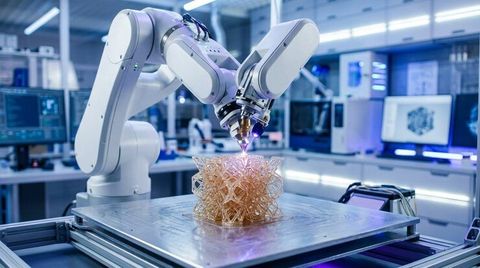
Additive manufacturing is changing factory floors. For years, the technology known as industrial 3D printing lived mostly in design studios and prototyping labs. Engineers used it to test shapes and check fit before committing to expensive metal tooling.
Today, that picture is shifting. Car companies and other manufacturers are bringing additive manufacturing directly onto or beside the assembly line, where it helps solve everyday production problems.
The change is practical rather than dramatic. Instead of printing concept models, factory workers and line engineers now print custom brackets, jigs, and safety covers when a traditional part is unavailable or too slow to order. In some plants, a solution that once took weeks to arrive from an outside supplier can be designed, printed, and installed in a single shift.
From Prototype Labs to Factory Floors
The move toward on-site production has been gradual but steady. At General Motors, fused deposition modeling printers now sit on the shop floor rather than in a separate research building . The company describes the shift as a cultural change: additive manufacturing is no longer treated as a special experiment but as a standard way to solve problems.
This approach gives frontline workers more control. When a robot end effector needs a small bracket to hold a switch, waiting weeks for a vendor is costly. At GM’s Factory Zero plant, a line-down situation was resolved in about four hours because the part could be printed nearby . That kind of speed does not replace mass production, but it keeps the line moving.
Why Factories Use Printed Tools
The parts printed for assembly lines are rarely visible to car buyers. They are working tools: fixtures that hold components steady during installation, jigs that guide a drill or fastener, and protective covers that prevent scratches on painted surfaces. These items must be strong enough to survive daily use in an industrial setting.
Materials matter here. Production-grade thermoplastics such as ABS, ASA, and nylon are common because they resist impact, chemicals, and ultraviolet light . A printed palm tool at a truck plant, for example, reduces hand fatigue when workers install wheel center caps hundreds of times per shift . These are small improvements, but they add up across thousands of vehicles.
How Additive Manufacturing Supports the Line
The most common use of additive manufacturing in assembly plants is not printing final vehicle parts. It is printing the tools that make assembly possible. This distinction is important because it explains why the technology has found a stable foothold without replacing traditional manufacturing.
Tooling and Fixtures
Custom fixtures are often needed in low volumes. A plant may require only a handful of a specific jig for a new model launch or a temporary production change. Traditional machining or injection molding can be expensive and slow for such small quantities. Printing the fixture on demand avoids tooling costs and shortens the wait.
Toyota’s production engineering division has used additive manufacturing to cut fixture lead times by as much as 80 percent, according to an interview with a company representative . The company also created a digital inventory of replacement components that can be printed when needed rather than stored physically.
Low-Volume and Custom Parts
Some automakers use printed parts in small-series vehicles or specialty models. Rivian has invested in additive manufacturing equipment for its plant in Normal, Illinois, where workers will be able to print parts on demand . The company also uses printed components for prototype vehicles and tooling before traditional molds are ready.
Cadillac’s Celestiq, a low-volume luxury electric car, uses a number of printed parts . This does not mean the entire car is printed. It means that for certain low-quantity components, printing can be more economical than setting up conventional production.
The Practical Limits
Additive manufacturing on the assembly line is not a replacement for stamping presses, injection molding machines, or casting lines. Speed, material cost, and part durability still limit where printed parts can be used. A printed bracket may be perfect for a temporary tool, but it would not be suitable for a structural component that must meet crash safety standards.
Repeatability and Quality Control
When a part is printed once for a prototype, small variations are acceptable. When a part is printed repeatedly for factory use, consistency becomes critical. Material batches, machine calibration, and print parameters must be controlled so that every printed tool performs the same way . Some companies are developing formal tracking systems to record print details and failure data, which helps improve material selection and design over time .
Material and Machine Costs
Industrial-grade printers and engineering thermoplastics are more expensive than consumer-grade equipment. Rivian reportedly spends about $1.7 million per year on materials alone . For companies considering this step, the calculation depends on how often the equipment is used and how much downtime it prevents.
| Aspect | Traditional Tooling | Additive Manufacturing |
|---|---|---|
| Lead time for simple fixture | Weeks to months | Hours to days |
| Cost for low-volume custom part | High upfront tooling cost | No tooling required |
| Design changes | Expensive and slow | Quick to modify and reprint |
| Best use case | High-volume standard parts | Low-volume tools and fixtures |
The table above summarizes the general trade-offs. It is not a universal rule, but it reflects why factories choose one method over another for specific tasks.
What This Means for the Wider Industry
The presence of additive manufacturing on assembly lines signals a broader shift in how factories think about production. Instead of viewing 3D printing as a tool only for designers, manufacturers are treating it as a flexible problem-solving method that belongs where problems actually occur.
For the general public, the result may be less visible than a fully printed car. It is more likely to appear as smoother production launches, fewer line stoppages, and faster responses to equipment issues. These changes happen behind the factory gate, but they affect how efficiently vehicles and other products are built.
Frequently Asked Questions
What is additive manufacturing on an assembly line?
It refers to the use of industrial 3D printers near or within a factory to produce tools, fixtures, and sometimes low-volume parts on demand, rather than relying only on external suppliers or traditional machining.
Does additive manufacturing replace traditional factory machines?
No. It complements existing production methods. Printed parts are typically used for tooling, custom fixtures, and low-volume components where conventional manufacturing would be too slow or too expensive.
Why do factories use 3D-printed tools instead of metal tools?
Printed tools can be made quickly and at lower cost for small quantities. They are suitable for many assembly aids and fixtures, though high-stress or safety-critical applications usually still require metal.
What materials are used for printed factory tools?
Common materials include ABS, ASA, nylon, and polycarbonate. These thermoplastics offer a balance of strength, durability, and resistance to factory conditions such as heat, impact, and UV exposure.
Conclusion
Additive manufacturing has found a practical role on the assembly line. It is not a headline-grabbing replacement for mass production, but a quiet enabler of faster fixes, lower tooling costs, and more flexible problem-solving. As materials and machines continue to improve, the technology is likely to become an even more ordinary part of how factories operate.

Related Post...
Metal Fabrication Machine Explanation: Facts, Functions and Common Uses
Updated: November 23, 2026
Read More