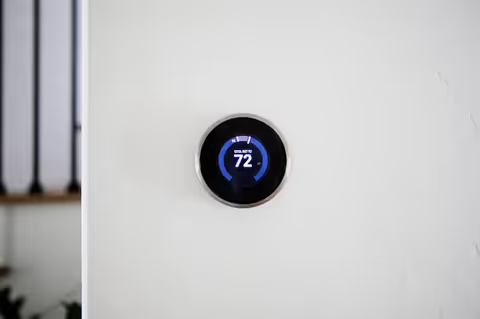
Thermal Comfort Sensors Insights on Comfort Measurement
Thermal comfort sensors are devices used to describe how a room feels to people, not just how warm or cool the air may seem. The topic comes from building science, indoor environmental quality, and heating, ventilation, and air-conditioning practice, where comfort depends on several factors at the same time.
What these sensors do
In simple terms, a thermal comfort sensor collects room data that helps describe whether a space feels balanced or uneven. Some devices read air temperature and relative humidity, while others also track air movement, radiant conditions, carbon dioxide, or particle levels as part of a wider indoor environment picture. Current building dashboards from Honeywell and Johnson Controls show this broader pattern, with sensors and software often used together in offices, schools, healthcare spaces, and other occupied buildings.
Importance
Why the topic matters now
Thermal comfort affects daily life because people spend much of their time indoors, often in shared rooms where personal preferences vary. A space can feel too warm for one person and too cool for another, even when the thermostat reads a normal value. That is why comfort measurement matters for homes, classrooms, workplaces, hospitals, hotels, and commercial buildings that need steady conditions for many occupants.
Thermal comfort sensors also matter because they support control decisions in HVAC systems. Building platforms now combine temperature, humidity, occupancy, CO2, particulate matter, and volatile organic compound data to understand how indoor conditions change during the day. Honeywell’s comfort pages describe systems that help monitor and control HVAC conditions, while Johnson Controls documents dashboards that display indoor air quality data in real time.
Common measurements in a comfort setup
| Measurement | What it helps indicate | Typical use |
|---|---|---|
| Air temperature | How warm or cool the room air is | Basic comfort control |
| Relative humidity | Whether the air feels dry or damp | Comfort balancing and moisture control |
| Air speed | Whether moving air changes how warm a person feels | Fan and ventilation tuning |
| Thermal radiation | Heat gained or lost from nearby surfaces | Window, wall, and sun-exposure effects |
| Occupancy and indoor air markers | How room use changes conditions over time | System scheduling and zone control |
This table reflects the comfort factors named in ASHRAE Standard 55 and the measurement approach described in ISO 7730:2025.
Recent Updates
Current trends from 2024 to 2026
A clear trend in 2024 to 2026 is the move from single-point room reading toward multi-parameter indoor monitoring. Newer dashboards increasingly combine temperature and humidity with CO2, particle counts, TVOC, and occupancy data so that comfort and indoor air quality can be viewed together. Honeywell and Johnson Controls both show this shift in their current building platforms.
Standards activity also shows continued attention to thermal comfort measurement. ISO’s 2025 version of ISO 7730 keeps the PMV and PPD framework for thermal comfort evaluation, and ISO 7726:2025 appears in the same technical area for measuring and monitoring physical quantities. Together, these references show that comfort is still being treated as a measurement problem, not only a thermostat setting.
India’s building-code picture has also moved forward. The Bureau of Energy Efficiency published the Energy Conservation and Sustainable Building Code 2024, describing it as an advancement over ECBC 2017 with tightened energy thresholds and a stronger sustainability focus. That matters for thermal comfort sensors because building operators often need room data to balance comfort, ventilation, and energy use under tighter performance targets.
Laws or Policies
India’s code environment
In India, thermal comfort measurement is shaped mainly by energy and building rules rather than a single comfort law. The Bureau of Energy Efficiency’s ECBC 2017 sets minimum energy standards for new commercial buildings above the stated size threshold, and the newer ECSBC 2024 continues that direction with updated efficiency and sustainability language. These codes are important because comfort systems are closely tied to how much energy a building uses.
In practice, building teams often use these rules together with national and international standards for comfort evaluation. ASHRAE Standard 55 is widely used to define acceptable thermal conditions, and ISO 7730:2025 provides a method for evaluating general thermal comfort with PMV, PPD, and local discomfort criteria. For Indian projects, local building bye-laws, project specifications, and state-level adoption can also shape how much sensor data is needed.
How policy affects sensor use
These rules do not require one single sensor model. Instead, they push projects toward better measurement of the indoor environment so that comfort can be checked against design targets and energy targets at the same time. That is one reason multi-sensor room devices and central dashboards are now common in modern building management setups.
Tools and Resources
Practical references used in this field
A few useful references for this topic are the ASHRAE Standard 55 page, the ISO 7730:2025 standard page, the ISO committee listing that shows related 2025 thermal-environment standards, and the Bureau of Energy Efficiency documents for ECBC 2017 and ECSBC 2024. These sources help readers understand what is measured, how comfort is evaluated, and how building rules shape the design of indoor spaces.
Digital tools often used with thermal comfort sensors
Building management dashboards are another useful resource because they bring sensor readings into one place. Honeywell’s comfort pages and Johnson Controls’ indoor air quality dashboard pages show how temperature, humidity, CO2, particulate matter, and TVOC can be tracked together. For simple record keeping, a spreadsheet with columns for room name, time, temperature, humidity, and observed comfort notes can also help compare patterns over days or weeks.
FAQs
What do thermal comfort sensors measure?
Thermal comfort sensors usually measure air temperature and relative humidity, and many systems also track air speed, radiant effects, or other indoor air indicators. The exact mix depends on the room, the building system, and the level of detail needed for comfort analysis.
How do thermal comfort sensors help in buildings?
They help building systems understand whether indoor conditions are steady or drifting away from the target range. That makes it easier to tune HVAC operation, reduce uneven room conditions, and follow comfort and energy goals together.
Which standard is used to assess thermal comfort?
ASHRAE Standard 55 and ISO 7730:2025 are two widely used references. ASHRAE focuses on acceptable thermal conditions for most occupants, while ISO 7730:2025 uses PMV, PPD, and local discomfort criteria.
Are thermal comfort sensors only for large buildings?
No. They are common in large commercial spaces, but they can also be used in smaller offices, classrooms, clinics, and homes when room comfort varies or when indoor conditions need closer tracking. The same measurement ideas apply even when the setup is simple.
Do thermal comfort sensors replace a thermostat?
No. A thermostat usually sets or maintains a target temperature, while thermal comfort sensors provide more detail about how the room feels and why comfort may change. In many modern systems, both are used together.
Conclusion
Thermal comfort sensors help describe indoor conditions in a more complete way than temperature alone. They matter because comfort depends on several physical factors, and those factors can change across rooms, seasons, and building types. Current standards such as ASHRAE 55 and ISO 7730:2025 keep comfort tied to measurable conditions, while India’s newer building-code direction shows the same interest in balancing comfort and energy use. Multi-parameter monitoring and building dashboards are now a common part of that picture.

Related Post...
Corrugated Board Slotters Explanation of Functions and Applications
Updated: July 16, 2026
Read More
Discover Rubber Testing Equipment for Quality and Performance Evaluation
Updated: July 16, 2026
Read More