Resistance Band Arm Guide: Upper Body Strength, Muscle Activation, and Exercise Form
Resistance bands provide a simple way to train the arms and upper body without relying on traditional weights. They are portable, adjustable, and can be used for different exercises involving the biceps, triceps, shoulders, and upper back.
A resistance band routine can work for beginners and experienced exercisers alike. The key is choosing appropriate resistance and maintaining controlled movement throughout each repetition.
Understanding Resistance Band Training
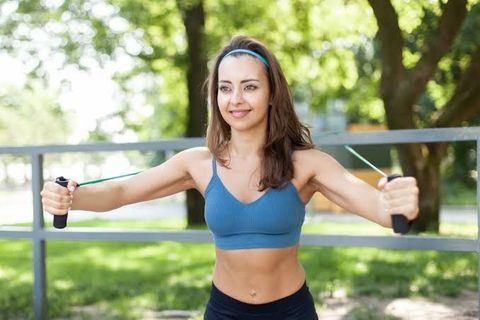
Resistance bands create tension as they stretch. Depending on the exercise, they can be used for pushing, pulling, curling, and extension movements.
Common exercises include:
Band biceps curls
Band hammer curls
Triceps pushdowns
Overhead triceps extensions
Band shoulder presses
Lateral raises
Band rows
Pull-apart exercises
Different band positions and resistance levels can change the difficulty of each movement.
Common Resistance Band Arm Exercises
| Exercise | Primary Focus |
| Band Biceps Curl | Biceps strength |
| Band Hammer Curl | Biceps and forearms |
| Triceps Pushdown | Triceps strength |
| Overhead Extension | Triceps and elbow extension |
| Band Shoulder Press | Shoulders and upper-body strength |
| Band Lateral Raise | Shoulder control |
| Band Row | Upper back and arm involvement |
Proper Exercise Form
Good technique helps maintain consistent resistance and controlled movement.
During band exercises:
Secure the band appropriately.
Keep your posture stable.
Maintain a comfortable range of motion.
Avoid excessive swinging.
Control both the pulling and returning phases.
Keep resistance manageable.
Check the band for damage before use.
For beginners, a lighter band can make it easier to learn proper positioning.
Muscle Activation
Resistance band exercises can involve multiple upper-body muscles depending on the movement.
For example:
Biceps curls: Keep the upper arms relatively stable while bending the elbows.
Triceps extensions: Focus on controlled elbow extension.
Lateral raises: Lift the arms smoothly without using momentum.
Rows: Pull toward the body while keeping the torso controlled.
The sensation of an exercise can vary between individuals, so technique and progressive training are more useful measures than simply chasing a particular feeling.
Building a Simple Band Arm Workout
A beginner-friendly session could include:
Band biceps curls
Band hammer curls
Triceps pushdowns
Overhead triceps extensions
Band lateral raises
Band rows
Start with manageable resistance and focus on smooth, consistent repetitions.
Progression Options
As strength and technique improve, difficulty can gradually increase through:
More repetitions
Additional sets
A stronger resistance band
Greater band tension
Slower repetitions
More challenging exercise variations
Change resistance gradually rather than making large increases suddenly.
Balancing Upper-Body Training
Resistance bands can train more than the arms. A balanced routine can also include:
Back exercises
Shoulder exercises
Chest movements
Core exercises
Mobility work
Combining pushing and pulling movements can provide broader upper-body conditioning.
Common Training Mistakes
Some common problems include:
Using a damaged band
Choosing excessive resistance
Allowing the band to snap back quickly
Swinging during repetitions
Losing stable posture
Moving too quickly
Increasing resistance too rapidly
Always inspect the band and anchor points before exercising, especially when the band is attached to an external object.
Frequently Asked Questions
Are resistance bands good for arm workouts?
Yes. Resistance bands can provide effective resistance for biceps, triceps, shoulders, and other upper-body exercises.
Can beginners use resistance bands?
Yes. Beginners can start with lighter resistance and focus on learning controlled movement before progressing to stronger bands.
Can resistance bands build arm strength?
Consistent resistance training can improve muscular strength when the exercises provide an appropriate challenge and training progresses over time.
How often should resistance band arms be trained?
Training frequency depends on resistance, workout volume, experience, recovery, and individual goals. Allow sufficient recovery between demanding sessions.
Do resistance bands work the biceps and triceps?
Yes. Curls can train the biceps, while pushdowns, extensions, and similar movements can train the triceps.
Conclusion
A resistance band arm workout can provide a convenient way to develop upper-body strength, muscle control, and training consistency. Band curls, triceps extensions, shoulder exercises, and rows can be combined into a simple routine without requiring a large amount of equipment.
Prioritize proper form, secure setup, manageable resistance, and gradual progression. With consistent training and adequate recovery, resistance bands can be a useful part of a broader upper-body fitness routine.
Disclaimer
This article is provided for general educational and informational purposes only and is not individualized medical or fitness advice. Exercise suitability varies between individuals. Anyone with an injury, medical condition, persistent pain, or physical limitation should consider consulting an appropriately qualified healthcare or fitness professional before beginning a new exercise routine. Inspect resistance bands before use and stop exercising if you experience sharp, severe, or unusual pain.

Related Post...

Dumbbell Exercises for Women: Full-Body Strength, Muscle Activation, and Proper Technique
Updated: August 17, 2026
Read More
Low-Impact Workout Guide: Strength Exercises, Mobility, and Full-Body Conditioning
Updated: August 17, 2026
Read More
Women’s Strength Training Guide: Lower Body Exercises, Core Stability, and Upper Body Strength
Updated: August 17, 2026
Read More