IoT in Greenhouse Automation: A Complete Guide to Modern Growing Systems
Greenhouse agriculture has become an important part of modern food production. It allows farmers to grow vegetables, fruits, flowers, and other crops in controlled environments, reducing their dependence on changing outdoor weather conditions. However, maintaining suitable growing conditions requires continuous attention to temperature, humidity, lighting, soil moisture, and ventilation.
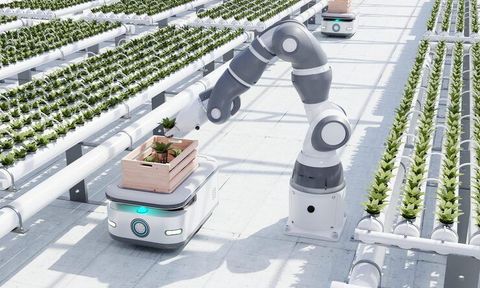
The Internet of Things (IoT) is changing how greenhouse environments are monitored and managed. IoT in greenhouse automation refers to the use of connected sensors, digital devices, communication networks, and automated control systems to collect information and manage greenhouse operations.
These technologies allow different greenhouse components to communicate with one another. For example, temperature sensors can identify rising heat levels and send information to an automated ventilation system. Similarly, soil moisture sensors can communicate with irrigation controllers to regulate water delivery.
By combining IoT, artificial intelligence (AI), cloud computing, and precision agriculture, greenhouse operators can make more informed decisions about crop management.
How IoT Greenhouse Systems Work
An automated greenhouse generally consists of four connected elements:
Sensors: Measure temperature, humidity, light intensity, soil moisture, and other environmental conditions.
Communication systems: Transfer collected information through Wi-Fi, Bluetooth, LoRaWAN, or cellular networks.
Data platforms: Process sensor information and display environmental conditions through dashboards or mobile applications.
Control equipment: Operate irrigation pumps, ventilation fans, heaters, cooling systems, and lighting equipment.
The system continuously collects information and compares measurements with predefined environmental settings. When conditions move outside selected limits, automated equipment can respond accordingly.
Importance of IoT Technology in Modern Greenhouses
Agricultural production faces several challenges, including unpredictable weather, water availability, rising resource requirements, and increasing demand for consistent crop quality.
Traditional greenhouse management often depends on manual inspections and individual equipment controls. This approach can make it difficult to respond quickly to environmental changes.
IoT technology provides continuous monitoring and coordinated control, helping greenhouse operators manage these challenges.
Improved Greenhouse Climate Control
Temperature and humidity directly influence plant growth, flowering, and fruit development. Excessive heat can create plant stress, while unsuitable humidity levels may encourage fungal diseases.
IoT-based greenhouse climate control systems monitor environmental conditions throughout the day. Automated ventilation, heating, cooling, and shading equipment can respond to changing measurements.
Different crops require different environmental conditions. Tomatoes, cucumbers, lettuce, and ornamental plants may therefore need separate climate management settings.
Smart Irrigation and Water Management
Water management is another important application of greenhouse automation.
Soil moisture sensors and irrigation controllers help determine when plants require additional water. Some systems also consider temperature, humidity, and crop growth stages when adjusting irrigation schedules.
Important applications include:
Soil moisture monitoring.
Automated drip irrigation.
Water-level monitoring in storage tanks.
Nutrient delivery through fertigation.
Detection of irrigation system irregularities.
These technologies can support more accurate water management and reduce unnecessary irrigation.
Energy Management and Operational Efficiency
Greenhouses may require electricity for ventilation, lighting, heating, cooling, and water pumping.
IoT energy monitoring systems collect information about equipment operation and electricity consumption. Operators can identify periods of high energy demand and adjust equipment schedules.
Smart lighting systems can also regulate artificial lighting according to natural sunlight levels and crop requirements.
Better Crop Monitoring and Disease Prevention
Environmental monitoring can help identify conditions associated with crop stress and disease development.
For example, extended periods of high humidity may increase the risk of certain fungal infections. Sensors can identify these conditions and generate alerts for further inspection.
When combined with cameras and AI-based image analysis, greenhouse systems can also support the identification of visible plant symptoms.
Recent Developments in Greenhouse Automation Technology (2025–2026)
The greenhouse automation industry is increasingly combining IoT monitoring with artificial intelligence, predictive analytics, and autonomous control systems.
Recent research and technology developments demonstrate growing interest in systems that can interpret environmental information rather than simply display measurements.
AI-Integrated Greenhouse Management
In March 2026, research published in the journal Sensors introduced AgroNova, an autonomous IoT platform designed for greenhouse microclimate monitoring and management.
The research described a system combining wireless sensor networks, automated decision-making, cloud technologies, and a large language model-based advisory component. Its seven-month deployment in an unheated tomato greenhouse collected more than 380,000 environmental measurements from five sensor nodes.
This development illustrates how AI-assisted systems can support greenhouse monitoring and local decision-making.
Predictive Climate Monitoring
Research published in July 2026 in the journal Internet of Things examined machine learning methods for predicting greenhouse microclimate conditions.
The research used IoT measurements and a sequence-to-sequence deep learning approach to forecast multiple environmental factors, including:
Temperature.
Relative humidity.
Carbon dioxide concentration.
Light conditions.
Predictive monitoring may help greenhouse operators identify environmental changes before they become significant problems.
Connected Greenhouse Technology Projects
In 2025, the SIOTIN project began development of an intelligent IoT system for greenhouse automation under a Romanian innovation programme covering 2025–2027.
The project focuses on multisensor monitoring, automated control devices, communication infrastructure, and a connected web and mobile platform.
Its objectives include improving resource management and supporting crop quality through integrated greenhouse monitoring.
Emerging Technology Trends
| Technology | Recent development | Potential application |
|---|---|---|
| AI and IoT | Intelligent environmental analysis | Predictive greenhouse management |
| Wireless sensors | Improved connected monitoring | Continuous climate measurement |
| Machine learning | Environmental forecasting | Early identification of climate changes |
| Computer vision | Automated image analysis | Crop health observation |
| Smart irrigation | Sensor-based water control | Precision water management |
| Cloud computing | Centralized agricultural data | Remote greenhouse monitoring |
These developments indicate a gradual movement from basic environmental monitoring toward predictive and increasingly autonomous greenhouse operations.
Laws, Regulations, and Government Policies
IoT greenhouse automation is influenced by agricultural policies, environmental regulations, electrical safety requirements, wireless communication standards, and data protection rules.
The applicable requirements depend on the country where the greenhouse operates and where its electronic equipment is manufactured or installed.
International Agricultural and Technology Regulations
Several regulatory areas are particularly relevant:
Electrical and equipment safety: Automated greenhouse systems use electrical controllers, pumps, sensors, motors, and lighting equipment. These components may need to comply with national electrical safety standards.
Wireless communication: IoT equipment using Wi-Fi, Bluetooth, cellular networks, or other radio technologies must follow applicable spectrum and equipment requirements.
Data protection: Connected greenhouse platforms may collect operational information, employee information, and location data. Applicable privacy laws may regulate how personal information is stored and processed.
Cybersecurity: Internet-connected controllers and monitoring platforms should follow appropriate cybersecurity practices, including secure authentication, software updates, and network protection.
European Union Requirements
The European Union has introduced several regulations relevant to connected agricultural equipment.
The Radio Equipment Directive (2014/53/EU) establishes requirements for radio equipment, including safety, electromagnetic compatibility, and efficient use of radio spectrum.
Additional cybersecurity requirements under Delegated Regulation (EU) 2022/30 became applicable to relevant categories of radio equipment on 1 August 2025.
The EU Cyber Resilience Act (Regulation 2024/2847) introduces broader cybersecurity requirements for products with digital elements, with its main obligations applying from 11 December 2027.
These requirements are relevant when greenhouse automation equipment is placed on the European market.
Agricultural Policies in India
India promotes protected cultivation and modern agricultural technologies through several government programmes.
The Mission for Integrated Development of Horticulture (MIDH) supports horticultural development, including protected cultivation activities.
In August 2025, the National Horticulture Board published a notification concerning modifications to MIDH guidelines, including provisions relating to protected cultivation.
The Indian Council of Agricultural Research (ICAR) also supports research in precision agriculture, protected cultivation, AI, and IoT-based agricultural technologies.
Farmers and greenhouse operators should check current programme guidelines, eligibility conditions, technical standards, and applicable state-level requirements before planning projects.
Tools and Resources for IoT Greenhouse Automation
Several digital platforms, hardware technologies, and agricultural resources can help users understand and manage smart greenhouse environments.
IoT Monitoring and Development Platforms
ThingsBoard: An IoT platform used for device management, real-time monitoring, dashboards, and data visualization.
Blynk: A development platform that supports connected device monitoring and mobile-based control applications.
Arduino: A hardware and software ecosystem used to develop sensor-based monitoring and automation prototypes.
ESP32: A microcontroller platform with wireless connectivity capabilities, commonly used in experimental greenhouse monitoring systems.
Greenhouse Sensors and Monitoring Equipment
Common equipment used in automated greenhouse environments includes:
Temperature and humidity sensors.
Soil moisture sensors.
Light intensity sensors.
CO₂ monitoring equipment.
Water-level sensors.
pH and electrical conductivity sensors.
Automated ventilation controllers.
Agricultural Data and Information Resources
FAO: Provides agricultural research, climate information, and resources related to sustainable food production.
ICAR: Publishes agricultural research and information about protected cultivation and precision farming in India.
National Horticulture Board: Provides information about horticultural development programmes and protected cultivation guidelines.
NASA POWER: Provides meteorological and solar data that can support agricultural environmental analysis.
Useful Greenhouse Planning Tools
Greenhouse operators can also use digital planning resources to evaluate operational requirements.
| Tool | Purpose |
|---|---|
| Greenhouse climate calculator | Estimate temperature and humidity requirements |
| Irrigation planning spreadsheet | Organize watering schedules |
| Sensor monitoring dashboard | Review real-time environmental measurements |
| Energy consumption calculator | Estimate equipment energy requirements |
| Crop growth tracking template | Record crop development and observations |
| Data visualization dashboard | Identify environmental patterns and changes |
These resources can help organize greenhouse information and support more consistent operational decisions.
Frequently Asked Questions
What is IoT in greenhouse automation?
IoT in greenhouse automation involves connected sensors, controllers, and digital platforms that monitor and regulate environmental conditions. It supports automated irrigation, ventilation, lighting, temperature management, and remote greenhouse monitoring.
Which sensors are commonly used in smart greenhouses?
Common sensors include temperature, humidity, soil moisture, light intensity, CO₂, pH, and electrical conductivity sensors. The required combination depends on crop type and greenhouse management objectives.
How does AI improve greenhouse automation?
AI can analyze historical and real-time sensor information to identify patterns, forecast environmental changes, and support automated decisions. It can also assist with crop monitoring and the identification of potential plant health problems.
Can IoT greenhouse systems operate without constant internet connectivity?
Yes. Some systems use local controllers and predefined automation rules to continue operating when internet connectivity is unavailable. However, remote dashboards, cloud analysis, and external alerts may require an internet connection.
Is IoT technology suitable for small greenhouses?
Yes. Small greenhouses can begin with basic temperature, humidity, and soil moisture sensors connected to simple controllers. Additional automation can be introduced gradually according to operational requirements.
Conclusion
IoT in greenhouse automation represents an important development in modern agriculture. By connecting sensors, control equipment, communication networks, and analytical platforms, greenhouse operators can monitor environmental conditions and manage growing environments with greater precision.
Recent developments in AI, machine learning, wireless monitoring, and predictive analytics are expanding the capabilities of smart greenhouse systems. These technologies can support improved irrigation management, climate monitoring, energy planning, and crop observation.
However, successful implementation depends on selecting suitable equipment, maintaining accurate sensors, protecting connected systems, and understanding crop-specific requirements.
As precision agriculture continues to develop, IoT-based greenhouse automation is expected to remain an important area of agricultural research and technological innovation.

Related Post...

Overview of the AI Spending Crisis and Its Effect on Technology Markets
Updated: October 31, 2026
Read More

Global Cybersecurity Insights: Why Banks and Businesses Face Rising Threats
Updated: October 31, 2026
Read More