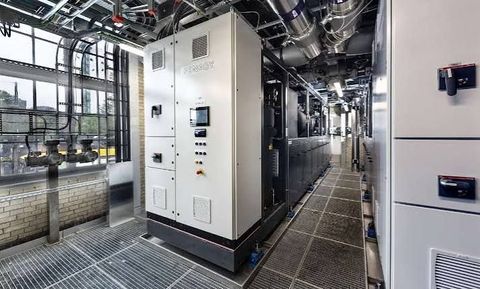
Industrial Voltage Regulators: Types, Uses, and Working Principles Guide
Industrial voltage regulators are electrical devices designed to maintain an electrical supply within a specified voltage range when the incoming voltage changes. Industrial equipment can be sensitive to voltage fluctuations, particularly machines that use electronic controls, motors, sensors, programmable controllers, or automated production systems.
Industrial voltage regulator systems help manage these variations by adjusting the output voltage according to the operating requirements of connected equipment.
Voltage regulation is based on a simple principle: electrical equipment is designed to operate within defined voltage limits, while the electricity supplied to a facility may vary because of changes in demand, grid conditions, distribution losses, or electrical loads. A regulator detects a change and uses an electrical or electronic control mechanism to adjust the output.
Automatic voltage regulators are designed to perform this adjustment without requiring continuous manual intervention. Depending on the design, a system may use transformers, electronic switching components, motor-driven mechanisms, or power-electronic circuits.
Why Voltage Regulation Is Needed
Electrical loads do not always receive a perfectly constant voltage. Large motors starting or stopping, changes in industrial production, and disturbances within an electrical network can contribute to voltage changes.
Voltage that is consistently outside an equipment's specified operating range can affect performance and may contribute to overheating, unexpected shutdowns, or malfunction of sensitive components. Voltage regulation equipment is therefore used in applications where maintaining an appropriate supply range is important.
Industrial voltage stabilizers are one category of equipment used for this purpose. They monitor the incoming supply and adjust the output so that connected equipment receives a more controlled voltage.
How Voltage Regulation Works
A basic automatic voltage stabilization system contains sensing circuits, a control mechanism, and a voltage-adjustment stage. The sensing circuit measures the input or output voltage and sends information to the control section.
The control section determines whether the measured voltage is within the defined range. If adjustment is required, the system changes the voltage using its particular regulation technology.
Common approaches include:
- Servo-controlled regulation, which uses a motor-driven mechanism to adjust transformer voltage.
- Static regulation, which uses power electronics for rapid voltage adjustment.
- Transformer-based regulation, which changes voltage through different transformer configurations.
- Electronic regulation, which uses semiconductor switching and control circuits.
The appropriate approach depends on the electrical load, required response time, voltage range, capacity, and operating environment.
Importance
Protecting Industrial Electrical Equipment
Industrial machinery can contain motors, variable-frequency drives, computers, controllers, sensors, and communication equipment. These components can have different voltage requirements and different tolerances for electrical disturbances.
Voltage control equipment can help maintain the supply within the operating range specified by equipment manufacturers. This is particularly relevant in facilities where voltage variations occur regularly.
Supporting Production Systems
Manufacturing processes increasingly depend on automated electrical equipment. A voltage disturbance affecting one control component can interrupt a larger process involving conveyors, pumps, robotic systems, or production machines.
Industrial voltage regulators can be integrated into electrical distribution arrangements to provide controlled voltage to selected equipment or groups of loads. Their role varies according to the facility's electrical architecture.
Applications Across Industries
Industrial voltage regulators can be found in a variety of environments, including:
- Manufacturing plants
- Data centers
- Process industries
- Laboratories
- Healthcare facilities
- Telecommunications facilities
- Commercial buildings
- Water treatment facilities
- Automation installations
The required regulator capacity and configuration depend on the electrical characteristics of the facility and the equipment being supplied.
Common Voltage Regulation Requirements
Different applications have different requirements. A small electronic control system may need precise regulation at a relatively low power level, while an industrial motor installation may involve substantially larger electrical loads.
| Application | Typical concern | Regulation consideration |
|---|---|---|
| Industrial automation | Electronic control stability | Response and precision |
| Motors and drives | Voltage variation during operation | Capacity and transient behavior |
| Data equipment | Supply continuity and quality | Regulation and protection |
| Laboratory equipment | Measurement stability | Precision regulation |
| Manufacturing machinery | Process interruptions | Capacity and response |
| Communication equipment | Electronic sensitivity | Controlled supply conditions |
Voltage regulation alone does not address every form of electrical disturbance. Frequency changes, harmonics, surges, transients, and interruptions may require separate electrical protection or power-quality equipment.
Recent Updates
Digital Monitoring
Recent industrial voltage regulator systems increasingly incorporate digital monitoring. Instead of displaying only a basic voltage value, modern controllers can record input voltage, output voltage, load conditions, alarms, and operating status.
Digital displays and communication interfaces can make it easier to integrate voltage control equipment into wider facility monitoring systems. Data may be transmitted through industrial communication networks when the regulator supports the required interface.
Faster Electronic Regulation
Power-electronic technology has expanded the use of static voltage regulation systems. These systems can adjust electrical parameters electronically rather than relying entirely on mechanical movement.
The response characteristics depend on the design and electrical configuration. Static systems can be suitable for applications where rapid voltage correction is an important consideration.
Integration With Automation
Automatic voltage control systems are increasingly considered part of wider electrical automation architectures. Regulators may communicate with building management systems, industrial control systems, or energy-monitoring platforms.
This integration can provide information about voltage conditions and equipment status. It can also allow operators to identify changes in electrical conditions over time.
Energy and Power Quality Monitoring
Another trend is the combination of voltage regulation with power-quality monitoring. Modern installations may measure voltage, current, power factor, frequency, harmonics, and other electrical characteristics.
This broader approach helps distinguish voltage variation from other power-quality issues. A regulator can address voltage-related conditions, while separate equipment may be required for other disturbances.
High-Voltage Applications
High voltage voltage regulators are used in specialized electrical environments where voltage levels and insulation requirements are substantially different from ordinary industrial low-voltage systems.
Such systems require carefully engineered insulation, protection, switching, grounding, and monitoring arrangements. Their design depends heavily on the voltage class and electrical network involved.
Laws or Policies
Electrical Regulations in India
Industrial electrical installations in India are subject to safety and technical requirements established through legislation, regulations, and applicable standards. The Electricity Act, 2003 provides a broad legal framework for the electricity sector, while electrical safety requirements are addressed through applicable rules and regulations.
The Central Electricity Authority's safety regulations include requirements concerning electrical installations, protection, earthing, operation, and safety practices. The precise requirements depend on the installation, voltage level, and type of facility.
Bureau of Indian Standards
The Bureau of Indian Standards develops Indian Standards covering various electrical products and systems. Voltage regulation equipment may fall under standards relating to transformers, stabilizers, power-electronic equipment, electrical safety, electromagnetic compatibility, or related equipment categories.
The applicable standard depends on the particular equipment design. Organizations should verify the relevant standard for the specific regulator and installation rather than assuming that one standard applies to every voltage regulation product.
Industrial Electrical Safety
Electrical installations should also incorporate appropriate protection against hazards such as electric shock, short circuits, overcurrent, overheating, and equipment faults. Earthing, protective devices, isolation arrangements, and enclosure design are important parts of electrical safety.
Industrial voltage regulators are components of an electrical system rather than substitutes for complete electrical protection. Installation and maintenance should follow applicable technical requirements and qualified electrical practices.
Energy Efficiency Considerations
Energy efficiency is another consideration for electrical equipment. A regulator itself consumes some energy during operation, and its efficiency can vary according to design and load conditions.
When evaluating an installation, engineers may consider regulation performance together with efficiency, loading patterns, thermal conditions, and the electrical characteristics of the connected equipment.
Tools and Resources
Voltage Measurement Instruments
Digital multimeters, power-quality analyzers, clamp meters, and electrical data loggers can be used to evaluate voltage and related electrical parameters. The appropriate instrument depends on the voltage level and measurement objective.
Power-quality analyzers can provide information about voltage variation, frequency, harmonics, and other electrical characteristics that a basic voltage measurement may not reveal.
Voltage Regulation Calculations
Engineers commonly evaluate regulator requirements using information such as:
- Input voltage range
- Required output voltage
- Single-phase or three-phase configuration
- Connected load
- Apparent power
- Starting current
- Power factor
- Permitted voltage variation
- Environmental conditions
For larger installations, load calculations and electrical system studies may be used to determine the appropriate equipment configuration.
Technical Standards and Documentation
Useful resources include manufacturer datasheets, electrical installation standards, equipment manuals, wiring diagrams, and power-quality measurement guidelines.
Documentation should identify the regulator's input range, output range, capacity, response characteristics, protection functions, environmental limits, and electrical connection requirements.
Monitoring Platforms
Industrial monitoring platforms can collect information from connected voltage regulation equipment. Depending on the system, data may be transmitted through industrial communication protocols or digital interfaces.
This can help facilities maintain historical records of voltage conditions and identify patterns that may require further electrical investigation.
FAQs
What are industrial voltage regulators used for?
Industrial voltage regulators are used to control variations in electrical supply voltage and maintain output voltage within a specified range. They can support equipment such as automation systems, electronic controls, motors, and other industrial loads.
How do automatic voltage regulators work?
Automatic voltage regulators continuously measure voltage and use a control mechanism to adjust the output when the measured value changes. The adjustment method may involve transformers, mechanical control, or power electronics.
What is the difference between industrial voltage stabilizers and regulators?
The terms are sometimes used interchangeably, although equipment designs can differ. A voltage stabilizer generally refers to equipment intended to maintain a relatively stable output voltage, while a voltage regulator is a broader term covering different methods of controlling voltage.
When are precision voltage regulation systems needed?
Precision voltage regulation systems may be used when connected equipment has relatively narrow voltage operating requirements. Examples can include certain electronic controls, laboratory equipment, measurement systems, and specialized industrial processes.
Do high voltage voltage regulators protect against all power-quality problems?
No. Voltage regulation primarily addresses voltage variation. Problems involving electrical interruptions, surges, transients, harmonics, frequency changes, or other power-quality conditions may require additional equipment and system-level measures.
Conclusion
Industrial voltage regulators help control electrical supply variations for equipment used in manufacturing, automation, data infrastructure, laboratories, and other facilities. Automatic voltage regulators can use mechanical, transformer-based, or electronic technologies depending on the application. Recent developments have increased digital monitoring, electronic regulation, network connectivity, and integration with broader power-quality systems. Applicable Indian electrical safety requirements and technical standards depend on the equipment, voltage level, and installation environment.

Related Post...
MALDI-TOF Mass Spectrometry: Insights Into Ionization, Mass Analysis and Molecular Identification
Updated: October 05, 2026
Read More
Global Supplier Audit Management: A Guide to Audit Planning, Compliance, Risk and Quality Control
Updated: October 03, 2026
Read More
Industrial Laser Annealing: Explore Basics, Equipment, Methods, and Applications
Updated: October 09, 2026
Read More