Factory Line Automation Insights for Improved Production Efficiency
Manufacturing efficiency depends on more than how quickly a machine operates.
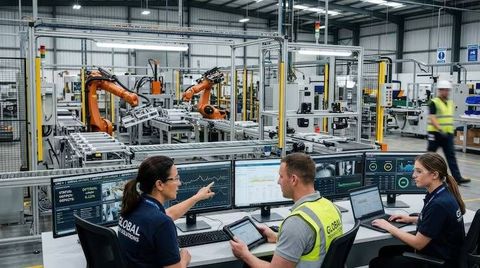
Production lines must coordinate equipment, materials, workers, quality checks, and maintenance activities to maintain consistent output without unnecessary delays.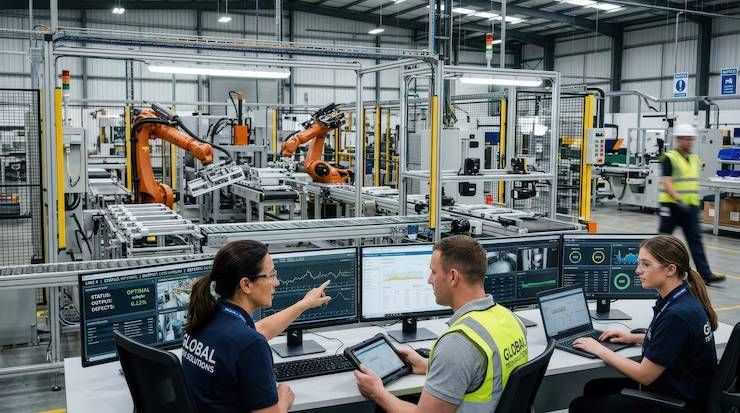
Factory line automation helps manufacturers coordinate these activities through programmable machinery, sensors, industrial control systems, robotics, and production monitoring software. When implemented appropriately, automation can reduce repetitive manual work, improve process consistency, and help production teams identify operational problems earlier.
Understanding automation technologies and their practical limitations helps manufacturers identify suitable improvements for existing facilities or new production lines. Evaluating equipment compatibility, integration requirements, maintenance needs, and measurable performance outcomes is essential to selecting solutions that deliver lasting operational value.
How Factory Line Automation Improves Production Efficiency
Factory line automation uses control systems and machinery to perform manufacturing tasks with reduced manual intervention. Depending on the production environment, these tasks may include material handling, assembly, inspection, packaging, labeling, and product movement between workstations.
One major advantage is process consistency. Automated equipment can repeat programmed operations under defined conditions, helping manufacturers reduce variations caused by inconsistent manual execution. This is particularly useful for repetitive production tasks requiring precise positioning, timing, or measurement.
Automation can also improve visibility across the production line. Sensors and connected monitoring systems collect information about machine status, operating conditions, cycle times, and interruptions. Production managers can use this information to identify bottlenecks and investigate why actual output differs from planned production.
However, installing automated equipment does not automatically increase overall productivity. If one workstation operates faster than downstream equipment can handle, the production bottleneck may simply move elsewhere. Effective automation must address the performance of the entire production process.
Technologies That Support Modern Automated Production Lines
Different technologies address different operational requirements. Manufacturers should evaluate them according to the task, production volume, product variation, and existing equipment.
Industrial Robotics and Automated Material Handling
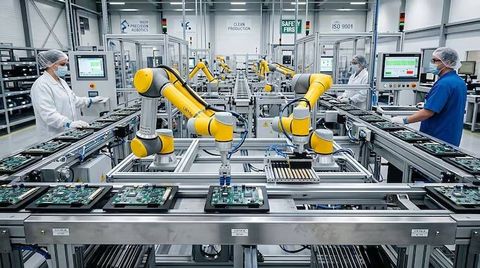
Industrial robots perform tasks such as welding, assembly, machine tending, palletizing, and repetitive pick-and-place operations. They are particularly useful when a process requires repeatable movement, consistent positioning, or operation in environments unsuitable for continuous manual work.
Automated guided vehicles and autonomous mobile robots can transport materials between designated locations, depending on the facility layout and navigation requirements. Conveyor systems remain useful for predictable, continuous material movement between fixed workstations.
The appropriate solution depends on throughput requirements, payload, workspace, safety provisions, and integration complexity. Highly flexible robotic systems may suit changing product configurations, while simpler dedicated machinery can be more practical for stable, repetitive operations.
Programmable Logic Controllers and Industrial Control Systems
Programmable logic controllers (PLCs) coordinate machine operations using programmed logic and signals from connected sensors. They commonly control sequences involving motors, actuators, switches, and other production equipment.
Supervisory control and data acquisition (SCADA) systems provide supervisory monitoring and control across industrial processes. Human-machine interfaces (HMIs) allow operators to view machine conditions, acknowledge alarms, and interact with control systems.
These technologies help production teams coordinate equipment and respond to abnormal conditions. Their effectiveness depends on reliable configuration, appropriate operator training, secure access, and compatibility with the machinery being controlled.
Manufacturing Execution Systems
A manufacturing execution system (MES) connects production activities with manufacturing plans and operational data. Depending on its capabilities, it can track work orders, material usage, production progress, quality results, and equipment performance.
Integrating an MES with enterprise resource planning (ERP) software can improve coordination between production operations and broader business processes. Before selecting a system, manufacturers should examine data requirements, integration interfaces, reporting needs, and the accuracy of information generated by existing equipment.
Identifying the Right Opportunities for Automation
The most effective automation projects begin with a clearly defined production problem rather than a preference for new technology.
Manufacturers should examine tasks involving recurring delays, excessive material movement, repetitive manual operations, inconsistent quality, or frequent production interruptions. These areas can reveal where automation may deliver practical improvements.
A production assessment should establish a baseline using relevant measurements, such as output per shift, cycle time, defect rate, unplanned downtime, and work-in-progress levels. These measurements provide a reference for evaluating performance after implementation.
It is also important to distinguish between problems caused by equipment limitations and those caused by poor scheduling, inconsistent procedures, or inadequate training. Automating an inefficient process without correcting its underlying problems can preserve the same inefficiencies in a more expensive system.
For example, a manufacturer experiencing repeated packaging delays might investigate conveyor speeds, product changeover times, and downstream capacity before investing in additional equipment. The assessment could reveal that better line balancing or a targeted machine upgrade addresses the bottleneck more effectively than automating the entire line.
Comparing Automation Solutions for Different Production Needs
Manufacturers have several implementation options, ranging from upgrading individual machines to integrating complete production lines. The right choice depends on operational requirements, existing infrastructure, and the level of flexibility needed.
| Automation approach | Suitable applications | Main consideration |
|---|---|---|
| Standalone machine automation | Repetitive tasks at individual workstations | Compatibility with surrounding processes |
| Robotic automation | Assembly, welding, palletizing, and machine tending | Payload, reach, tooling, and safety |
| Conveyor and material handling automation | Continuous movement between workstations | Layout, throughput, and congestion |
| Integrated production line | Coordinated operations across multiple stages | System integration and line balancing |
| Production monitoring and MES | Tracking output, quality, and operational performance | Data accuracy and software integration |
A standalone upgrade may be appropriate when a specific machine causes recurring delays. Integrated automation may provide greater coordination when multiple production stages depend on synchronized operations.
When evaluating automation equipment suppliers or system integrators, manufacturers should review relevant industry experience, technical capabilities, installation planning, commissioning procedures, training, and after-sales support. The proposal should clearly define system scope, expected performance, exclusions, and responsibilities for integration.
Managing Integration, Maintenance, and Workforce Requirements
Automation projects frequently involve more than installing equipment. Existing machines may use different control architectures, communication protocols, and data formats. Integrating them can require additional engineering, interface development, and testing.
Manufacturers should assess the condition of legacy equipment before connecting it to new systems. Outdated controllers, unsupported software, inconsistent data, and limited spare-parts availability can complicate implementation.
Maintenance planning is equally important. Automated systems still experience wear, component failures, sensor faults, and software-related interruptions. Preventive maintenance, condition monitoring, spare-parts planning, and documented troubleshooting procedures help reduce avoidable downtime.
Workforce preparation also influences results. Operators need to understand normal system behavior, alarm responses, safe operating procedures, and escalation requirements. Maintenance teams may require additional training in robotics, control systems, industrial networking, or diagnostic software.
Safety must be incorporated into system design and commissioning. Risk assessments, appropriate guarding, interlocks, emergency stops, and safe maintenance procedures should reflect the equipment and working environment. Automation should reduce exposure to hazards without introducing unmanaged risks around moving machinery.
Measuring the Return on Factory Automation
Evaluating automation requires more than comparing equipment expenditure with projected production increases. Manufacturers should consider the complete lifecycle of the system.
Relevant financial and operational factors include equipment acquisition, engineering, installation, integration, training, maintenance, energy consumption, spare parts, and production disruption during implementation. Potential benefits may include higher throughput, reduced scrap, lower rework, fewer repetitive manual tasks, and improved equipment availability.
A useful evaluation compares baseline performance with realistic post-implementation targets. For example, manufacturers can track overall equipment effectiveness (OEE), which combines availability, performance, and quality into one measure of production equipment effectiveness.
OEE should be interpreted alongside other operational indicators because improvements in one area may conceal problems elsewhere. Higher machine speed, for instance, may not improve saleable output if defect rates rise or downstream stations cannot keep pace.
Manufacturers should also model different operating scenarios rather than relying on optimistic projections. Actual results depend on production demand, system reliability, workforce readiness, product variation, and how effectively the new equipment is integrated into daily operations.
Frequently Asked Questions
Does factory automation require replacing existing machinery?
No. Manufacturers can often automate selected tasks or upgrade controls, sensors, and material handling systems while retaining suitable existing equipment. Feasibility depends on machine condition, compatibility, safety, and integration requirements.
Which factory processes are suitable for automation?
Repetitive, measurable, and predictable tasks are often good candidates. Assembly, inspection, packaging, material movement, and machine tending may be suitable, depending on production conditions and technical requirements.
How can manufacturers evaluate automation suppliers?
Assess technical capability, relevant implementation experience, equipment compatibility, safety provisions, commissioning plans, training, maintenance support, and clearly defined performance requirements. Compare proposals against the same operational criteria.
Can automation reduce manufacturing downtime?
Automation can improve monitoring and process control, helping teams detect certain problems earlier. However, downtime reduction depends on system reliability, maintenance practices, component availability, and effective troubleshooting.
Conclusion
Factory line automation can improve production efficiency when technologies are selected around clearly defined operational needs. Robotics, industrial control systems, material handling equipment, and manufacturing software each contribute differently to production performance.
Manufacturers should begin with process analysis, establish measurable baselines, and compare implementation options before committing to major investments. A carefully planned approach that accounts for integration, maintenance, workforce training, and safety is more likely to produce sustainable improvements than automation driven by technology alone.

Related Post...

Wire Mesh Conveyor Belt: Explore Designs for Industrial Material Handling
Updated: October 06, 2026
Read More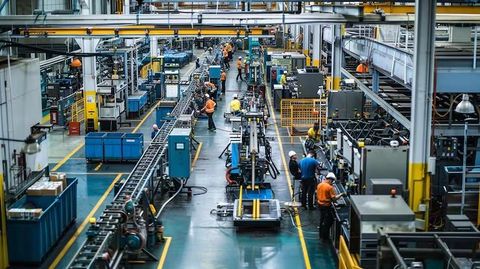
Factory Line Manufacturing Automation: Explore Modern Production Systems
Updated: October 06, 2026
Read More